
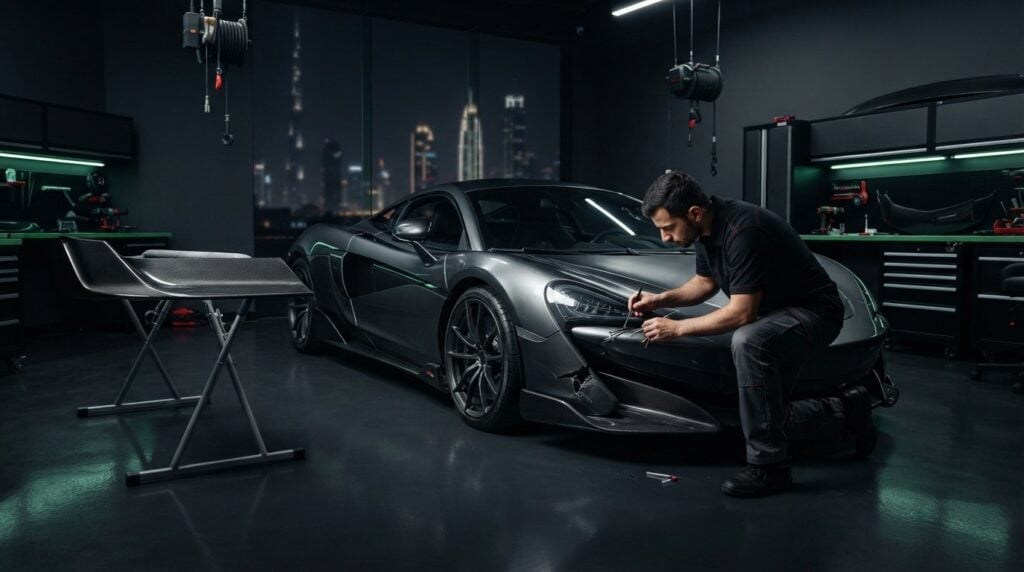
That sickening crunch of low-slung carbon fiber meeting a steep curb doesn’t have to mean writing off an elite aerodynamic package. When you drive a machine fitted with bespoke conversions, the stakes are undeniably high. You worry about disrupted weave patterns on exposed composites, mismatched pearlescent paint, and the staggering expense of replacing imported panels. In that tense moment, calculating the true cost to repair a damaged body kit becomes your immediate priority.
Restoring these aerodynamic components isn’t a simple touch-up; it’s a precision engineering discipline designed to preserve your vehicle’s provenance, safety, and performance. In this 2026 guide, you’ll discover how expert technicians reverse severe surface trauma and restore an unblemished aesthetic without compromising structural integrity. We break down the primary labor and material variables that drive overall expenses, assess when carbon repair beats outright replacement, and highlight the technical standards required for invisible results.
Key Takeaways
- Understand the primary factors that dictate the cost to repair a damaged body kit, from composite structural integrity to specialized labor.
- Discover why smart restoration of genuine Brabus or Mansory panels is often more economically viable than enduring long procurement delays for new components.
- Learn how directional carbon fiber weave alignment and multi-stage paint matching achieve completely invisible repairs on exotic surfaces.
- Identify brand-specific restoration hurdles across boutique platforms, including complex Mansory aerodynamic contours and integrated Brabus electronics.
- Recognize why locking in your restoration with advanced paint protection film or peelable paint is essential to defend vulnerable surfaces against future road debris.
Assessing Body Kit Damage: The Repair vs. Replace Dilemma
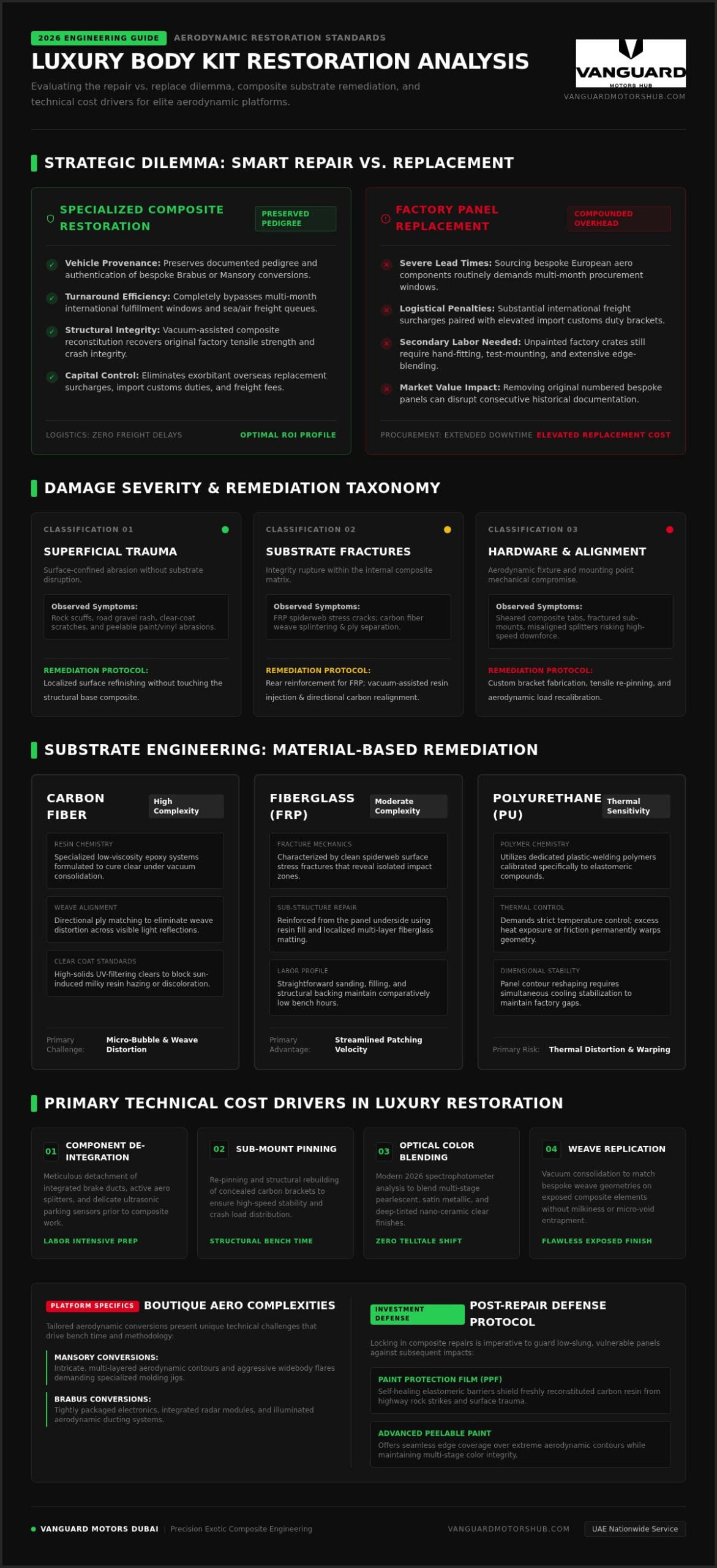
Deciding between panel restoration and outright replacement hinges on preserving vehicle provenance while managing financial reality. Smart repair techniques prioritize localized composite reconstruction, eliminating the need to discard genuine components. For high-end conversions like Brabus or Mansory, preserving the original component protects the car’s documented pedigree. Replacing an authentic composite piece often risks long factory backorders, international freight delays, and steep import duties. Expert structural restoration maintains factory crash integrity and safeguards the long-term market valuation of your vehicle.
Identifying Minor vs. Major Body Kit Damage
Pinpointing the severity of damage determines the right technical approach across different automotive body kit components and materials. Surface-level trauma requires a very different remediation path than fractured sub-structures:
- Superficial blemishes: Minor rock scuffs, clear coat abrasions, or abrasions in protective peelable paint and vinyl wraps require simple surface refinishing without touching the structural base.
- Substrate fractures: Fiberglass (FRP) tends to display clean, spiderweb stress cracks that technicians can reinforce from behind. Exposed carbon fiber, however, splinters across its structural weave, demanding vacuum-assisted resin injection and directional ply realignment.
- Hardware failures: Sheared mounting tabs or misaligned aerodynamic splitters jeopardize downforce stability at speed, requiring dedicated bracket fabrication and recalibration.
The Cost-Benefit Analysis of Replacement
Evaluating the total cost to repair a damaged body kit versus ordering a factory replacement reveals a massive gap in logistics and downtime. Sourcing bespoke European aero pieces routinely involves multi-month fulfillment windows. Even after delivery, bare unpainted panels still require extensive hand-fitting, test-mounting, and multi-stage paint blending to achieve an unblemished profile.
Specialized composite restoration bypasses these international logistics hurdles entirely. At Vanguard Motors, master technicians deploy precision carbon fiber repair and smart repair methodologies nationwide across the UAE, rebuilding fractured splitters, diffusers, and widebody arches back to factory tensile strength. When analyzing the cost to repair a damaged body kit against the steep expense and downtime of replacement parts, expert cosmetic repair delivers an efficient, museum-grade return on investment.
Primary Cost Drivers for Luxury Body Kit Restoration
Precision craft dictates the true cost to repair a damaged body kit on exotic machinery. Restoring an aerodynamic profile requires far more bench time than patching conventional stamped steel. Specialists must carefully detach integrated brake ducts, active aero splitters, and ultrasonic parking sensors before composite work even begins. Bench hours mount quickly when technicians account for meticulous disassembly and re-pinning of underlying carbon brackets to satisfy rigorous professional auto body restoration standards.
Material-Based Pricing Factors
The substrate defining your aerodynamic conversion dictates both labor complexity and material consumption during remediation:
- Fiberglass-Reinforced Plastic (FRP): Straightforward to sand, resin-fill, and structurally reinforce, keeping labor hours relatively low during localized patching.
- Carbon Fiber: Requires specialized low-viscosity epoxy systems, directional ply weaving, and vacuum-bag consolidation to cure without trapped micro-bubbles or weave distortions.
- Polyurethane (PU): Demands precise heat management and plastic-welding polymers because excess friction or thermal exposure permanently warps panel geometry.
The Role of Paint and Finish in Total Cost
Achieving a flawless aesthetic finish frequently demands as much technical mastery as repairing the underlying composite. Multi-stage pearlescent coats, satin metallic bases, and deep-tinted clear finishes require meticulous blending across adjacent factory panels to avoid telltale shade shifts in direct sunlight. Modern 2026 spectrophotometer paint systems and advanced nano-ceramic clear coats demand tighter application tolerances than ever before to ensure invisible transitions across custom bodywork.
Exposed carbon components require an entirely separate skill set. Technicians must match the original weave pattern and apply high-solids UV-filtering clears to prevent milky haze or resin discoloration under intense desert sun. If you want an honest assessment of your setup, you can consult our technical team directly on WhatsApp to evaluate your damaged composite components before committing to repairs.
Material Matters: Comparing Repair for Carbon Fiber vs. FRP
Composite materials react fundamentally differently under kinetic impact, directly shifting the overall cost to repair a damaged body kit. Carbon fiber relies on woven structural filaments that transfer load across continuous tensile threads. When cracked, energy travels down individual fibers, demanding exact directional ply re-layering. Fiberglass-reinforced plastic utilizes random strand orientation suspended in polyester or vinylester resin. Impacts shatter this matrix locally without propagating stress fractures across large aerodynamic surfaces, making FRP far simpler to reconstruct on the bench.
The Intricacies of Carbon Fiber Restoration
Mastering carbon remediation requires microscopic precision during surface preparation. Technicians use feathered sanding protocols to avoid severing intact outer filaments before injecting high-modulus bonding resins. For supercars wearing chopped composite components, specialists utilize dedicated forged carbon repair techniques to replicate irregular marble-like patterns without seams. Reviewing a detailed guide to Carbon Fibre Car Parts Repair reveals why optical-grade, UV-filtering resins are vital; subpar formulations oxidize, turning crystal-clear gloss yellow under intense sunlight.
Fiberglass (FRP) Repair Efficiency
Fiberglass provides a straightforward, budget-conscious remediation path for high-impact aero parts:
- Layered mat infusion: Rebuilding fractured splitters involves grinding out stressed polyester, stepping woven glass mats from behind, and soaking the foundation in high-strength epoxy.
- Aesthetic flexibility: Technicians easily sand, block, and glaze cured FRP surfaces, cutting down the labor hours required to prepare panels for paint booths.
- Preventing structural voids: Rushing the lamination stage traps tiny air pockets beneath the gelcoat, leading to surface bubbling or stress cracks once subjected to high-speed track vibration.
Understanding these substrate traits clarifies your repair versus replacement cost evaluation when facing body damage. While FRP body panels offer swift, accessible surface reconstruction, high-grade carbon fiber demands aerospace-grade bonding matrices to withstand intense aerodynamic drag. Vanguard’s precision carbon fiber repair protocols restore structural load limits and visual alignment, keeping the overall cost to repair a damaged body kit balanced against vehicle value.
Brand-Specific Considerations: Brabus, Mansory, and Jetour
Bespoke tuning houses construct exterior programs using radically different manufacturing architectures. Because of this, calculating the cost to repair a damaged body kit varies dramatically between a precision-engineered German platform and a sculpted Italian supercar package. Each brand requires specialized structural disassembly protocols, brand-specific alignment brackets, and custom electrical handling before physical composite remediation can start.
Restoring Bespoke Tuning House Excellence
Brabus programs demand exceptional mechanical and electronic precision during restoration. These conversions integrate complex fiber-optic puddle lighting, illuminated emblems, and millimeter-wave radar sensors directly into carbon splitters and front aprons. Technicians must source authentic hardware, isolate CAN-bus harness feeds, and recalibrate active driver-assist modules after remounting panels. Utilizing brand-approved composite resins and automotive-grade bonding adhesives is vital for high-end kit restoration because substandard materials flex irregularly under thermal expansion and crack along factory seams.
Mansory components represent the extreme edge of aerodynamic geometry. Featuring hyper-aggressive dry carbon diffusers, forged carbon hood vents, and multi-tier side blades, these pieces leave zero margin for dimensional inaccuracy. If you’re exploring the engineering tolerances of bespoke conversions, review our insights on Brabus Body Kit Installation to see why specialized bench jigs are mandatory for genuine tuning programs.
The Complexity of Jetour and Luxury SUV Kits
Performance SUV conversions introduce unique structural challenges on the repair bench. Modern platforms like the Jetour T2 feature broad-shouldered fender flares, aggressive chin splitters, and rugged lower diffusers that cover substantial physical acreage. These expansive panels encounter massive aerodynamic drag and frequent impact from road debris:
- Underbody integrity checks: Elevated ride heights expose sub-frame brackets to hidden torsional stress, making complete structural underbody inspections critical before re-hanging cosmetic shells.
- Downforce and airflow stabilization: Repairing warped front diffusers or roof wings requires precise leveling to preserve engineered airflow and prevent high-speed cabin buffeting.
- Hardware reinforcement: Technicians replace sheared factory clips with reinforced mounting fasteners engineered to withstand extreme road vibration.
Restoring these high-impact packages protects your investment and maintains the authentic visual drama intended by the design house. To schedule a comprehensive vehicle assessment or get immediate guidance on your project, connect with our restoration engineers via WhatsApp to discuss your damaged panels.
Protecting Your Investment: Post-Repair Excellence at Vanguard
Rebuilding cracked composite structures is only half the battle. Once your aero components leave the paint booth, freshly cured clear coats remain highly vulnerable to highway stone spray, sandblast pitting, and environmental oxidation. Without dedicated surface armor, repetitive road abuse quickly ruins newly restored panels, driving up the recurring cost to repair a damaged body kit over the lifecycle of your build. Establishing a complete defense protocol locks in the restoration and keeps your aero profile unblemished.
Preventing Future Damage with PPF
Applying self-healing Paint Protection Film (PPF) serves as an indispensable mechanical barrier over freshly cured composite surfaces. High-velocity aggregate impacts are absorbed by the film’s elastomeric topcoat, which automatically levels out surface marring under ambient engine heat or warm sunlight. Read our breakdown on The Ultimate Shield: Why Paint Protection Film is the Standard for Excellence to understand why wrapping high-impact splitters delivers massive cost savings over recurring bodywork.
At Vanguard, technicians employ specialized digital plot patterns to wrap hyper-intricate aerodynamic surfaces. We contour film around every sharp rake, recessed intake, and vented strake found on Mansory or Brabus body kits without stretching or lifting.
Bespoke Finishing Options
A damaged component also opens the door to complete styling transformations. Vanguard integrates post-repair aesthetic customization through multiple advanced finishing pathways across the UAE:
- Peelable Paint Applications: Delivers a sprayable, OEM-depth protective coating that conceals microscopic composite repairs while shielding authentic factory panels against stone chips.
- Colored Sticker Wraps: Enables instant color changes across your entire platform, ensuring full tonal harmony between newly restored aero diffusers and original body panels.
- Vanguard Premium Package: Combines structural restoration with precision PPF installation and super car detailing for an all-inclusive preservation cycle.
Defend your vehicle against road hazards while eliminating the repeated cost to repair a damaged body kit down the road. Take the proactive step to safeguard your exterior conversion today: Contact Vanguard Motors for a bespoke repair and protection quote and let our specialists restore your machine to peak perfection.
Reclaim Flawless Performance and Provenance
Restoring a bespoke aerodynamic conversion is an uncompromising investment in your vehicle’s provenance. Analyzing the true cost to repair a damaged body kit comes down to composite precision, directional weave realignment, and multi-stage paint matching. Choosing dedicated structural restoration preserves original components, eliminates months of overseas shipping delays, and maintains critical aerodynamic stability at high speeds.
At Vanguard Motors, we bring specialized expertise in Brabus, Mansory, and high-tensile carbon fiber repairs directly to discerning drivers across the country. Delivering complete national UAE service coverage, our master craftsmen handle everything from invisible composite repair to post-restoration armor with self-healing Paint Protection Film (PPF). Don’t let accidental road trauma compromise your machine’s aggressive stance and market value. Restore your vehicle’s masterpiece with Vanguard Motors and get back on the road with absolute confidence.
Frequently Asked Questions
How much does it typically cost to repair a carbon fiber body kit?
The overall cost to repair a damaged body kit made of carbon fiber depends primarily on whether the trauma is cosmetic or structural. Surface scuffs and clear coat scratches require light resin leveling and refinishing, demanding far less bench time. Deeper fractures requiring directional ply weaving, vacuum bagging, and weave realignment require intensive technical labor. Specialist rates reflect the complex composite engineering required to match original tensile strength.
Can a cracked fiberglass body kit be safely repaired?
Yes, cracked fiberglass (FRP) body kits can be safely and permanently repaired back to original rigidity. Technicians grind down the fractured zone, eliminate micro-cracks, and step-laminate new structural glass fabric across the rear surface with high-grade bonding resin. Once cured, the repaired area matches or exceeds the original tensile strength, ensuring the panel withstands road vibration and high-speed downforce without cracking along the joint.
Will the paint match perfectly on my luxury car’s body kit repair?
Yes, professional restoration achieves a completely seamless paint match using computerized spectrophotometer scanning and custom test-card sprayouts. Exotic multi-stage pearls, candy coats, and satin finishes require strict control of flake orientation and clear coat thickness. Skilled technicians blend the newly finished areas into adjacent factory panels, guaranteeing that the restored piece looks identical to the rest of the car under direct sun and artificial light.
How long does a professional body kit restoration take?
A standard professional body kit restoration typically requires anywhere from three to seven business days. Minor resin scratch remediation and spot repainting sit on the shorter end of that window. Severe composite reconstruction, custom bracket fabrication, multi-layer weave realignment, and multi-stage baking cycles require extensive bench time. Technicians take the time necessary to allow epoxy systems and high-solids clear coats to cure fully before reassembly.
Is it better to repair an original Brabus kit or buy a replica?
Repairing an authentic Brabus kit is virtually always preferable to installing a replica component. Original kits utilize proprietary polyurethane or prepreg carbon engineering that fits factory tolerances perfectly, preserving vehicle provenance and resale value. Replicas frequently suffer from wavy surfaces, poor bracket alignment, and brittle composites that crack at highway speeds. Investing in professional restoration keeps your vehicle’s authenticity and high-speed stability completely intact.
Can I apply PPF immediately after my body kit has been repainted?
No, you should not install Paint Protection Film immediately after a fresh paint spray. Modern automotive clear coats emit solvent gases as they dry, and trapping these vapors under film causes bubbling, hazy finishes, and adhesion failure. Technicians recommend allowing the freshly cured finish to outgas for several days to a couple of weeks, depending on the bake cycle, before sealing the restored panel with protective film.
Does repairing a body kit affect the car’s aerodynamic performance?
A properly executed composite repair does not degrade aerodynamic performance or vehicle stability. Expert technicians align internal structural ribs and maintain original curvature tolerances so airflow characteristics remain identical to factory design. Evaluating the true cost to repair a damaged body kit includes assessing bench jig precision; sloppy work alters rake angles, while precision composite rebuilding preserves designed front-end downforce and stability at speed.
What happens if the mounting points of the body kit are damaged?
Damaged mounting tabs and brackets are rebuilt or replaced using structural bonding compounds and reinforced composite backing. Technicians never rely on brittle body fillers to secure mounting hardware. They reconstruct sheared fastening flanges with high-tensile epoxy and carbon or glass fabric, ensuring fastener holes align precisely with OEM chassis points. This structural restoration prevents dangerous panel vibration, flutter, or detachment at high speeds.