
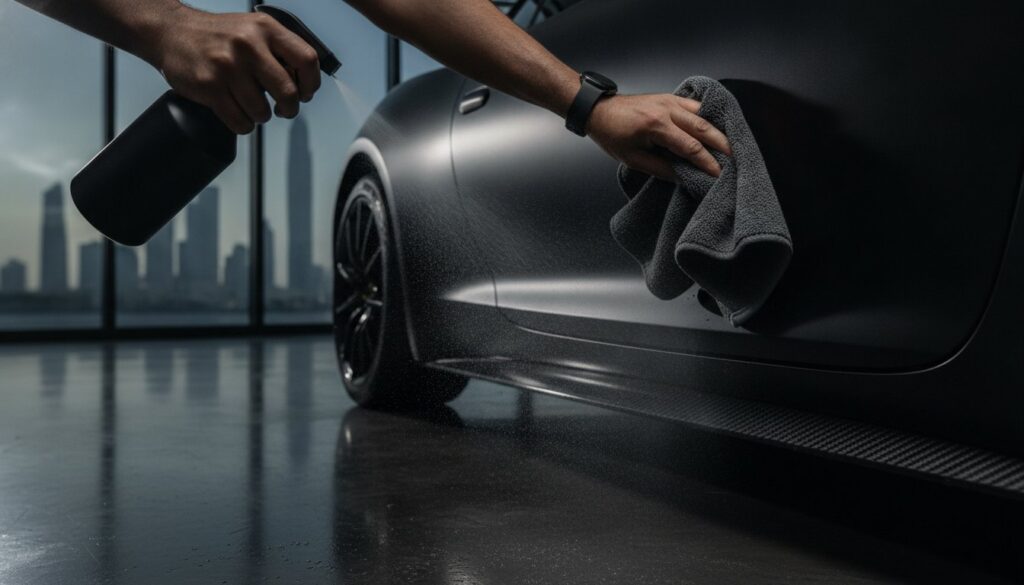
Dragging a high-pressure hose across your custom vinyl or PPF might feel like the gold standard of care, but it is often the quickest way to degrade your investment. You’ve spent significant resources on a premium finish; the fear of micro-scratches or hard water spots from traditional washing is a valid concern for any high-performance vehicle owner. Mastering the art of a waterless car wash for wrapped cars isn’t just about saving time or resources. It’s a precision-engineered method of lubrication designed to protect your vehicle’s aesthetic integrity in even the most demanding environments.
This 2026 guide promises to reveal the meticulous techniques and professional-grade formulas required to maintain a flawless, scratch-free finish on your vinyl or PPF-wrapped vehicle. We will explore the chemistry behind high-lubricity sprays that encapsulate grit, the specific microfiber techniques used by elite detailers, and how to manage heavy dust accumulation without risking the wrap’s surface. Whether you’re maintaining a finish from Vanguard Motors Dubai yourself or scheduling a mobile detailing professional to handle the precision work, you’ll gain the expertise needed for a showroom-quality shine that lasts.
Key Takeaways
- Master the science of polymer encapsulation to lift and isolate abrasive contaminants without risking friction damage to your vinyl or PPF surface.
- Discover why a waterless car wash for wrapped cars is the superior method for preventing edge lifting and micro-marring caused by traditional high-pressure equipment.
- Learn to evaluate the “soil level” threshold to determine when your vehicle requires a precision waterless touch or a more intensive professional intervention.
- Identify the essential professional toolkit, including high-GSM microfiber towels and high-lubricity solutions, necessary for a scratch-free 2026 finish.
- Understand how to integrate routine DIY care with professional mobile detailing to extend the lifespan of ceramic coatings and premium wraps.
Why Waterless Car Wash for Wrapped Cars is a Professional Necessity
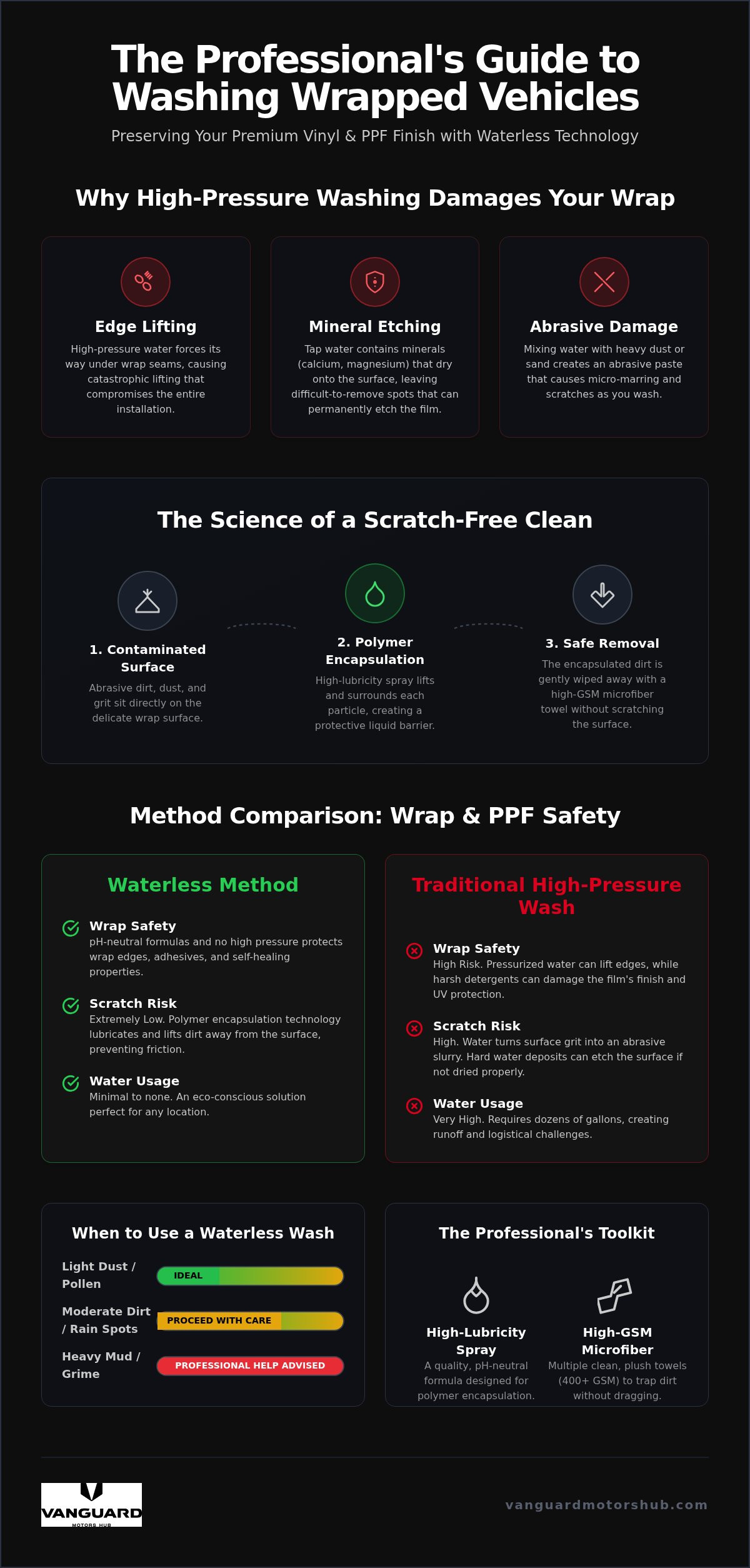
A waterless car wash is far more than a simple convenience; it’s a specialized maintenance protocol. By definition, it utilizes a high-lubricity, pre-mixed solution engineered to lift and encapsulate surface contaminants. This chemical process creates a protective barrier between the dirt and your vehicle’s delicate exterior. For owners of high-performance vehicles, adopting a waterless car wash for wrapped cars is a strategic move to preserve long-term aesthetics. Traditional methods often rely on high-pressure water which, while effective for bare metal, poses a significant threat to vinyl. The concentrated force can easily penetrate the seams of a wrap, leading to catastrophic edge lifting that compromises the entire installation.
Mineral deposits represent another silent killer for premium finishes. Traditional tap water contains calcium and magnesium that, when left to dry, etch into the surface of a wrap. These “hard water spots” are notoriously difficult to remove from vinyl without causing further damage. By 2026, chemical engineering has advanced to a point where waterless solutions offer superior surface tension reduction. These modern formulas provide a safer, more controlled alternative to the abrasive “mud” created when water meets heavy dust or sand.
The Vulnerability of Wrapped Surfaces
Vinyl (PVC) and Paint Protection Film (TPU) possess distinct physical properties that require specific care. Vinyl is generally less porous but more susceptible to UV degradation if aggressive detergents strip away factory-applied inhibitors. Conversely, premium TPU films are prized for their self-healing capabilities. A precision-led waterless car wash for wrapped cars ensures these thermal-reactive layers remain functional. It cleans the surface without clogging the microscopic pores of the film, maintaining the integrity of a finish from Vanguard Motors Dubai while preventing the film from becoming brittle over time.
Environmental Efficiency in 2026
Efficiency is the hallmark of the modern automotive lifestyle. In arid climates, managing fine sand accumulation is a daily battle. Traditional washing often turns this dust into an abrasive paste that causes micro-marring. Waterless technology encapsulates these particles instantly, allowing for a clean wipe without friction. This method also aligns with 2026 water conservation standards, offering an eco-conscious solution for the luxury owner. Whether you’re at a private residence or an executive parking suite, you can achieve a showroom-quality shine in minutes without the logistical mess of a traditional wash bay.
The Science of Lubrication: Protecting Vinyl and PPF Surfaces
The shift toward a waterless car wash for wrapped cars represents a move from mechanical force to chemical sophistication. In 2026, the efficacy of a cleaning agent is measured by its lubricity rather than its foam volume. Traditional suds are designed to carry dirt away in a stream of water, but on a non-porous vinyl or PPF surface, this often leads to hydroplaning dirt particles across the finish. High-end waterless solutions utilize advanced polymers to change how the surface interacts with debris. A deep dive into The preparation method of waterless carwash liquid reveals the complex interplay of surfactants and silicones required to achieve this. These components work in tandem to break the bond between the wrap and the dirt. Polymer encapsulation is the process of isolating contaminants in a liquid shell. This ensures that every particle is suspended, preventing it from making contact with the wrap during the wiping process.
Chemical compatibility is the cornerstone of professional-grade maintenance. Using pH-neutral formulas is vital; these solutions clean effectively without degrading the sensitive adhesives that keep your wrap secured to the bodywork. Modern 2026 formulas often integrate gloss enhancers and synthetic waxes that provide a sacrificial layer of protection against the elements. This added barrier is essential for maintaining the depth of color in a finish from Vanguard Motors Dubai, ensuring the material remains supple and resistant to environmental stressors.
Encapsulation vs. Traditional Suds
For owners of luxury vehicles, suds are a visual comfort rather than a technical requirement. Lubricity is the true hero of wrap maintenance. While water-heavy washes can saturate the edges of a wrap, a waterless agent creates a molecular bond with the surface. This bond provides a slick interface that allows high-GSM microfibers to glide effortlessly, significantly reducing the risk of marring the finish. Because the solution doesn’t rely on a high-volume runoff, it keeps the cleaning action localized and controlled, which is ideal for intricate body kits and precision wraps.
Static Reduction and Dust Repellency
Standard waxes often leave a tacky residue that acts as a magnet for fine sand and grit. In 2026, waterless formulas have moved toward synthetic polymers that offer static reduction. These agents leave an anti-static finish that actively repels dust, a critical feature for vehicles kept in high-exposure environments. This ensures your car maintains its showroom glow long after the initial wipe-down. If you’re unsure about the chemical compatibility of your current maintenance kit, consulting with an expert technician can prevent costly damage to your premium wrap.
Waterless vs. Traditional Washing: Selecting the Right Method
Choosing the correct maintenance path is a technical decision based on the current state of your vehicle’s exterior. While a waterless car wash for wrapped cars is the gold standard for routine upkeep, it isn’t a universal solution for every environmental scenario. The primary metric for this decision is the “Soil Level” threshold. If your vehicle is covered in light dust, fingerprints, or minor road film, waterless agents are superior. For a busy professional in 2026, time is the ultimate currency. A waterless session takes roughly 15 to 20 minutes to restore a showroom glow, whereas a traditional setup can easily consume over an hour of logistical preparation and cleanup.
Heat management is another critical factor in the 2026 automotive care landscape. Traditional soaps often dry too quickly in direct sunlight, leaving behind abrasive surfactants and mineral spots that can mar a wrap. Modern waterless polymers remain stable at higher surface temperatures, providing a safer cleaning window without the risk of flash-drying. While DIY care is efficient for daily maintenance, integrating professional mobile detailing ensures that hard-to-reach areas and complex body kits receive the deep-cleaning precision they require. For comprehensive maintenance schedules, consult our Supercar Detailing Guide to establish professional-grade cleaning intervals.
When to Avoid Waterless Washing
Heavy contamination demands a different strategy. If your vehicle has encountered thick mud, heavy grit, or road salt, skipping the pre-rinse is a recipe for surface failure. The “Pre-Rinse Rule” states that any visible clumps of grit must be removed with a touchless pressure wash before a microfiber towel ever touches the surface. Matte finishes are particularly vulnerable here. Unlike gloss wraps, matte surfaces cannot be polished to remove micro-scratches, making your initial cleaning choice a permanent one for the life of the wrap.
Method Comparison Framework
Use the following framework to determine the safest approach for your vehicle’s current condition:
| Method | Risk of Scratches | Edge Safety | Speed | Portability |
|---|---|---|---|---|
| Waterless Wash | Ultra-Low (with proper technique) | Excellent | Fastest | High |
| Rinseless Wash | Low | Good | Moderate | Medium |
| Pressure Wash | Moderate (grit splashback) | High Risk | Slow | Low |
Selecting a waterless car wash for wrapped cars provides the most control over friction and chemical exposure. It allows you to focus on specific panels without saturating the entire vehicle, which is essential for preserving the integrity of the adhesive at the wrap seams. When your car leaves the showroom, maintaining that elite finish requires a proactive approach that balances convenience with technical precision.
Step-by-Step: Executing a Flawless Waterless Wash on Premium Wraps
Achieving a professional result requires more than just a spray bottle; it demands a disciplined workflow and a specialized toolkit. For a successful waterless car wash for wrapped cars, your inventory must include high-GSM (grams per square meter) microfiber towels, ideally 400 or higher, to ensure contaminants are pulled deep into the fibers. You’ll also need a premium, pH-neutral waterless solution and high-output LED detailing lights to reveal any hidden streaks or residue. Before you begin, ensure the wrap surface is cool to the touch. Cleaning a warm vinyl or PPF surface in the 2026 sun is a recipe for premature product evaporation and potential marring.
Adopting a “sectional” strategy is non-negotiable. You shouldn’t spray the entire vehicle at once. Instead, focus on one panel, or even half a panel, at a time to maintain total control over the lubrication layer. This prevents the solution from drying before you can safely lift the dirt. Once a section is complete, a post-wash inspection is vital. Use your detailing light to scan for missed spots or excess product buildup around the edges where the wrap meets the body panels. Performing a waterless car wash for wrapped cars effectively requires this level of methodical attention to detail.
The “One-Way Wipe” Technique
Precision execution starts with saturation. Step 1: Generously mist the panel and your microfiber cloth to maximize lubricity. Step 2: Employ a linear, one-way motion to lift dirt away from the surface. Step 3: Follow the “Clean Side” rule by flipping your cloth to a fresh section after every single pass. Circular motions are the primary cause of swirl marks on vinyl, as they grind trapped particles back into the delicate film. By wiping in straight lines, you ensure that any remaining grit is moved off the panel rather than being rubbed into it.
Buffing and Finishing
The final steps define the quality of the shine. Step 4: Use a secondary, dry high-pile microfiber for the final buff to remove any remaining polymers and reveal the depth of the wrap’s color. Step 5: Carefully inspect edges and seams for solution buildup, which can attract dust later. Pro Tip: Use a soft-bristled detail brush to clear residue from intricate areas like emblems or the complex lines of Brabus or Mansory kits. If you’d rather leave this level of precision to the experts, you can book our professional mobile detailing van for an on-site, showroom-quality finish.
Pro-Level Maintenance: Beyond the Basic Waterless Clean
Pro-level care isn’t just about removing surface dust. It’s about preserving the chemical and physical bonds of your protection layers. If your vehicle features a ceramic coating over PPF, a waterless car wash for wrapped cars acts as a maintenance booster. These solutions often contain silica-based polymers that replenish the hydrophobic properties of the coating, extending its lifespan and keeping the surface slick. This synergy ensures that your investment remains protected against environmental contaminants while maintaining its aesthetic brilliance. A well-maintained coating makes future cleaning sessions even more efficient, as dirt finds it harder to bond with the surface.
The “Vanguard Premium” approach integrates your weekly DIY sessions with professional oversight. During your waterless routine, perform a meticulous edge sealant check. Look for microscopic lifting or debris trapped at the seams where the film meets the body panel. Catching these issues early prevents the need for a full re-wrap later. Choosing the right film from the start is essential for long-term success. Our Car Wrap Buying Guide details which materials offer the best edge adhesion and durability for high-performance use.
Maintaining Matte and Satin Finishes
Matte and satin finishes require a specialized chemistry to stay pristine. Standard gloss-enhancing solutions contain oils and waxes that can create uneven “hot spots” or unwanted shine on a matte surface. You must select matte-specific surfactants that leave zero residue and preserve the flat aesthetic of the film. Immediate removal of acidic contaminants like bird droppings is mandatory for matte wraps. These substances can etch into the film within hours under the 2026 sun, leaving a permanent mark that cannot be polished out like it could on a traditional gloss finish.
The Role of Professional Detailing
While DIY care is effective for routine maintenance, a professional decontamination wash should be scheduled every few months. This removes embedded pollutants and industrial fallout that a standard waterless spray cannot fully reach. For owners with demanding schedules, the Vanguard Mobile Detailing Van provides a comprehensive solution. Our technicians bring professional-grade equipment and expertise directly to your location, ensuring your vehicle receives elite care without disrupting your day. Excellence in automotive preservation is a continuous commitment. Combining the precision of a waterless car wash for wrapped cars with periodic professional inspections ensures your vehicle remains a masterpiece of form and function. For expert wrap maintenance and technical support, contact Vanguard Motors Hub to secure your vehicle’s future.
Future-Proofing Your Elite Vehicle Aesthetic
Maintaining a flawless finish in 2026 requires a shift from traditional force to molecular precision. By mastering the science of polymer encapsulation and the discipline of the one-way wipe, you ensure your vinyl or PPF remains as vibrant as the day it was installed. A routine waterless car wash for wrapped cars isn’t just about cleanliness; it’s a strategic defense against environmental stressors and mechanical wear. This method preserves the structural integrity of your wrap’s edges and maintains the self-healing properties of premium films.
While DIY care is vital for daily upkeep, true automotive excellence often demands a professional hand. Vanguard Motors Hub stands as a visionary leader in the UAE, specializing in PPF preservation and luxury car wrapping. Our state-of-the-art facility and specialized mobile detailing services are trusted by the world’s most elite supercar owners to maintain showroom-quality standards. Whether you’re managing a custom color change or a high-performance Brabus kit, our technicians deliver the precision your vehicle demands. Protect your investment with professional maintenance at Vanguard Motors Hub. Your vehicle is a masterpiece of engineering; give it the meticulous care it deserves.
Frequently Asked Questions
Is waterless wash safe for all types of car wraps?
Yes, a waterless car wash for wrapped cars is safe for vinyl, PPF, and peelable paint when using professional-grade, pH-neutral solutions. These formulas are designed to clean without degrading the underlying adhesive or stripping UV inhibitors. Whether your vehicle features a glossy color change or a transparent protection film, the high-lubricity agents ensure the surface remains pristine. It’s an ideal solution for maintaining the sophisticated finishes found on modern supercars and luxury daily drivers.
Can I use a waterless car wash in direct sunlight?
You can use waterless solutions in direct sunlight, but it isn’t the preferred professional practice. Modern 2026 polymers are engineered to resist flash-drying better than traditional soaps. However, high surface temperatures can still cause the product to evaporate too quickly, reducing its lubrication window. For the best results, work in a shaded area or ensure the panels are cool to the touch before application to maintain a streak-free, showroom finish.
How many microfiber towels do I need for a full waterless wash?
You should have at least 8 to 12 high-GSM microfiber towels ready for a full vehicle session. Using too few towels is the most common cause of micro-marring on delicate vinyl. You must flip to a clean section of the cloth after every single pass to ensure you aren’t dragging trapped grit across the wrap. A fresh, dry towel is also necessary for the final buffing stage to reveal the true depth of the film’s color.
Will a waterless wash scratch my car if it is very dusty?
A waterless car wash for wrapped cars won’t scratch your vehicle if the dust is light to moderate. The polymer encapsulation technology surrounds each dust particle in a protective liquid shell, lifting it away from the surface. This prevents the friction that causes swirl marks. If the vehicle is covered in heavy grit or thick mud, you must perform a touchless pre-rinse first to remove the bulk of the abrasive material safely.
How often should I perform a waterless wash on my wrapped car?
Performing a wash every 7 to 10 days is the optimal interval for preserving wrap integrity. Frequent maintenance prevents environmental contaminants, such as bird droppings or industrial fallout, from bonding permanently to the vinyl or PPF. Routine care also allows you to inspect the edges and seams of the wrap regularly. This proactive approach ensures your vehicle maintains its showroom quality and extends the overall lifespan of the installation.
Does waterless wash provide any UV protection for my vinyl wrap?
Yes, many 2026 waterless formulas are infused with advanced UV inhibitors. These agents provide a sacrificial layer that helps protect the wrap from the degrading effects of intense solar radiation. By using these products, you help prevent the vinyl from becoming brittle or losing its color saturation over time. It’s a critical component of long-term preservation for any vehicle kept in high-exposure environments where UV damage is a constant threat to aesthetic quality.
Can I use waterless wash on matte or satin finishes?
You can use waterless products on matte or satin finishes, but the formula must be specifically designed for non-gloss surfaces. Traditional waterless washes often contain gloss enhancers or waxes that can create uneven, shiny spots on a matte wrap. Use a dedicated matte surfactant that cleanses the surface without leaving a residue. This maintains the sleek, flat aesthetic of your finish while providing the necessary lubrication to lift away dirt safely without adding unwanted shine.
What should I do if I have heavy mud on my wrapped car?
Heavy mud requires a transition to a traditional touchless pressure wash before applying any waterless agents. You shouldn’t attempt to wipe away thick mud or heavy grit with a cloth, as the sheer volume of abrasive material can overcome the solution’s lubrication capacity. Once the heavy soil is removed via water and the car is only lightly soiled, you can finish the process with a waterless solution to achieve a spot-free, professional-grade shine.