

More power doesn’t automatically make a car more enjoyable to drive. The best car mods for a better driving experience, not just speed, improve braking, steering response, cornering stability, comfort and everyday control. Five areas are worth considering: brakes, suspension, weight, tyres and overall setup.
It’s natural to want quicker acceleration, but confidence also comes from how a car slows, turns and behaves on ordinary roads. A well-matched setup can make each drive feel more composed without adding engine power.
This guide covers five practical modification areas, what each can change behind the wheel and the trade-offs to consider for daily use in the UAE. Learn why consistent braking matters, how suspension can influence steering and cornering, and why a balanced car can be more rewarding than one built only for speed.
Key Takeaways
- Prioritize braking consistency so the car feels controlled when slowing down, not just quick when accelerating.
- Choose suspension adjustments around the steering response and ride comfort you want for everyday UAE driving.
- Reduce weight thoughtfully, since a lighter car can feel more responsive but changes should preserve its balance and usability.
- Use suitable, properly inflated tyres and a composed suspension setup to support predictable cornering.
- Separate performance upgrades from appearance and protection choices: Vanguard Motors Dubai’s Paint Protection Film (PPF) Installation helps protect the vehicle’s finish without changing how it drives.
1. Braking performance and consistency
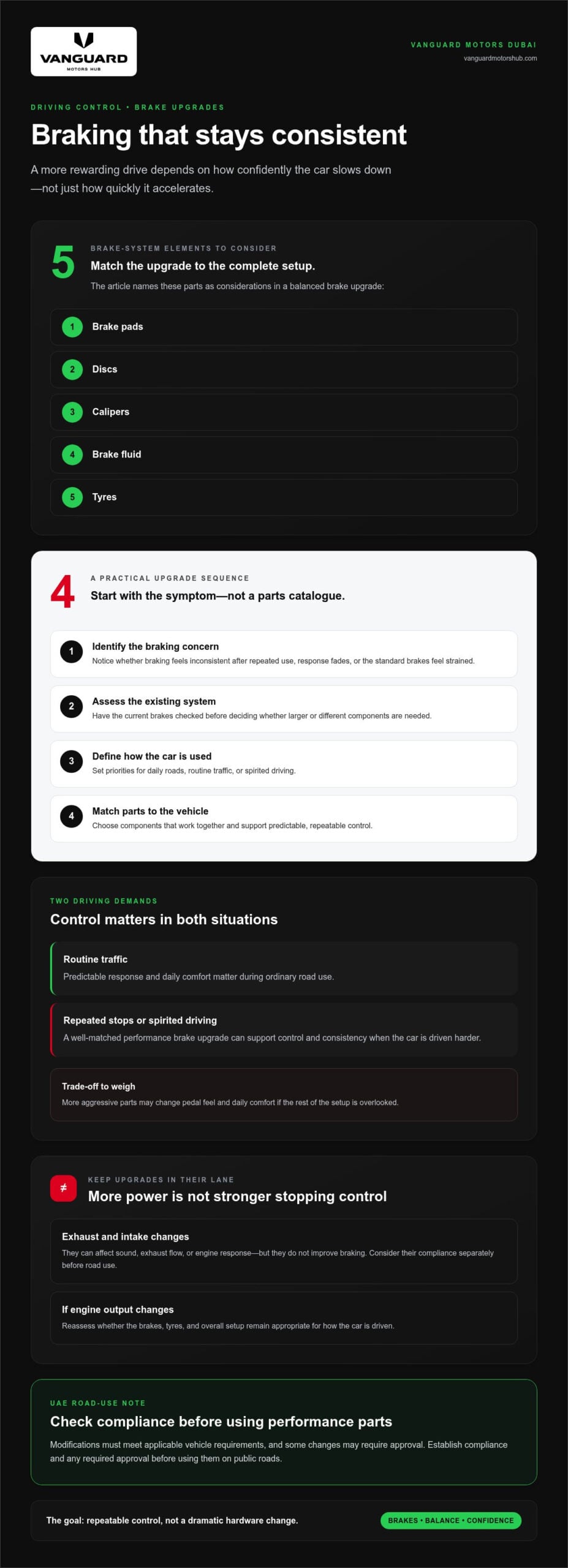
Brakes shape how confidently a driver can use an engine’s power. Performance brake upgrades can improve control and consistency during repeated stops or spirited driving. They matter most when standard brakes feel strained, braking response fades, or the vehicle carries more performance than its current setup can manage. Stopping power deserves as much attention as acceleration, especially when a car is driven hard. A balanced upgrade considers the complete system, including pads, discs, calipers, fluid, tyres, and the vehicle’s intended use.
Start with the symptom, not a parts catalogue. If braking feels inconsistent after repeated use, have the existing system assessed before choosing larger components. A well-matched upgrade can support controlled deceleration, but more aggressive parts may affect pedal feel and daily comfort if the rest of the setup is overlooked. For a road-driven car, predictable response in routine traffic matters as much as performance during a demanding drive. The goal is repeatable control, not a dramatic hardware change.
Which car modifications are legal in the UAE, and do they require approval? For UAE road use, modifications must comply with applicable vehicle requirements, and some changes may require approval. Establish compliance and any required approval before using performance parts on public roads.
Performance exhaust systems can change sound and exhaust flow, but they don’t improve braking. A true dual exhaust may affect the emissions system, so establish its compliance before road use. Consider exhaust modifications separately from brake work: assess effects on emissions and noise, then judge braking by the condition and performance of the brake system. This helps prevent a power or sound upgrade from being mistaken for a stopping upgrade.
Performance intake manifolds are part of the engine’s breathing setup, not the braking system. Their effect depends on how the manifold matches the engine and its supporting components. An intake change paired with an exhaust may alter engine response, but extra power doesn’t provide stronger stopping control. If the car’s output changes, reassess whether its brakes, tyres and overall setup remain appropriate for how it’s driven.
How much do common comfort and handling car modifications cost in the UAE? The price depends on the vehicle, selected parts, installation complexity, and supporting work, and is given after a quote request. For brake upgrades, those factors include the components chosen and how they integrate with the existing system; comfort or handling changes have their own parts and fitting requirements.
Use a practical sequence: identify a braking concern, inspect the current system, define your priorities for daily roads or spirited driving, then match parts to the vehicle. Keep exhaust and intake decisions separate from brake selection, and account for any resulting change in engine response. This makes upgrades more coherent, with braking control supporting the whole driving experience rather than speed alone.
2. Coilovers and steering response
Coilovers combine a spring and damper in one adjustable assembly. Depending on their design, they can let a specialist tune ride height and damping to suit the car. A considered setup can sharpen steering response, reduce body roll and make the chassis feel more connected to the road. The aim isn’t simply to lower the car. It’s to keep the wheels composed over changing surfaces while preserving usable comfort.
Subaru WRX, Honda Civic, and Toyota GR86 drivers may value different settings. A WRX used for daily commuting needs a different balance from a GR86 driven mainly on smooth roads. Stiffer damping may reduce body movement, but excessive firmness can make rough surfaces less comfortable and reduce the suspension’s ability to follow bumps. Choose settings around the vehicle’s real use, not appearance alone.
Lowering a car or changing its wheels and suspension can affect ground clearance, ride comfort, alignment, tyre contact and handling. In the UAE, legality and approval depend on the modification and applicable vehicle requirements. A part that fits the car doesn’t necessarily make the resulting setup compliant for road use.
Before installation, define the desired result: less body roll, more direct steering or a balanced daily ride. Then match the coilover design and settings to the vehicle and intended use. After fitting, have the alignment assessed, since changing ride height can alter suspension geometry. An off-centre steering wheel or uneven tyre wear can indicate that the setup needs attention.
Wheel choice also affects how the suspension feels. A different wheel size or offset can change clearance around suspension components and how the tyre sits. Confirm fitment against the car’s specifications, and consider the wheel and tyre together rather than as separate visual upgrades. For example, a wheel that interferes with a coilover can compromise the installation before the car reaches the road.
On UAE roads, a setup needs to suit the surfaces the driver actually encounters. Low ride height can leave less clearance for ramps and uneven entrances, while firm damping may transmit more impact into the cabin. After installation, test the car on familiar routes and note steering response, ride comfort and any rubbing. This real-world check helps distinguish a precise setup from one that only looks purposeful when parked.
Coilovers are most effective as part of a matched chassis setup. Ask the installer to explain the adjustment range, intended use, and post-installation alignment process in clear terms. Record the chosen settings so they can be compared after driving. A measured approach helps a Subaru WRX, Honda Civic, or Toyota GR86 feel more composed without sacrificing the comfort and predictable response expected from a daily driver.
3. Vehicle weight reduction
Reducing mass can make a vehicle feel more responsive without adding engine power. With less weight to move, the engine, suspension and tyres have less mass to manage. The effect depends on where weight is removed and whether the change preserves the car’s balance. A thoughtful plan targets unnecessary mass, not essential safety equipment or everyday features.
The contrast between the 2014 Ariel Atom 3.5R and 2024 BMW M3 CS shows how different vehicle weights can be. These are very different cars, so the figures aren’t a direct measure of modification results. They do illustrate why vehicle mass is part of the wider conversation about acceleration, braking, and how a car changes direction.
Start by separating weight into two categories: sprung and unsprung mass. Sprung mass is supported by the suspension, while unsprung mass includes components that move with the wheels. Reducing weight at the wheels can help the suspension respond to road changes, but wheel and tyre fitment must remain suitable. Removing mass from the cabin or body affects the vehicle differently, so its location matters as much as the total removed.
For a road car in the UAE, assess every proposed change against daily needs. A stripped cabin may reduce mass but also remove comfort and practicality you rely on. Avoid removing safety equipment. Instead, identify non-essential items and consider their function before making changes. Keep the vehicle’s balance, suspension behaviour and intended use in view rather than chasing the largest possible weight reduction.
Can aftermarket modifications affect car insurance or vehicle warranty in the UAE? Yes, modifications can affect insurance terms or warranty coverage. The impact depends on the change, policy wording, warranty conditions and whether a modification relates to a fault or claim.
Before modifying the vehicle, document its existing configuration and list each planned change. Changing wheels, for example, affects unsprung mass and may alter suspension response, while removing cabin equipment changes weight elsewhere. Consider changes as part of a complete setup, not as isolated upgrades. Keep records of parts and installation work, then pay attention to steering, ride and braking during normal driving.
Weight reduction works best when it supports a clear goal, such as a more responsive vehicle or a balanced track-oriented setup. A daily-driven BMW M3 CS has different comfort priorities from an Ariel Atom 3.5R. Keep useful equipment, preserve predictable handling, and evaluate each change by its effect on the whole car. The right approach is selective, not simply removing everything possible.
4. Cornering stability
A stable car should respond predictably as steering input increases through a bend. Suspension, tyres, alignment and braking work together, so changing one can alter how the others feel. Suspension improvements can help a Ford Mustang or Chevrolet Camaro feel more balanced when handling its power. The target is controlled movement, not a chassis so stiff that it skips across uneven pavement.
Assess the car’s behaviour before selecting parts. You might notice delayed response at turn-in, excessive lean or a nervous feel when changing direction. Each sensation can have different causes, so inspect the current setup rather than assuming stiffer springs will solve everything. The right car mods for a better driving experience, not just speed, address a specific behaviour while preserving composure on the roads you actually use.
Tyres are essential to cornering control. Choose tyres suited to the vehicle and keep them properly inflated according to the manufacturer’s guidance. Check tread and wear patterns, since uneven wear can point to a setup issue. A Chevrolet Camaro with mismatched or worn tyres may respond inconsistently in a corner, even if its suspension components are in good condition.
After changing suspension or wheel components, have the alignment assessed. Incorrect alignment can affect steering feel, tyre contact and wear. During a familiar drive, notice whether the vehicle tracks straight and responds smoothly to small steering adjustments. UAE routes can include varied surfaces, so evaluate the car beyond a single smooth stretch. A composed setup should feel controlled without requiring constant correction.
A rear wing can help keep a car’s wheels on the road, but it doesn’t necessarily make the vehicle faster. It’s one part of a wider setup, not a fix for poor alignment, unsuitable tyres or worn suspension. For a road-driven Mustang, establish predictable chassis balance before treating an aerodynamic addition as the solution. The best car mods for a better driving experience, not just speed, work together rather than competing for attention.
After any change, assess the vehicle progressively on familiar roads and in safe driving conditions. Note steering response, body movement and whether the car settles consistently after a bend. If new components create a harsher ride or less predictable behaviour, reassess their compatibility instead of adding more parts. A measured approach helps preserve everyday usability while making cornering more controlled and deliberate.
5. Daily drivability
A daily-focused modification should make ordinary journeys easier, not turn every trip into a compromise. More horsepower without control can make a car feel unpredictable, especially if throttle response, tyres and chassis no longer work well together. Judge each change by its effect on parking, traffic, longer drives and familiar roads in the UAE. A quick acceleration run can’t tell you whether the car remains comfortable and composed in everyday use.
Tyres influence grip, comfort and the sound entering the cabin. The balance depends on tyre design, condition, pressure and the vehicle’s setup. A performance-focused tyre may prioritize cornering grip, while a touring-oriented choice may suit drivers who value a quieter, more relaxed ride. Keep tyres properly inflated according to the vehicle manufacturer’s guidance, and assess noise and comfort on your usual routes.
Do better tyres improve comfort, grip and road noise? They can affect all three, but the result depends on tyre design, condition and the vehicle. Choose according to your priorities, maintain the correct pressure and monitor wear.
A seat or steering wheel change can improve comfort if it helps the driver maintain a natural position and reach controls without strain. Before replacing either, adjust the existing seat for pedal reach, back support and a clear view of the road. A replacement seat should keep you securely positioned, while a different steering wheel should allow comfortable access to essential controls. Test the fit on a familiar drive, not by appearance alone.
Can a car seat or steering wheel upgrade improve driving comfort? Yes, a suitable seat or steering wheel can support a more comfortable driving position. Correct fit and access to the vehicle’s controls matter more than a sportier shape.
Automatic transmission behaviour also shapes the daily experience. Cruise control can maintain a steady pace, while an automatic transmission selects a suitable gear. Together, they can make steady journeys feel more relaxed than constant accelerator adjustments. Power upgrades should remain compatible with predictable throttle response. More horsepower is no substitute for smooth operation in traffic or controlled low-speed manoeuvres.
Evaluate changes one at a time. After fitting new tyres, for example, note cabin noise, ride comfort, steering feel and grip on familiar roads. Then decide whether another modification would solve a real problem. This makes cause and effect easier to judge, especially when several components could influence the same driving sensation.
If custom rims are part of your daily-use plans, discuss custom rim options with the team before settling on a look. Keep fitment and your priorities for everyday driving central to the decision.
Vanguard Motors Dubai: Paint Protection Film (PPF) Installation
Vanguard Motors Dubai offers Paint Protection Film (PPF) Installation for drivers looking to protect their vehicle’s finish, not change its braking or handling. After choosing performance modifications, keep mechanical upgrades focused on driving feel and consider PPF when preserving the exterior matters. For a different look, Colored Sticker Wraps and Peelable Paint Applications offer customization options. The Vanguard Premium package is another option for vehicle enhancement.
Choose PPF when paint protection is your priority; choose a wrap or peelable paint application when you want a changed appearance. These services complement performance-focused decisions without replacing mechanical modifications. To discuss paint protection or customization for your vehicle, contact Vanguard Motors Dubai.
Make your next modification count
Before choosing another upgrade, decide what you want to feel different on your next drive. A more composed response, easier daily use or a finish that reflects your style can each guide a different choice. The best car mods for a better driving experience, not just speed, serve your priorities without compromising how you use your vehicle.
Performance changes and appearance enhancements serve different purposes. Vanguard Motors Dubai offers Paint Protection Film (PPF) Installation to protect the vehicle’s finish, alongside Colored Sticker Wraps and Peelable Paint Applications for a customized look. These options complement your build without being braking or handling upgrades.
Take your priorities into the next conversation and decide which direction best suits your vehicle. Contact Vanguard Motors Dubai to discuss your vehicle’s next enhancement. A considered choice can make every drive feel more distinctly yours.
Frequently Asked Questions
What car modifications improve comfort and everyday drivability, not just speed?
Start with changes that address a daily frustration, such as an uncomfortable seating position, tiring cabin noise or abrupt throttle response. Adjust your existing seat and steering position before replacing components, and check tyre condition before changing the setup. A commuter who spends time in traffic, for example, may benefit more from smoother control inputs and a quieter cabin than from an engine upgrade that adds power without improving comfort.
Best suspension upgrades for a smoother ride and better handling?
Matched springs and dampers are a sensible starting point when the goal is a controlled ride without excessive firmness. The right combination depends on the vehicle’s weight, suspension design and road use. If a car feels unsettled over bumps, inspect its existing dampers, springs and related components before changing ride height. Worn parts can undermine a new setup, so diagnose the cause before selecting an upgrade.
Which brake upgrades are worthwhile for normal street driving?
For ordinary road use, keeping the original braking system in good condition is often the most relevant first step. Check for uneven wear, vibration or a change in pedal feel, then address affected components with parts suited to the vehicle. A larger brake package isn’t automatically a better choice for routine commuting. Prioritize predictable response and compatibility with the car’s existing wheels and intended use.
What sound-deadening and infotainment upgrades make daily driving better?
Sound-deadening material can help reduce some road and panel noise when applied to suitable cabin areas. For infotainment, prioritize clear screen visibility, dependable phone pairing and controls that are easy to use while parked. In bright daylight, screen readability matters, so test the display from the driver’s seat before choosing an upgrade. Keep installation tidy and preserve access to existing vehicle controls and service points.