
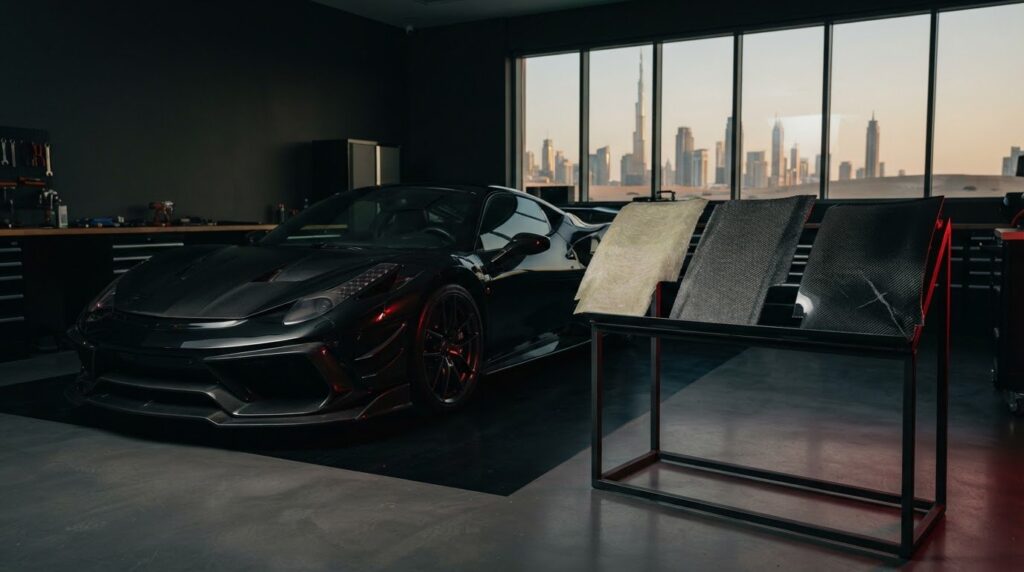
The most dramatic body kit isn’t automatically the most durable. A car body kit changes or adds exterior components such as bumpers, side skirts, or a spoiler. A well-made kit can last 5 to 10 years or more with regular maintenance and careful use. A realistic assessment of aftermarket body kit durability starts with the material, fitment, ground clearance, and quality of repairs.
It’s natural to focus on appearance and material when choosing a kit, but aftermarket body kit durability depends on more than those factors. Fiberglass, FRP, and carbon fibre respond differently to impact, while installation quality and driving conditions also affect how well a kit holds up. In the UAE, heat, speed bumps, and driveway angles can put extra demands on low or poorly fitted components.
This guide explains how body kits work and compares the durability and repairability of common materials. You’ll also learn how installation, UAE road conditions, UV exposure, and maintenance affect long-term performance, then use a practical guide to match a kit to your car and driving habits.
Key Takeaways
- Dry-fit every component before painting, then assess panel gaps, sensor positions, wheel clearance, and headlight alignment to catch fitment issues early.
- Choose material for how you drive: FRP is repairable but can crack under impact, while carbon fiber is lightweight and rigid but may need specialized repair.
- Protect carbon-fibre components from prolonged UV exposure with a UV-protective clear coat, and keep their finish maintained.
- Low ground clearance increases the chance of FRP damage on speed bumps and steep driveways; approach obstacles carefully and consider the kit’s fit with your usual routes.
- When a body kit changes your car’s appearance, Paint Protection Film (PPF) Installation can help protect painted surfaces from everyday wear.
Installation-related damage and longevity
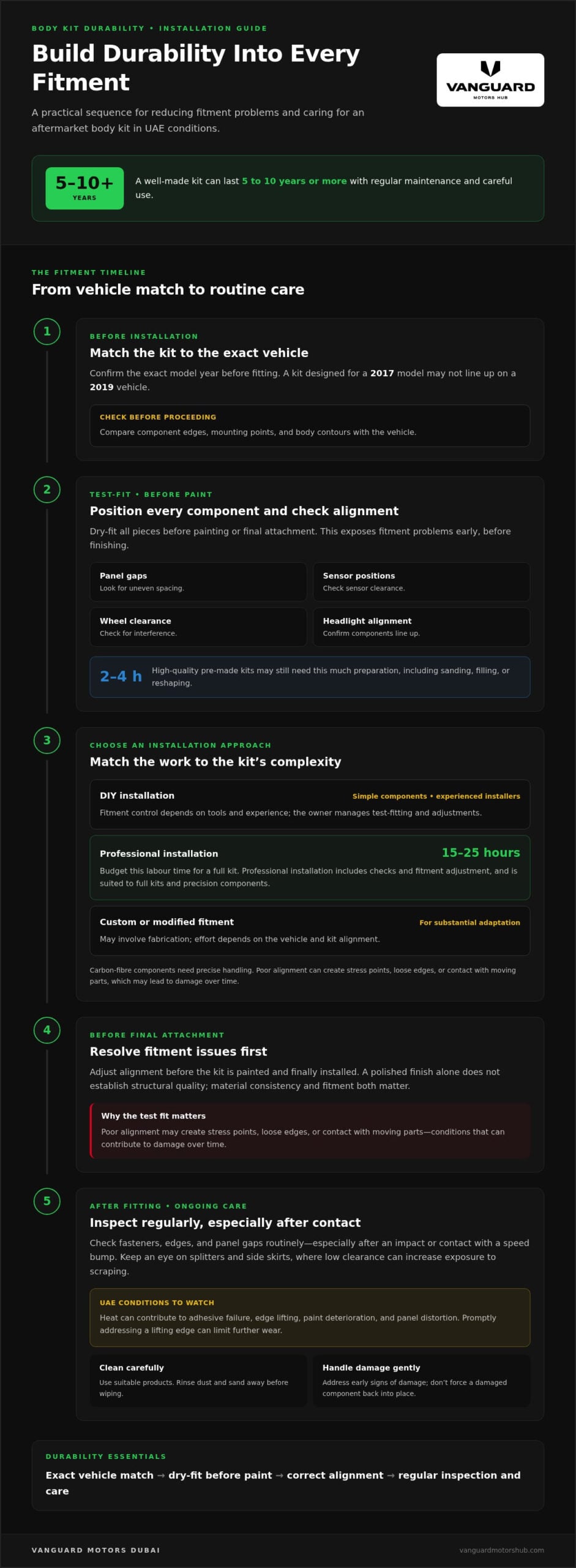
Aftermarket body kit durability depends on correct fitment, careful installation, and ongoing care. A well-made kit can last 5 to 10 years or more with regular maintenance and careful use.
Installation Quality and Test-Fitting
Test-fitting means positioning each component on the vehicle before paint or final attachment. It exposes fitment problems early, unlike installation that relies on adjustments after finishing. Check panel gaps, sensor positions, wheel clearance, and headlight alignment during the test fit. A kit designed for a 2017 model may not line up on a 2019 vehicle, so confirm the exact model year.
Dry-fit every component before sending it for paint. High-quality pre-made kits may still need 2-4 hours of preparation, including sanding, filling, or reshaping. Carbon-fibre components need precise handling, and professional installation helps achieve proper fitment. Poor alignment can create stress points, loose edges, or contact with moving parts, which may lead to damage over time.
Installation and Ongoing Maintenance
Installation lays the foundation; maintenance helps preserve it. After fitting, inspect fasteners, edges, and panel gaps regularly, especially after an impact or contact with a speed bump. In the UAE, heat can contribute to adhesive failure, edge lifting, paint deterioration, and panel distortion. Promptly addressing a lifting edge can limit further wear.
Routine checks can catch gradual changes before they lead to larger repairs. Keep an eye on aerodynamic components such as splitters and side skirts, since low clearance can expose them to scraping. Clean the kit with suitable products, and don’t force a damaged component back into place.
| Installation option | Fitment control | Preparation and effort | Best suited to |
|---|---|---|---|
| DIY installation | Depends on tools and experience | Owner manages test-fitting and adjustments | Simple components and experienced installers |
| Professional installation | Includes checks and fitment adjustment | Budget 15-25 hours of labour for a full kit | Full kits and precision components |
| Custom or modified fitment | May involve fabrication | Effort depends on vehicle and kit alignment | Kits needing substantial adaptation |
In the UAE, installation pricing depends on the material, vehicle, labour, and any adjustment or fabrication; the price is provided after a quote request. Treat installation as part of the kit’s total project, not an optional finishing step. Labour needs can vary with the number of components and fitment complexity.
For a durable result, choose a kit matched to the exact vehicle, dry-fit it before painting, and resolve alignment issues before final installation. These steps protect appearance and function, including sensor clearance and headlight alignment.
OEM vs Aftermarket Body Kits: Which Is Better for Your Car in Dubai?
Across the UAE, OEM kits usually offer more predictable material consistency, while aftermarket quality ranges from basic to premium. Compare material, fitment, weight, and likely road exposure with how you use your vehicle.
FRP, Carbon Fibre, and Polyurethane
FRP, or fibreglass-reinforced plastic, combines glass fibres and resin. It can be repaired and painted, but may crack under impact or stress. Carbon fibre is lighter and has higher tensile strength than fiberglass, yet severe force can crack or shatter it. Polyurethane is heavier, but its flexibility makes it more forgiving during impacts and installation.
For regular driving, weigh repairability against impact tolerance. FRP can suit a design that needs finishing and later paint repairs; polyurethane prioritizes flexibility. Carbon fibre suits weight-conscious builds, but damage may require specialized repair. Composite blends can combine carbon fibre, Kevlar, and fiberglass, with properties shaped by their construction.
Material Consistency and Fitment
OEM parts tend to be more consistent in material quality. Aftermarket components vary, so inspect the surface finish and compare each part’s shape with your vehicle’s body lines. Polyurethane often has smoother edges, which can reduce installation adjustments. FRP may need finishing after installation, while some carbon-fibre components require adjustment for a seamless fit.
Before buying, match the kit to the exact vehicle model and year. Compare component edges, mounting points, and body contours, then dry-fit the pieces before painting. This can reveal uneven gaps and reshaping needs. A polished finish alone doesn’t establish structural quality. Material consistency and fitment deserve equal attention.
Weather Effects on Materials
Heat in the UAE can contribute to warping, adhesive failure, edge lifting, paint deterioration, and panel distortion. Prolonged UV exposure can also yellow carbon fibre or reduce its gloss, so use a UV-protective clear coat. During routine cleaning, inspect exposed edges and painted surfaces for fading, lifting, or distortion.
Weather can affect components in different ways. Adhesive-backed edges may lift, while rigid panels may distort or show finish damage. Rinse dust and sand away before wiping, and address early signs of damage before regular driving adds stress to the affected area.
What UAE rules apply to aftermarket body kits and vehicle modifications? RTA guidance states that vehicles with modified bodies may be referred to its Technical Inspection Committee. UAE federal traffic regulations address inspection after substantial changes to a vehicle’s engine, chassis, or colour.
Do aftermarket body kits affect vehicle safety, sensors, or crash performance? They can. Changes may affect parking sensors, radar modules, cameras, crash structures, cooling channels, or airflow. Preserve component clearances and check affected systems after installation.
How can I inspect a body kit for quality before buying? Inspect the finish, edges, material consistency, and alignment with your vehicle’s model year. Dry-fit the parts before painting, then assess panel gaps, sensor positions, wheel clearance, and headlight alignment.
Choose according to your priorities: flexibility, repairability, or reduced weight. To discuss material and fitment considerations for your build at Vanguard Motors Dubai, talk through your body kit requirements.
Should You Invest in a Full Carbon Fiber Body Kit?
A full carbon-fibre body kit suits drivers who prioritize low weight and a distinctive finish. For UAE roads, weigh those advantages against impact brittleness, UV care, and the repair demands of carbon components.
Strength and Impact Behaviour
Carbon fibre has higher tensile strength than fiberglass and is significantly lighter. That strength helps resist deformation, but it doesn’t make a panel immune to impact. Carbon components are rigid and can crack or shatter under severe force, unlike metal panels, which can bend. A low front splitter striking a speed bump illustrates the trade-off: weight savings don’t prevent impact damage.
Fiberglass is also brittle and can crack under stress, making it less suitable for daily driving on rough roads or where minor collisions are likely. FRP has a practical advantage after damage: its components are relatively easy to repair and paint. Carbon repairs need specialized techniques, and replacement may be the only option in some cases. When choosing a full set, consider repairability alongside appearance and weight.
UV Protection and Surface Care
In the UAE, prolonged sunlight makes surface protection essential. UV exposure can yellow carbon fibre or reduce its gloss, even when components have UV-resistant coatings. Apply a UV-protective clear coat, then inspect the finish during routine cleaning for fading, chips, or surface damage.
Use a consistent care routine: wash away dust and grit before wiping, since abrasive particles can mark a glossy surface. Don’t overlook small chips; exposed or damaged finish can undermine the component’s appearance. A clear coat helps protect the finish, but it doesn’t prevent cracking from a hard impact.
Deciding Whether a Full Kit Fits Your Use
Before choosing carbon fibre, consider the kit’s components in relation to your regular driving. A front lip or side skirt sits closer to road hazards than higher body panels. Think about your routes, parking access, and how often you encounter steep entries or rough surfaces. These details affect exposure to scraping and impact.
Use this quick comparison before committing to a material:
- Choose carbon fibre when reduced weight and its distinctive finish are priorities, and you can maintain UV protection.
- Choose FRP when repairability and repainting matter more than impact resistance.
- Reconsider a full set if low components face frequent rough-road contact or driveway scraping.
Carbon-fibre installation demands precision, so plan professional fitting and proper care as part of the modification. A carbon kit can deliver a lightweight, refined appearance, but its long-term condition depends on protecting the finish and avoiding impacts that rigid components handle poorly.
Risk of FRP cracking from speed bumps and low ground clearance
FRP body kits can crack when low components strike speed bumps, ramps, or driveway edges. In the UAE, that risk increases when a front splitter or bumper sits close to the road. Ground clearance, approach angle, and driving route all influence whether the kit’s visual appeal comes with frequent scraping or repairs.
Before choosing a low kit, identify the obstacles on your regular routes. Check the vehicle’s clearance at the front, sides, and rear, then consider steep parking entrances and speed bumps. Some drivers need to approach driveways at a 45-degree angle to reduce scraping. That approach can help, but it cannot prevent every impact when a component sits too low.
Why FRP Cracks Under Road Stress
FRP is repairable, but its rigidity makes it vulnerable to cracking under stress or impact. A WRX owner’s inexpensive front lip cracked in three places after three months of use and driveway impacts. This example shows how repeated contact can turn a minor clearance issue into a replacement decision.
A scrape may damage the finish first; a harder strike can split the material. After contact, inspect the underside of splitters and bumper edges for cracks, loose sections, or fresh paint damage. Fiberglass components can often be patched and repainted, but repairability doesn’t make repeated impacts harmless. Continued stress can reopen a repaired area.
Heat, Warping, and Component Checks
UAE heat may contribute to body-kit warping, adhesive failure, edge lifting, paint deterioration, and panel distortion. Check exposed edges and panel alignment during routine cleaning, especially after prolonged outdoor parking. If an edge lifts or a panel changes shape, address it before driving adds movement or stress.
Heat-related changes can affect components differently. An adhesive-backed edge may lift, while a rigid FRP panel may distort. A damaged mount can also leave a splitter or bumper less secure. Inspect attachment points as well as the visible surface, rather than judging the kit by appearance alone.
Reducing Scrape and Repair Risk
Approach speed bumps and steep entrances carefully. Slow down, cross at an angle when clearance requires it, and avoid turning sharply while a low component passes over an obstacle. These steps reduce direct contact, but they can’t compensate for a kit that consistently meets the road.
- Before driving: check clearance around the front lip, side skirts, and rear diffuser.
- After contact: inspect FRP for cracks, loose mounts, and damaged paint.
- For the material decision: compare FRP’s repairability with polyurethane’s flexibility and your regular routes.
Repairing a cracked FRP panel can preserve its shape and finish, but repeated damage may make replacement more practical. Assessing clearance before installation can help protect both the kit and its appearance.
Fiberglass body kit durability and repairability
Fiberglass body kits can transform a vehicle’s appearance, but their rigid construction can crack under stress or impact. Their practical advantage is repairability: damaged FRP components can often be patched and repainted. The right repair depends on the crack, its location, the mounting points, and the condition of the surrounding finish.
Assess the Damage Before Repair
Start by cleaning the damaged area and checking both sides of the component where accessible. Look for a surface crack, a split through the panel, loose mounting points, or distortion around the damaged section. A small crack away from a fastener presents a different repair challenge from a split beside a mount, where movement can continue to stress the repair.
Check fitment before refinishing. A panel pulled out of alignment may crack again if the underlying mounting issue remains. During professional installation, technicians can identify whether the component needs reshaping, reinforcement, or mounting adjustment before painting. Cheap fiberglass parts may require sanding, filling, reshaping, reinforcement, and adjustment to sit correctly.
Repair Work and Finish
A typical repair sequence starts with removing or stabilizing the component, preparing the damaged area, repairing the FRP, and restoring its surface finish. The exact steps depend on crack depth and panel condition. Paint matching and refinishing matter too: a structurally repaired section can still look uneven if the surrounding finish isn’t blended carefully.
Don’t treat filler or fresh paint as proof that a crack is resolved. Inspect the repaired area and its mounts after reinstallation. If the component still flexes or sits unevenly, resolve the fitment problem before regular driving. This matters especially for a front lip or side skirt exposed to road contact.
Maintenance and Repair Planning
During routine vehicle cleaning, inspect fiberglass edges, fasteners, and painted surfaces. After a scrape or impact, check for new cracks and loose mounts before driving normally. Prompt repairs can prevent continued movement from extending damage. Avoid repeated contact with the same obstacle, since a repaired area remains vulnerable to renewed stress.
- For a repairable panel: assess the crack, mounting condition, shape, and paint finish together.
- For a complex repair: compare the work needed for reinforcement and refinishing with replacement.
- For a new upgrade: prioritize fitment and professional installation, not appearance alone.
Repair pricing in the UAE depends on damage, access, preparation, and refinishing, with the price provided after a quote request. If fiberglass damage affects your vehicle’s appearance, discuss cosmetic repair for your vehicle.
Vanguard Motors Dubai: Paint Protection Film (PPF) Installation
Vanguard Motors Dubai installs Paint Protection Film (PPF) for drivers seeking to protect painted surfaces around a body kit. PPF can help guard the finish against everyday surface wear, but it doesn’t repair cracks or prevent structural damage from impact. Repair damage to an FRP component first, then consider finish protection as part of its upkeep.
For a change in appearance, Colored Sticker Wraps and Peelable Paint Applications offer further customization options. The right choice depends on whether your priority is protecting the existing finish or changing its look.
Contact Vanguard Motors Dubai to discuss your vehicle’s needs, or visit vanguardmotorshub.com.
Make Your Next Modification Count
A thoughtful plan for aftermarket body kit durability starts with how you want the vehicle to look and how you’ll maintain its finish. Before your next modification, decide whether your priority is preserving painted surfaces, changing the exterior appearance, or refreshing the finish. That decision helps align the kit with the rest of the vehicle rather than treating each upgrade in isolation.
Vanguard Motors Dubai offers Paint Protection Film (PPF) Installation, Colored Sticker Wraps, and Peelable Paint Applications. Each offers a different way to approach your vehicle’s finish alongside a body kit. Choose the option that best matches your design goals and the care routine you’re prepared to follow.
For a considered next step, share your vehicle and finish goals with the team. Contact Vanguard Motors Dubai today and move forward with clarity and confidence.
Frequently Asked Questions
What Is a Car Body Kit?
A car body kit is a set of exterior components that changes a vehicle’s styling or aerodynamic profile. It may replace or add parts such as bumper covers, side skirts, and spoilers. For example, a front bumper and matching side skirts can create a more unified appearance than a single lip. These components are separate from mechanical upgrades such as exhaust modifications.
Materials: What Should UAE Car Owners Choose?
Choose based on your daily routes, repair priorities, and preferred finish. Polyurethane suits drivers who value flexibility and impact tolerance. ABS plastic offers good impact resistance and heat and chemical resistance, but can crack under extreme stress. FRP can be repaired and painted, while carbon fibre is lightweight but needs impact and UV considerations. A low front lip used on steep driveways may favour flexibility over appearance alone.
OEM vs Aftermarket: Which Should You Choose?
Choose an OEM kit when predictable material consistency and a factory-matched design are priorities. An aftermarket kit offers broader styling choices, but its quality and fitment can vary. Before selecting one, compare the component contours with your vehicle and confirm the kit matches its exact model year. A kit that looks right in product photos still needs to align with your car’s body lines and attachment points.
How Durable Are Aftermarket Body Kits in Everyday Driving?
A well-made body kit can last 5 to 10 years or more with regular maintenance and careful use. Everyday durability depends on how components meet road hazards, how well they fit, and whether damage is addressed promptly. For example, frequent contact between a low side skirt and steep parking ramps can shorten its service life. Regularly inspect edges and mounts after scraping or impact.
Which Body Kit Materials Are Most Durable: Fiberglass, Polyurethane, ABS Plastic, or Carbon Fiber?
Polyurethane generally offers a strong balance for everyday impact tolerance because it flexes more readily than rigid materials. ABS plastic also resists impacts, heat, and chemicals, though extreme stress can crack it. Fiberglass and FRP can be patched and repainted but may crack under impact. Carbon fibre is light and strong, yet severe force can crack or shatter it. The best choice depends on how you drive and your repair priorities.
How Do Heat, UV Exposure, Sand, and Road Debris in the UAE Affect Body Kit Durability?
UAE heat can contribute to warping, adhesive failure, edge lifting, paint deterioration, and panel distortion. Prolonged UV exposure can yellow carbon fibre or dull its gloss, so a UV-protective clear coat matters. Sand and road debris can abrade finishes, especially on exposed lower panels. Rinse grit away before wiping, then check front lips and side skirts for chips or lifted edges.
What Are Common Causes of Aftermarket Body Kit Cracking, Warping, or Paint Failure?
Common causes include impact with speed bumps, low ground clearance, poor fitment, stressed mounting points, and UAE heat. FRP can crack after repeated scraping, while heat may contribute to panel distortion or adhesive failure. Paint problems can follow poor surface preparation or prolonged UV exposure. If a panel begins to sit unevenly, inspect its mounts and alignment rather than covering the problem with fresh paint.
How Should I Maintain and Repair an Aftermarket Body Kit to Make It Last Longer?
Wash away dust and sand before wiping, then inspect exposed edges, mounts, and paint during routine cleaning. After an impact, check the component’s underside and attachment points for cracks or looseness. Repair damage before continued movement makes it worse. FRP repairs may involve patching and refinishing; carbon fibre may require specialized techniques. Correct fitment is essential, since an unresolved alignment issue can stress a repaired panel.