
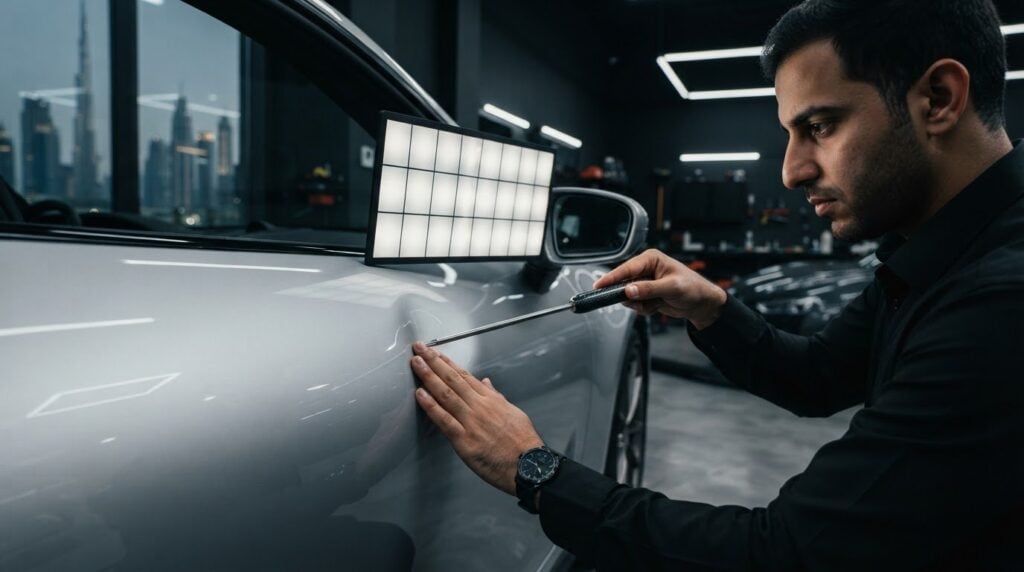
Can an aluminum dent disappear without repainting, or is conventional bodywork the safer choice? Aluminum panel paintless dent repair can preserve the factory finish, but the material’s response to pressure makes the decision more exacting than it is with steel. The right repair depends on more than the dent’s size.
It’s reasonable to worry about visible distortion or damage to the paint. Aluminum can be more prone to stretching or cracking during repair, so a careful assessment matters. If the finish is intact, the damage is manageable, and the panel is accessible, PDR may be suitable. Cracked paint, severe stretching, or restricted access can point toward another repair method.
This guide explains what makes aluminum panels different, which damage characteristics influence PDR suitability, and how the process may differ from conventional bodywork. You’ll also find practical questions to ask a repair provider about their experience with aluminum, proposed approach, and expected finish before authorizing work. When the panel or damage is uncertain, an inspection is the clearest first step.
Key Takeaways
- Aluminum panel paintless dent repair may suit some dents, but panel access, damage shape, and finish condition all influence the decision.
- Aluminum can respond differently from steel during reshaping, so the repair approach should be matched to the specific panel and damage.
- Compare PDR with conventional bodywork by asking how each option may affect the finish and final appearance.
- Prepare for an assessment with clear photos, the dent’s location, and details about how it happened.
- Ask the provider to inspect the panel and explain the proposed process, expected outcome, and reasons for choosing that method.
What Is Aluminum Panel Paintless Dent Repair, and What Can It Address?
Paintless dent repair, or PDR, reshapes a dented panel while preserving the existing factory paint when the finish is intact and the damage is suitable. The method may use controlled pressure from behind the panel or a pulling technique from its outer surface. Paintless dent repair (PDR) can apply to aluminum as well as steel, but the material alone doesn’t determine whether a dent can be repaired this way.
With aluminum panel paintless dent repair, the goal is to restore the panel’s contour without repainting. A shallow, rounded dent with unbroken paint may be a candidate. A sharp crease, deep impact, visibly stretched metal, or chipped or cracked finish can make PDR less suitable, or call for a different repair method. No dent shape guarantees a paintless result.
How does paintless dent repair restore an aluminum panel?
A technician works gradually, either applying measured pressure from behind the damaged area or using a specialized pulling method to draw the metal outward. The aim is controlled reshaping, not a single forceful push. The surface is checked repeatedly under suitable lighting so remaining highs or lows can be identified. Whether the original paint can be retained depends on its condition and the panel’s response during repair.
Which aluminum panel dents may be considered for PDR?
Shallow, rounded dents with intact paint are often more promising assessment candidates than deep or sharply defined damage. Suitability depends on the dent’s size, depth, shape, and location, as well as how much the metal has stretched. A small impact isn’t automatically simple, and a larger dent isn’t automatically unsuitable. Panel edges, internal braces, and limited tool access can restrict how precisely the area can be reached.
- Rounded and shallow: The contour may be more accessible to gradual reshaping.
- Creased or sharply impacted: A concentrated fold can be harder to correct without leaving distortion.
- Stretched metal or damaged paint: The panel may not hold its original contour, or the finish may not remain intact.
- Restricted location: Edges and braces can complicate access and affect the repair options.
These are useful clues, not a diagnosis. An inspection can account for access, finish condition, and damage severity before a repair method is chosen. Ask the provider to explain why PDR does or doesn’t fit the specific panel, what alternatives are available, and what result is realistically achievable.
Why Does Aluminum Make Paintless Dent Repair More Demanding?
Aluminum isn’t simply a lighter version of steel. Its response to reshaping varies with the alloy, panel design, and damage history, so an approach that suits one panel may not suit another. It may also spring back differently from steel, making controlled adjustments and careful surface checks especially important. In aluminum panel paintless dent repair, the technician needs to assess both the visible dent and how the panel may respond as it’s worked.
Work-hardening is the change in a metal’s behavior as it’s deformed, which can make an area less willing to reshape and more sensitive to further force. Technicians consider it because repeated or poorly controlled pressure may increase the risk of distortion, stretching, or cracking. That doesn’t mean every aluminum panel will behave the same way. It means the repair plan should account for the specific material and damage rather than rely on a fixed assumption.
How do aluminum panels respond differently to reshaping?
Vehicle panels can use different aluminum alloys and constructions, so there’s no single response that applies to every car. A shallow dent may move gradually, while a sharper impact can concentrate stress in a smaller area. Applying force repeatedly without reassessing the surface can make correction harder or create new irregularities. A measured approach helps the technician judge whether to continue, change technique, or stop and reconsider the repair method.
Why do access and temperature matter during aluminum PDR?
Access shapes the repair plan. Braces, inner structures, and tight spaces behind a panel may prevent a tool from reaching the dent at the right angle, which can limit pressure-based techniques. Some repair methods may also call for controlled temperature conditions. The appropriate procedure and any temperature guidance can depend on the vehicle and panel, so manufacturer-specific instructions should be verified rather than assumed.
These factors are why a dent’s appearance alone can’t confirm whether PDR is suitable. Ask how the provider will reach the damaged area, what approach they propose, and how they’ll monitor the panel as it’s reshaped. If access is restricted or the metal’s response is uncertain, an inspection can clarify the options before work begins.
Vanguard Motors Dubai offers cosmetic repair and car damage repair. Ask whether your particular aluminum panel can be assessed for PDR before arranging work. You can share your dent details and ask about an assessment.
Aluminum PDR vs. Conventional Repair: Which Approach Fits the Damage?
Choosing between paintless dent repair and conventional body repair isn’t a contest between a “better” and a “worse” method. It’s a decision about the panel’s condition, the finish you want to preserve, and what the damage will allow. For aluminum panel paintless dent repair, an intact finish and workable access may support a PDR assessment. Cracked paint or more severe deformation can call for a different approach.
| What to assess | PDR may be considered when | Conventional repair may be considered when |
|---|---|---|
| Paint condition | The existing finish is intact | Paint is cracked, chipped, or otherwise damaged |
| Damage shape | The dent is gradual and the panel appears to retain its shape | There’s a sharp crease, stretched metal, or severe deformation |
| Access | The damaged area can be reached with the chosen method | Panel construction or restricted access limits effective reshaping |
| Repair needs | Retaining the existing finish is feasible | Filling, refinishing, or panel replacement may be appropriate |
When may paintless repair be worth assessing?
An accessible dent with intact paint and a gradual contour may be worth presenting for PDR assessment. But those signs aren’t a guarantee. A dent near a panel edge, for example, can be harder to reach than a similar mark in an open area. The panel’s condition and the technician’s view of the achievable finish matter as much as the visible size of the damage.
When might conventional body repair be more appropriate?
Cracked paint, sharp creases, stretched metal, or extensive deformation can signal that reshaping alone won’t address the damage or preserve the finish. Conventional repair may involve filling and refinishing. In some cases, panel replacement may be considered. The right option depends on inspection, not appearance alone. For damage that may affect a vehicle’s structure or safety, seek an appropriate professional assessment before treating it as a cosmetic issue.
Use the comparison as a starting point, not a diagnosis. Ask the repair provider to explain how the paint, dent shape, access, and finish expectations influence their recommendation. If conventional work is proposed, clarify whether it involves filling, refinishing, or replacement, and why. For broader cosmetic concerns, consult a cosmetic car repair guide before deciding on a repair path.
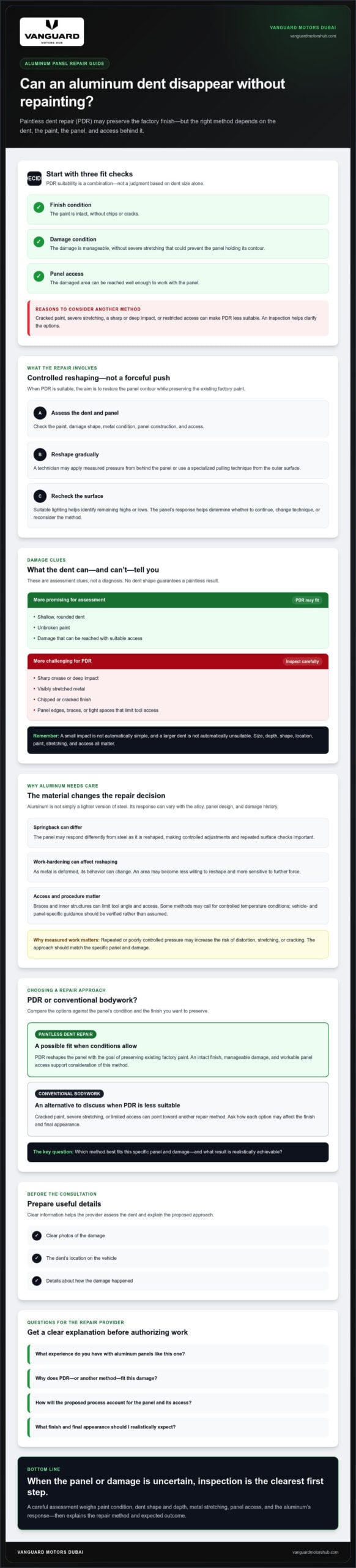
How to Assess an Aluminum Dent and Prepare for a Repair Consultation
A clear description helps a repair provider understand the damage before examining the panel. It won’t confirm whether PDR is suitable, but it can make the initial conversation more focused. Gather the details below, then ask whether an in-person inspection is needed before the repair method can be confirmed.
What information helps a technician evaluate an aluminum dent?
Record which panel is affected and where the dent sits on it. Note its approximate size, how it happened if known, and whether you can see chips, cracks, or other marks in the paint. Take photographs in good light: include a wider view showing the dent’s position on the vehicle, then close-ups from more than one angle. Reflections can reveal contours, but don’t rely on a photo alone to judge depth.
- 1. Identify the panel: Specify the door, bonnet, fender, or other affected area, and note whether the dent is near an edge or visible reinforcement.
- 2. Describe the damage: Estimate its size and shape, and explain the impact if you know what caused it.
- 3. Check the finish: Report any chipped, cracked, or visibly marked paint. Don’t scrape or press the dent to investigate.
- 4. Take useful photos: Capture a well-lit wide view and clear close-ups. Share more than one angle if the contour changes with the light.
What questions should you ask before approving the work?
Use the assessment to understand the reasoning, not simply to obtain a yes-or-no answer. Ask how the provider decides whether your specific panel is suitable for aluminum panel paintless dent repair, whether access affects the method, and what finish outcome is realistic. Find out how any limitations will be explained before work begins. If the proposed method changes after inspection, ask what new detail informed that recommendation.
- Does the paint condition support the proposed repair method?
- Will the panel’s location or construction limit access?
- What visible marks or contour changes might remain?
- Is an in-person inspection needed before the method is confirmed?
After the repair, discuss any separate paint-preservation options and when they may be appropriate. A paint protection film guide can help you understand PPF as a distinct consideration, not a substitute for assessing or repairing existing damage.
Vanguard Motors offers cosmetic repair and car damage repair. Ask whether your particular aluminum panel can be assessed for PDR. Ask about an assessment on WhatsApp and share the panel details and photos to begin the conversation.
Choosing an Aluminum PDR Provider: Make the Next Step Informed
A confident recommendation should be supported by a clear assessment, not a blanket promise that every dent can be removed without paintwork. For aluminum panel paintless dent repair, ask the provider to explain how the panel’s condition, access, and damage shape inform the proposed method. You should understand both the intended result and any limitations before authorizing work.
What signals a careful repair assessment?
Look for specific answers about your panel, not a generic assurance based on a photo or a quick glance. A careful provider should explain what they’ve observed, how they’ll assess the paint and access, and why the proposed approach fits the damage. They should also be willing to discuss alternatives if PDR isn’t suitable.
- Assessment: Do they inspect the panel and explain the factors behind their recommendation?
- Method: Can they describe the proposed repair process in terms you understand?
- Limitations: Do they identify what may prevent the desired result, rather than guaranteeing every dent can be corrected?
- Finish checks: Ask how they’ll evaluate the panel’s appearance during and after the work, and what outcome is realistic.
Compare providers on the quality of their explanation, the proposed process, and how clearly they set expectations. A promise of a flawless finish is less useful than an honest account of what inspection can establish and what remains uncertain. If the assessment changes the recommended method, ask what the provider found and how that affects the expected result.
How can Vanguard help you explore the right repair option?
Vanguard Motors offers cosmetic repair and car damage repair. Its available services don’t confirm aluminum-specific assessment or repair capability, so ask directly whether your particular aluminum panel can be assessed before arranging work. Share the panel location, visible paint condition, and clear photos to help start an informed discussion. An inspection may still be needed to confirm suitability.
Choose the next step with clarity. Discuss your dent repair options on WhatsApp, share the damage details, and ask whether the aluminum panel can be assessed for PDR.
Make Your Next Repair Decision with Confidence
Aluminum panel paintless dent repair may preserve the existing finish when the paint, damage, and panel access are suitable. Aluminum can respond differently from steel, so a dent’s appearance alone can’t confirm that PDR is the right method. A careful inspection helps clarify whether paintless or conventional repair better fits the damage and what finish outcome is realistic.
Before approving work, ask how the provider assessed the panel, why they recommend a particular method, and what limitations could affect the result. Clear photos and details about the dent can help start that conversation, but an in-person assessment may still be needed.
Vanguard Motors offers cosmetic repair and car damage repair. Its aluminum-specific assessment capability isn’t confirmed, so ask whether your particular panel can be evaluated. Discuss your aluminum dent repair options on WhatsApp and share the damage details to ask about suitability. With the right information and a considered assessment, you can choose your next step with greater confidence.
Frequently Asked Questions
Is paintless dent repair possible on aluminum panels?
Paintless dent repair can be possible on aluminum panels, but suitability depends on the alloy, dent shape and depth, paint condition, panel access, and repair method. A shallow, rounded mark with intact paint may be assessed differently from a sharp crease near a brace. An inspection lets a technician examine the actual panel and explain the options. No particular dent can be guaranteed a paintless result.
Can aluminum dents be repaired without repainting?
Aluminum panel paintless dent repair may preserve the existing paint when the finish is intact and the dent is suitable for reshaping. Cracked or chipped paint, a sharp crease, stretched metal, or difficult tool access can change the available options. Depending on the panel and damage, another repair method may be needed. A technician should inspect the actual area before recommending a paintless approach or setting expectations for the finish.
How is aluminum paintless dent repair different from steel PDR?
Aluminum and steel respond differently to reshaping, so a repair approach that suits one material may not suit the other. Aluminum work may call for different tools, techniques, and judgment, depending on the panel and damage. Alloys, panel construction, and access also vary between vehicles. Ask the provider how these factors affect the proposed process instead of assuming one PDR method applies to every aluminum or steel panel.
What happens if the paint is cracked on an aluminum dent?
Cracked or chipped paint can prevent a paint-preserving PDR result and may mean refinishing or another repair method is needed. The appropriate option depends on the extent of the paint damage, the dent, and the vehicle’s panel. Avoid authorizing a method based on appearance alone. Show the affected area to a repair professional, who can assess the finish and explain whether paintless repair remains suitable.
How long does aluminum paintless dent repair take?
There’s no universal repair time for an aluminum dent. Timing can depend on the dent’s size and location, access behind the panel, panel condition, and the process selected. Ask the provider for a time estimate after they’ve assessed the damage. If useful, confirm whether their estimate covers the initial assessment, the repair itself, or both, since these may involve separate steps.
How do I know whether my aluminum dent is suitable for PDR?
Document the dent and paint condition, then request a professional assessment. The provider should consider the damage’s shape and depth, its location on the panel, access, and any signs of stretched metal. Clear photos can support an initial discussion, especially if they show both the wider panel and close-up views. However, images may not reveal every detail or replace an in-person inspection needed to confirm the repair method.