
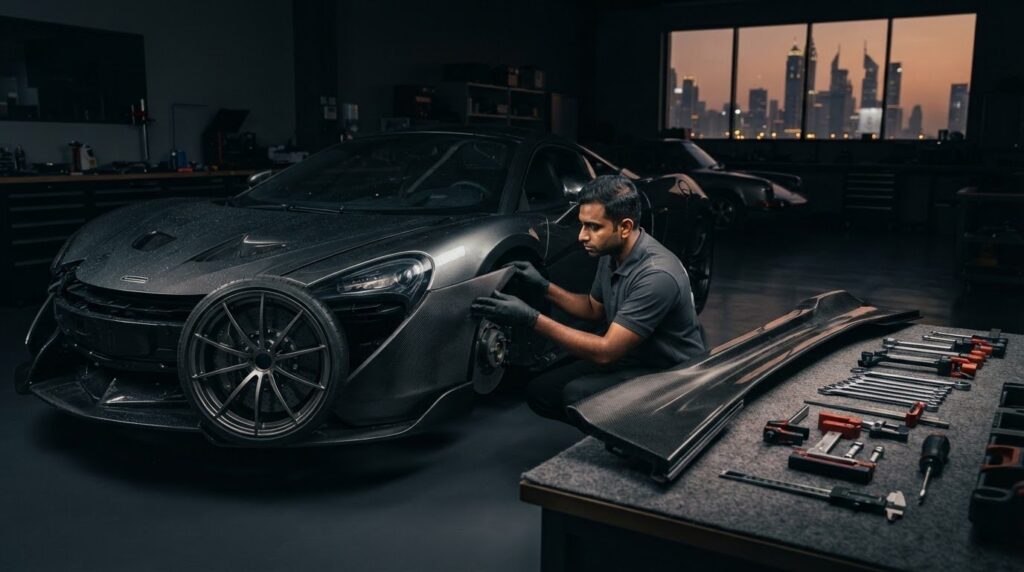
The lowest-priced body kit can demand the most work before it fits. For a bespoke body kit conversion across the UAE, including major hubs like Dubai, the total cost depends on the kit material, the amount of fitment adjustment required, and the complexity of installation; the price is provided after a quote request with Vanguard Motors Dubai. Installation can take 1-10 days, depending on the number of parts and the work involved.
It’s natural to focus on a kit’s purchase price, but material choice also affects preparation, fitment, and the finished appearance. Fiberglass may need sanding, reshaping, reinforcement, or mounting adjustments, while ABS/PP is a practical choice for UAE weather. Carbon fibre offers a premium finish, with its own fitment and finishing considerations.
This guide explains how materials affect cost, what to look for in secure installation, and how test fitting can reveal panel gaps or conflicts with factory systems such as sensors and cooling airflow. It also covers how local driving conditions, including ramps and speed humps, can influence design choices, helping you plan a conversion that balances visual impact with everyday usability.
Key Takeaways
- Compare the full conversion scope, not just the kit: preparation, mounting adjustments, and installation complexity can all affect the final quote.
- Choose materials with UAE conditions and your priorities in mind; the right balance of flexibility, finish, and durability matters.
- Use a test fit to catch uneven panel gaps and potential conflicts with sensors, lighting, cooling airflow, or wheel clearance before final installation.
- Plan the design around Dubai’s everyday roads and access points, including ramps and speed humps, to preserve practical ground clearance.
- Understand how substantial vehicle changes may affect inspection requirements, and keep the relevant modification and vehicle documents organized.
How Much Do Body Kits Cost in the UAE?
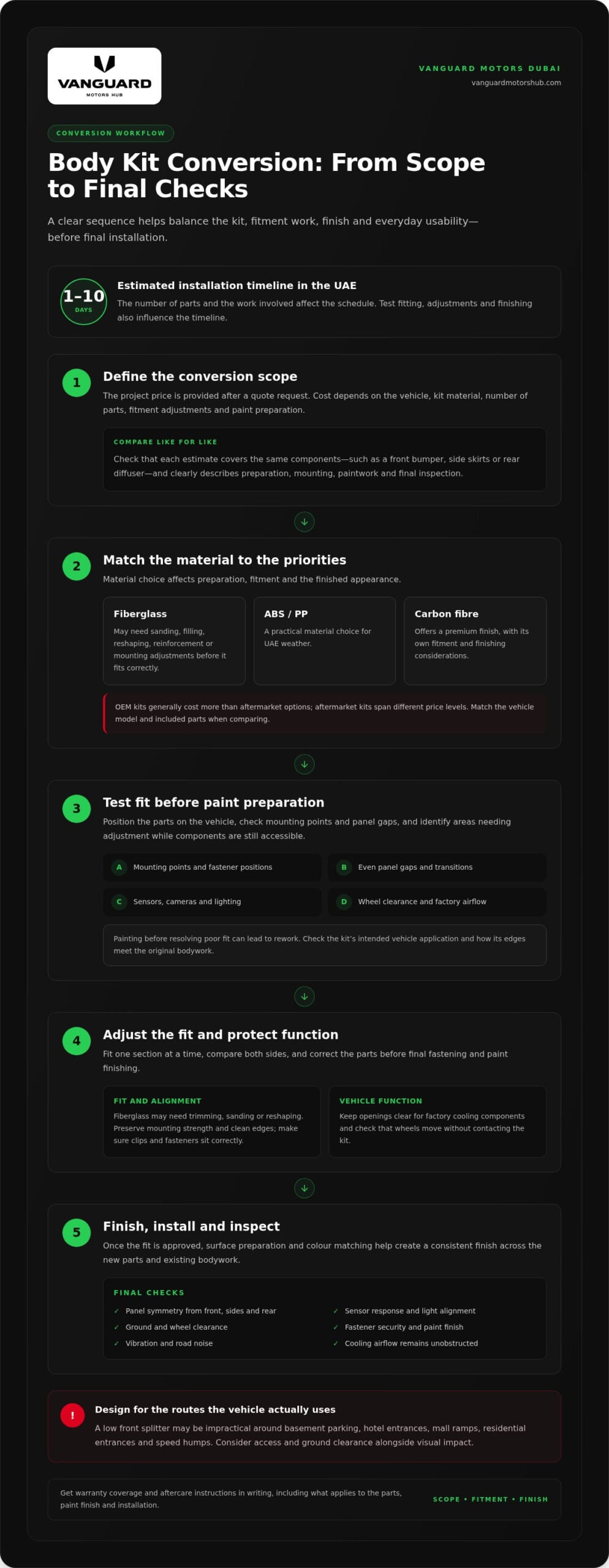
The cost of a body kit conversion depends on the vehicle, kit material, number of parts, fitment adjustments, and paint preparation. The price varies by project and is provided after a quote request. A quote is easier to assess when it separates the kit, test fitting, installation, and finishing work.
In Dubai, Abu Dhabi, and Sharjah, compare quotes by scope rather than headline price. Check whether each estimate covers the same components, such as a front bumper, side skirts, or rear diffuser. Then look for clear descriptions of preparation, mounting, paintwork, and final inspection. A low component price may not include the labour needed to correct uneven edges or mounting points.
Fiberglass parts can require sanding, filling, reshaping, reinforcement, and mounting adjustments before they fit correctly. This preparation can mean more work than a component requiring fewer corrections. OEM kits generally cost more than aftermarket options, and aftermarket kits span different price levels. For a useful comparison, match the vehicle model and included parts before weighing estimates.
Test fitting should happen before paint preparation. The installer positions the parts on the vehicle, checks mounting points and panel gaps, and identifies areas that need adjustment. Painting a part before resolving a poor fit can lead to rework. Once the fit is approved, surface preparation and colour matching help create a consistent finish across the new components and existing bodywork.
Drivers choose body kits to change a vehicle’s appearance, create a more distinctive profile, or refine its aerodynamic design. In Dubai, an aggressive front splitter may be impractical around basement parking, hotel entrances, mall ramps, residential entrances, and speed humps. Consider those routes before choosing a low front end. A striking design should still suit the vehicle’s everyday access and ground clearance.
Installation timelines in the UAE are estimated at 1-10 days, depending on the number of parts and complexity. A bumper-and-side-skirt conversion may involve fewer components than a build with several custom-fitted panels and paintwork. Test-fitting, adjustment, and finishing all influence the schedule, so the parts list and planned work provide a more useful timeline than the kit alone.
Warranty and aftercare depend on the kit and installation terms. Get coverage and care instructions in writing, including what applies to the parts, paint finish, and installation. After the conversion, follow the specified cleaning and maintenance guidance.
Fitment, panel gaps, and factory-system integration
Accurate fitment means more than aligning a bumper’s outer edge. Before the kit receives its final finish, test fit it and check mounting points, panel gaps, sensors, lights, wheel clearance, and airflow.
Luxury and Performance Vehicle Fitment
Luxury and performance vehicles often combine sculpted body panels with closely integrated factory equipment. A replacement bumper, for example, must align with adjacent fenders while retaining workable positions for parking sensors and lighting. OEM kits are generally model-specific; aftermarket fitment depends on the manufacturer’s quality and may need adjustment. Review the kit’s intended vehicle application and inspect how each edge meets the original bodywork.
Performance upgrades also need to respect the car’s existing function. A front opening should not unnecessarily restrict airflow to radiators, intercoolers, oil coolers, brake ducts, or air-conditioning condensers. For a low front splitter, consider ground clearance and wheel movement, especially if the vehicle regularly uses ramps or uneven access points.
Panel Gaps and Factory-System Integration
Consistent panel gaps help a bespoke body kit conversion Dubai look cohesive rather than assembled from mismatched parts. During a test fit, compare the spacing along both sides of a bumper and check its transitions to the bonnet, fenders, and lamps. Uneven gaps can indicate a mounting issue, a part that needs adjustment, or a mismatch between the kit and vehicle.
Factory systems need their own checks. A kit can alter sensor positions or obstruct a camera’s field of view if its openings and mounting locations don’t align. Inspect headlight alignment, sensor operation, and clearance around each wheel. After installation, assess panel symmetry, ground clearance, fasteners, paint finish, vibration, and road noise.
Trimming and Test Fitment
Test fitting comes before permanent installation and paint finishing. The installer places each component on the vehicle, checks mounting points, and marks areas needing correction. Fiberglass parts may require trimming, sanding, or reshaping; adjustments should preserve mounting strength and clean edges.
Fit one section at a time, then compare both sides before finalizing changes. Check that clips and fasteners sit correctly, adjacent panels meet evenly, and the wheels move without contacting the kit. This sequence helps identify problems while parts remain accessible, rather than after paintwork or final fastening.
Finish the inspection with a practical walkthrough. Confirm that lights remain unobstructed, sensors respond, and bumper openings leave the factory cooling components clear. Check panel symmetry from the front, sides, and rear. Then inspect fastener security and listen for vibration or road noise during a controlled drive.
For a tailored review of your vehicle’s fitment and factory-system integration, discuss your body kit requirements with an installation team before finalizing the design.
Materials including ABS, polyurethane, fiberglass, and carbon fibre
Material choice shapes a body kit’s visual character, preparation needs, and finishing process. In the UAE, weigh the intended use and component design alongside appearance and fitment. ABS/PP is recommended for UAE weather, while fiberglass is a budget material and carbon fibre is a premium option.
ABS and PP
ABS and PP are practical starting points for a conversion exposed to UAE conditions. Compare each component’s shape, mounting design, and surface finish before selecting it. A front bumper and a side skirt have different installation demands, even when made from the same material. Check that each part aligns with the vehicle and leaves factory openings unobstructed.
Before paintwork, place each ABS or PP component on the vehicle and check its edges against neighbouring panels. This reveals alignment issues before finishing begins. A clean match across the bumper, fender, and lamp area supports a cohesive result.
Polyurethane
Polyurethane is used for body kit components when flexibility is a consideration. Its suitability depends on the component’s design and the vehicle’s intended use. Compare its shape and mounting points with the original bodywork, then inspect how it sits around corners and adjoining panels. These details influence both installation and the finished appearance.
Fiberglass
Fiberglass is a budget body kit material, but low-cost parts may need substantial preparation. Sanding, filling, reshaping, reinforcement, and mounting adjustments may be necessary before installation. These steps affect the finish and how securely the component sits. Inspect the part for uneven edges and surface irregularities before paint preparation, when corrections are easier to make.
Carbon Fibre
Carbon fibre is a premium choice for drivers seeking a distinctive finish and performance-inspired detail. Inspect the weave, edges, mounting areas, and surface consistency of each component. A carbon front lip, for example, should align cleanly with the bumper and sit securely at its attachment points. Carbon components also need careful handling during fitting and finishing.
Use a simple selection process: match the material to the component, inspect its construction, then assess preparation needs. A complex bumper may need more adjustment than a small trim piece. Consider whether the design leaves space for factory sensors and cooling openings. The material should support the intended look without compromising access to those systems.
In Dubai’s heat, body kit materials and installation quality matter together. Heat can contribute to warping, adhesive failure, edge lifting, paint deterioration, and panel distortion. Careful installation includes secure mounting and finishing suited to the component. Review the completed surfaces, edges, and attachment points before accepting the conversion.
Do custom body kit modifications require RTA approval in Dubai?
In the UAE, body kits are legal if they don’t obstruct lights or exceed width limits. For a Dubai conversion, assess those two conditions against the complete fitted design, not just individual parts. A replacement bumper, wide fender, or extended side skirt can change the vehicle’s visible outline or affect lighting.
This rule provides a practical starting point, but it doesn’t establish that every modification is exempt from inspection or approval. The design and extent of the change matter. A cosmetic addition that preserves the vehicle’s lighting and width differs from work that substantially changes the body or other vehicle characteristics.
Before installation, review the full kit layout against the vehicle from the front, sides, and rear. Check whether a front splitter or bumper extension covers any light. Look at the widest points, including added fender pieces. A part that appears modest from the front may still extend the side profile. Evaluate the finished configuration rather than relying only on a product photograph.
Use this practical pre-installation sequence:
- Identify every component, such as the front bumper, side skirts, rear diffuser, and fender extensions.
- Check that the fitted parts leave all lights unobstructed.
- Review the vehicle’s overall width with the proposed components installed.
- Compare the completed design with the original vehicle outline and intended use.
These checks help reveal design concerns before paint and final fastening. For example, a broad fender conversion deserves careful attention to the vehicle’s outer edges. Assess a low front splitter alongside everyday access, such as ramps and parking entrances. These practical checks complement, but don’t replace, the UAE’s lighting and width conditions.
Don’t assume that a kit’s model compatibility or clean appearance proves its installed dimensions meet the rule. Fitment changes can affect how far parts project from the body. A test fit lets the installer inspect the actual assembly, including lights and the vehicle’s full width, before finishing begins.
For a bespoke body kit conversion, make the lighting and width review part of the design decision. If the conversion also involves substantial body changes, the relevant inspection process may differ from a straightforward cosmetic installation. The next section explains inspection and documentation considerations for modified vehicles. Keeping the design within the stated conditions is a clear first step, but it doesn’t replace inspection requirements that apply to the vehicle’s specific modifications.
What documents and inspections are needed to legalize a body kit conversion in Dubai?
In the UAE, vehicles with modified bodies may be referred to the RTA Technical Inspection Committee. Federal traffic regulations address inspection after substantial changes to a vehicle’s engine, chassis, or colour. Assess a body kit conversion by the extent of its changes, not appearance alone.
Keep a clear record of the conversion so the vehicle’s original condition and completed work are easy to explain. Useful records include the vehicle registration, a written description of the parts fitted, purchase documents, and photographs taken before and after installation. These are practical records to organize, not necessarily official submission requirements.
Ask the installer to document the components and work performed. Note whether the conversion changed bumpers, fenders, or other body panels, and whether it involved structural work. Keep any test-fit and final inspection notes with those records. A precise description helps distinguish a cosmetic kit from work that substantially alters the vehicle.
Prepare the vehicle for a technical inspection by reviewing the completed installation. Focus on whether:
- Lights remain visible and operate correctly.
- The kit is securely mounted, with no loose edges or fasteners.
- Panels sit symmetrically and don’t create unsafe projections.
- Wheels move without contacting the added bodywork.
- Factory sensors and other integrated systems function as intended.
These checks support a thorough presentation of the finished vehicle, but they don’t replace an inspection decision. If the vehicle’s body has changed substantially, referral to the RTA Technical Inspection Committee may form part of the process. The referral and inspection context depend on the scale and nature of the modification.
Separate bodywork changes from other modifications in your records. A body kit combined with an engine or chassis change involves more than a cosmetic conversion, because federal traffic regulations address inspection after substantial changes to those vehicle areas. A colour change also falls within the stated inspection context. Describe each modification clearly rather than grouping all work under a general label.
Before presenting the vehicle, organize the registration, work description, parts records, and photographs together. Confirm that the installed kit matches the documented work and that its lights, mounting, and factory systems have been checked. This preparation gives a clear account of the conversion and helps focus the inspection on the vehicle’s actual modifications.
Planning a conversion or preparing its work documentation? Discuss your car kit conversion requirements before installation begins.
Vanguard Motors Dubai: Paint Protection Film (PPF) Installation
Vanguard Motors Dubai offers Paint Protection Film (PPF) Installation for drivers seeking a protection-focused next step after a body kit conversion. Consider PPF when you want to protect selected painted surfaces while keeping the finished design visible. For a different visual direction, Colored Sticker Wraps and Peelable Paint Applications offer alternatives for changing the vehicle’s appearance.
The right choice depends on your priorities: protecting the painted finish, changing the colour, or choosing a peelable paint application. Discuss the vehicle and planned finish so the service aligns with your conversion goals. The Vanguard Premium Package is also available.
Contact Vanguard Motors Dubai or visit vanguardmotorshub.com to discuss your vehicle.
Shape the Next Stage of Your Build
Plan your bespoke body kit conversion in Dubai as part of the vehicle’s wider visual direction. Decide what you want the finished car to express, then align its paintwork and surface treatment with that intent. A considered finishing choice can help the transformation feel complete, not like a collection of separate upgrades.
For the next stage, Vanguard Motors Dubai offers Paint Protection Film (PPF) Installation, Colored Sticker Wraps, and Peelable Paint Applications. These options suit different goals, from protecting painted surfaces to changing the vehicle’s appearance. Choose the direction that complements your build and how you want to present your car.
Move forward with a clear vision for the finish. Contact Vanguard Motors Dubai to discuss your vehicle’s finish and next steps. Bring your ideas together and give your project a distinctive final touch.
Frequently Asked Questions
What’s Included in Car Body Kit Installation Process?
Installation typically includes confirming the parts and vehicle application, preparing the vehicle, fitting components, and completing the finish. Before work begins, agree on which panels are included and whether existing parts need removal. After fitting, review the completed vehicle in daylight and photograph each side. Keep those images with the work records so future repairs can refer to the installed components and their placement.
Which Dubai garages specialize in bespoke body kit conversions?
Vanguard Motors Dubai offers car kit conversions, including Brabus, Mansory, and Jetour kits. For a bespoke body kit conversion in Dubai, identify the vehicle model and the desired transformation before settling on a specific kit. A model-specific conversion may differ from a broader custom appearance change. Keep the chosen components and intended finish clearly defined so the scope reflects the result you want.
What types of custom body kits are available in Dubai?
Options include full conversion kits and individual components such as bumpers, side skirts, diffusers, and fender extensions. Drivers can also choose model-focused transformations, including Brabus, Mansory, and Jetour kits. Decide whether you want a complete change or a targeted visual upgrade, such as a revised front profile. The vehicle model and desired design help narrow the suitable kit category.
How much does a bespoke body kit conversion cost in Dubai?
The price depends on the vehicle and project scope, and is provided after a quote request. Key cost factors include kit material, number of components, preparation, fitment adjustments, paintwork, and installation complexity. For a useful estimate, define the parts you want and whether finishing work is included. Compare quotes with the same scope, rather than comparing kit-only figures with fully installed conversions.
How long does a custom body kit conversion take in Dubai?
Installation is estimated at 1-10 days, depending on the number of parts and complexity. The schedule also follows the work sequence: parts must be fitted, adjusted, prepared, and finished. A conversion involving several panels can require more coordination than a single component. Before planning vehicle use, align the expected handover with the agreed scope and whether paint finishing forms part of the project.
What materials are used for bespoke body kits, and how do they compare?
Common choices include ABS or PP, polyurethane, fiberglass, and carbon fibre. ABS/PP is recommended for UAE weather, while fiberglass is a budget material that may need extra preparation. Carbon fibre is a premium option, and polyurethane offers another material choice for kit components. Compare each part’s construction, finish, and mounting design, since material alone doesn’t determine how well a kit suits the vehicle.
How do I choose a reputable custom body shop in Dubai?
Choose based on the quality of the proposed work plan, not appearance claims alone. Look for a clearly itemized scope covering parts, installation, finishing, and final checks. Ask how fitment, factory sensors, lighting, and wheel clearance are evaluated. A clear process makes the intended changes understandable before work starts and provides records of the components fitted for future servicing or resale discussions.
What are the risks of aftermarket body kit conversions for safety, insurance, and resale value?
Poor fitment can leave parts loose, affect wheel clearance, or interfere with lights, sensors, and cooling openings. These issues can compromise safe vehicle operation. Keep the kit’s purchase and installation records, and provide your insurer with an accurate description of modifications. For resale, documentation and an orderly finish help prospective buyers understand what changed; uneven panels or missing records can raise concerns during a vehicle assessment.