
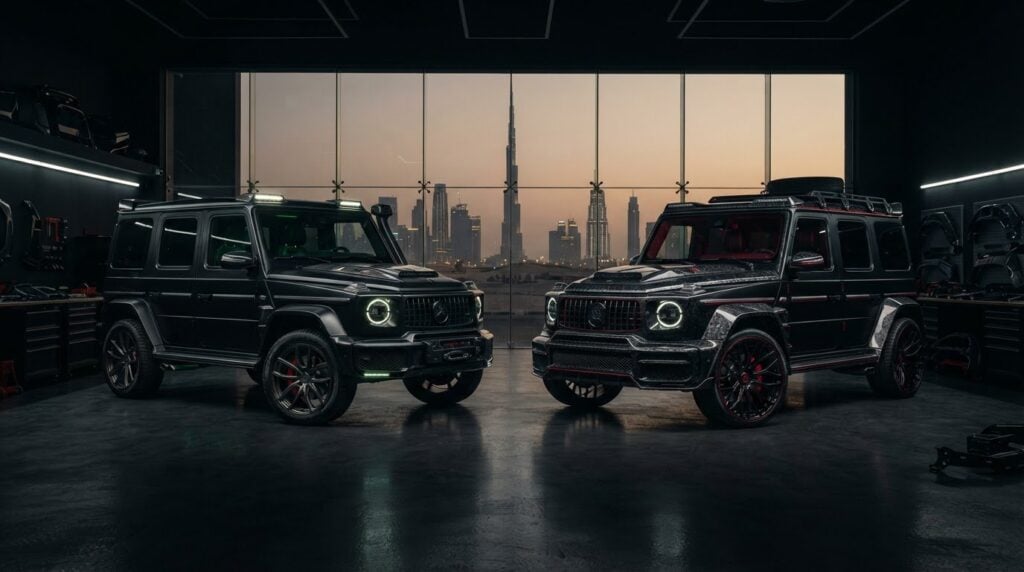
The most aggressive build for your vehicle isn’t always the loudest one on the asphalt. When weighing Brabus vs Mansory for Mercedes G-Wagon conversions, drivers inevitably confront two entirely divergent schools of automotive design: tactical, OEM-plus German engineering versus unapologetic, coachbuilt haute couture. You already know that an ordinary factory AMG G 63 no longer commands the exclusive distinction you require. Even so, committing to an extensive widebody conversion introduces genuine anxieties regarding forged carbon composite fitment, microscopic panel alignment, maintenance protocols, and vehicle resale value.
This comprehensive 2026 comparison delivers an authoritative evaluation of both tuning houses. We break down the styling philosophies, proprietary carbon weaves, bespoke interior craftsmanship, and twin-turbo powertrain outputs scaling up to 900 horsepower. Ahead, you’ll discover an actionable decision matrix that pairs your driving ambition with the proper marque, complete with professional installation and protection protocols designed to safeguard your build for years to come.
Key Takeaways
- Understand the fundamental engineering divide when evaluating Brabus vs Mansory for Mercedes G-Wagon builds, contrasting tactical German refinement with coachbuilt haute-couture extravagance.
- Compare pre-preg structural carbon weaves against complex forged composite architectures to identify which aerodynamic profile matches your aesthetic and durability requirements.
- Analyze twin-turbo powertrain calibrations scaling to 900 horsepower alongside custom exhaust modifications engineered for distinct acoustic profiles.
- Examine cockpit transformation benchmarks, pitting precision-tailored Mastik leather against dramatic, fully bespoke leather upholstery designs.
- Identify the critical installation standards, panel gap calibration procedures, and full-body Paint Protection Film (PPF) strategies necessary to safeguard your investment.
Brabus vs Mansory for Mercedes G-Wagon: Core Philosophies Compared
Evaluating Brabus vs Mansory for Mercedes G-Wagon builds isn’t merely an aesthetic choice; it’s a decision between two diametrically opposed customization philosophies. Since its military inception, the iconic Mercedes-Benz G-Class has served as an exceptional foundation for extreme coachbuilding. While both marques command elite prestige across modern luxury vehicle markets, their underlying engineering DNA speaks to entirely different drivers. Discerning owners invariably assess three decisive metrics before commissioning a build: aerodynamic integrity, structural identity, and OEM electronic compatibility.
The Brabus Heritage: Precision OEM-Plus Evolution
Brabus operates with surgical German discipline. Operating out of Bottrop, the brand functions as an engineering-driven powerhouse focused on enhancing factory architecture rather than reinventing it. Every element in their signature Widestar program undergoes stringent TÜV validation to verify aerodynamic downforce and thermodynamic cooling efficiency. The resulting profile preserves the boxy, purposeful silhouette of the G-Class, accentuating its muscular proportions through widened fenders, functional carbon inlets, and seamless diagnostic integration.
The Mansory Philosophy: Avant-Garde Automotive Haute Couture
Mansory approaches the platform as an unapologetic, high-fashion canvas. Guided by Kourosh Mansory’s ethos of radical individualism, the Gronos conversion program treats the SUV as rolling bespoke sculpture. Mansory frequently redesigns exterior body lines beyond original factory sheet metal, introducing dramatic vents, raked splitters, and custom forged carbon panels. It’s an aggressive design language engineered specifically for private collectors seeking unrivaled visual impact and instant recognition.
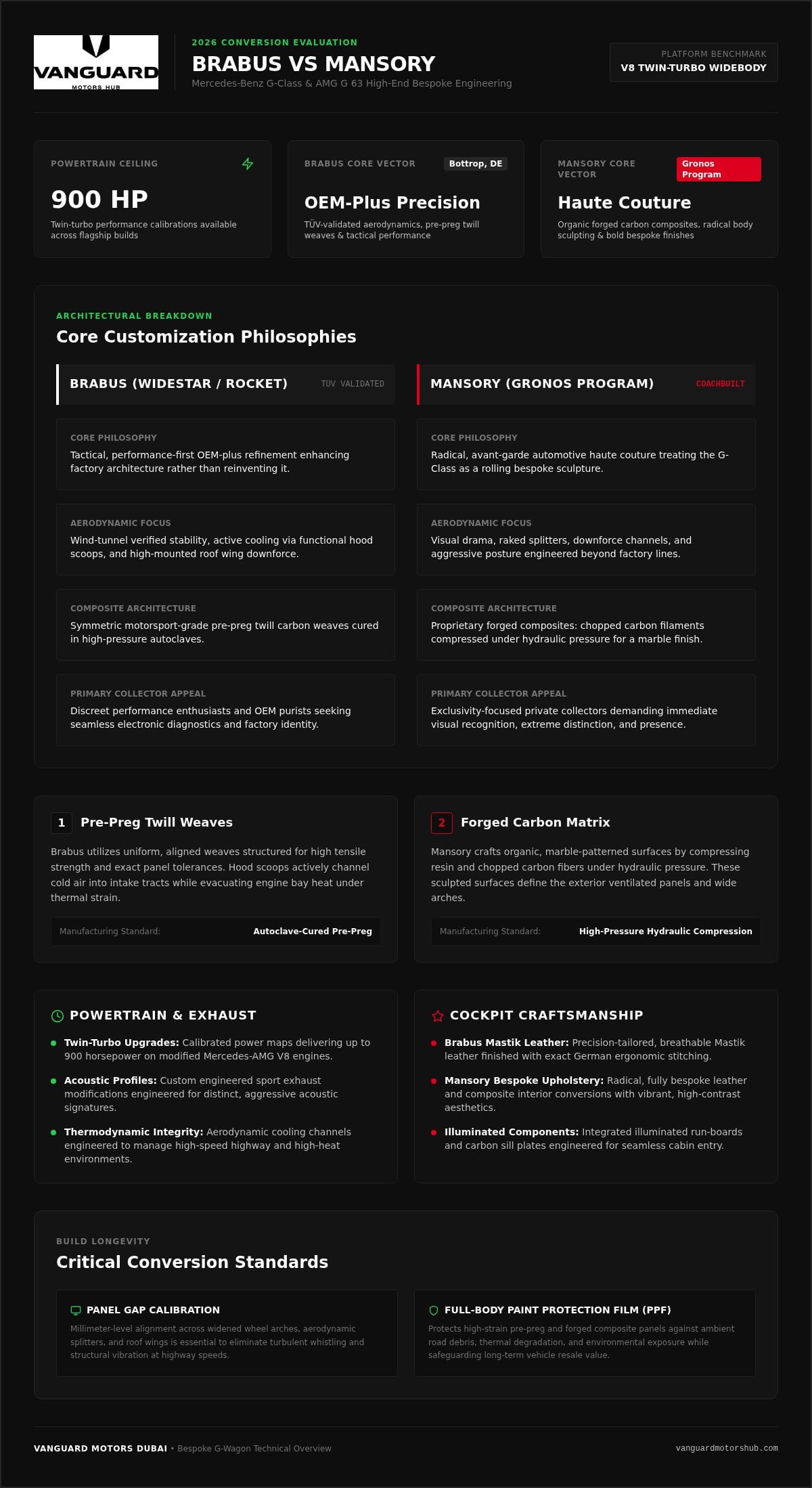
| Comparison Vector | Brabus (Widestar / Rocket) | Mansory (Gronos Program) |
|---|---|---|
| Core Philosophy | Tactical, performance-first OEM-plus refinement | Radical, avant-garde coachbuilt haute couture |
| Aerodynamic Focus | Wind-tunnel verified stability and active cooling | Visual drama, downforce channels, and aggressive posture |
| Composite Styling | Symmetric pre-preg twill carbon weaves | Experimental forged composites and proprietary weaves |
| Primary Appeal | Discreet performance enthusiasts and OEM purists | Exclusivity-focused collectors demanding immediate presence |
Aerodynamics and Carbon Fiber Craftsmanship: Weave vs Forged
Intense ambient heat and high-speed highway runs place immense thermal strain on composite panels. In the debate between Brabus vs Mansory for Mercedes G-Wagon platforms, composite engineering defines both visual presence and structural longevity. The two houses utilize radically different composite technologies, pitting traditional pre-preg twill weaves against experimental forged carbon matrixes.
Brabus Widestar Aerodynamics: Functional Downforce and Airflow
Brabus champions symmetrical pre-preg carbon fiber cured in high-pressure autoclaves. This motorsport-grade process yields uniform weave alignment, lightweight tensile strength, and exact panel tolerances. Functional carbon hood scoops draw cold air directly into the intake tract while routing engine bay heat out. At highway speeds, aerodynamic components like the high-mounted roof wing on the Brabus 900 Rocket actively stabilize the upright rear axle against turbulent crosswinds. To prevent vibration and turbulent whistling, adhering to strict Brabus body kit installation standards ensures precision millimeter alignment across the widened wheel arches and illuminated run-boards.
Mansory Gronos Exterior Artistry: Forged Composite Mastery
Mansory pioneered forged carbon fiber across the luxury customization space. By compressing chopped carbon fiber filaments mixed with specialized resin under extreme hydraulic pressure, Mansory crafts organic, marble-like composite surfaces. The Gronos exterior program applies this distinctive medium across sculpted ventilated hoods, flared front aprons, and roof-mounted auxiliary light pods. Owners can commission these striking components in gloss, satin, or bespoke tinted matrixes to match custom livery concepts.
- Tensile Integrity: Pre-preg weaves offer directional structural rigidity, whereas forged carbon provides multi-directional stress resistance in complex shapes.
- Thermal Resilience: Intense regional sunlight requires premium automotive clear coats to shield exposed carbon resin from micro-cracking and UV degradation.
- Component Longevity: Specialized in-house carbon fiber car parts repair restores cracked resin, chips, or road rash back to factory-gloss perfection.
Achieving flawless alignment across complex carbon composite panels requires technical mastery. If you’re planning your exterior transformation, speak with our conversion specialists to evaluate composite finishes, thermal protection protocols, and aerodynamic fitment.
Performance Tuning and Exhaust Engineering: Power Delivery Compared
Pushing a 2.5-ton luxury off-roader past supercar acceleration numbers requires serious mechanical precision. Power plants operating in high ambient temperatures face immediate thermal thresholds that separate cosmetic tuning from deep engine optimization. The debate between Brabus vs Mansory for Mercedes G-Wagon conversions centers heavily on how each engineering team manages boost pressure, transmission durability, and exhaust acoustics under heavy loads.
Brabus PowerXtra Modules: Dyno-Tested Reliable Performance
Brabus focuses on linear, factory-like power bands. Using their proprietary PowerXtra auxiliary control modules, engineers remap fuel injection, ignition parameters, and boost curves across the AMG 4.0-liter biturbo V8. Upgrading to the Brabus 800 or 900 specification introduces reinforced turbocharger core assemblies, bespoke compressor wheels, and machined turbine housings. These internal upgrades maintain safe exhaust gas temperatures while pumping out up to 900 horsepower and 1,250 Nm of torque (electronically capped at 1,050 Nm to protect factory drivetrains). Actively valved side-pipe exhausts feature a discreet “Coming Home” acoustic setting, allowing quiet city cruising alongside an unrestricted straight-through V8 roar in Sport mode.
Mansory Engine Conversions: Unrestricted Power and Exhaust Notes
Mansory targets visceral, high-revving theater. The Gronos powertrain packages utilize high-flow downpipes, modified turbocharger configurations, and direct engine control unit recalibrations. Power outputs range from the 720-hp P720 setup to radical conversions exceeding 850 hp and 1,000 Nm of torque. This aggressive approach yields zero-to-one-hundred km/h sprint times near 3.5 seconds. The exhaust architecture uses custom side-exit pipes with distinctive geometric tips, creating a sharp, unbaffled acoustic presence that dominates city boulevards.
- Drivetrain Resilience: Brabus caps peak torque curves to reduce mechanical fatigue across the AMG Speedshift 9G-Tronic transmission and front-axle differentials.
- Thermal Management: In regional summer temperatures exceeding 45°C, high-volume charge-air coolers and enlarged intercoolers prevent catastrophic heat soak during continuous high-speed runs.
- Acoustic Tuning: Mansory builds emphasize constant, deep-throated resonance, while Brabus retains dual-mode electronic valving to modulate backpressure and sound decibels.
Both builders turn the Mercedes-AMG G 63 into an unrelenting highway weapon. Selecting between them comes down to whether you prefer factory-grade daily usability or raw, unapologetic power delivery.
Bespoke Interior Craftsmanship: Mastik Leather vs Radical Upholstery
Stepping inside a customized G-Class reveals the sharpest contrast in the Brabus vs Mansory for Mercedes G-Wagon equation. While exterior styling projects your presence outward, the cabin represents an intimate sensory environment where tactile perfection matters. In severe desert climates, intense solar radiation through upright glass makes material selection, grain breathability, and UV stabilization essential considerations.
Brabus Masterpiece Interiors: Sophisticated Elegance and Precision Stitching
Brabus upholstery follows an architectural, executive discipline. Utilizing proprietary Mastik leather, artisans execute millimeter-precise diamond quilting alongside micro-perforated cooling panels. The hide is tanned specifically to resist shrinking and cracking under extreme cabin heat. Tactile touchpoints feature cold-touch aluminum door pins, illuminated carbon entrance sills, and CNC-machined pedal sets. Rear seating configurations often replace factory bench seating with twin individual executive chairs, separated by a customized business console featuring inductive charging ports and integrated cooling compartments.
Mansory Haute Couture Cabins: Striking Palettes and Unbound Customization
Mansory approaches the cockpit like an elite fashion house presenting runway collections. Vibrant monochromatic tones or aggressive contrasting palettes define their signature style, spanning electric turquoise, deep mandarin, and luminous neon stitching. Door panels and seating bolsters feature complex organic wave patterns stitched into ultra-soft, customized hides. Mansory frequently covers the ceiling with interactive fiber-optic starlight headliners, capable of mimicking custom constellations through dynamic LED sequences.
- Leather Longevity: High-saturation dyes used in bespoke builds demand regular hydration and ceramic UV sealants to prevent drying or premature pigment fade.
- Ergonomic Detailing: Brabus maintains factory seat contour geometry, whereas Mansory reshapes bolster thickness and steering wheel grips using contoured carbon accents.
- Acoustic Isolation: Complete cabin teardowns during full re-upholstery provide an ideal opportunity to integrate multi-layer sound deadening beneath the carpet linings.
Whether you lean toward understated German precision or bold, expressive luxury, expert cabin re-trimming preserves both interior beauty and vehicle market value. Schedule a bespoke interior consultation with our upholstery artisans to curate your custom hides, stitching patterns, and leather restoration protocols.
Selecting, Installing, and Protecting Your Bespoke G-Wagon Conversion
Choosing between Brabus vs Mansory for Mercedes G-Wagon builds ultimately hinges on your appetite for understated performance versus dramatic coachbuilt individualism. Beyond choosing a styling program, the final execution rests entirely on conversion bench precision and post-installation defense. A flawless widebody conversion requires millimeter-accurate panel gaps, rock-solid composite bonding, and robust surface armor to withstand highway sand-blast and intense solar exposure.
The Decision Matrix: Matching Identity to Engineering
- Choose Brabus: Prioritize this route if you value tactical performance, wind-tunnel-verified stability, and OEM-plus integration that maintains factory diagnostics alongside strong secondary-market liquidity.
- Choose Mansory: Select this program if you demand unmistakable visual presence, avant-garde coachbuilding, and bespoke forged composite textures that stand apart at any gathering.
- Collector Demand vs. Usability: Brabus packages retain factory-level ergonomics for seamless daily driving across urban expressways. Radical Mansory builds often serve as ultra-exclusive statement pieces in curated private collections.
Master-Level Installation, Calibration, and PPF Defense
Executing an elite conversion demands rigorous engineering standards:
- Step 1 (Laser Alignment & Diagnostics): Technicians benchmark baseline chassis clearances, calibrate driver-assist radar sensors, and map factory panel gaps before component disassembly.
- Step 2 (Composite Dry-Fitting & Surface Prep): Carbon components undergo multi-stage test-fitting, hand-finishing, and automated color matching to eliminate thermal warping risks.
- Step 3 (Structural Fastening): Technicians secure aerodynamic splitters and widebody arches using manufacturer-grade structural fasteners and elastomeric adhesives, preventing high-speed vibrations.
- Step 4 (Comprehensive Armor): Flared arches, front diffusers, and exposed carbon hoods receive custom-plotted paint protection film to shield delicate composite resin against stone chips, swirl marks, and severe UV degradation.
The caliber of installation craftsmanship matters just as much as the conversion package itself. To map out your conversion architecture with certified composite specialists, Book Your G-Wagon Consultation today.
Elevate Your G-Wagon to Supercar Distinction
Deciding between Brabus vs Mansory for Mercedes G-Wagon builds represents a choice between two pinnacles of automotive prestige. Whether you gravitate toward the tactical, wind-tunnel-proven refinement of a Brabus Widestar or the radical, coachbuilt forged composite presence of a Mansory Gronos, both programs turn the iconic AMG G 63 into an extraordinary rolling statement. The kit you select sets the aesthetic tone, but the expertise behind the installation guarantees lasting value, structural integrity, and flawless road performance.
Our dedicated technical facility brings together master-level proficiency across authentic Brabus and Mansory conversions. From micron-perfect composite alignment and specialized carbon fiber repair to tailored leather upholstery and self-healing Paint Protection Film (PPF) integration, every transformation is executed with obsessive precision. Ready to engineer your ultimate build? Discuss your bespoke G-Wagon conversion with our elite master technicians on WhatsApp to begin your transformation today.
Frequently Asked Questions
What is the main difference between Brabus and Mansory for the Mercedes G-Wagon?
The primary distinction when comparing Brabus vs Mansory for Mercedes G-Wagon projects lies in engineering restraint versus coachbuilt extravagance. Brabus emphasizes functional, OEM-plus aerodynamic refinement, wind-tunnel validation, and balanced powertrain upgrades that preserve factory body geometry. Mansory focuses on radical visual transformations, extensive forged carbon composite sculpting, and high-fashion bespoke interiors designed for dramatic street presence and hyper-exclusivity.
Can I install a Brabus or Mansory body kit on any Mercedes G-Class model?
Yes, authentic conversion packages are engineered primarily for the current W463A platform, with dedicated kits available for both standard G 500 and AMG G 63 variants. While older chassis generations also support legacy conversions, modern widebody programs require platform-specific bumper mountings, sensor brackets, and exhaust alignments. Certified customization technicians always verify your vehicle’s model year, engine code, and factory electronics before ordering and fitting aerodynamic components.
How does an authentic carbon fiber conversion affect my G-Wagon manufacturer warranty?
Installing cosmetic exterior carbon fiber components does not automatically void your vehicle’s entire manufacturer warranty. Under standard automotive consumer protection guidelines, factory warranties only face limitation on components directly altered or affected by aftermarket parts. High-performance software recalibrations and auxiliary exhaust bypasses may alter powertrain coverage, but reputable customization houses provide standalone parts warranties and preserve underlying electronic diagnostic networks without triggering factory fault codes.
Why is Paint Protection Film (PPF) essential immediately after installing a custom body kit?
Applying Paint Protection Film immediately after installation seals exposed carbon composite surfaces and fresh paintwork against airborne sand abrasion, gravel impacts, and intense UV degradation. Flared widebody fenders and extended aerodynamic splitters protrude past factory wheel arches, catching excessive road debris. High-grade optical PPF provides self-healing physical armor, shielding vulnerable clear coats and resin matrixes from chipping, yellowing, and thermal etching caused by extreme climate conditions.
Which brand retains better resale value on the secondary automotive market?
Authenticated Brabus builds typically enjoy broader liquidity and stronger residual value across secondary luxury vehicle markets. Brabus benefits from decades of German engineering recognition and broader buyer acceptance, making pre-owned models easier to trade through premier exotic vehicle networks. Mansory builds command staggering sums among private bespoke collectors, but their radical aesthetics attract a narrower pool of high-net-worth buyers who share that specific, unapologetic design taste.
How long does a comprehensive widebody kit conversion and interior transformation take?
A comprehensive widebody conversion and bespoke interior transformation generally requires between six to twelve weeks to complete. The build timeline accounts for precision dry-fitting, automated paint blending, structural bonding, and multi-stage curing. If you commission complete leather re-upholstery alongside custom exhaust tuning and full-body paint protection film application, meticulous hand-crafting, diagnostic calibration, and quality control road tests require dedicated bench time to guarantee absolute perfection.
Can damaged carbon fiber components on a Brabus or Mansory build be repaired?
Yes, specialized carbon fiber repair facilities can structurally restore and cosmetically refinish cracked, scratched, or chipped composite panels. If a composite front splitter or side skirt sustains road rash or stress fractures, certified composite technicians grind away compromised layers, infuse fresh resin, and rebuild the carbon weave or forged pattern. The component is then hand-sanded, recoated in high-solids automotive clear lacquer, and cured to match surrounding panels seamlessly.