
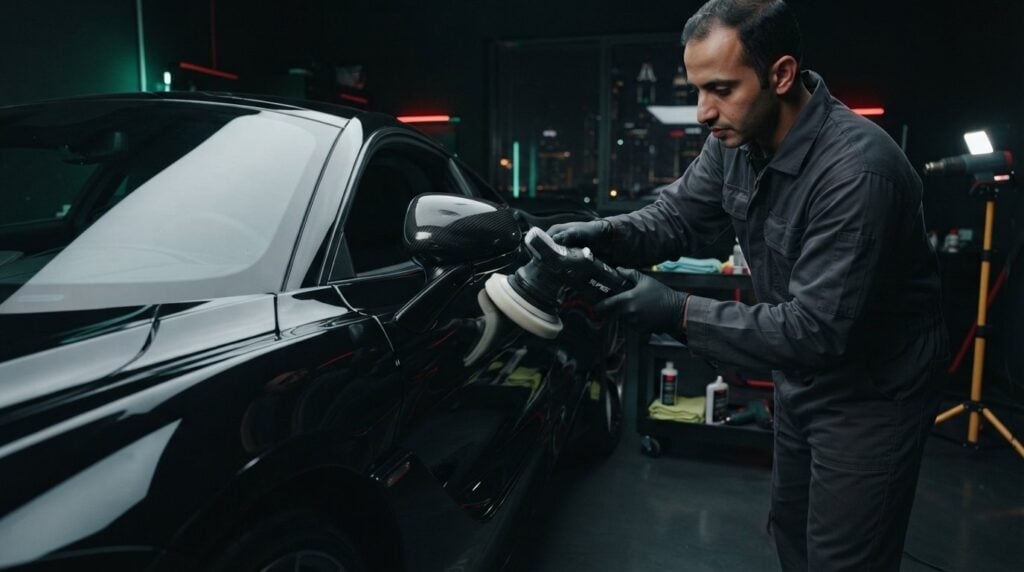
What if the mirror-finish on your custom liquid wrap wasn’t just a temporary luxury, but a surface you could actually correct and refine? Many elite car owners ask, can you polish peelable paint without destroying the very layer meant to protect the vehicle? You’ve likely spent thousands of dirhams on a bespoke finish, yet the sudden appearance of surface swirls feels like a direct threat to your investment. It’s a common anxiety that taking a high-speed machine to a removable coating will result in a shredded disaster. You want that elite, glass-like reflection, but the fear of compromising the film often keeps the polisher in the cabinet.
This 2026 guide provides the technical secrets to safely polishing professional-grade liquid wraps without damaging their integrity. You’ll discover the specific requirements for 2K polyurethane topcoats, the exact pad pressures required for the UAE heat, and the professional compounds that deliver a flawless result. We’re moving past the era of dull, rubberized dips and into a world of high-performance maintenance that ensures your vehicle remains the standard of excellence on every road. From machine settings to chemical compatibility, you’ll gain the confidence to maintain a concours-level finish.
Key Takeaways
- Distinguish between basic rubberized coatings and professional 2K liquid wraps that support high-end machine correction and wet-sanding.
- Master the technical parameters to answer can you polish peelable paint while maintaining its reversible properties and structural bond.
- Understand how to manage heat dissipation and panel temperatures to prevent resin softening during the polishing process in the UAE climate.
- Implement a specialized maintenance routine using pH-neutral solutions and a no-touch washing philosophy to extend your custom finish’s lifespan.
- Discover why professional-grade equipment and precision techniques are vital for achieving a factory-level mirror finish on complex supercar surfaces.
Understanding the Polishability of Modern Peelable Paint
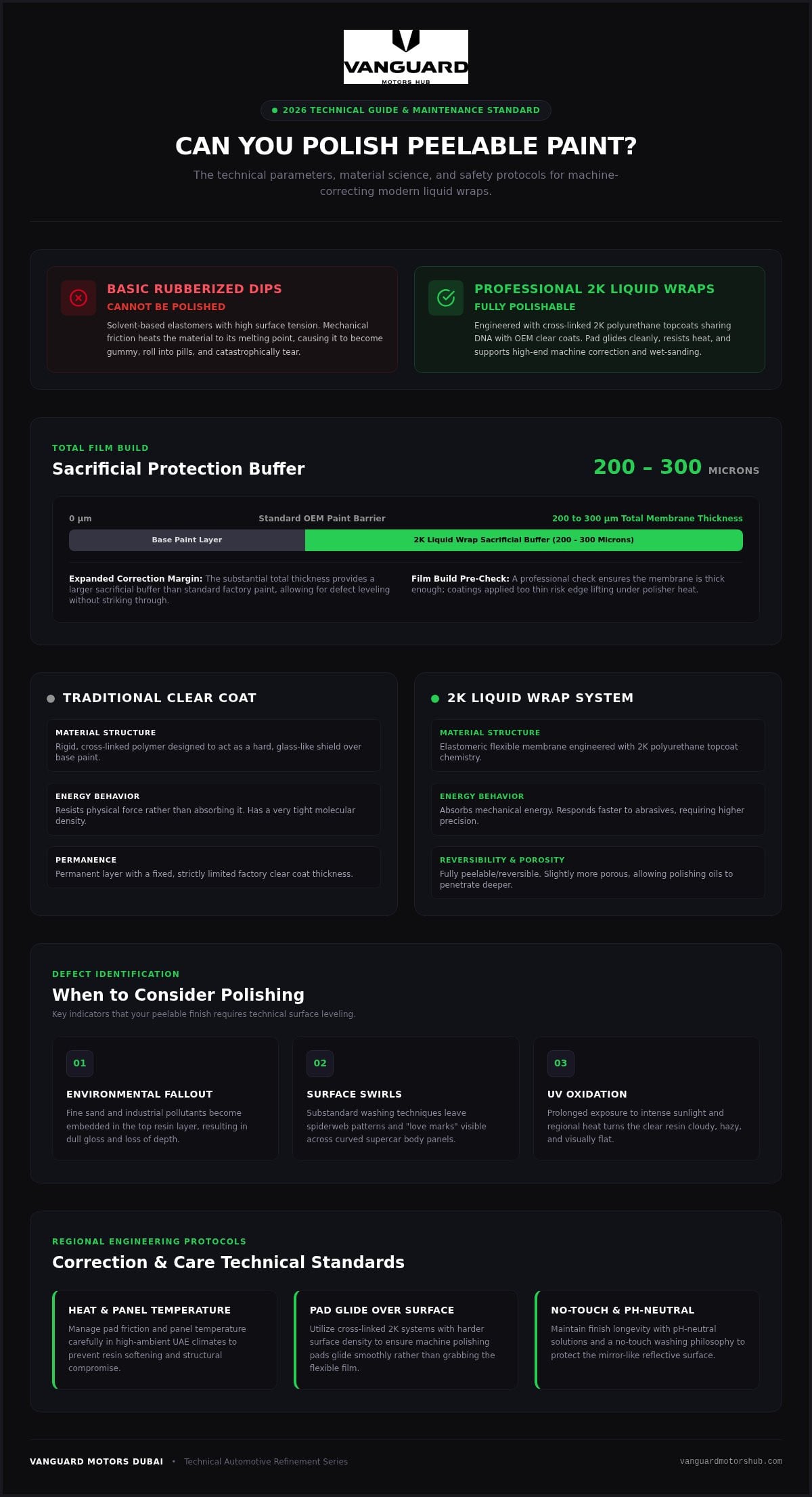
Peelable paint has evolved far beyond the temporary rubberized coatings of the past. In the current 2026 landscape, elite automotive finishes utilize high-build liquid polymer systems that replicate the depth and clarity of factory paint. The definitive answer to whether can you polish peelable paint is a resounding yes, provided you aren’t working with basic rubberized dips. Professional-grade liquid wraps, such as those applied at Vanguard Motors Dubai, are engineered with 2K polyurethane topcoats. These resins share a similar DNA with traditional automotive clear coat systems, allowing them to withstand the mechanical friction of a polishing pad.
While traditional paint is permanent, these modern resins are designed to be reversible. This creates a unique challenge for the detailer. You’re balancing aesthetic correction with structural maintenance. You aren’t just removing a scratch; you’re refining a flexible membrane. Because these systems often reach a total thickness of 200 to 300 microns, they actually offer a larger sacrificial buffer than OEM paint. This extra “meat” on the surface allows for aggressive correction that would otherwise strike through factory clear coats.
The Distinction Between Dip and Liquid Wrap
The chemistry of the coating dictates its polishability. Standard rubberized dips are typically solvent-based elastomers with high surface tension. When a polishing pad spins against these surfaces, the friction generates localized heat that quickly reaches the material’s melting point. The coating becomes gummy, rolls up into “pills,” and eventually tears. It’s a catastrophic failure for the finish.
Professional liquid wraps use sophisticated cross-linked polymers. These 2K systems feature a harder surface density that allows the polishing pad to “glide” rather than “grab.” They dissipate heat more efficiently, which is vital in the high-ambient temperatures of the UAE. If your coating doesn’t have a dedicated clear coat layer, keep the machine in the cabinet. Only 2K-infused systems possess the structural integrity to handle machine correction.
When Should You Consider Polishing?
Knowing when to pull the trigger on a correction is just as important as the technique itself. Over time, even the best liquid wraps succumb to the harsh environmental conditions of the Middle East. You should consider polishing when you notice specific defects:
- Environmental Fallout: Fine sand and industrial pollutants can become embedded in the top layer, dulling the gloss.
- Surface Swirls: Improper washing techniques often leave “love marks” or spiderweb patterns that catch the sun.
- Oxidation: Prolonged UV exposure can cause the resin to look slightly cloudy or hazy.
Before you begin, always evaluate the film build. If the coating was applied too thin, the heat from a dual-action polisher might cause the edges to lift. A professional assessment ensures there’s enough material to safely level the surface and restore that signature mirror-like finish.
Liquid Wrap vs. Traditional Clear Coat: The Technical Differences
Traditional factory clear coats are rigid, cross-linked polymers designed to provide a hard, glass-like shield over your vehicle’s color. Professional liquid wraps operate on a different scientific principle. These are elastomeric membranes. They possess a level of flexibility that allows them to stretch and, eventually, peel. This fundamental shift in material science changes the physics of surface correction. When asking can you polish peelable paint, you must understand that the pad interacts with a surface that absorbs energy rather than just resisting it. Because the material is softer than OEM clear, it responds faster to abrasives, meaning the window for a perfect finish is narrower and requires higher precision.
Porosity also plays a significant role. Traditional clear coats, especially modern ceramic-infused versions, have a very tight molecular structure. Liquid wraps are slightly more porous. This characteristic means they can hold onto contaminants more aggressively, but it also allows certain polishing oils to penetrate deeper. The goal of polishing a liquid wrap is to level the surface micro-texture without compromising the 200 to 300-micron thickness that provides your impact protection. You’re refining the top layer while preserving the structural bond to the factory paint underneath.
Heat Management and Friction
Friction is the primary tool of any detailer, but it’s also the greatest threat to a peelable finish. Professional liquid wraps have a lower glass transition temperature than factory paint. In the intense UAE climate, panel temperatures can already be elevated before you even trigger the polisher. If the friction from the pad generates excessive localized heat, the resin can reach a softening point. This leads to “surface bunching,” where the film ripples or moves under the pressure of the machine. To prevent this, professionals use a “move-and-monitor” technique. We work in smaller sections and allow the panel to rest between passes, ensuring the thermal load never destabilizes the coating’s adhesive bond.
Abrasive Interaction
The choice of compound can make or break a liquid wrap correction. When evaluating machine versus hand polishing techniques, the use of diminishing micro-abrasives is non-negotiable. These particles break down into smaller, finer shapes as you work the product, ensuring the “cut” becomes a “polish” automatically. Heavy-cut wool pads are generally prohibited in this sector. Their aggressive fibers generate too much heat and can leave deep scouring marks in the flexible polymer. Instead, we rely on medium-to-soft foam pads that distribute pressure evenly across the panel. If you aren’t sure if your current finish can handle a machine pass, speak with our technical experts to determine the safest path for your vehicle’s aesthetic restoration.
Step-by-Step Guide: How to Safely Polish Peelable Finishes
Executing a correction on a liquid wrap is a high-stakes operation where precision meets performance. While we have established that can you polish peelable paint, the process requires a departure from traditional detailing norms. You aren’t just buffing a rigid surface; you’re managing a flexible, high-build polymer membrane that responds differently to mechanical stress. Success depends on a controlled environment and the right technical sequence to ensure the finish remains reversible and resilient.
The Preparation Phase
Preparation is the foundation of any elite finish. For peelable paint, you must avoid traditional clay bars. These tools can snag on the flexible surface or leave deep marring in the polymer pores. Instead, utilize a chemical decontamination process to remove iron particles and industrial fallout. Once the surface is chemically clean, use a dedicated prep spray to strip any remaining oils. Taping off every panel edge, trim piece, and gap is non-negotiable. Because the mechanical bond of a liquid wrap is weakest at the edges, a spinning pad can easily catch and lift the film if it isn’t properly shielded with automotive masking tape.
Machine Settings and Technique
The choice of machinery defines your safety margin. We recommend a Dual-Action (DA) random orbital polisher for almost all peelable applications. Set your machine to a moderate speed, typically between 3,000 and 4,000 Orbits Per Minute (OPM). This range provides enough energy to level defects without generating the catastrophic heat associated with high-speed rotary buffers. Use a classic cross-hatch pattern, moving the machine at a steady rate of one inch per second. Leveraging NIST research on automotive clearcoat resilience shows that while rigid clears resist marring through hardness, liquid wraps rely on elasticity. Consequently, you must monitor surface temperatures constantly with an infrared thermometer, ensuring the panel never exceeds 50 degrees Celsius.
Refining the Gloss
The final stage is where the true aesthetic transformation happens. After the initial leveling pass, switch to an ultra-fine finishing polish and a soft black foam pad. This stage removes any remaining haze and “jewels” the surface to a mirror-like state. Achieving the depth and clarity found in our Supercar Detailing Guide requires a light touch and minimal downward pressure. Once the polishing is complete, wipe the panel down with a fresh microfiber and seal the surface with a ceramic-based spray. This seals the corrected polymer and provides a hydrophobic barrier against the harsh UAE elements, locking in that showroom shine for years to come.
Long-Term Maintenance: Keeping Your Peelable Paint Flawless
Preserving the integrity of a liquid wrap in the UAE requires a shift from standard detailing to a preservation-first mindset. While the previous sections established that can you polish peelable paint to restore its depth, the most efficient strategy is preventing defects before they manifest. A “No-Touch” washing philosophy is the gold standard for maintaining these flexible surfaces. By reducing physical contact, you eliminate the primary cause of swirl marks and micro-marring, ensuring the polymer stays level and clear for its entire lifespan.
Chemical stability is equally vital. Professional peelable resins are sensitive to high-alkaline cleaners which can dry out the flexibilizers within the coating. Always select pH-neutral soaps specifically formulated for high-end finishes. These solutions lift desert dust and grime without stripping the essential oils that keep the wrap pliable. In a region where ambient temperatures frequently exceed 40 degrees Celsius, maintaining this chemical balance prevents the finish from becoming brittle or hazy over time.
Washing and Drying Best Practices
The equipment you use defines the longevity of your finish. We recommend using a high-pressure foam cannon to saturate the vehicle in a thick layer of lubricating suds. This allows encapsulated dirt to slide off the panel before a wash mitt ever touches the surface. If you must use a mitt, employ the two-bucket method with grit guards to ensure no sand particles are dragged across the film.
- Air Drying: Use a high-velocity leaf blower or dedicated car dryer to remove standing water from gaps and body lines.
- Microfiber Selection: If towel drying is necessary, only use high-GSM (grams per square meter) microfiber towels to minimize friction.
- Avoid Automation: Never take a liquid-wrapped vehicle through an automated brush wash; the mechanical agitation is too aggressive for the flexible topcoat.
Protective Sealants
Applying a sacrificial layer is the final step in a professional maintenance routine. Spray-on ceramic sealants or graphene coatings work exceptionally well on polished peelable surfaces. These products fill the microscopic pores of the polymer, creating a slick, hydrophobic barrier that prevents bird droppings and industrial fallout from etching into the wrap. This extra layer of protection is a core component discussed in The 2026 Car Wrap Buying Guide, where we analyze how modern aesthetics meet long-term durability.
Environmental factors in the Middle East, particularly intense UV radiation, can accelerate the degradation of any automotive finish. Regular application of a UV-stable sealant acts as a sunscreen for your car, blocking the rays that cause pigment fading and resin breakdown. If your vehicle has lost its signature glow despite regular washing, book a professional maintenance session to have our experts evaluate and refresh your protective layers.
Professional Refinement: Why Expert Intervention Matters
Restoring a showroom shine to aged peelable paint isn’t a weekend project; it’s a technical restoration. While the core question of can you polish peelable paint has been answered, the difference between a functional correction and a masterpiece lies in the hands of an expert. The margin for error on a 2K liquid wrap is slim. If you exceed the thermal threshold of the resin or apply uneven pressure on a body line, you risk permanent delamination. At Vanguard Motors Dubai, we treat every correction as a surgical procedure. Our team integrates these polishing techniques with our bespoke conversion services, ensuring that a Brabus or Mansory kit transition feels seamless against the vehicle’s original lines.
DIY polishing often results in “strike-through” where the buffer burns through the clear layer and into the color base. This is especially risky in the UAE, where high ambient temperatures leave little room for thermal mismanagement. Professionals use digital depth gauges to measure the film thickness across every panel before the machine even touches the surface. This data-driven approach ensures we only level what is necessary to achieve clarity, preserving the maximum amount of protection for the years ahead.
The Vanguard Precision Advantage
Our facility utilizes multi-spectrum LED array lighting to identify microscopic defects that are invisible to the naked eye. We don’t believe in a universal approach. Instead, we develop custom-tailored correction plans based on the specific chemistry of the peelable brand applied to your vehicle. This level of detail is a cornerstone of our Cosmetic Car Repair Services, where we bridge the gap between temporary protection and permanent aesthetic excellence. We analyze the crosslink density of your finish to select the exact pad and compound combination that will yield a mirror finish without compromising the peelable bond.
Concierge Care Solutions
We understand that your time is as valuable as your vehicle. For those who require elite maintenance without the logistics of a workshop visit, our mobile detailing van brings factory-level precision directly to your location. This service is part of the Vanguard Premium Package, a holistic protection strategy designed for the most demanding owners in the UAE. Whether you’re dealing with sand-blasted panels or wash-induced haze, we have the expertise to answer can you polish peelable paint with a flawless, mirror-like reality. Don’t leave your custom finish to chance. Schedule your professional consultation via WhatsApp today to restore your vehicle’s elite status and ensure its aesthetic value remains protected.
Master the Future of Liquid Wrap Preservation
The evolution of automotive aesthetics has redefined the boundaries between protection and perfection. As we have explored, the question of can you polish peelable paint is no longer a matter of possibility, but a matter of technical precision. By choosing modern 2K systems and adhering to the rigorous maintenance protocols detailed throughout this guide, you ensure your vehicle transcends the limitations of traditional, duller wraps. The result is a finish that is both fully reversible and capable of maintaining a deep, liquid-like gloss through professional correction.
Vanguard Motors Dubai stands at the forefront of this innovation as an authorized installer of premium liquid wrap systems. We specialize in the unique requirements of luxury and supercar aesthetics, providing national coverage for detailing that meets the highest global standards. Whether you are preserving a custom kit or a factory finish, our expertise ensures your vehicle remains a masterpiece on the road. Consult our experts for professional peelable paint restoration and experience the intersection of high-performance protection and elite-level refinement.
Frequently Asked Questions
Is it possible to machine-polish all types of peelable paint?
No, you cannot machine-polish every variety. Only professional-grade 2K liquid wraps are engineered to withstand the friction and heat of a polisher. Traditional rubberized coatings or aerosol-based dips have a much lower melting point; they will gum up or tear under a machine pad. If you are unsure which system is on your vehicle, have a technician verify the resin type before attempting any mechanical correction.
Will polishing make the peelable paint harder to remove later?
Polishing won’t affect the reversibility of the film as long as you don’t generate excessive heat that bonds the resin to the factory clear coat. The goal is to level the top microns of the 2K topcoat while leaving the primary structure and adhesive layer intact. When it’s time for a color change, the polished film should peel in full sheets exactly like an unpolished layer.
Can I use a ceramic coating on top of polished peelable paint?
Applying a ceramic coating over polished liquid wrap is highly recommended for long-term protection. Since the polishing process opens the micro-pores of the polymer, a ceramic layer seals the surface and provides a hydrophobic barrier. This combination is a core part of the Vanguard Premium Package. It significantly increases scratch resistance and prevents environmental staining from the intense UV radiation and desert dust found across the UAE.
How often should I polish my liquid wrap to maintain its gloss?
The frequency of correction depends on your driving habits and storage conditions. Most owners only need to address the question of can you polish peelable paint once every 12 to 24 months. You should only polish when visible defects like wash-induced swirls or oxidation begin to dull the finish. Following a no-touch washing routine between sessions will significantly extend the time between professional machine corrections.
What happens if I burn through the peelable layer while polishing?
If you burn through the peelable layer, the affected panel will likely require a professional respray. Unlike factory paint where a strike-through exposes primer, burning through a liquid wrap can damage the integrity of the protective membrane. Because these systems are applied in layers, a technician can often strip and re-apply the coating to a single panel. This ensures a perfect color match without requiring a full-vehicle overhaul.
Do I need special compounds for peelable paint correction?
When asking can you polish peelable paint, the choice of compound is critical. You must use diminishing micro-abrasives rather than aggressive, old-school cutting compounds. These modern formulas break down into finer particles as you work; this prevents deep scouring in the flexible resin. Avoid products containing heavy solvents or petroleum distillates. We recommend water-based finishing polishes paired with medium-to-soft foam pads for the safest results on supercar finishes.
Can polishing remove deep scratches in a liquid wrap?
Polishing is designed to remove surface-level defects like swirls, light oxidation, and minor marring. It cannot fix deep scratches that have penetrated through the clear topcoat and into the base color layers. If a scratch is deep enough to catch a fingernail, attempting to polish it out may result in thinning the film too much. In these cases, a cosmetic repair or a partial panel re-application is the only way to restore the aesthetic value.
Is hand polishing safer than using a machine on peelable paint?
Hand polishing is safer in terms of heat management, but it’s often ineffective at truly leveling the tough 2K topcoats used in modern wraps. A Dual-Action machine is actually preferred by professionals because it provides a more consistent finish and controlled energy distribution. While hand polishing reduces the risk of burn-through, it’s difficult to achieve the mirror-like clarity required for luxury vehicles without the precision of a professional random orbital polisher.