
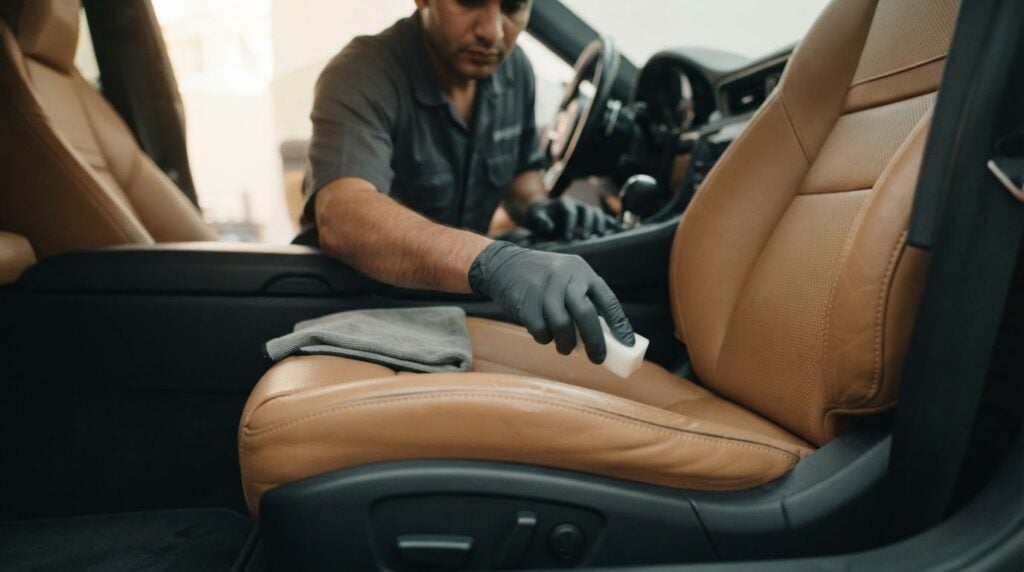
Softer seats are not necessarily repaired seats. Professional car leather softening and rejuvenation conditions leather to improve its feel when it has become dry or stiff, but conditioner alone will not mend cracks or tears. The right treatment also depends on the leather’s finish.
It’s easy to assume that any leather-care product suits every seat. In practice, identifying the finish and assessing the surface helps determine whether conditioning is appropriate or whether damaged areas need restoration.
This guide explains what conditioning does, which leather finishes it may suit, and how to care for treated seats. You’ll also learn when a crack needs repair rather than another application of conditioner, with practical tips from Vanguard Motors Dubai for maintaining a vehicle interior through regular use and UAE conditions.
Key Takeaways
- Conditioning can help dry, stiff leather feel more supple, but it won’t repair cracks or tears.
- Leather finish matters: suitable conditioning approaches can differ across aniline, pigmented and semi-aniline leather.
- Keep cleaning and conditioning as separate steps, and clean seats every few months to help maintain their condition.
- Learn how to deal with surface residue after treatment and which signs suggest existing damage needs repair.
- Discover when professional leather restoration is the more appropriate next step for a worn or damaged interior.
Cleaning and maintaining leather after treatment
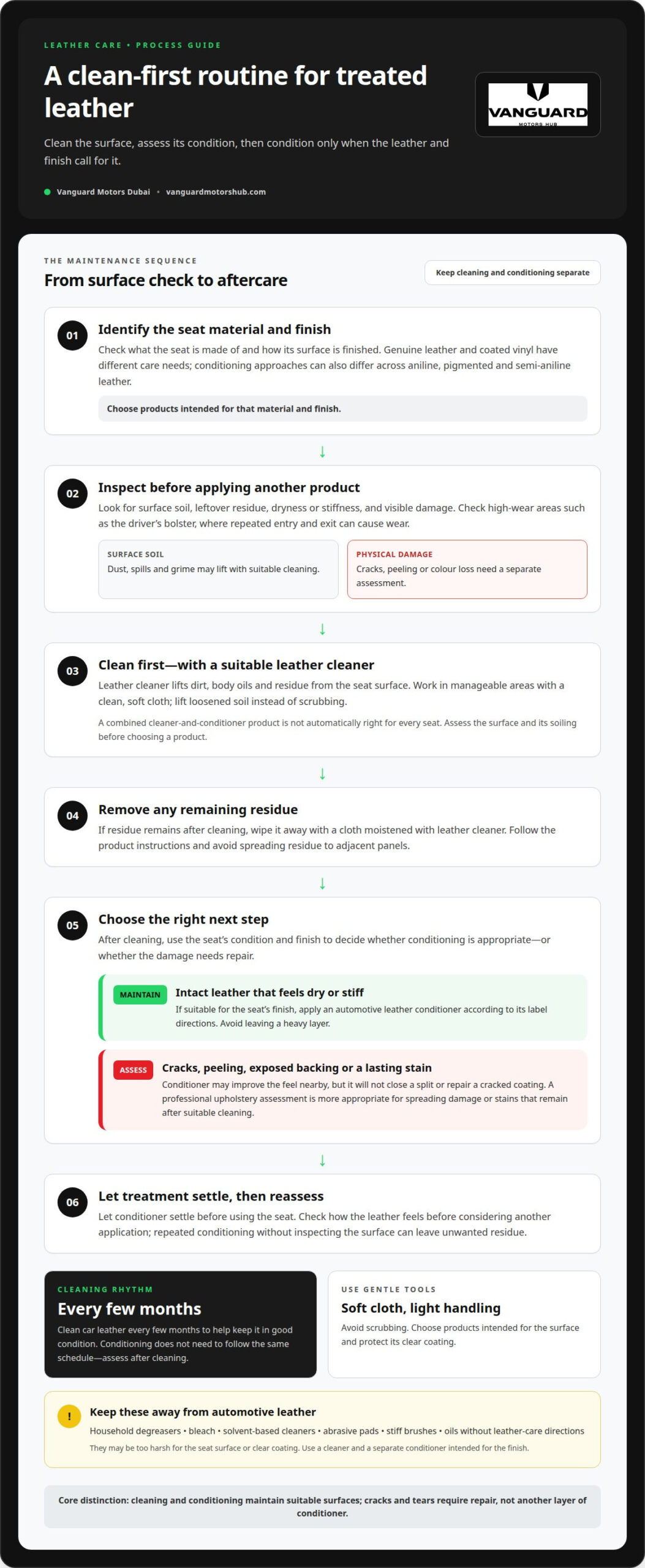
After treatment, follow a simple routine: remove surface soil first, then condition only if needed. Keeping these steps separate makes it easier to assess the seat before applying another product.
Separating Cleaning and Conditioning
Leather cleaner lifts dirt, body oils, and residue from the seat surface. Conditioner is a separate step intended to support a softer feel. Don’t assume a combined cleaner-and-conditioner product is right for every seat. Assess the surface and its soiling, then clean with a suitable automotive leather cleaner. If residue remains, wipe it away with a cloth moistened with leather cleaner, following the product instructions.
Conditioner Selection for UAE Climate
For car interiors in the UAE, choose an automotive leather conditioner that suits the seat’s finish and follow its label directions. No single conditioner suits every leather surface. Match the product to the material, apply it as directed, and avoid leaving a heavy layer. If a seat feels stiff after cleaning, assess its surface before deciding whether conditioning is appropriate.
Products to Avoid on Automotive Leather
Avoid household degreasers, bleach, solvent-based cleaners, and abrasive pads on automotive leather. These products and tools may be too harsh for the seat’s surface or clear coating. Don’t use a stiff brush to force out marks or apply oil without leather-care directions. Choose a cleaner and a separate conditioner intended for the seat’s finish, and apply them with a soft cloth.
Cleaning and Conditioning Frequency
Clean car leather every few months to help keep it in good condition. Dust, spills, and regular use can leave visible soil, but conditioning doesn’t need to follow the same schedule as cleaning. Assess the leather after cleaning; its finish, feel, and the product instructions help determine whether conditioning is appropriate. Reapplying conditioner without inspecting the surface can leave unwanted residue.
For dry or stiff leather, clean the surface first and remove any remaining residue with a cloth moistened with leather cleaner. Then apply a compatible conditioner according to its directions. Let the treatment settle before using the seat, and assess its feel before considering another application.
Use a clean, soft cloth to apply cleaner and lift loosened soil instead of scrubbing the seat. Work in manageable areas, and protect the clear coating by choosing products intended for that surface. This controlled approach helps prevent residue from spreading to adjacent panels.
Preventing cracks versus repairing existing cracks
Preventing cracks starts with identifying the seat material and keeping its surface clean. DIY care can help maintain intact upholstery, but splits, peeling, and deep stains need a different assessment.
Preventing Cracks in Seat Materials
First identify whether a seat is genuine leather or coated vinyl; the materials have different surfaces and care needs. Check the driver’s bolster, where repeated entry and exit can cause visible wear. Keep grit from rubbing against the seat, clean spills promptly, and use products suited to the material. Conditioner may help suitable leather feel softer, but it won’t restore a cracked coating or vinyl surface.
Repairing Cracks and Stains
Surface grime sits on the upholstery and may lift with suitable cleaning. A deep stain remains visible in the material or finish after surface soil is removed. Cracks, peeling, and colour loss also need assessment beyond routine cleaning. Note where the damage is and what it looks like, such as a split along a seat bolster, before choosing a repair approach.
Prevention and repair address different stages of wear. For intact leather, regular cleaning and compatible conditioning help maintain the surface; avoid friction from dust, sharp objects, or rough clothing. For an existing crack, conditioner may improve the feel nearby, but it cannot close the split. Applying more product over damaged material can mask the problem without repairing it.
DIY care suits light surface grime and routine upkeep when the seat is intact. A professional upholstery assessment is more appropriate for a spreading crack, peeling coating, exposed backing, or a stain that remains after suitable cleaning. Repair decisions depend on the material, the depth and location of the damage, and whether the surrounding finish is stable.
For example, a faint mark on a seat cushion differs from a dark stain embedded near a seam. Likewise, a smooth crease differs from a crack with separated edges. Cleaning may address surface soil; physical damage needs repair, not repeated cleaning or conditioning.
Before treating a worn seat, identify the material, distinguish grime from lasting discoloration, and inspect cracks under clear light. Those steps help separate maintenance from repair and reduce the chance of applying an unsuitable product. For a closer assessment of visible upholstery damage, share details of the damaged seat.
The examples also illustrate why the condition of a seat matters when considering care. The author reported that traditional dressing left the 27-year-old seats in his MR2 feeling stiff and dry. Those observations describe particular seats and experiences, rather than establishing that one treatment suits every damaged surface. A product’s intended use and the material’s condition both matter when deciding whether maintenance is appropriate or an existing problem needs assessment.
A commenter said their car seats looked pretty good despite being 18 years old. The leather seats used in the cleaner test were in a 2004 Land Rover Discovery. Leather Softening Crème is intended for worn, dried-out leather, including vehicle seats. These examples distinguish long-lasting appearance, a reported response to traditional dressing, and a product’s stated purpose. They do not change the central distinction: upkeep is for a surface that remains intact, while cracks and peeling call for an assessment of the damage.
Leather types and finishes the conditioner is suitable for
Whether a conditioner is suitable depends on the seat’s leather type and surface finish, not simply its colour or age. The conditioner discussed here is described as suitable for aniline, pigmented, semi-aniline, and other listed leather types. That does not mean every conditioner suits every car seat, so identify the material and follow the product directions.
Aniline leather has a more natural-looking surface, while pigmented leather has a coloured surface coating. Semi-aniline leather combines features of both. These differences matter because the conditioner first meets the seat’s surface; the finish affects how the product is absorbed and how the surface looks afterwards.
Before treating a seat, test an inconspicuous area for colour transfer, uneven absorption, or a change in sheen. Dark and light seats can both be aniline or pigmented, so colour alone won’t identify the finish. If the surface has a clear coating, assess and protect that coating rather than assuming conditioner should go directly onto the leather beneath it.
How finish changes product choice
Use the product label as your first guide. Check that it names the leather type or finish, then follow its application directions. A conditioner described as suitable for aniline, pigmented, and semi-aniline leather covers those categories, but the label still matters for any specific formula. Don’t assume that “leather” on the packaging means the product is compatible with every seat.
Texture and wear offer useful clues, but they cannot identify leather conclusively. A smooth, uniform appearance may indicate a coating, while a more natural-looking surface may suggest aniline leather. Seat design, wear, and previous treatments can make visual assessment less certain. When available, use the vehicle’s material information alongside a surface inspection.
Conditioning does not replace cleaning or repairing the finish. Soil can sit on a coated surface, while a damaged coating may peel or crack. Conditioner cannot rebuild a missing layer. Separate routine maintenance from restoration: identify the material, assess the surface, and choose a product with the stated compatibility.
Consider a semi-aniline seat with a worn driver’s bolster. Confirm that the product is suitable, inspect the area for damage, and apply it as directed. If the surface is cracked or peeling, or reacts unusually during the inconspicuous-area test, stop treating it as routine conditioning. The material and its finish determine the appropriate next step.
Preventing leather from drying and cracking
In the UAE, limit direct sunlight on leather, remove dust and spills, and follow care-product directions. Park in shade when practical, use a windshield sunshade, and avoid leaving conditioner residue on the seats.
Sunlight through the windows can expose seats to prolonged heat and fading. A sunshade limits direct exposure on the dashboard and front seats, while shaded parking reduces sunlight in the cabin. These steps support routine care, but they won’t repair existing cracks. Inspect high-contact areas, such as the driver’s seat bolster, for early wear.
Keep the seat’s clear coating in mind. Protecting that coating is preferable to applying products directly to the leather beneath it. Choose care products suited to the surface and follow their directions; avoid abrasive tools that could mark the finish. If a surface looks cracked, peeled, or uneven, don’t treat it as ordinary dryness.
Dust and grit can collect in seams and seat creases, then rub against the surface during use. Use a soft cloth and a suitable leather cleaner to remove loose soil without aggressive scrubbing. Clean car leather every few months to help keep it in good condition. Wipe up spills promptly, since dried residue can be harder to remove.
Conditioning does not replace shade or cleaning. After removing soil, assess the surface and follow the conditioner’s instructions for compatible leather. Apply only as directed, and remove residue according to the product guidance. A seat that still feels stiff after cleaning may need conditioning, while visible cracking calls for a repair assessment.
- Before parking: Choose shade where practical, or place a windshield sunshade to reduce direct exposure.
- After a spill: Blot the affected area with a clean cloth, then clean using a suitable product.
- During routine care: Inspect seams, bolsters, and creases for grime, dryness, or surface damage.
- After cleaning: Assess the finish before conditioning, and follow product directions to protect the coating.
Humidity can vary inside a vehicle in the UAE, especially when wet clothing or damp items enter the cabin. Dry those items outside the car when possible, and ventilate the interior when conditions allow. Don’t leave moisture trapped on seats or in seams. After a beach visit, for example, remove damp towels instead of leaving them on the upholstery.
Consistent care is more useful than repeatedly applying products. Cleaning every few months provides a practical routine; inspect sooner after spills or visible dust buildup. If a crack has opened or the coating has started to peel, cleaning and conditioning won’t restore the damaged surface. Treat maintenance and repair as separate decisions.
Product scent and residue
A leather product’s scent and finish offer separate clues. A noticeable fragrance doesn’t show whether a treatment suits the seat, and a slick surface doesn’t prove the leather has absorbed it. Follow the product instructions, then assess the surface after application. In the UAE, cabin heat can make odours more noticeable, so ventilate the interior before judging the result.
Residue may appear as streaks, a greasy feel, or an uneven sheen across the seat. Follow the product directions; if residue remains on the surface, wipe it with a cloth moistened with leather cleaner. Work gently over the affected area instead of rubbing hard. This removes leftover product without treating every scent as a cleaning problem.
Keep the seat’s clear coating in mind. Protecting that coating is preferable to applying products directly to the leather beneath it. Choose products compatible with the surface, and avoid layering conditioner over a sticky or glossy film. For example, if one panel feels slick while the next feels dry, address the residue before considering another application.
Cleaning and conditioning are separate steps, not a single routine. Clean first, remove remaining soil or product, then decide whether the seat needs conditioning. Adding conditioner to cover a strong scent can increase residue instead of resolving the cause. Fragrance can linger in an enclosed cabin, so ventilate the car rather than masking it with another scent.
After treatment, leave the leather unused for at least a few hours. This gives the applied product time to settle before passengers press against the seat or transfer it to their clothing. Follow the product’s drying directions if they call for longer. In warm UAE conditions, don’t assume that a heated cabin means the treatment is ready sooner.
- Check the surface: Look for streaks, tackiness, or uneven sheen after application.
- Remove residue: Use a cloth soaked in leather cleaner, following the product directions.
- Air the cabin: Ventilate the vehicle instead of adding fragrance over a treatment scent.
- Allow settling time: Keep the seat unused for at least a few hours.
If scent persists alongside residue, stop adding products and assess the surface before further treatment. For support with a leather surface that remains tacky or uneven, request leather restoration support.
When comparing cleaner performance, keep the test method in mind: cleaners were allowed to sit for 10 seconds unless a product’s instructions specified otherwise, and each cleaner was scrubbed for a full minute unless a product’s instructions specified otherwise. Those steps describe the test, not a reason to leave a cleaner on leather longer than its own directions allow. A measured approach helps keep cleaning distinct from conditioning, especially when you are trying to identify whether a scent or surface film remains after treatment.
The product is offered in a 500ml size, while the page estimates that 250mL of product is sufficient for a two-seater sports car and 500mL of product is sufficient for a four- or five-seater sedan. It also estimates that 1 Litre of product can be used for multiple applications or larger cars. Consider the vehicle size and intended applications when choosing an amount; using more product than needed may leave additional residue to remove. These estimates concern coverage, not how much cleaner or conditioner a particular seat requires.
Vanguard Motors Dubai: Leather Restoration
Vanguard Motors Dubai’s Leather Restoration service is a natural next step when dry leather has developed cracks, peeling, or persistent surface damage. It addresses worn automotive interiors that conditioning alone cannot repair, such as a split or damaged finish. The right approach depends on the leather’s condition and the extent of the visible wear.
If the seats feel stiff but remain intact, routine care may be enough. For cracks, tears, or finish damage, contact Vanguard Motors Dubai about Leather Restoration for your interior.
Give your interior a considered next step
Choose care based on the seat’s actual condition, not just its age or appearance. If routine maintenance cannot address the damage, Vanguard Motors Dubai offers Leather Restoration for worn automotive interiors. An assessment can help distinguish surface wear from damage that needs restoration, so the next step suits the material and finish.
Thoughtful car leather softening and rejuvenation is one part of preserving a refined cabin. To enhance and protect your vehicle further, Vanguard Motors Dubai also offers Paint Protection Film (PPF) Installation, Colored Sticker Wraps, and Peelable Paint Applications. Each service addresses a different aspect of vehicle appearance and protection.
Share what you’re noticing in the cabin and take the next step toward a well-maintained interior. Contact Vanguard Motors Dubai about leather care. A precise approach can help keep your vehicle’s interior looking composed and cared for.
Frequently Asked Questions
What is leather conditioning?
Leather conditioning is a care step that can help dry or stiff automotive leather feel more supple. It doesn’t clean away soil or rebuild cracked and peeling surfaces. For example, a seat that feels rigid but has an intact finish may benefit from suitable conditioning, while a split seam needs repair. The material and finish determine which product is appropriate, so follow its directions rather than treating every seat alike.
Can leather conditioner restore cracked or peeling car seats?
No. Conditioner may improve the feel of intact but dry leather, but it cannot reconnect split edges or replace peeling surface material. A crack that catches a fingernail or exposes a different layer, for instance, needs repair rather than more conditioner. Avoid rubbing product into damaged areas, which can leave residue without fixing the defect. Leather Restoration is the relevant service for worn or damaged automotive upholstery.