
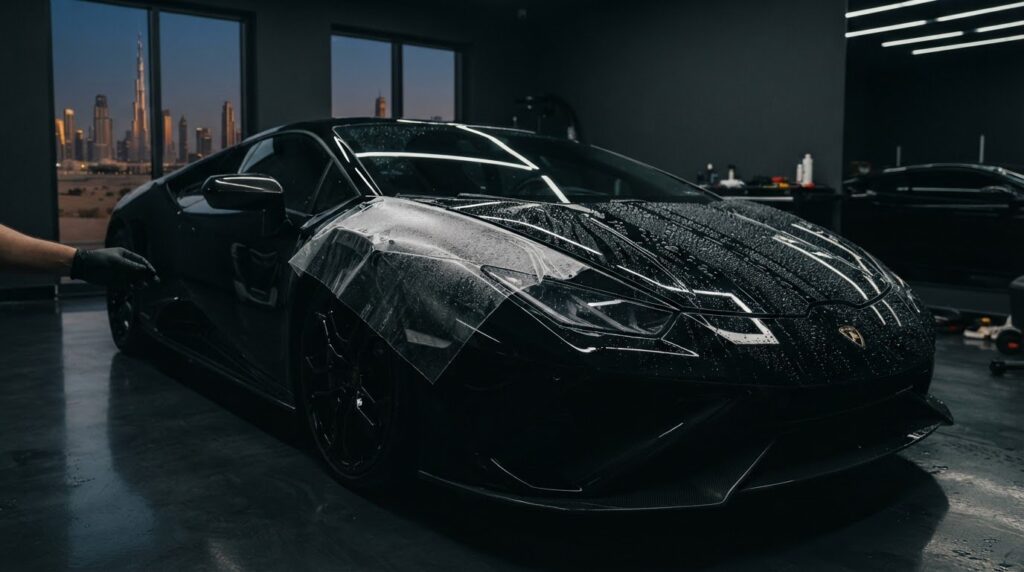
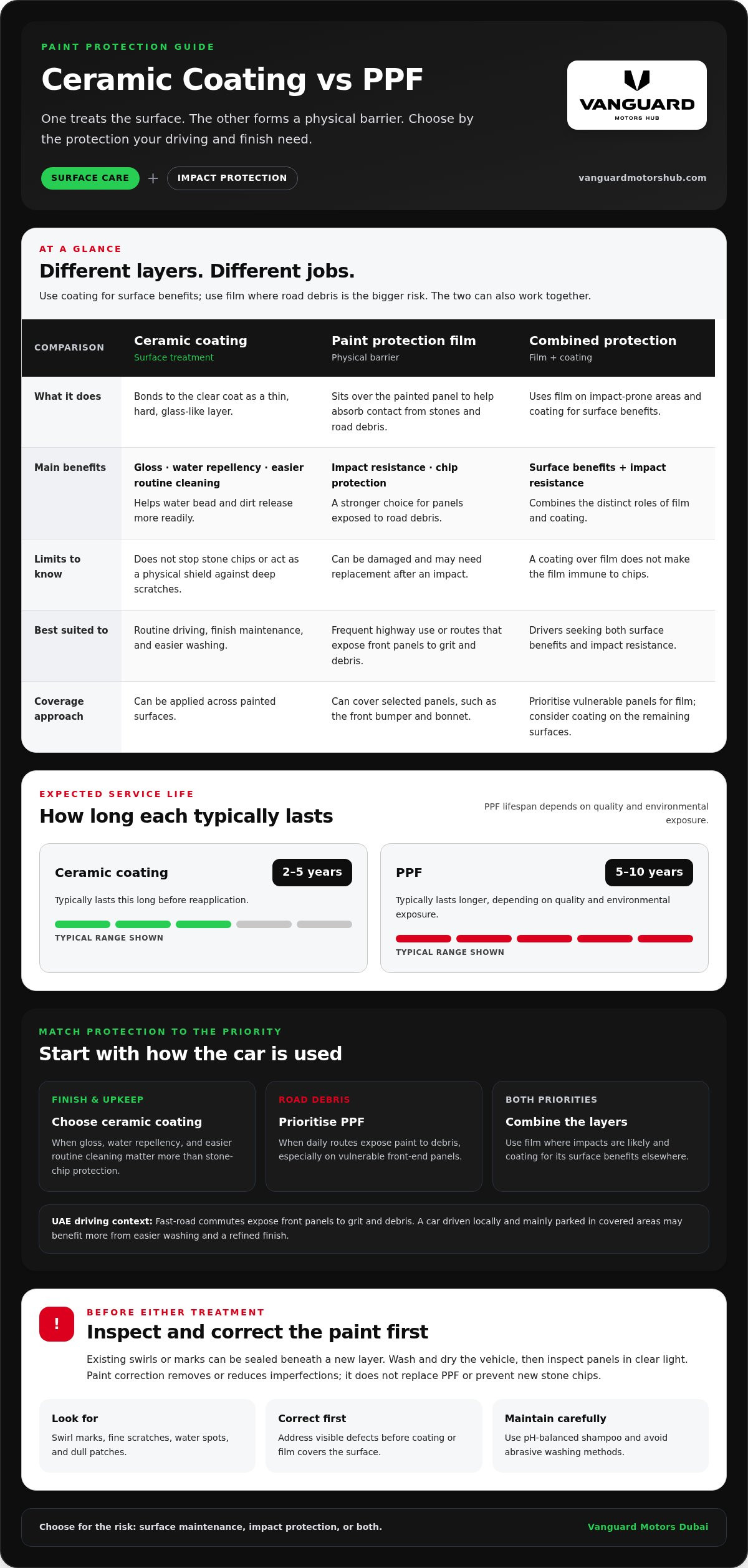
The best answer to ceramic coating vs PPF isn’t always one or the other: ceramic coating adds a thin, slick layer that helps repel water and preserve shine, while paint protection film (PPF) creates a thicker physical barrier against road debris and light surface damage. Ceramic coating typically lasts 2 to 5 years before reapplication; PPF typically lasts 5 to 10 years, depending on quality and environmental exposure. For broader protection, the two can work together.
It’s easy to see why the options seem interchangeable: both help preserve your car’s finish, but they protect in different ways. Ceramic coating is a surface treatment, usually based on silicon dioxide (SiO2), that forms a hard, glass-like matrix when cured. At 1 to 2 microns thick, it enhances gloss and makes routine cleaning easier, but it isn’t a substitute for a film barrier against stone chips.
This guide explains what ceramic coating and PPF do, when paint correction matters, and how the two can work together. You’ll also find a practical way to choose protection based on your car, driving conditions, and finish goals in the UAE.
Key Takeaways
- Match protection to your driving: frequent highway use and exposed front-end panels make impact resistance a priority, while preserving gloss and simplifying upkeep may point toward a surface treatment.
- Assess the paint before applying protection. Correcting visible swirls and marks first helps avoid sealing those imperfections beneath a new layer.
- Choose PPF coverage strategically, focusing on panels most exposed to road debris when full-vehicle coverage isn’t your priority.
- Consider combining film with a coating to bring different forms of protection together, while keeping each layer’s role clear.
- Compare maintenance needs and expected service life alongside the initial protection goal to find the right fit for your car.
What Is Ceramic Coating?
Ceramic coating is a liquid-applied treatment that bonds to a vehicle’s clear coat. Most formulations use silicon dioxide (SiO2), which forms a hard, glass-like matrix as it cures. At 1 to 2 microns thick, it creates a surface layer, not a physical shield against stones or deep scratches. Its strengths are gloss, water repellency, and easier routine cleaning.
In the UAE, choose protection around how the car is driven and parked. A daily commute on fast roads exposes front panels to grit and debris, making impact resistance a priority. A car mainly parked in covered areas and driven locally may benefit more from easier washing and a refined finish. Ceramic coating can help resist UV exposure and chemical contamination, but it won’t prevent chips. PPF is the stronger choice for vulnerable areas.
Plan coverage around risk, not just the upfront choice. Ceramic coating can be applied across painted surfaces, while PPF can cover selected panels, such as the front bumper and bonnet. If you don’t plan to protect the whole vehicle with film, prioritise the areas most exposed to road debris. When impact protection is the main goal, cover those panels first and consider a surface treatment for the rest.
| Option | Best suited to | Primary protection | Budget approach |
|---|---|---|---|
| Ceramic coating | Routine driving and finish maintenance | Water repellency, gloss, and easier cleaning | Broad surface treatment without film coverage |
| Partial PPF | Daily routes with exposed front panels | Physical barrier against road debris | Focus coverage on high-impact panels |
| Combined protection | Drivers seeking surface benefits and impact resistance | Film where impacts are likely, coating on other areas | Prioritise the most vulnerable panels first |
Choose ceramic coating alone when gloss and easier cleaning matter more than stone-chip protection. Choose PPF when your routes regularly expose paint to debris or you want to protect specific panels. The ceramic coating vs PPF decision comes down to whether your priority is surface maintenance or a physical barrier against impacts.
For everyday care, wash with pH-balanced shampoo and avoid abrasive methods that can leave swirl marks. Ceramic coatings help water bead and dirt release more readily, but they don’t make paint self-cleaning. PPF also needs careful washing. A coating can be applied over film as an additional surface treatment, but it won’t make the film immune to chips.
Each option has limitations. Ceramic coating won’t stop stone chips, and poor preparation can leave swirl marks visible beneath the cured layer. PPF can be damaged and may need replacement after an impact. Warranty coverage depends on the written terms and exclusions.
Premium ceramic coating tiers are listed with chemical resistance across 2-14 pH. That range describes resistance, not permission to use harsh cleaners; choose pH-balanced products for routine washing. If you want a polished finish and simpler upkeep, coating may fit. If your daily route puts front panels in the path of debris, consider PPF first.
Do I need paint correction before PPF or ceramic?
Paint correction is advisable before either treatment because existing swirls or marks can be sealed beneath the new layer. On a new car, inspect the bonnet, doors, and bumpers in clear light before applying protection. Even a factory-fresh finish can show transport or washing marks. Correcting defects first helps create a cleaner, more consistent result.
Start with a careful wash and dry, then inspect the paint panel by panel. Look for swirl marks, fine scratches, water spots, and dull patches. Distinguish surface contamination from defects in the clear coat. Paint correction removes or reduces imperfections before a coating or protection film covers the surface. It doesn’t replace PPF or prevent new stone chips.
Ceramic coatings use a liquid formula that bonds to the prepared paint. Once cured, the layer supports gloss, UV defense, and hydrophobic behaviour. A hydrophobic surface causes water to bead and run off more readily; the listed contact angle is 100°+. That behaviour helps with washing, but it doesn’t create a physical barrier against road debris. Sun exposure in the UAE makes UV defense valuable, yet chips still require impact protection.
Paint protection film works differently. It sits between the painted panel and external impacts, helping absorb contact from loose stones and road debris. For a new car that regularly travels on highways, PPF is the stronger choice for chip protection. Ceramic coating can complement it by adding water repellency and gloss, but coating alone won’t stop a stone from striking the paint.
- Choose correction first when visible swirls or marks affect the finish you want.
- Choose PPF when stone chips and debris are the main concern, especially on exposed front panels.
- Choose ceramic coating when your priority is hydrophobic behaviour, UV defense, and easier routine cleaning.
For the ceramic coating vs PPF decision, separate surface care from impact resistance. Inspect each panel, note finish defects, and identify where road exposure is greatest. Correct the paint before adding protection, then use film on impact-prone areas and coating for its surface benefits. This sequence helps avoid sealing visible defects beneath a fresh layer.
For a new car with exposed panels, a professional PPF installation assessment can help translate those priorities into a coverage plan.
PPF material, thickness and self-healing properties
Paint protection film is a transparent urethane film applied over painted panels. Typical PPF measures 150 to 200 microns thick, creating a physical layer between the finish and road debris. That thickness distinguishes film from a thin liquid coating, but thickness alone doesn’t describe performance. Material, top-coat construction, installation, and the panels covered all affect how the film behaves on a vehicle.
Many premium films use thermoplastic polyurethane, or TPU, which is valued for flexibility and its ability to follow curved panels. Some TPU films have a self-healing top coat; others don’t. Fine marks from washing or light contact can appear on this outermost surface. When comparing film specifications, check whether self-healing is included rather than relying on the word “urethane” alone.
Self-healing refers to minor surface scratches, not damage through the film or into the paint. On many premium films, heat from sunlight or warm water can help fine marks disappear. For example, a light mark from washing may soften as the top coat warms. A cut, puncture, or deep scratch won’t simply heal, so inspect the film after an impact instead of assuming every mark will vanish.
Coverage matters as much as material. The front bumper often faces loose stones, while the bonnet and mirror housings can also take debris. You can choose full-body coverage or focus on these exposed panels. Partial coverage protects selected areas, not nearby paint left uncovered. Review the coverage map to see exactly where the film edges will sit.
- Standard film: A urethane barrier protects covered paint from everyday contact, but don’t assume it has a self-healing top coat.
- Self-healing film: A top coat can help minor surface scratches fade with heat from sunlight or warm water.
- Coverage: Match the wrapped panels to exposure, especially the front bumper and other forward-facing surfaces.
Film selection also involves balancing thickness, appearance, and expected service life. Premium TPU paint protection film is described as lasting 7-10 years, while actual longevity depends on quality and environmental exposure. In the UAE, frequent sun exposure makes film maintenance and care especially relevant; avoid treating self-healing as immunity from wear. Follow the film’s care instructions and use pH-balanced shampoo to preserve its surface.
Compare film material, stated thickness, top-coat features, and coverage together. A thicker urethane film without a self-healing top coat differs from a film designed to recover from minor scratches. For a daily-driven car, prioritise the front bumper and other impact-prone panels. For broader paint protection, plan how film will cover the vehicle’s exterior.
Combining PPF with ceramic or graphene coating
Paint protection film and a surface coating can work together because they address different forms of wear. PPF creates a physical barrier, typically 150 to 200 microns thick, while ceramic coating adds a much thinner surface layer, commonly 1 to 2 microns. The film absorbs some impact from road debris; the coating adds water-repellent behaviour and shine. Neither layer makes paint immune to damage.
The order matters. First, wash and inspect the paint, then correct visible swirls or marks before protection is applied. Install PPF on selected panels, such as the front bumper or bonnet. Once the film is installed and ready for another layer, apply a compatible coating over the film and other painted areas. This keeps impact protection focused where debris is most likely to strike.
Coverage planning determines how the combination works across the car. With partial PPF, protect high-impact areas, then coat the film and remaining painted panels. Full-body film provides broader physical coverage, with coating added separately as a surface treatment. The right plan depends on driving exposure, the finish you want, and which panels need a barrier rather than easier cleaning.
- PPF: absorbs contact from road debris and protects the panels it covers.
- Ceramic coating: adds hydrophobic behaviour, gloss, and easier routine cleaning.
- Graphene coating: can be considered as another coating layer, with benefits and care requirements guided by its specific product instructions.
Graphene coating is a type of coating, not a film, and doesn’t replace PPF’s physical barrier against stone impacts. Formulations and application instructions vary, so treat graphene and ceramic as distinct coating options rather than assuming they perform identically. Either may be applied over film when the specific product instructions permit it.
After application, careful washing helps maintain both layers. Use pH-balanced shampoo and avoid abrasive tools that can mark the coating or film’s top surface. If a stone damages PPF, that area may need film repair or replacement; a coating won’t restore a cut. Coating also won’t prevent chips on paint left uncovered by partial film.
For a balanced setup, map the panels, correct the paint, install film, then add the chosen coating according to its application requirements. Each layer has a distinct role: PPF provides impact resistance, while ceramic or graphene coating affects surface behaviour. Choose according to your driving conditions, not on the assumption that layers eliminate every risk.
How long does ceramic coating last compared with PPF?
Ceramic coating typically lasts 2 to 5 years before it needs reapplying. Entry-level ceramic options are reapplied annually. The range reflects differences in coating type, preparation, care, and environmental exposure. In the UAE, strong sun and frequent dust can make consistent washing especially important. Treat the stated lifespan as a planning guide, then watch how water behaviour and surface gloss change over time.
Paint protection film typically lasts 5 to 10 years, depending on quality and environmental exposure. Premium TPU paint protection film is described as lasting 7-10 years. Unlike coating, PPF is a physical layer, so its service life also depends on the film’s condition across each covered panel. A damaged or lifting section may need attention before the rest of the film reaches the end of its useful life.
| Protection | Typical lifespan | What to monitor |
|---|---|---|
| Ceramic coating | 2 to 5 years | Water repellency, gloss, and ease of cleaning |
| Entry-level ceramic | Reapplied annually | Whether the surface still performs as expected |
| PPF | 5 to 10 years | Film condition, edges, and visible damage |
| Premium TPU PPF | 7-10 years | Wear and exposure across covered panels |
These options provide different kinds of protection. A coating’s water-repellent behaviour may become less noticeable as the surface wears, while the paint remains exposed to impacts. PPF can continue acting as a barrier even if its appearance changes, but a tear or puncture affects protection in that spot. Inspect the bonnet, bumper, and mirrors individually instead of judging the whole vehicle by one panel.
Care helps maintain both options. Wash with pH-balanced shampoo and avoid abrasive cleaning that can mark the surface. Remove accumulated dust carefully. A car often driven on exposed roads may need closer inspection than one mostly kept in a garage. Sun and environmental exposure also affect PPF, so check covered areas during routine cleaning.
For a coating, consider reapplication when water behaviour and gloss no longer meet your expectations. For film, look for visible damage or edges that no longer sit smoothly. These checks can help distinguish normal wear from a local issue. If you want both easier surface maintenance and impact protection, combining coating and PPF can provide separate benefits, though each layer has its own lifespan.
Use the lifespan ranges to plan maintenance, not as a promise that every vehicle will reach the same endpoint. Compare how long each option may serve your needs against the protection it provides. For a tailored PPF coverage discussion, discuss PPF installation for your car.
Vanguard Motors Dubai: Paint Protection Film (PPF) Installation
Vanguard Motors Dubai installs Paint Protection Film (PPF) for drivers seeking a physical barrier on vulnerable painted panels. It’s a practical option if your routes expose the front end to road debris or you want to protect selected areas rather than coat every surface. Plan coverage around the panels most exposed to impact.
If your priority is changing your car’s appearance rather than adding clear-film protection, Colored Sticker Wraps and Peelable Paint Applications offer different options. Choose according to whether you want impact resistance, a new look, or both through separate services.
Contact Vanguard Motors Dubai to discuss PPF installation and a coverage plan suited to your priorities.
Choose Your Car’s Next Finish
Start with a clear priority: preserve the finish, personalise the appearance, or balance both. The right ceramic coating vs PPF choice supports how you want to use and present your car, rather than adding protection without a defined purpose.
Vanguard Motors Dubai offers Paint Protection Film (PPF) Installation to protect paint, alongside Colored Sticker Wraps and Peelable Paint Applications for visual changes. Decide which outcome matters most, then shape the plan around your vehicle and priorities.
A focused conversation can help turn that goal into a considered next step. Contact Vanguard Motors Dubai to discuss your car’s paint protection and move forward with confidence.
Frequently Asked Questions
Can you ceramic coat over PPF?
Yes, ceramic coating can be applied over PPF as a separate surface layer. The film remains the impact barrier, while the coating adds properties such as water repellency and gloss. For example, a vehicle with film on the bonnet can have coating applied over both the film and uncovered paint. Follow the application instructions for both products, including any preparation or curing requirements.
Does PPF damage the paint when it’s removed?
Properly installed and removed PPF can come off to reveal the original paint underneath. Before removal, assess the film’s condition and the paint beneath it, especially if the vehicle has older repairs or existing damage. Careful removal matters, as pulling film carelessly can cause problems. Keep installation and removal records so future work can account for the film’s age and coverage.
What Does PPF Actually Stop?
PPF provides a physical barrier against common surface impacts, including loose stones and road debris striking covered panels. It can also help shield the finish from minor contact and surface scratches. For instance, film on a front bumper protects that area, not adjacent paint or uncovered mirrors. It isn’t protection against every collision, deep cut, or damage that reaches beyond the film.
What Is Paint Protection Film (PPF)?
Paint Protection Film is a transparent urethane film applied over a vehicle’s painted surfaces. Typical film thickness is 150 to 200 microns, and coverage can target selected panels or extend across more of the car. Some premium films have a self-healing top coat that helps minor surface scratches fade with heat. Film protects only the areas it covers, so a coverage plan defines its practical reach.
What Is the Combo Strategy and Why Does It Work?
A combination strategy places PPF on impact-prone areas and applies coating over the film and other painted surfaces. This pairs a physical barrier with surface benefits instead of asking one product to do both jobs. For example, a driver might protect the front end with film, then coat the remaining paint to make routine washing easier. Each layer still needs care suited to its surface.
What PPF Cannot Replace?
PPF can’t replace paint correction when existing swirls or marks affect the finish, because film may preserve what lies beneath it. It also doesn’t provide every surface benefit associated with coating, such as enhanced water repellency, and it doesn’t remove the need for careful washing. If a panel is already chipped or damaged, film won’t repair the defect. Address the paint condition before planning coverage.
Which Should You Choose for Your Car?
Choose PPF if your priority is protecting specific painted panels from stone impacts and road debris. Choose ceramic coating if you mainly want water repellency, gloss, and easier cleaning. A car used regularly on highways may benefit from film on exposed areas, while a vehicle focused on finish maintenance may suit coating. If both goals matter, consider combining them and plan coverage panel by panel.
What is the difference between ceramic coating and paint protection film (PPF)?
The key difference in ceramic coating vs PPF is how each protects the finish. Ceramic coating is a liquid-applied layer that bonds to paint and supports gloss, water repellency, and UV defence. PPF is a physical film that helps shield covered panels from road debris and impacts. One changes surface behaviour; the other adds a barrier between paint and contact.