
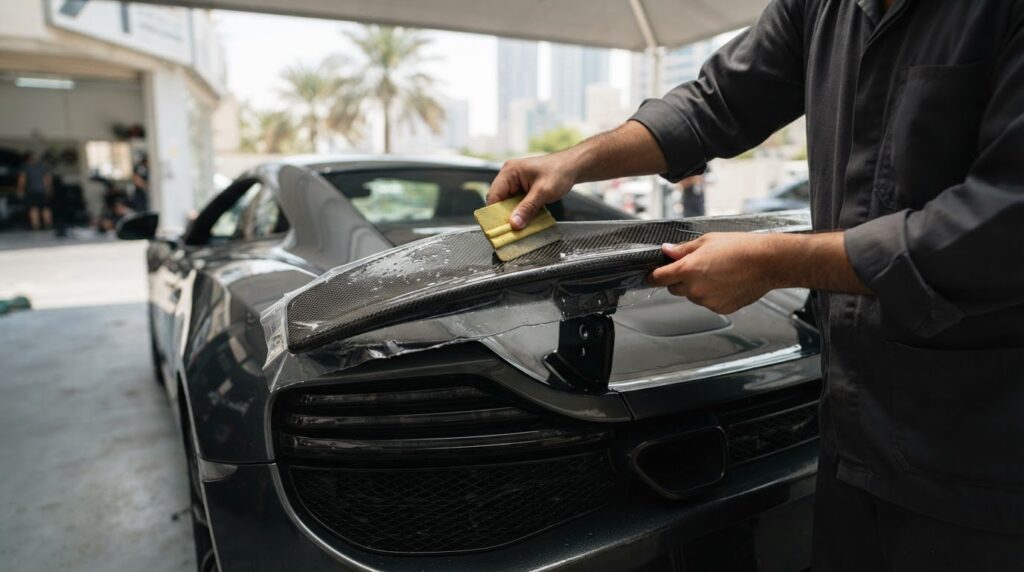
A clear-coated carbon-fibre spoiler can be protected with paint protection film, but its finish and shape determine how the film should be fitted. At Vanguard Motors Dubai, custom PPF for carbon fiber spoilers is not simply cut to size: the installer assesses the coating, contours, seams and mounting areas before application. The film helps shield the surface from scratches and stone chips; it does not reinforce the part against impacts or ground contact.
That distinction matters when preserving the visible weave and ensuring the spoiler still mounts cleanly. Carbon-pattern vinyl changes the appearance; it is not the same protection as film applied to genuine carbon fibre. For a clear-coated component, the key is to assess whether the finish is suitable for adhesive film and plan coverage around the spoiler’s shape.
This guide explains what carbon-fibre PPF does, how to coordinate spoiler fitting with film installation, and what to check around mounting points across the UAE. It also covers applying film to clear-coated carbon fibre, including the finish, pattern and edges that affect the result. You’ll see what to plan before professional installation and when custom fitting makes more sense than treating the spoiler like a standard painted panel.
Key Takeaways
- Choose a film finish and appearance that suit the spoiler, and assess transparent film on the carbon finish before committing to coverage.
- Plan the spoiler fitting and film sequence together so the intended covered surfaces and installation responsibilities are clear.
- Assess mounting points and nearby bodywork for film interference, especially where adhesive or hardware needs direct contact.
- For clear-coated carbon fibre, evaluate the finish, condition, shape and film edges before application.
- Understand the difference between surface protection and appearance changes: film, ceramic coating and carbon-pattern vinyl serve different purposes.
What Is Carbon Fiber PPF?
Carbon-fibre PPF is paint protection film fitted to a carbon-fibre component. It helps protect the surface from scratches and stone chips. On a spoiler, the film must suit both the finish and the contours. Custom PPF for carbon fiber spoilers means planning coverage for that specific component, rather than assuming a standard painted-panel pattern will fit.
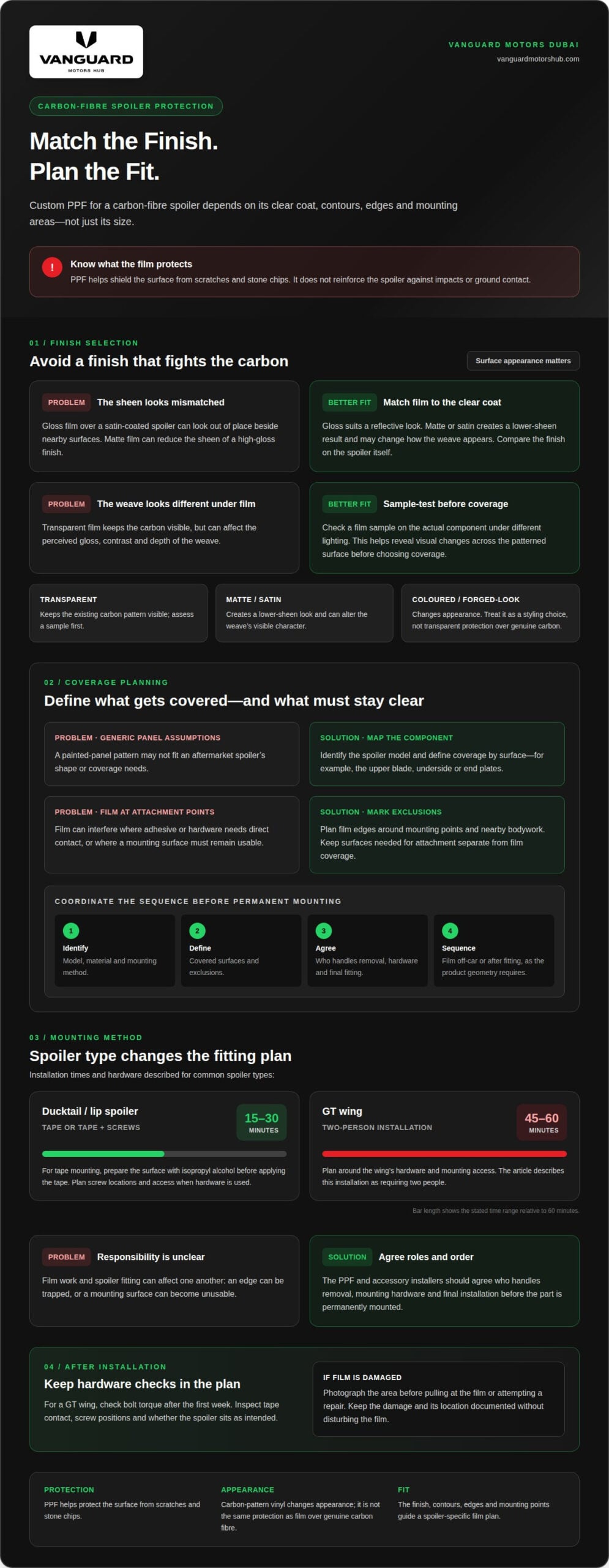
Start with the surface finish. A spoiler may have a high-gloss clear coat, a matte clear coat or a satin appearance. Gloss film can preserve a reflective look, while matte or satin film creates a lower-sheen result. Matte film can also change how the carbon weave appears, so judge the finish against the actual spoiler, not just a film sample.
Transparent film is designed to keep the underlying carbon visible. That makes sample testing especially useful: film can affect the perceived gloss, contrast and depth of the weave. Compare a sample on the component under different lighting before selecting coverage. This is particularly helpful on a patterned surface, where even a small visual change can stand out across the spoiler.
Forged carbon has a different visual pattern from conventional woven carbon. Film with a forged-carbon appearance is a styling choice, not transparent protection over genuine forged carbon. Coloured film also changes the spoiler’s appearance. Before choosing it, consider how the colour will look beside the vehicle’s paint and exterior trim.
- Gloss: suits a high-gloss clear coat when maintaining a reflective appearance is the priority.
- Matte or satin: suits a lower-sheen look and can alter the visible character of the carbon weave.
- Transparent: keeps the existing carbon pattern visible, but deserves a sample assessment first.
- Colored or forged-look: changes the appearance and should be treated as a styling decision.
Match the film to the clear coat, not just the material name. For example, glossy film over a satin-coated spoiler can look mismatched with adjacent surfaces. Matte film, by contrast, may reduce the sheen of a high-gloss finish. Assess the selected film against the spoiler’s curves, edges and intended coverage. A finish sample helps clarify the visual result before installation.
For a clear decision, identify whether your goal is surface protection, a change in appearance, or both. Then compare gloss, matte or satin, transparent and coloured options on the actual carbon-fibre component. The clear coat and the spoiler’s shape guide the final choice.
How professionals plan spoiler fitting and PPF installation
The spoiler and its film need one coordinated installation plan. Product-specific fit, coverage and mounting responsibilities determine the sequence.
Professional Fitting and Installation Sequence
First, identify the spoiler model, material and intended mounting method. Then define which surfaces the custom PPF for carbon fiber spoilers will cover and which it will exclude, such as the upper blade, underside or end plates. This prevents a painted-panel quote from being mistaken for accessory coverage. Aftermarket spoilers need their own fit and film plan.
Before permanent mounting, the PPF installer and accessory installer should agree on the sequence and responsibilities. Determine who will handle removal, mounting hardware and final installation. For example, applying film while the spoiler is off the vehicle may provide better access to the edges, while fitting it first may suit another product-specific process. The geometry and mounting points determine the practical order.
Professional Installation Methods and Hardware
Mounting method affects both access and film placement. Ducktail and lip spoilers can typically take 15-30 minutes to install using 3M tape or a tape-and-screw combination. A GT wing is described as taking 45-60 minutes and requiring two people. Those differences make it important to identify the accessory type before scheduling the coordinated work.
For a tape-mounted spoiler, prepare the surface with isopropyl alcohol before applying the tape. A tape-and-screw setup also requires planning for hardware locations and access. The PPF and accessory installers should agree on who handles each component before the part is permanently mounted. This helps avoid trapping a film edge or making a mounting surface unusable.
Installation and Maintenance
After installation, the relevant hardware still needs attention. For a GT wing, check the bolt torque after the first week. The mounting method also determines what to inspect, including tape contact, screw positions and whether the spoiler sits as intended. Film coverage must remain separate from surfaces needed for attachment.
Have the accessory’s repair, coating and existing-film history ready when requesting an accessory-specific quote. These details help define the work alongside the spoiler model and mounting method. If the film is damaged, photograph the area before pulling at it or attempting a repair. The record shows the damage and its location without disturbing the film.
For a coordinated discussion of spoiler fitting and film coverage, plan the installation sequence with the team.
How professionals check mounting areas for film interference
Inspect mounting points separately before finalising film coverage. Check where adhesive tape, screws or other hardware meet the spoiler and vehicle.
For a spoiler that is already mounted, provide photographs showing its position and the nearby bodywork. This gives the installer a view of access, surrounding panel gaps and possible removal needs. A close-up of the spoiler alone may miss the body surfaces needed to assess clearance. Wider views show how the part sits against the vehicle.
Inspect the spoiler’s actual attachment layout. Tape-mounted lips need clean, usable contact surfaces; a tape-and-screw design also needs clear access to its hardware. Identify those areas before mapping the film coverage. If film crosses a surface intended for adhesive, it can interfere with attachment. Coverage must stop before, or be planned around, that contact area.
- Position: establish how the spoiler sits against nearby bodywork.
- Access: assess whether the installed part blocks film application or mounting access.
- Attachment surfaces: identify tape footprints, screw locations and other contact points.
- Coverage: define film boundaries around the areas needed for mounting.
For example, a lip spoiler may use tape along its underside. If the film extends onto that adhesive footprint, the mounting and film plans conflict. Assess the actual contact area rather than assuming the entire underside can be covered. On a screw-mounted design, hardware locations also affect where film can sit without obstructing installation.
Clearance involves more than whether the spoiler touches the vehicle. Consider the access needed to position the part, reach its attachment points and finish the film edges. On an existing installation, photographs can reveal restricted access or nearby trim. If the available views suggest removal may be needed, coordinate that decision before work proceeds.
For custom PPF for carbon fiber spoilers, the coverage map should distinguish protected surfaces from mounting surfaces. This makes the film boundary clear and gives both installation teams a shared reference. It also helps prevent a seam or edge from crossing a tape contact zone. The spoiler’s shape and attachment design determine that boundary.
Before finalising the plan, compare the proposed film area with each attachment point. Keep a tape footprint available for its intended bond, and leave screw locations accessible. This check connects the accessory’s fit with film placement. It also clarifies whether the spoiler can stay mounted during application or needs to be removed for access.
Professional PPF application on clear-coated carbon fibre
The main risks are poor adhesion to an unsuitable coating and damage to a weak finish during removal. Film also won’t reinforce a spoiler against cracking or damage from scraping the ground.
A professional starts by assessing the carbon-fibre accessory’s surface, condition and shape. Clear-coated carbon fibre can be covered with PPF like paint, provided its existing finish is suitable for adhesive film. A sound, even clear coat gives the installer a surface to assess for application. Peeling, cracking or other visible defects affect the preparation and coverage plan.
Surface assessment matters because carbon fibre is not always finished in the same way. One spoiler may have a smooth clear coat; another may show wear or previous repairs. Assess the specific part rather than treating every carbon component as ready for paint protection film. The coating’s condition and compatibility determine whether film application is appropriate.
Next, assess the geometry. A spoiler can combine a broad upper surface, a curved leading edge, tight corners and narrow end plates. Each transition affects how the film sits. The pattern must suit those contours, and the planned seams and exposed edges need review before application. A pattern that fits a flatter surface may not suit a sharply curved tip.
- Surface: assess the clear coat, condition and any visible defects.
- Shape: map curves, corners, edges and changes in surface direction.
- Pattern: select coverage suited to the accessory’s geometry.
- Finish: plan seams and exposed edges for the intended appearance.
Plan coverage around the spoiler’s visible and functional surfaces. For example, a film edge placed across a prominent curve may be more noticeable than one aligned with a natural transition. Consider the weave and finish when deciding where seams should sit. Exposed edges also need deliberate placement because they define the boundary between protected and uncovered carbon.
Application requires a controlled sequence. Prepare the assessed surface, align the pattern to the component and work the film across its contours. Curved sections need careful positioning so the material follows the shape without compromising the planned edges. On a multi-plane spoiler, the pattern and seam layout should account for each change in direction.
Clear-coated carbon fibre needs a part-specific plan, not an assumed paint-panel treatment. A professional assessment connects coating suitability, surface condition, geometry and pattern choice. This establishes where the film can sit and how the seams will appear. It also keeps the purpose clear: PPF protects the surface, but cannot prevent a spoiler from cracking or scraping damage.
How does PPF compare with ceramic coating or vinyl wrap for carbon fiber spoilers?
Choose a treatment based on your goal: surface protection, a change in appearance, or both. PPF is intended to help protect against scratches and stone chips. Ceramic coating and vinyl wrap are different treatments, not interchangeable solutions for a carbon-fibre spoiler.
PPF forms a film over the spoiler’s existing finish. It is relevant when the priority is a protective layer against road debris and light surface damage. Some films also have self-healing properties, but these are limited to light surface marks. PPF is not reinforcement: it will not prevent a spoiler from cracking or protect it from scraping the ground.
Ceramic coating is applied to a surface rather than fitted as a sheet of film. It therefore serves a different role from PPF, which covers the component with a physical film layer. Decide what matters most for the spoiler: a film barrier, a coating treatment or a visual transformation. The part’s clear coat and intended use guide that decision.
Vinyl wrap is primarily a styling choice. Carbon-pattern vinyl can create the look of carbon fibre, but it is not equivalent to protecting a genuine carbon-fibre part. If the spoiler is real carbon, a decorative pattern does not replace PPF’s intended protection from scratches and stone chips. Coloured wrap may suit a redesign, while transparent film retains the underlying finish.
- PPF: choose it when surface protection from scratches and rock chips is the priority.
- Ceramic coating: consider it as a surface treatment, not a fitted film layer.
- Vinyl wrap: use it to change appearance, including with a carbon pattern.
For example, transparent PPF may suit a clear-coated carbon spoiler with a visible weave when preserving its appearance matters. A spoiler intended to contrast with the vehicle can instead use coloured vinyl as a styling treatment. These options solve different problems. Carbon-pattern wrap can imitate a look, while PPF is intended to protect the actual surface.
Before selecting a treatment, define the desired result and identify the existing finish. Then consider the spoiler’s shape, edges and mounting areas. These factors influence how film can be applied, while the choice between PPF, coating and wrap depends on your goal. Combining treatments also requires a planned sequence, since the surface treatment must suit both the film and the component.
For a spoiler-specific comparison, discuss the right protection approach for the finish and result you want.
Vanguard Motors Dubai: Engine carbon cleaning , rim repaint , alloy repaint , rim colour change , alloy colour change , wheel colour change , wheel paint , custom rims , custom exhaust , custom carbon
Vanguard Motors Dubai installs Paint Protection Film (PPF) for owners who want protection planned around a carbon-fibre spoiler. Turn to the team when the spoiler’s finish, shape or mounting areas need to be part of the film plan. Carbon Fibre Installation & Repair is also available for projects involving a carbon component that needs installation or repair. For a different visual direction, Colored Sticker Wraps and Peelable Paint Applications offer alternatives to clear film.
Share the spoiler’s fitting and finish details to help frame the work around your intended result. Contact Vanguard Motors Dubai to discuss your spoiler project.
Plan the spoiler as part of the full finish
The next step is to define how the spoiler should look alongside the vehicle’s existing surfaces. A clear design brief helps align protection with the car’s overall character, rather than treating the accessory as an isolated part. For custom PPF for carbon fiber spoilers, keep the intended appearance and the spoiler’s role in the final build at the centre of your decision.
Consider what you want to preserve: visible carbon texture, a consistent sheen or a distinct styling change. Bring that direction into the installation discussion, especially if the spoiler is part of a wider modification. A considered plan helps turn a visual preference into a practical fitment decision.
For a tailored next step, contact Vanguard Motors Dubai to discuss your spoiler project. A clear direction is the foundation for a finish that feels deliberate and complete.
Frequently Asked Questions
What is custom PPF for carbon fiber spoilers?
Custom PPF for carbon-fibre spoilers is paint protection film planned and fitted for a specific component. Its coverage and edges are matched to the accessory, rather than assumed from a standard body-panel pattern. For example, a narrow lip and a broad wing have different shapes and visible boundaries. The goal is to protect the spoiler’s surface while accounting for its intended finish and mounting areas.
Can paint protection film be safely applied to real carbon fiber spoilers?
Yes, PPF can be applied to real carbon fibre when its existing coating or finish is suitable for adhesive film. A professional first assesses the surface, including clear-coat wear, repairs and previous coatings. For example, a sound, clear-coated spoiler presents a different starting point from one with peeling or damage. The part’s finish and condition guide the application plan, so not every carbon component is treated identically.
What types and thicknesses of PPF are best for carbon fiber spoilers?
The right film depends on whether you want to preserve the existing appearance or change its sheen or colour. Transparent film keeps the carbon visible, while gloss, matte, satin and coloured options create different visual results. Choose thickness as part of the film specification for the particular spoiler. Its curves, edges and mounting surfaces matter, so a sample and fit assessment help inform the choice.
How is custom PPF measured, cut, and installed on a spoiler?
A professional uses the spoiler’s make, model and shape to plan coverage, then assesses a pattern against its curves and edges. The pattern may be adjusted for end plates, narrow tips or other distinctive contours. Before application, the installer considers where seams and exposed edges will sit. The final fit should also leave required attachment surfaces accessible, rather than covering areas used by tape or hardware.
How long does spoiler PPF installation take, and how long does it last?
Installation time depends on the spoiler’s shape, access and whether removal is part of the agreed sequence. A compact lip and a complex wing require different handling, so a painted-panel timing estimate may not apply. Film longevity also depends on the selected product, the surface beneath it and how the vehicle is cared for. Include accessory-specific scope and aftercare guidance in the installation plan.
Does PPF change the gloss, color, or appearance of carbon fiber?
Film can affect the perceived sheen, so its finish matters. Gloss film can maintain a reflective look, while matte or satin film creates a lower sheen. Transparent film leaves the carbon pattern visible but may still influence its perceived depth or contrast. For example, compare a sample against the spoiler under different lighting before choosing, especially when matching nearby trim.
How should a PPF-protected carbon fiber spoiler be cleaned and maintained?
Use gentle cleaning suited to the installed film, and avoid abrasive tools that could mark its surface or lift an edge. Pay attention to the spoiler’s narrow seams and tips, where dirt can collect. Don’t pick at a lifted or damaged area. If damage appears, photograph it before attempting a repair. Follow the film installer’s aftercare instructions for products and cleaning methods compatible with that specific film.
Where can I find custom PPF installers for carbon fiber spoilers in the UAE?
Vanguard Motors Dubai provides Paint Protection Film (PPF) Installation for carbon-fibre spoilers. Share the spoiler’s shape, finish and mounting details so the installation can be planned as an accessory-specific project. The team also offers Carbon Fibre Installation & Repair for related component work. Discuss the intended appearance and coverage to start planning an approach for your vehicle.