
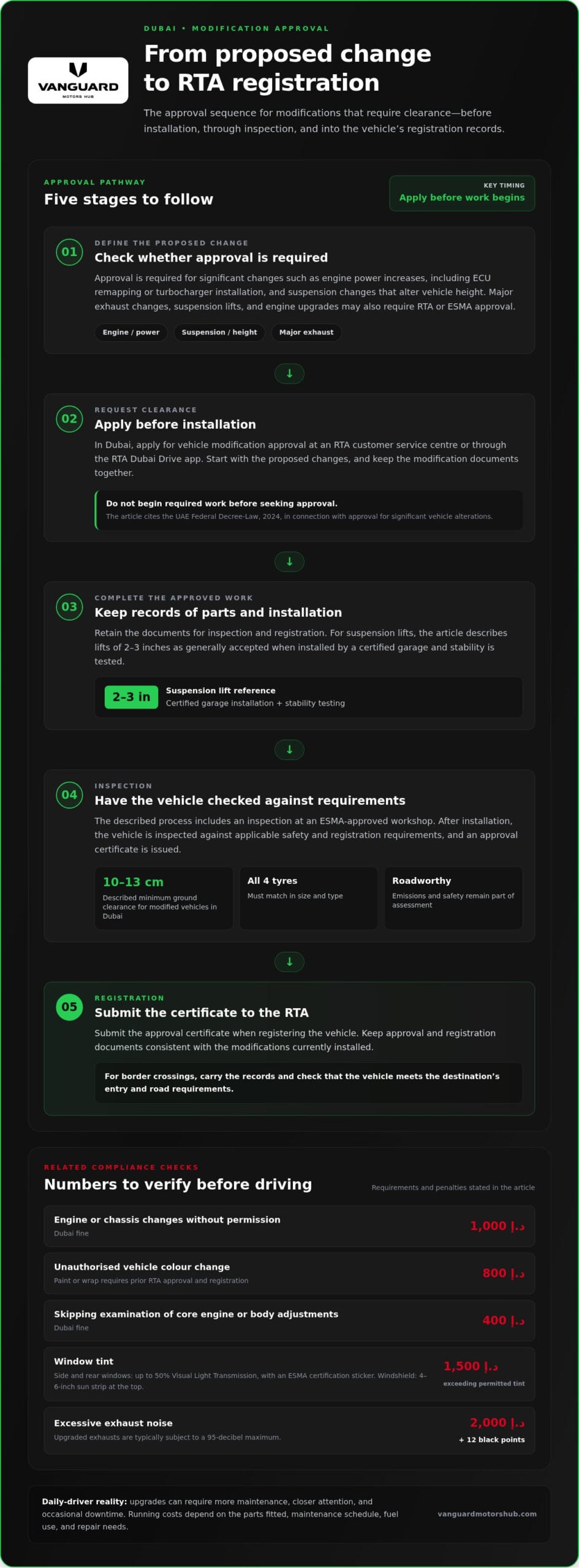
Daily driving a highly modified car in the UAE is possible only when modifications that require approval are cleared and the vehicle remains roadworthy. In Dubai, obtain required approval before making changes; the described process involves an inspection at an ESMA-approved workshop, an approval certificate, and submission to the RTA when registering the vehicle. In Dubai, engine or chassis changes without permission can bring a د.إ 1,000 fine, while an unauthorised colour change can bring a د.إ 800 fine.
It’s easy to focus on the parts that change a car’s power or appearance. For everyday use, approval, safety, and practical demands matter just as much. A modification that looks right in the workshop still needs to suit UAE roads and conditions.
This guide explains how vehicle modification approval works in Dubai, which changes may be prohibited, and how heat, sand, exhaust noise, and performance upgrades can affect daily driving. It also covers why inspection readiness, maintenance, and insurance deserve attention before you take a modified car on the road.
Key Takeaways
- Understand why significant changes may need approval before installation, and how inspection and registration fit into the process.
- Recognize prohibited alterations to lighting, plates and crash structures before they create safety or compliance problems.
- Prepare a modified car for UAE heat and sand by considering its cooling, filtration, tyres and maintenance needs.
- Learn how to assess performance upgrades for road use, including their effect on noise, drivability and ongoing maintenance.
How do I get approval for car modifications in Dubai?
In Dubai, seek approval before making modifications that require it. The UAE Federal Decree-Law, 2024, is cited in connection with approval for significant vehicle alterations. The process described involves an ESMA-approved workshop inspection, an approval certificate, then submission to the RTA when registering the vehicle.
Start with the proposed changes, not the installation. Engine power increases, including ECU remapping and turbocharger installation, require approval in the UAE. Suspension changes that alter vehicle height also require approval. Major exhaust changes, suspension lifts, and engine upgrades may require RTA or ESMA approval. Keep modification documents together for inspection and registration.
In Dubai, you can apply for vehicle modification approval at an RTA customer service centre or through the RTA Dubai Drive app. Apply before work begins when approval is required. After installation, the vehicle is inspected against applicable safety and registration requirements. Submit the approval certificate to the RTA when registering the vehicle.
Colour changes need particular attention. Changing a vehicle’s colour by paint or wrap requires prior RTA approval and registration in the UAE. In Dubai, an unauthorised colour change carries a د.إ 800 fine. Keep records of the approved colour and completed work with the vehicle’s documents.
Window tint also has defined limits. UAE side and rear windows may have up to 50% Visual Light Transmission, and tint must carry an ESMA certification sticker. The windshield is limited to a 4–6-inch sun strip at the top. Dubai lists a د.إ 1,500 fine for exceeding the permitted tint percentage.
Vehicle setup can affect inspection. Modified vehicles in Dubai are described as needing 10–13 cm minimum ground clearance. Suspension lifts of 2–3 inches are generally accepted when installed by a certified garage and stability is tested. All four tyres must match in size and type. Core engine or body adjustments require examination; skipping it carries a د.إ 400 fine.
A modified car can deliver tailored performance and appearance, while a stock car generally avoids modification-related approval steps. For daily driving, upgrades can also mean more maintenance, closer attention, and occasional downtime.
For excessive exhaust noise, an upgraded exhaust is typically subject to a 95-decibel maximum. Driving a noisy vehicle in Dubai carries a د.إ 2,000 fine and 12 black points; unsafe, unapproved alterations can also lead to penalties and impoundment. Emissions and roadworthiness should remain part of the inspection assessment.
Across the UAE, keep the vehicle’s approval and registration documents consistent with its installed modifications. For border crossings, carry those records and make sure the vehicle meets the destination’s entry and road requirements.
Running costs depend on the parts fitted, maintenance schedule, fuel use, and repair needs. A highly modified daily driver may also face downtime. Before buying a modified used car, compare its current configuration with its approval documents, inspect its condition, and review its service and repair records.
Which car modifications are strictly prohibited?
In the UAE, a modified vehicle must not compromise safety or impersonate emergency services. Prohibited changes include flashing lights, red or blue lights resembling emergency-vehicle lighting, and structural alterations that weaken crash protection. Cutting the chassis, removing pillars, or changing crash structures is prohibited. These changes can affect occupant protection in a collision, so they are not merely cosmetic.
Lighting restrictions apply to both colour and placement. Check the applicable rules before fitting external decorative lighting, as permitted colours and uses may be restricted. Flashing effects and emergency-style red or blue lights are prohibited. Keep every fitted light working: in Dubai, non-working lights carry a د.إ 400 fine and six black points. Non-working lane-change or rear signal lights carry two black points.
Window tint has specific limits. Front-windshield tinting is restricted to a small strip at the top, while front side windows are typically limited to 50% visible light transmission. The UAE also allows side and rear window tinting up to 50% visible light transmission. A tint installation should preserve visibility and carry its ESMA certification sticker. In Dubai, exceeding the permitted tint percentage carries a د.إ 1,500 fine.
Vehicle identity must remain intact. Tampering with the VIN or license plates is a criminal offence, and obscuring a plate in Dubai carries a د.إ 400 fine. Keep plates visible and legible after any bodywork, wrap, accessory installation, or repair. A decorative frame or added component should never cover identifying characters.
Stickers and writing also have rules in Dubai. Adding phrases or stickers to a vehicle without permission carries a د.إ 500 fine. That matters for decorative graphics as well as slogans: a design that changes the vehicle’s appearance still needs to respect the applicable permission requirements. A colour change by paint or wrap also requires prior RTA approval and registration in the UAE.
For wheels and cabin changes, consider function as carefully as appearance. Studded tyres are banned on public roads. Interior additions should not obstruct the driver’s view, pedals, seat belts, or access to controls. A steering-wheel alteration or loose cabin display can create a safety issue even if the vehicle’s exterior is unchanged.
Before fitting lights, graphics, or structural parts, separate visual upgrades from changes that affect safety or identity. For appearance-focused projects, review colored sticker wrap options with UAE approval requirements in mind, and keep plates, visibility, and required lighting unobstructed.
Heat and sand considerations for modified cars
UAE driving brings two distinct demands: sustained road use in heat and occasional travel across loose sand. A performance setup designed for paved roads may not suit dunes. A lowered car, stiff suspension, or low-profile tyres can limit clearance and comfort on uneven surfaces. A 4×4 is recommended for traction on loose sand, while high ground clearance helps prevent getting stuck or damaging the underbody.
Heat resistance matters when choosing tyres for desert use. All-terrain tyres are recommended because they provide better grip and heat resistance. Before a sand trip, adjust tyre pressure for the terrain, then reinflate to standard road pressure afterwards. Keep all four tyres matched in size and type, and inspect their condition before returning to the emirates’ paved roads.
Sand can enter the engine through its air intake, so filtration deserves attention. A snorkel kit can protect the engine from sand and dust ingestion during desert driving. Before departure, clean or replace the air filter, then check the engine oil, coolant, and brake fluids. These checks help you assess the vehicle’s readiness before rough terrain adds extra demands.
Underbody protection and suspension affect how a vehicle handles uneven ground. Skid plates can protect the underbody from rocks and rough terrain, while reinforced suspension can improve stability over dunes and uneven surfaces. Neither removes the need for inspection. After a desert drive, check the suspension, brakes, and filters for sand damage, then wash the vehicle thoroughly, especially underneath.
High engine torque can help a vehicle climb steep dunes efficiently, but power alone does not make a desert-ready setup. The engine still depends on suitable tyres, traction, clearance, and driver control. Keep recovery gear in the vehicle for desert trips: a shovel, tow rope, air compressor, and traction boards are recommended. Test the battery and brakes before setting out.
Daily road use also calls for choices suited to your usual routes. Consider how a low ride height handles driveways and parking, and how stiff suspension performs on poor road surfaces. Treat exhaust changes and sand equipment as separate decisions, since each affects a different part of the driving experience. Tinting should follow applicable UAE guidelines, not be treated as a substitute for cabin cooling.
Road and transport requirements still matter between trips. After sand driving, restore tyre pressure before returning to normal roads, clear dust from filters, and inspect the brakes and suspension. Build a routine around how the vehicle is actually used, whether for daily commuting, occasional desert driving, or both.
Insurance implications
Tell your insurer about every material change to the vehicle, including engine tuning, exhaust work, suspension changes, colour changes, and chassis alterations. Keep invoices, installation records, inspection results, and approval documents together. These records help you describe the car accurately when arranging cover or making a claim.
How much does it cost to legalize and insure a modified car in the UAE? There is no single combined cost: approval-related expenses depend on the changes and inspection requirements, while insurance pricing depends on the vehicle, declared modifications, driver, and selected cover. Request insurance terms based on the vehicle’s actual specification, not its original factory configuration.
Accurate disclosure matters because a modified car’s value and repair requirements can differ from those of a stock vehicle. For example, a declared carbon-fibre component or performance upgrade can affect replacement parts and repair estimates. Keep the insurer’s written record of declared modifications, and compare it with the installed parts and vehicle documents whenever the specification changes.
Approval paperwork also helps maintain a clear insurance record. In Dubai, significant alterations require official approval. The described process includes an inspection at an ESMA-approved workshop, an approval certificate, and submission to the RTA for registration. Keep the certificate with the vehicle’s registration documents. If the approved configuration differs from the insured description, resolve that mismatch before relying on the policy for the changed vehicle.
Roadworthiness can affect the practical outcome after an incident. A modified vehicle that fails its annual inspection cannot have its registration renewed until it complies. Driving a vehicle that fails security and safety requirements or is unfit for driving in Dubai carries a د.إ 500 fine, 12 black points, and up to 30 days of impoundment. An expired registration or impoundment can disrupt everyday use, even before insurance questions arise.
Emissions and noise also belong in the vehicle’s operating record. An upgraded exhaust is typically subject to a 95-decibel maximum in the UAE. Dubai lists a د.إ 2,000 fine and 12 black points for driving a noisy vehicle. A compliant certificate, inspection paperwork, and service records help document what was installed and how the car is maintained.
Before renewing cover, compare the policy’s vehicle details with the current build. Confirm that the chassis identifier, declared accessories, vehicle use, and insured value match your records. Save written updates after each approved change, such as a documented exhaust replacement or engine adjustment. This organized file gives the insurer a consistent account of the vehicle’s condition, specification, and legal status.
Legal and illegal performance upgrades
Performance upgrades affect more than acceleration. In the UAE, engine power increases, including ECU remapping and turbocharger installation, require approval. Treat suspension changes that alter ride height the same way. These changes can affect handling, road clearance, and inspection results, so assess the complete setup rather than viewing each part in isolation.
Approval is not a substitute for safe installation. A suspension setup must preserve predictable handling, braking stability, and suitable clearance for the roads you use. In Dubai, significant vehicle alterations require official approval, and core engine or body adjustments must be examined. Keep installation records and the resulting approval certificate with the vehicle documents.
Exhaust upgrades need particular attention on public roads. An upgraded exhaust is typically subject to a maximum noise level of 95 decibels in the UAE. Dubai lists a د.إ 2,000 fine and 12 black points for driving a noisy vehicle. A quieter driving style may reduce attention, but it cannot make an exhaust compliant if its noise exceeds the limit.
Illegal modifications can carry further consequences. UAE fines for illegal car modifications are typically د.إ 500 to د.إ 1,000 per violation. In Dubai, engine or chassis changes without permission carry a د.إ 1,000 fine. An unsafe or unroadworthy vehicle may also face impoundment. The deciding issue is not whether an upgrade looks professionally installed, but whether it meets approval and safety requirements.
Choose performance characteristics that suit regular driving. Tuning guidance for a daily vehicle prioritises low-end and midrange response, conservative ignition timing, and safe fuel maps. This favours smooth, usable power over a setup that performs well only at high engine speeds. Monitor relevant readings with gauges or a wideband, and follow a strict maintenance schedule.
Inspections assess the finished vehicle, not just its parts list. Check that the engine runs consistently, warning lights stay off, and the suspension behaves predictably on ordinary roads. Exhaust noise, emissions, and vehicle integrity also matter to roadworthiness. A modification that triggers a warning, causes unstable handling, or produces excessive noise can undermine everyday usability.
For exhaust work, align the intended sound and performance with UAE limits before installation. Discuss an exhaust modification with the road-use requirements in view, and keep approval and inspection records together.
Vanguard Motors Dubai: Paint Protection Film (PPF) Installation
Vanguard Motors Dubai installs Paint Protection Film (PPF) for owners seeking an added layer of protection for their vehicle’s painted surfaces. It is a practical consideration for a modified car used regularly on UAE roads, where preserving the finish matters alongside performance and compliance.
For a different exterior look, Vanguard Motors Dubai also offers Colored Sticker Wraps and Peelable Paint Applications. These options focus on appearance, while PPF is the relevant service when paint protection is the priority. Any colour change still needs to meet Dubai’s approval and registration requirements.
If you’re planning a finish upgrade, contact Vanguard Motors Dubai or visit vanguardmotorshub.com to discuss the suitable option for your vehicle.
Shape a build that works beyond the workshop
Make your next decision with the car’s full life in view. The right modification should suit your daily routes, preserve the vehicle’s usability, and fit the finish you want to maintain. That balance is central to daily driving a highly modified car in the UAE: thoughtful choices can bring personal style together with practical ownership.
For exterior protection or a visual refresh, Vanguard Motors Dubai offers Paint Protection Film (PPF) installation, Colored Sticker Wraps, and Peelable Paint Applications. Choose according to your priority, whether that is protecting painted surfaces or changing the vehicle’s appearance. Include approval and registration requirements in your plan for any colour change.
A clear brief helps turn an idea into a considered next step. Share the vehicle, the finish you have in mind, and how you use it day to day. Contact Vanguard Motors Dubai to discuss your vehicle’s finish, then move forward with a build that feels distinctive, composed, and ready for the road.
Frequently Asked Questions
What Makes a Modification Legal or Illegal?
A modification is road-legal when it meets UAE safety requirements and receives any required approval. A change that compromises vehicle safety, identity, or roadworthiness can be prohibited or fail inspection. For example, a performance part installed without the necessary approval may create a compliance issue even if it works correctly. Consider the effect on the whole vehicle, not just the component, and retain records of the changes.
What car modifications are allowed in the UAE?
Some appearance and performance changes are allowed when they comply with applicable rules and approval requirements. Examples include a colour change registered with the RTA, compliant window tint, or an exhaust setup that meets noise limits. What matters is how the change affects the vehicle’s specifications, safety, and registration. A modification’s popularity or professional appearance does not establish that it is legal for public-road use.
What’s Allowed (with approval)?
Changes that significantly alter the original vehicle specifications may be permitted after official approval. Examples include engine-power increases, suspension changes that alter height, and colour changes by paint or wrap. Approval applies to the resulting vehicle configuration, not just the part itself. Keep the approval certificate and registration details consistent with the finished build, especially if a later upgrade changes the vehicle again.
What modifications are legal for daily-driven cars in the UAE?
For regular road use, prioritise changes that preserve predictable braking, visibility, handling, and reliable operation. A visual enhancement that leaves safety systems and identifying details unobstructed is different from an unapproved engine or chassis alteration. Before relying on a modified car for commuting, consider how its setup performs in parking structures, traffic, and routine inspections, not just on an occasional drive.
Do UAE insurers cover performance modifications, and what must be disclosed?
Insurance terms depend on the policy, so disclose the car’s actual specification rather than describing it as stock. Include engine tuning, exhaust changes, suspension work, body kits, and other material upgrades, with supporting invoices or approval records. Keep the insurer’s written description of the insured vehicle with your modification documents. If the build changes later, update the information so the policy reflects the car you are actually driving.
How do UAE heat, sand, and traffic affect reliability of highly modified cars?
Heat, dust, and stop-start traffic can put extra demands on a modified car’s cooling, filtration, tyres, and brakes. A tuned engine used in slow traffic may need closer attention to operating temperatures than one driven mainly on open roads. Sand can load filters and affect exposed components. For daily driving a highly modified car in the UAE, match maintenance to the route and use, then inspect affected systems after desert trips.