
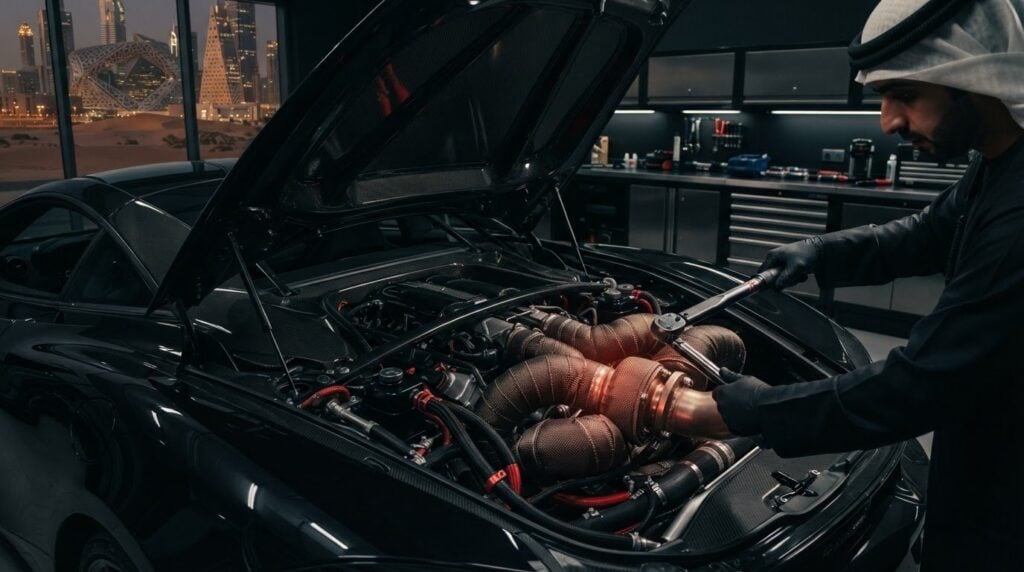
Bolting on high-flow exhaust hardware without an aggressive thermal defense is an expensive gamble with catastrophic engine bay failure. Modern turbocharged performance platforms routinely push turbine exit temperatures beyond 1,600°F under sustained throttle, turning an unshielded pipe into a radiant furnace. Without meticulous downpipe heat protection and installation, that uncontrolled radiant blast quickly degrades sensitive wiring harnesses, boils hydraulic fluids, and blisters painted bodywork.
You invested in an upgraded exhaust to eliminate backpressure, sharpen turbo spool, and liberate genuine horsepower; not to endure maddening chassis rattles, warped flanges, or persistent check engine lights. In this definitive guide, you will master advanced thermal management and execute precise downpipe fitment to unlock peak performance while fiercely protecting critical engine components. We break down the engineering limits of ceramic barriers, volcanic wraps, and bespoke hard lagging, alongside the mechanical standards needed for a flawless, leak-free build.
Key Takeaways
- Contain extreme exhaust gas temperatures exceeding 800°C to safeguard sensitive wiring, brake lines, and adjacent carbon components from radiant thermal degradation.
- Compare the mechanical limits of ceramic barrier coatings, volcanic wraps, and bespoke hard lagging to select the ideal thermal defense for your engine bay layout.
- Master professional downpipe heat protection and installation protocols, from turbo flange truing to cross-pattern torquing sequences that prevent exhaust leaks.
- Prevent catastrophic hardware failure and flange warpage by pairing high-temperature superalloy fasteners with chemically matched anti-seize compounds.
- Protect your high-performance investment with millimeter-precise packaging clearances engineered to withstand violent thermal expansion under sustained boost.
Understanding Downpipe Heat Protection and Its Mechanical Importance
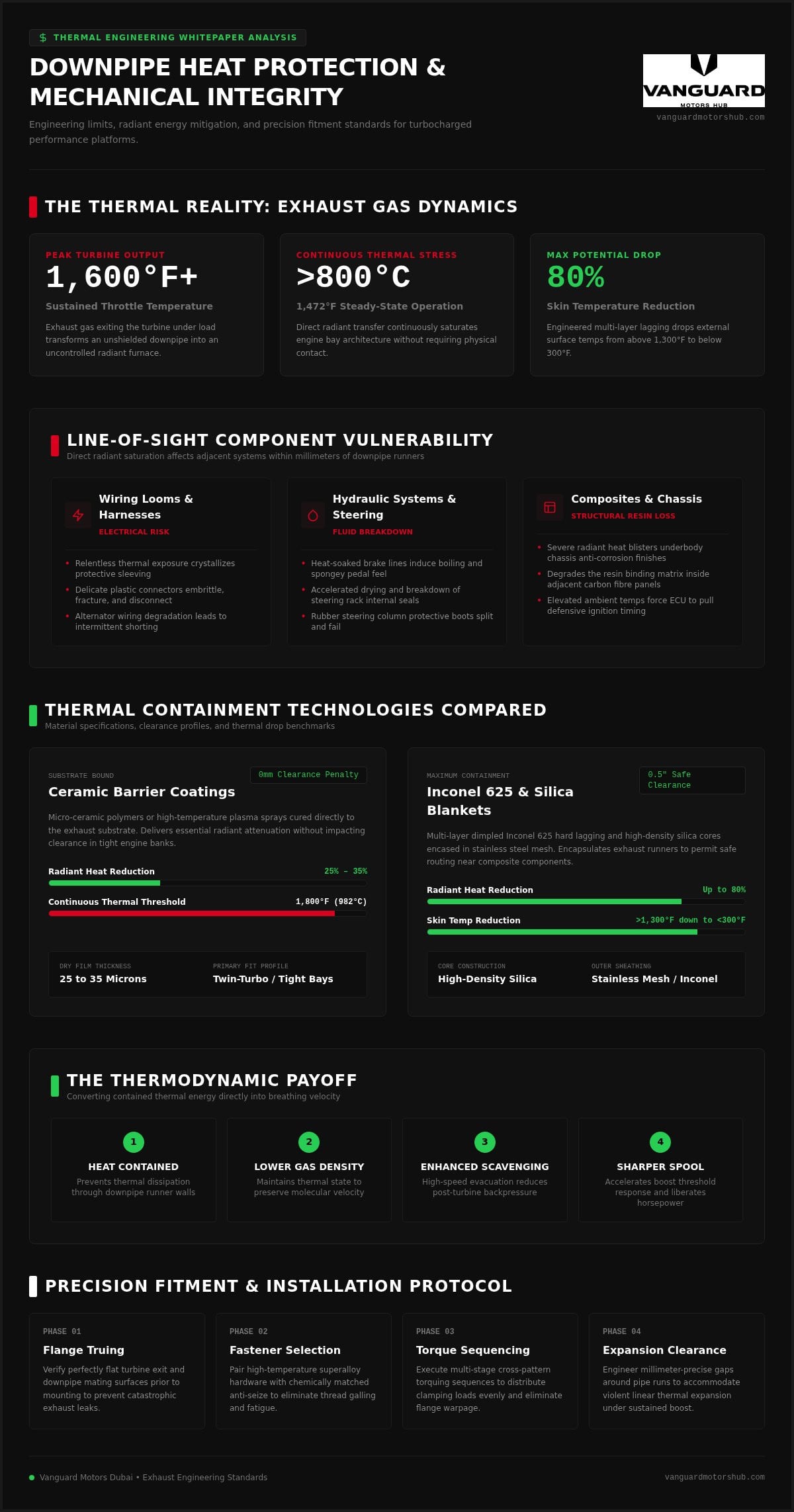
Downpipe heat protection is targeted thermal insulation engineered to control, contain, and deflect extreme radiant exhaust energy. Downpipes sit directly downstream of the turbocharger turbine housing, routinely enduring sustained exhaust gas temperatures exceeding 800 degrees Celsius (1,472°F) during aggressive driving. Without an intentional thermal barrier, this violent caloric output radiates unchecked into the engine bay, rapidly degrading alternator wiring, cooking steering racks, and baking composite intake systems.
Containing that thermal energy does more than shield adjacent hardware; it unlocks thermodynamic efficiency. Hot exhaust gases maintain lower density and higher molecular velocity. By preventing heat from escaping through the downpipe walls, you preserve exhaust gas scavenging speeds, reduce post-turbine backpressure, and noticeably sharpen boost response. Executing rigorous downpipe heat protection and installation turns an otherwise destructive thermal liability into an operational asset for engine breathing.
The Physics of Radiant Exhaust Heat in Confined Engine Bays
Thermal energy disperses through three distinct mechanisms: conduction, convection, and radiation. While convective currents circulate warm air, radiant transfer acts like infrared sunlight, projecting intense electromagnetic energy directly into any line-of-sight component without heating the intervening air. Unshielded downpipes transfer massive thermal loads directly into adjacent structural bulkheads and chassis members. This continuous radiant saturation elevates under-hood ambient temperatures, directly increasing intake air temperatures and forcing the engine management system to pull protective ignition timing.
Vulnerable Components Surrounding Modern Downpipe Assemblies
High-strung engine compartments leave razor-thin clearance margins, often routing high-flow downpipes within millimeters of mission-critical hardware. Left unmanaged, severe thermal cycling causes rapid physical degradation:
- Wiring Looms and Connectors: Relentless radiant exposure bakes wire harnesses, crystallizes protective outer sleeving, and causes delicate plastic electrical connectors to turn brittle and fracture.
- Hydraulic Lines and Steering Gear: Radiant heat soaks brake fluid within nearby hard lines, softening pedal feel while degrading steering rack seals and rubber steering column boots.
- Composites and Structural Finishes: Severe radiant discharge blisters underbody chassis coatings and degrades the structural resin matrix within neighboring carbon fibre panels.
Evaluating Downpipe Heat Protection Methods: Coatings vs. Blankets vs. Wraps
Selecting the correct thermal containment strategy separates championship-caliber builds from melted liabilities. Three primary technologies dominate the performance aftermarket: ceramic barrier coatings, tailored blankets or Inconel cladding, and composite woven wraps. Each delivers a distinct thermal reduction profile, packaging clearance, and mechanical lifespan. Matching the method to your operating environment ensures your downpipe heat protection and installation delivers lasting component preservation under extreme duty cycles.
Ceramic Thermal Barrier Coatings
Formulated from micro-ceramic polymers or applied via high-temperature plasma spray, these coatings bond directly to the exhaust substrate. Premium thin-film formulations cure to a dry thickness of just 25 to 35 microns, handling continuous exhaust temperatures up to 1,800°F (982°C). Their standout advantage is zero clearance penalty. For cramped engine bays and complex twin-turbo banks, ceramic barriers deliver a 25% to 35% radiant drop without interfering with adjacent oil lines or chassis rails.
Tailored Thermal Blankets and Inconel Heat Shields
For radical thermal reduction, multi-layer blankets and rigid Inconel cladding lead the industry. Removable blankets use high-density silica cores encased in stainless steel mesh, slashing exterior temperatures while allowing easy removal for routine mechanical inspections. At the pinnacle of motorsport engineering, dimpled Inconel 625 hard lagging encapsulates the downpipe runners entirely. This micro-welded shielding reduces outer skin temperatures from over 1,300°F down to below 300°F. That 80% thermal drop lets you route exhaust runners within half an inch of composite bulkheads.
Composite Exhaust Wrap Solutions
Woven volcanic basalt rock fibers, commonly called titanium wrap, offer continuous resistance up to 1,200°F. While accessible, woven wraps require strict installation discipline, including tight 50% overlaps and marine-grade stainless locking ties. Wraps present documented operational liabilities on premium street machines. Porous fibers absorb leaking engine oil or hydraulic fluid, creating a dangerous wick effect that dramatically increases under-hood fire risks. Trapped ambient moisture can also initiate intergranular corrosion along 304 stainless steel tubing during cold shutdown cycles.
Application Decision Matrix
- Daily Street Performance: Oven-cured ceramic coatings provide permanent, zero-maintenance defense with complete corrosion immunity.
- High-Boost Track Weapons: Tailored silica blankets supply extreme insulation around turbo exits while remaining removable for race-prep inspections.
- Mid-Engine Exotics and Supercars: Bespoke Inconel 625 encapsulation delivers the ultimate millimeter-precise packaging and maximum heat suppression.
Determining the ideal thermal barrier depends heavily on your vehicle’s engine architecture and boost pressures. If you want tailored technical guidance on configuring bespoke exhaust shielding, connect with an exhaust modification specialist to protect your high-performance platform.
Pre-Installation Engineering: Fitment Clearance and Hardware Selection
Flawless exhaust fabrication collapses without meticulous mechanical prep work. Before picking up a ratchet, assessing the turbine discharge environment determines whether your setup delivers enduring acoustic precision or maddening cabin drone. Mating surfaces demand absolute geometric flat planes. Inspect the turbocharger outlet flange with a precision machinist straight edge, checking for micro-warpage, stubborn carbon pitting, or severe galling. Installing a high-flow downpipe against an uneven cast turbine housing guarantees premature gasket blowout under wide-open throttle.
Hardware selection dictates serviceability. Standard carbon steel fasteners quickly corrode and seize under extreme thermal cycling, while standard stainless bolts can gall instantly. Select A286 superalloy, Inconel 718, or aerospace-grade titanium studs paired with copper-plated, distorted-thread prevailing-torque lock nuts. These retain continuous tension without backing out as metals expand. Executed correctly alongside broader supercar exhaust upgrades, rigorous downpipe heat protection and installation ensures high-boost track sessions never compromise structural mechanical integrity.
Tolerances, Thermal Expansion, and Clearance Verification
Downpipe dimensions physically grow when heated. High-grade 304 and 321 stainless steel tubes expand significantly in overall length and diameter at 1,500°F. Calculate minimum clearance buffers during dry mockup:
- Chassis and Subframe Clearance: Maintain at least 0.75 inches (19 mm) of static clearance from steering shafts, suspension pickup points, and subframes to prevent hard metal contact under full engine deflection.
- Transmission Tunnel Packaging: Verify clearance along heat-shielded floorpans. Insufficient spatial buffers lead to severe resonance and unwanted noise, vibration, and harshness (NVH) transferring into the cabin.
- Thermal Shield Boundary: Account for the added bulk of thermal blankets or Inconel cladding, ensuring insulation layers never chafe against dynamic components.
Oxygen Sensor and Catalytic Converter Hardware Prerequisites
Sensor integration requires surgical attention. Inspect factory primary and secondary lambda bungs for damaged threads, chasing them with an M18 x 1.5 tap if oxidation is present. Coat sensor threads exclusively with nickel-based anti-seize rated to 2,400°F (1,315°C). Never use copper anti-seize near exhaust sensors or titanium studs; copper breaks down past 1,800°F and can promote galvanic embrittlement.
Always discard factory multi-layer steel (MLS) gaskets after removal. Crushed fire-rings on used gaskets cannot re-conform to high-stress interfaces. Fresh OEM-spec MLS gaskets guarantee an absolute hermetic seal, safeguarding wideband oxygen sensors against erroneous readings caused by atmospheric reversion leaks.
Step-by-Step Downpipe Installation and Thermal Shielding Protocol
Executing a flawless downpipe installation requires methodical alignment and disciplined assembly techniques. Cross-pattern torquing is the practice of incrementally tightening diametrically opposed flange nuts in progressive stages to distribute clamp load evenly across the entire surface of the sealing gasket. Adhering to this structured three-phase protocol guarantees structural alignment, eliminates chronic exhaust leaks, and establishes long-term thermal performance.
Phase 1: Factory Removal and Thermal Barrier Application
Begin by treating all factory exhaust hardware with high-performance penetrating fluid, allowing ample soak time to prevent shearing stubborn turbine studs. Once the factory hardware is extracted and downpipes are on the bench, install your chosen thermal protection before attempting chassis fitment. Fasten woven wraps or tailored blankets securely using marine-grade stainless locking ties or safety-wire twists. Ensure every oxygen sensor bung remains unobstructed, perfectly centered, and free of thermal insulating material to avoid binding sensor threads during reassembly.
Phase 2: Precision Alignment, Torquing, and Sensor Integration
Maneuver the shielded downpipe into the engine bay, hanging it loosely on secondary rubber isolator brackets before addressing the turbine outlet. This intermediate support prevents bending stress on the turbo studs while you align the flanges. Follow these critical assembly steps:
- Initial Hand Threading: Thread all prevailing-torque lock nuts by hand against the fresh MLS gasket to confirm clean thread engagement.
- Staged Cross-Pattern Torquing: Tighten opposing fasteners in three progressive passes (30%, 70%, and 100% of final factory torque ratings) to seat the fire-ring uniformly without cocking the flange. Remember that applying nickel anti-seize reduces thread friction, requiring you to de-rate torque values by 20% to avoid over-stretching the studs.
- Calibrated Sensor Torquing: Thread oxygen sensors into their respective bungs using an open-sided sensor socket, torquing precisely to factory specifications (typically 35 to 45 Nm) to prevent fracturing internal ceramic zirconia elements.
Phase 3: Post-Installation Validation and Initial Heat-Cycle Curing
Lower the vehicle and fire the engine, keeping it at a steady idle for ten minutes. Conduct an immediate acoustic check along the turbo discharge flange, using a mechanic’s stethoscope or smoke tracer to verify zero gas leakage. Expect minor vapor emissions during this window; composite wrap binders and ceramic topcoats undergo an initial outgassing and curing phase as core temperatures rise. Allow the engine to cool completely to ambient shop temperature, then perform a final torque verification across all flange hardware to counter initial thermal relaxation.
Mastering modern downpipe heat protection and installation transforms vehicle responsiveness while permanently shielding surrounding electronics. If you demand motorsport-grade mechanical execution for your exotic or luxury platform, book your custom exhaust modification today.
Protecting Supercar Investments: Professional Exhaust Engineering
Exotic powertrains operate on razor-thin mechanical margins. Upgrading downpipes on twin-turbo flat-sixes, Hot-V V8s, or mid-engine configurations is never a casual driveway project. When you install high-flow hardware, you alter the delicate thermal equilibrium of an intricately packed chassis. Flawless execution in downpipe heat protection and installation safeguards high-value automotive investments from devastating radiant damage while unlocking their true acoustic and mechanical capability.
Preventing Catastrophic Failures on High-Value Platforms
In mid-engine architectures, exhaust runners sit inches away from composite body panels, high-pressure fuel rails, and dry-sump oil lines. Inadequate thermal barriers or careless spatial alignment invite catastrophic outcomes:
- Thermal Degradation of Composites: Radiant heat exceeding critical limits breaks down the structural epoxy matrix inside bespoke carbon fibre engine bays and aero diffusers, leading to irreversible delamination.
- Housing and Manifold Stress Cracking: Forcing a misaligned downpipe into position pre-loads the turbocharger turbine housing with continuous physical tension, inducing stress fractures when the metals endure violent thermal expansion cycles.
- Flash Fire Hazards: Fluid line proximity demands zero margin for error; improper shielding clearances can turn minor oil seepage into an instantaneous engine compartment blaze.
The Vanguard Motors Hub Standard in Mechanical Precision
Safeguarding exotic vehicles requires an elite technical approach. At Vanguard Motors Hub, expert technicians treat exhaust modifications with pure motorsport discipline. Operating from a state-of-the-art facility equipped for precision fitment and thermal shielding across the UAE, the engineering team approaches every platform with surgical care. Every mounting point is measured for clearance under dynamic deflection, mating surfaces undergo micrometer truing, and high-temp shielding is integrated with millimetric precision.
This holistic engineering philosophy bridges performance tuning and aesthetic protection. By controlling heat dissipation at the mechanical source, you protect bespoke conversions, custom carbon fiber aero components, and delicate exterior paint finishes from radiant degradation. For drivers who demand unrelenting performance without compromising vehicle longevity, professional downpipe heat protection and installation preserves your investment through every lap, launch, and high-speed sprint.
Elevate Your Build with Precision Thermal Management
Liberating maximum exhaust flow shouldn’t come at the expense of engine bay longevity. When you master downpipe heat protection and installation, you turn extreme radiant heat into acoustic clarity and sharp turbo spool. Balancing effective insulation with surgical fitment preserves sensitive wiring looms, shields composite aero components, and eliminates chronic flange leaks under hard driving.
High-performance engineering requires uncompromising attention to detail. At Vanguard Motors Hub, our technicians specialize in high-end vehicle exhaust modifications, uniting bespoke conversions and advanced thermal management under one roof across the UAE. We eliminate clearance guesswork and protect your mechanical investment with motorsport-grade accuracy. Ready to transform your vehicle’s performance and acoustics safely? Upgrade your exhaust with precision thermal engineering at Vanguard Motors Hub and unleash your machine’s full potential.
Frequently Asked Questions
Why is downpipe heat protection necessary on turbocharged engines?
Turbocharged engines produce continuous turbine exit temperatures between 1,200°F and 1,650°F during aggressive driving. Without insulation, this intense radiant energy rapidly degrades nearby alternator wiring, melts plastic harness clips, and boils brake fluid in adjacent hard lines. Investing in professional downpipe heat protection and installation lowers under-hood temperatures significantly while keeping exhaust thermal velocity high to improve turbo scavenging.
Does heat wrapping a downpipe cause the metal to crack over time?
Heat wrapping can cause fatigue cracking on low-grade or thin-walled stainless steel pipes. Wrapping traps intense thermal energy directly against the metal skin, accelerating microscopic grain crystallization and sensitization over repetitive heat cycles. Porous wraps can also absorb road moisture and leaking motor fluids against the tubing, triggering intergranular corrosion or serious engine bay fire risks on high-performance platforms.
What is the difference between ceramic coating and a downpipe heat blanket?
Ceramic coatings provide a microscopic 25 to 35 micron thermal barrier bonded directly to the metal, offering zero clearance penalties and continuous corrosion defense. Heat blankets rely on thick silica cores encased in stainless steel mesh to achieve massive radiant drops up to 80%. While blankets offer superior surface insulation, they require ample physical clearance and careful mounting to avoid contact with moving suspension parts.
Will downpipe heat protection increase horsepower or engine performance?
Thermal protection delivers measurable performance advantages by optimizing exhaust gas dynamics. Trapping heat within the exhaust runner keeps gases hotter, less dense, and traveling at higher velocities, which sharpens turbocharger spool response. Lower under-hood temperatures also prevent intake air charge heat soak, allowing the engine management system to maintain aggressive ignition timing without pulling power to prevent knock.
How much clearance is required between a downpipe and chassis components?
Unshielded downpipes require at least 2.0 inches (50 mm) of clearance from sensitive wiring, brake lines, and composite chassis panels. Applying dense Inconel cladding or high-grade thermal shielding safely compresses this working clearance to roughly 0.5 inches (12.5 mm). Adequate clearance prevents severe radiant heat damage while isolating the cabin from intrusive resonance and engine vibration during hard acceleration.
Can poor downpipe installation trigger a check engine light?
Improper installation frequently triggers catalytic efficiency or sensor circuit fault codes. Exhaust leaks around warped mating flanges pull fresh atmospheric oxygen across the primary lambda sensor, corrupting fuel trims. Damaged sensor threads or cross-threaded bungs can also crack sensitive internal zirconia elements. Rigorous downpipe heat protection and installation protocols ensure precise sensor seating, flat flange sealing, and complete code-free operation.
How should a freshly heat-wrapped downpipe be broken in during initial startup?
Break-in requires a controlled initial thermal cycle inside a well-ventilated bay. Idle the vehicle for 10 to 15 minutes without revving while binding resins and protective coatings cure. Expect minor visible smoke and a distinct chemical odor during this initial outgassing period. Once the exhaust reaches full idle operating temperature, shut down the engine and allow it to cool completely before aggressive driving.