
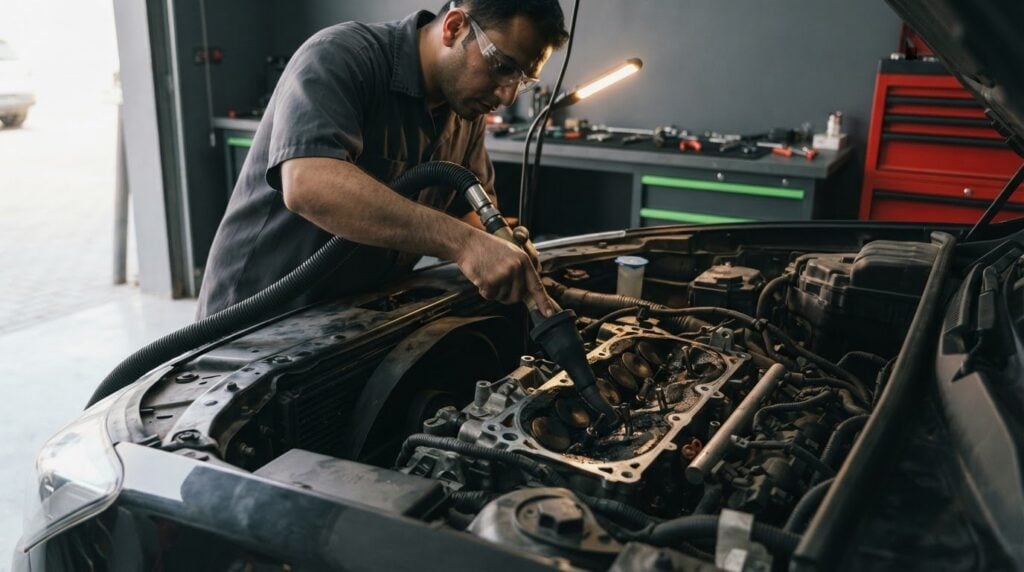
More cleaning isn’t automatically better, but leaving deposits unaddressed can affect how a GDI engine performs. A broad guideline for engine carbon cleaning for GDI engines is every 20,000 to 60,000 miles, with the interval shaped by driving conditions and fuel quality. That range is a guide, not a fixed schedule for every vehicle.
It’s reasonable to look for clear signs that cleaning is worthwhile before arranging maintenance. In a GDI engine, fuel doesn’t wash over the intake valves, so deposits can build up and may contribute to reduced power or increased fuel use. Fuel additives can help with some deposits, but they don’t fully remove buildup that calls for professional intake cleaning.
This article explains how carbon deposits can affect performance and fuel consumption, what professional intake-valve cleaning involves, and how to weigh potential benefits against preventive maintenance. It also covers how driving conditions affect cleaning intervals, what prevention can do, and when professional service may be appropriate.
Key Takeaways
- Understand why direct fuel injection leaves intake valves vulnerable to deposits, and how driving habits and fuel quality can influence buildup.
- Learn why fuel additives may support fuel-system maintenance but can’t fully clean deposits on intake valves.
- Recognize performance changes that can make professional assessment worthwhile, rather than cleaning automatically on a fixed schedule.
- Compare professional cleaning approaches, including when more intensive methods may be used for heavier deposits.
- Weigh preventive maintenance against the engine’s condition, symptoms and service needs to make a more informed decision.
What are the best strategies to prevent carbon buildup in a GDI engine?
Gasoline Direct Injection (GDI) engines spray fuel directly into the combustion chamber. Unlike port-injected engines, they don’t send fuel across the backs of the intake valves. Oil vapour from the crankcase ventilation system and other by-products can therefore collect on valve surfaces. Over time, deposits may harden and restrict airflow. Fuel additives can help clean parts of the fuel system, but in a typical GDI design, they can’t wash the backs of the intake valves.
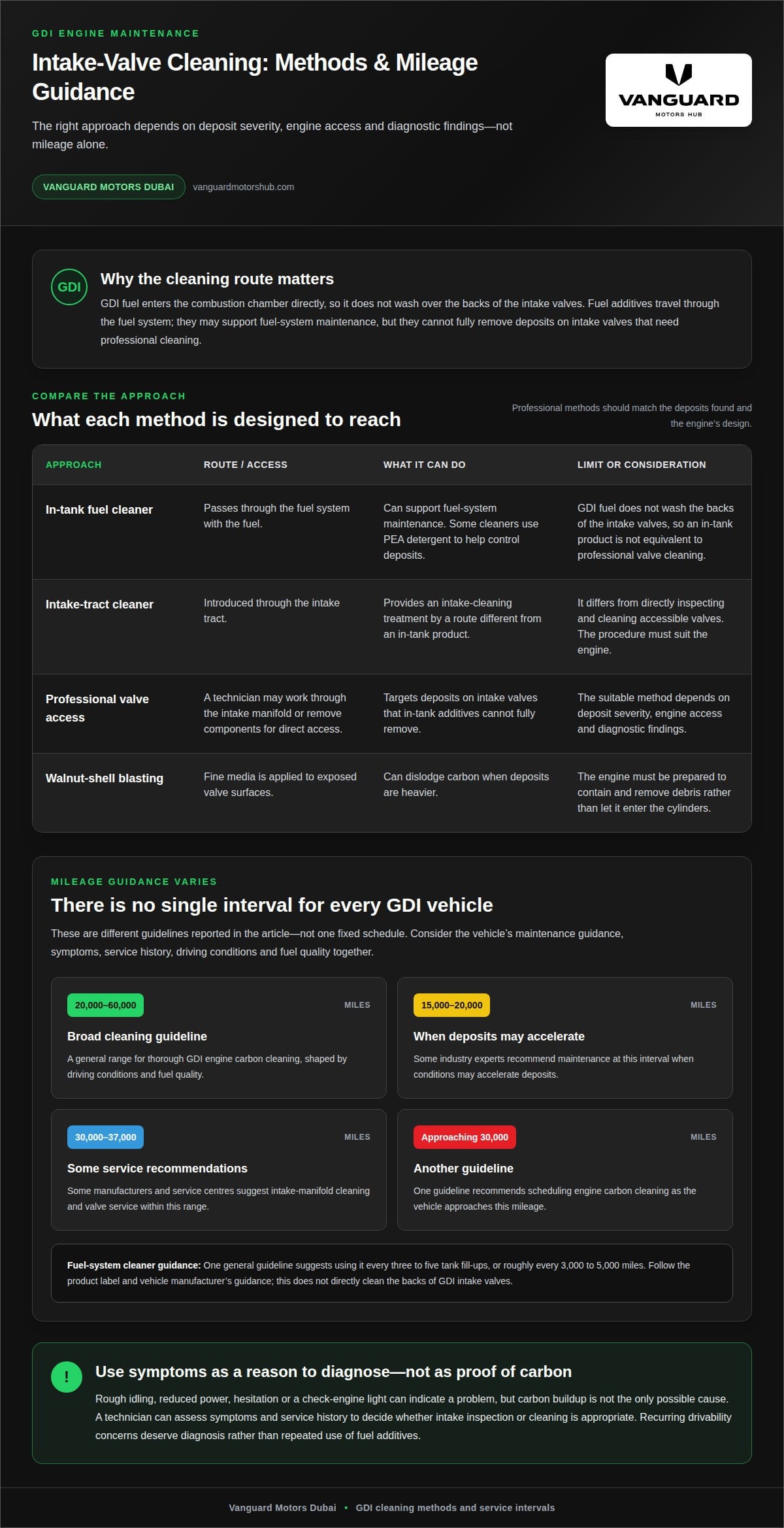
There isn’t one cleaning interval for every GDI vehicle. A general guideline places thorough cleaning every 20,000 to 60,000 miles, depending on driving conditions and fuel quality. Some industry experts recommend maintenance every 15,000 to 20,000 miles when conditions may accelerate deposits. These are mileage-based guidelines, not a substitute for the vehicle manufacturer’s maintenance schedule. Consider the engine’s symptoms, service history and operating conditions together.
Fuel injector cleaner can support fuel-system maintenance, but it has limits. One general guideline suggests using it every three to five tank fill-ups, or roughly every 3,000 to 5,000 miles. Follow the product label and the vehicle manufacturer’s guidance. The suggested method is to add cleaner to an almost empty tank, then fill the tank to help mix it. This approach treats fuel-system deposits; it does not directly clean the backs of GDI intake valves.
Fuel quality and driving patterns also matter. Top-tier gasoline contains detergents that can help reduce deposits on injectors and intake valves. Frequent short trips, extended idling and stop-start driving may give deposits more opportunity to form than steady highway driving. An oil catch can in the PCV system can trap some oil vapour and contaminants before they reach the intake, but it needs appropriate installation and regular attention. Check the vehicle manufacturer’s recommendations before adding equipment or changing maintenance practices.
Watch for changes rather than relying on mileage alone. Rough idling, reduced power, hesitation or a check-engine light can indicate a problem, though carbon buildup isn’t the only possible cause. A technician can assess symptoms and service history, then decide whether intake inspection or cleaning is appropriate. A vehicle approaching a cleaning interval, with no symptoms and consistent maintenance, may not need automatic treatment. Recurring drivability concerns, however, deserve diagnosis rather than repeated use of fuel additives. In the UAE, driving patterns and fuel choices vary, so matching maintenance to the vehicle’s actual use is more considered than applying one schedule to every GDI engine.
Professional intake valve cleaning services
Professional cleaning targets deposits on intake valves that in-tank additives can’t fully remove. The right approach depends on deposit severity, engine access and diagnostic findings.
Intake-Valve Cleaning Methods
Professional intake-valve cleaning removes deposits using a method suited to the engine’s design and buildup. This matters because fuel additives travel through the fuel system, while GDI fuel enters the combustion chamber without washing the valve backs.
A technician may clean through the intake manifold or remove components for direct access. For heavier deposits, walnut-shell blasting uses fine media to dislodge carbon from exposed valve surfaces. The engine must be prepared to contain and remove debris rather than let it enter the cylinders. The method should match the condition found, not simply the vehicle’s mileage.
Some service methods introduce an intake cleaner through the intake tract. This differs from directly inspecting and cleaning accessible valves. A clear explanation of the method helps distinguish general intake treatment from work aimed specifically at valve deposits.
PEA Detergents and Valve Cleaners
PEA, or polyetheramine, is a detergent used in some fuel-system cleaners to help control deposits. Its relevance depends on where the product travels: an in-tank cleaner passes through the fuel system, but GDI fuel doesn’t wash the backs of the intake valves.
Use a cleaner only as directed on its label and by the vehicle manufacturer. An in-tank product may support fuel-system maintenance, but it isn’t equivalent to professional intake-valve cleaning. Intake cleaners are applied through a different route, and the procedure must suit the engine. Treating the products as interchangeable can leave the original valve deposits untouched.
Cleaning Frequency for GDI Valves
Cleaning frequency means the interval between professional services. It should be guided by mileage, symptoms, driving conditions and fuel quality, since a fixed schedule can overlook how differently engines accumulate deposits.
Professional intake-valve cleaning may be appropriate depending on the vehicle’s condition and deposit buildup. Some manufacturers and service centres suggest intake-manifold cleaning and valve service every 30,000 to 37,000 miles; another guideline recommends scheduling engine carbon cleaning for GDI engines as the vehicle approaches 30,000 miles. These ranges are not identical, so the vehicle’s maintenance guidance and condition should shape timing.
Rough idling, hesitation or power loss can justify diagnosis before a scheduled interval. A check-engine light can also signal other faults, so symptoms alone don’t establish carbon as the cause. Diagnostic results and service history help determine whether valve cleaning is appropriate.
Choosing a Carbon-Cleaning Garage
A reputable GDI carbon-cleaning garage explains its diagnostic process, proposed cleaning method and why that method suits the engine. This matters because intake treatment and direct valve cleaning don’t address deposits in exactly the same way.
In the UAE, look for a clear explanation of how the service relates to the reported symptoms, mileage and engine design. A sound process distinguishes diagnosis from treatment, describes whether the valves are accessed directly, and explains how debris is controlled during cleaning. It should set realistic expectations rather than promise a specific performance result before assessing the vehicle.
For a discussion focused on your vehicle’s symptoms and cleaning needs, share your engine details and discuss intake cleaning.
Carbon buildup effects on engine performance and fuel use
In a GDI engine, fuel enters the combustion chamber directly, bypassing the backs of the intake valves. Oil vapour and combustion by-products can accumulate there, forming deposits that narrow the path for incoming air. As deposits build, airflow and cylinder filling can become less efficient. The effects depend on deposit severity, so symptoms and measured performance matter more than assuming every GDI engine is in the same condition.
Severe deposits can reduce engine power by up to 10% after 50,000 miles of operation. That change may feel like slower acceleration, weaker response under load, or reduced flexibility when merging. A driver might notice the difference most clearly when climbing a hill or accelerating from a low speed. These signs can also have other causes, so power loss alone doesn’t establish that carbon is responsible.
Fuel use can rise too. Severe carbon deposits can increase GDI engine fuel consumption by 2-5% after 50,000 miles of operation. A small change in fuel economy may be difficult to notice on one journey. Compare similar routes and driving conditions over time, rather than judging from a single tank. Repeatedly higher consumption alongside rough running or hesitation gives a technician more useful context.
Carbon-related performance changes often develop gradually. An engine that once accelerated smoothly may begin to hesitate, idle unevenly or feel less responsive. Note when the change occurs, such as during a cold start, at idle or under acceleration. A check-engine light adds a diagnostic clue, but doesn’t identify intake-valve deposits on its own. Reading fault codes and inspecting the engine help distinguish carbon buildup from ignition, fuel-delivery, sensor or other engine concerns.
Emissions can also be affected. Carbon deposits can cause engines to exceed particulate emission limits by up to 30-40% compared with clean engines. This figure describes a possible emissions impact, not a dashboard reading or a direct measure of deposit thickness. For a specific vehicle, diagnostic testing is more informative than assuming emissions behaviour from mileage alone. That distinction matters when deciding whether symptoms point toward cleaning or another repair.
Driving context helps explain why two GDI vehicles with similar mileage may behave differently. Frequent short trips and stop-start use create a different operating pattern from steady highway driving. A vehicle used mainly for short urban journeys, for example, may show different symptoms from one driven regularly at consistent speeds. Keep maintenance records and note changes in idle quality, acceleration and fuel use. Those details help connect day-to-day behaviour with inspection findings.
Cleaning decisions should follow diagnosis, not a single performance figure. A technician can relate symptoms to test results and inspect the intake system when appropriate. If deposits are present, their amount and location help determine the next step. Comparing performance and diagnostic findings before and after service also gives a clearer picture of what changed than relying on the impression from one drive.
Costs and benefits of preventive cleaning
Preventive cleaning aims to address intake-valve deposits before they contribute to noticeable drivability changes. Its value depends on the engine’s condition, maintenance history, symptoms and proposed method. Cleaning performed solely because a vehicle has reached a particular mileage may offer little benefit if deposits are limited. Conversely, deposits identified during diagnosis can make cleaning a considered maintenance decision rather than a guess.
Potential benefits are practical: restoring airflow where deposits restrict the intake path, addressing a suspected cause of rough running, and helping maintain consistent engine response. These outcomes depend on carbon buildup being present and relevant to the symptoms. Cleaning can’t correct unrelated faults, such as an ignition problem or another cause of poor fuel economy. Diagnosis should therefore come before treatment, especially when a check-engine light or hesitation has several possible explanations.
Preventive work also has an opportunity cost. Money spent on cleaning an engine without meaningful deposits could be better directed toward maintenance the vehicle actually needs. One owner reported having intake and fuel-system cleaning at 105,000 miles without noticing a difference afterward. That individual experience doesn’t establish how another engine will respond, but it illustrates why mileage alone can’t prove that a service is worthwhile.
The main disadvantages are paying for unnecessary treatment and expecting cleaning to resolve symptoms caused by another fault. A method that doesn’t reach the affected valve surfaces may also fail to address the deposits. In the UAE, where driving patterns vary, a garage should explain its findings, method and reasons for recommending cleaning. Clear diagnosis helps distinguish preventive service from treatment for a confirmed concern.
For professional cleaning, the price depends on engine access, deposit severity, the chosen method and the work required. A quote provides a case-specific estimate based on these factors. Direct valve cleaning may involve more access work than intake treatment, so comparing services by name alone can be misleading. Understand what the quoted work covers before weighing it against the expected benefit.
A balanced decision follows a simple sequence: review symptoms and service history, diagnose the concern, establish whether deposits are present, then match the cleaning method to the findings. If the engine runs normally and inspection doesn’t indicate significant buildup, immediate cleaning may not be a priority. If diagnosis links deposits to performance concerns, cleaning can be a targeted step. This approach weighs preventive maintenance against evidence instead of treating every GDI engine on the same schedule.
What are the methods for cleaning GDI intake valves, and how do they compare?
GDI intake valves can be cleaned with chemical treatments or direct mechanical removal. The methods differ in how they reach deposits, the access required and the amount of buildup they can address. Matching the procedure to the valve condition matters more than choosing a method by name alone.
Intake-manifold cleaning
An intake-manifold treatment introduces cleaner through the intake tract while the engine runs or as part of a controlled service process. It can address deposits in the intake path, but an in-tank additive follows fuel into the combustion chamber and doesn’t wash the backs of GDI intake valves.
This distinction matters when deposits are suspected on the valve surfaces themselves. A general fuel-system cleaner and a professional intake treatment aren’t interchangeable. The technician selects the procedure based on the engine layout, symptoms and inspection findings.
Walnut-shell blasting
Walnut-shell blasting removes carbon mechanically by directing fine shell media at exposed intake valves. It is a popular option for deposits on disassembled or opened-up GDI intake systems, especially when buildup is heavy and direct access is needed.
The method requires careful preparation. The technician positions the valves, contains the blasting media and removes loosened debris so it doesn’t enter the cylinders. This hands-on approach can target hardened deposits more directly than an additive, but it requires engine access and a more involved procedure. Walnut shells are the cleaning medium, not a treatment poured into the fuel tank.
How the methods compare
Chemical intake cleaning may suit lighter deposits or maintenance performed through the intake system. Walnut blasting is a more direct mechanical approach for visible, stubborn buildup. Neither method should be selected solely because a vehicle has reached a particular mileage. Inspection and diagnosis help establish the deposits’ location and severity.
For example, if an engine idles roughly and inspection shows deposits on the valve backs, a technician may recommend direct cleaning. If diagnosis instead points to an ignition or sensor fault, valve treatment won’t resolve the underlying issue. The right comparison is between the engine’s condition and the procedure’s reach, not broad claims that one method is best for every GDI vehicle.
Choosing a suitable procedure
A sound service process identifies the affected area, explains how the selected method reaches it and describes how debris is controlled. Ask whether the procedure cleans the valves directly or treats another part of the intake system. That detail helps clarify what the service is designed to address.
If symptoms or inspection findings point to intake deposits, discuss the right intake-valve cleaning approach.
Vanguard Motors Dubai: Engine carbon cleaning , rim repaint , alloy repaint , rim colour change , alloy colour change , wheel colour change , wheel paint , custom rims , custom exhaust , custom carbon
Vanguard Motors Dubai provides engine carbon cleaning for drivers whose GDI engines show symptoms or need an intake-deposit assessment. If diagnosis indicates carbon buildup, cleaning offers a focused next step based on the engine’s condition and the suitable method.
For a vehicle with rough running, hesitation or reduced response, discuss the symptoms and maintenance history when arranging service. This connects the cleaning decision to the concern rather than treating mileage alone as proof that work is needed. Vanguard Motors Dubai also offers rim and alloy repainting, colour changes, custom rims, custom exhausts and custom carbon work for other vehicle projects.
Contact Vanguard Motors Dubai to discuss engine carbon cleaning for your vehicle.
Build a clear plan for your next service
A considered approach to engine carbon cleaning for GDI engines starts with a useful conversation about how the vehicle is running. Describe changes in idle, acceleration or fuel use, along with recent maintenance and any diagnostic findings. This helps focus the discussion on the concern that matters, rather than treating cleaning as an automatic step.
Before arranging work, note when symptoms appear and whether they have changed over time. Details such as cold starts, traffic conditions or acceleration under load can help frame the discussion. Clarify what outcome matters most to you, whether that’s addressing a drivability concern or planning maintenance.
Vanguard Motors Dubai can discuss engine carbon cleaning alongside other vehicle projects. For appearance and paint protection, its services include Paint Protection Film (PPF) installation, colored sticker wraps and peelable paint applications. Keep mechanical priorities separate from cosmetic choices, then plan each around the vehicle’s needs.
When you’re ready to discuss your vehicle’s symptoms or service needs, contact Vanguard Motors Dubai for advice. A clear conversation is a confident first step toward a considered service plan.
Frequently Asked Questions
How often should a Gasoline Direct Injection (GDI) engine undergo cleaning to maintain peak performance?
A general interval for thorough GDI cleaning is 20,000 to 60,000 miles, adjusted for driving conditions and fuel quality. Drivers whose conditions accelerate deposits may follow a 15,000 to 20,000-mile maintenance interval. Treat these as broad guidelines, not a universal requirement. For example, a vehicle used mainly for short, stop-start journeys may need a different assessment from one driven steadily on highways.
What are some signs that indicate my GDI engine might need cleaning or maintenance?
Rough idling, hesitation during acceleration, reduced power or a check-engine light can indicate a need for diagnosis. These signs don’t prove carbon buildup, since ignition, sensor and fuel-delivery faults can cause similar behaviour. Note when the symptom occurs, such as during a cold start or under load. That detail, alongside maintenance records and diagnostic results, helps establish whether intake cleaning is relevant.
What is carbon cleaning for a GDI engine, and why is it needed?
Carbon cleaning removes accumulated deposits from parts of a GDI engine, particularly the backs of its intake valves. Direct injection sends fuel into the combustion chamber, so fuel doesn’t wash those surfaces during normal operation. Professional engine carbon cleaning for GDI engines may be considered when inspection connects deposits with airflow or drivability concerns. The aim is to address buildup, not treat every performance problem as a carbon issue.
What are the common symptoms of carbon buildup in GDI engines?
Common clues include uneven idling, sluggish acceleration, hesitation or a noticeable loss of engine response. A vehicle may feel less responsive when accelerating uphill or merging into traffic, for example. Fuel consumption can also change, but one tank isn’t enough to identify a cause. Record repeated changes under similar driving conditions, then use a diagnostic assessment to distinguish deposits from other engine faults.
How often should a GDI engine be carbon cleaned?
There’s no single interval that suits every GDI engine. General guidance ranges from 20,000 to 60,000 miles, while some recommendations use 15,000 to 20,000 miles for conditions that encourage deposits. Use the vehicle’s maintenance guidance, driving pattern, symptoms, and inspection findings together. An additive schedule doesn’t determine when intake valves need professional cleaning, because fuel additives don’t directly reach their backs.
What are the steps involved in walnut blasting a GDI engine?
Walnut blasting is a direct cleaning method for exposed intake valves. A typical service follows these stages:
- Access the intake valves and position them for cleaning.
- Contain the area, then direct walnut-shell media at deposits.
- Remove loosened material and inspect the cleaned surfaces.
Careful debris control is essential. The exact access work depends on the engine design.
How much does GDI engine carbon cleaning cost in the UAE?
The price depends on the engine’s access requirements, deposit severity, selected cleaning method and work involved. A quote request provides a case-specific price. Direct valve cleaning may require different access work from intake treatment. When reviewing an estimate, clarify which areas the proposed service addresses and whether diagnosis is included, so you understand the scope instead of comparing service names alone.
Can fuel additives clean carbon deposits on GDI intake valves?
Fuel additives can help with some fuel-system deposits, but they can’t fully remove deposits on the backs of GDI intake valves. In a GDI design, fuel enters the combustion chamber directly instead of flowing over those valves. Adding cleaner to the tank may support fuel-system maintenance without cleaning the valve surfaces. If inspection identifies valve deposits, professional intake cleaning may be needed to reach them.