
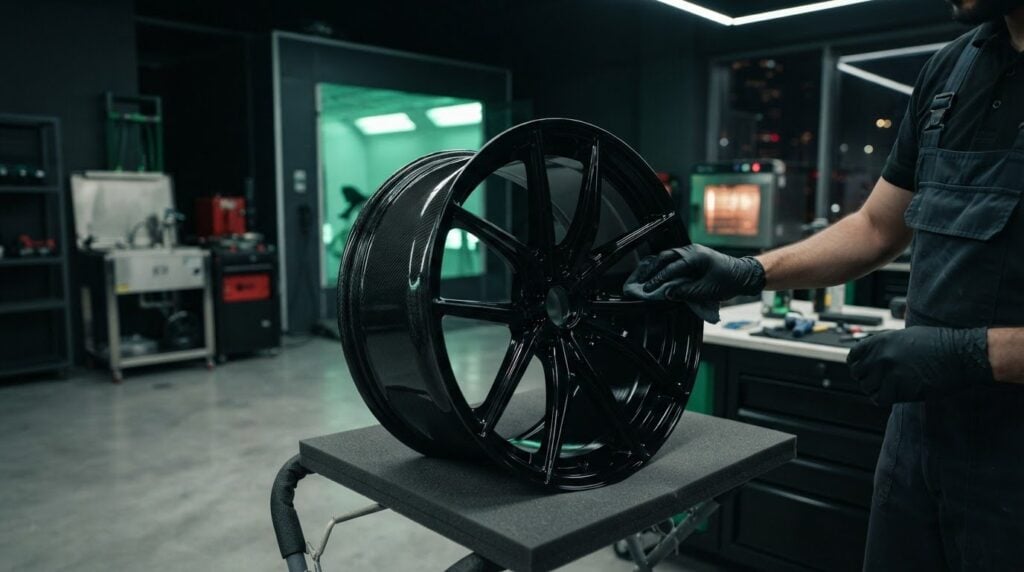
Most quick fixes for curb rash simply hide structural damage beneath fragile aerosol layers that blister the moment your calipers generate real heat. Achieving a flawless gloss black alloy wheel repaint isn’t an afternoon cosmetic touch-up; it’s an exacting technical discipline requiring specialized chemical stripping, precision media preparation, and temperature-controlled thermal curing. If you’ve watched caustic brake dust pit an otherwise immaculate wheel face, you already understand why temporary shortcuts fail under hard driving conditions.
You don’t have to settle for clouded clears or thin paint that flakes away within months. This guide equips you to master the complete evaluation process for a professional wheel transformation, ensuring you achieve an OEM-level, mirror-deep reflection engineered for lasting heat and corrosion resistance. We explore the essential differences across modern refinishing methods, outline the preparation standards elite workshops demand, and reveal the advanced post-finish protection protocols that keep your wheels pristine for years.
Key Takeaways
- A professional gloss black alloy wheel repaint delivers striking visual depth and aggressive contrast while permanently eliminating accumulated curb rash and oxidation.
- Industrial-grade refinishing provides the heat tolerance and chemical resistance necessary to prevent the peeling, chipping, and fading common to DIY sprays and vinyl films.
- Flawless OEM results require a multi-stage technical workflow featuring complete chemical immersion stripping, precision substrate profiling, and controlled thermal curing.
- Advanced clear coats paired with dedicated ceramic barriers shield newly cured alloy surfaces against corrosive iron brake dust and road debris.
- Selecting an elite refinishing partner requires verifying specialized equipment, including sealed down-draft booths, dedicated curing ovens, and computerized wheel balancing systems.
Why Choose a Gloss Black Alloy Wheel Repaint: Aesthetics, Protection, and Value
A professional gloss black alloy wheel repaint is a precision cosmetic and protective engineering upgrade that restores structural surface integrity while redefining your vehicle’s road presence. Factory silver wheels often dilute the visual impact of an otherwise aggressive exterior. Swapping dull, weathered finishes for an obsidian, mirror-like depth establishes an immediate sense of performance and luxury. Beyond pure aesthetics, complete wheel refinishing provides a cost-effective alternative to purchasing replacement aftermarket forged sets, preserving your vehicle’s resale value through strict adherence to OEM standards.
The Aesthetic Impact of Deep Gloss Black on Modern Vehicle Stance
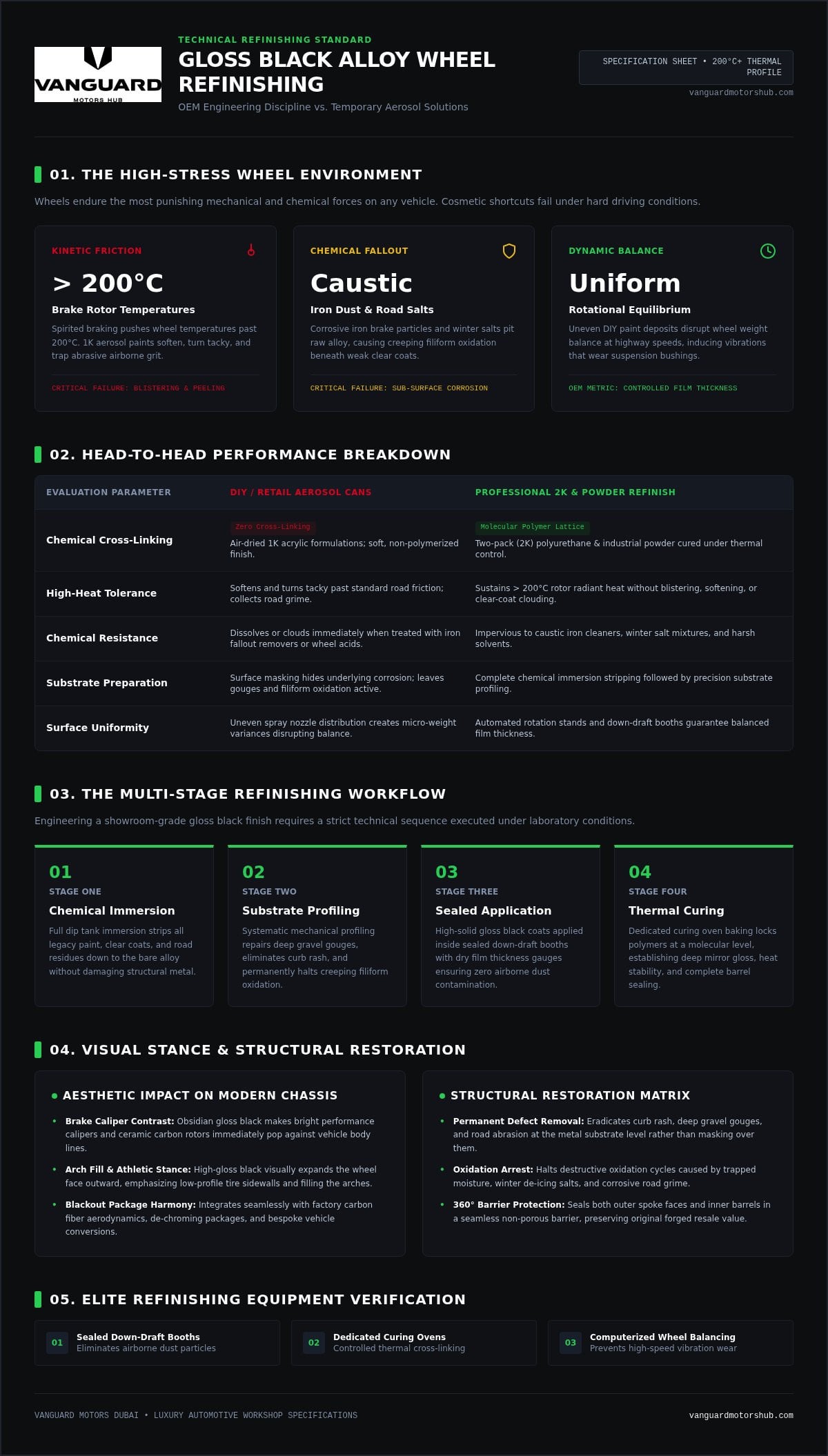
Deep gloss black creates dramatic visual contrast that makes performance brake calipers and ceramic rotors instantly pop against the chassis. The ultra-dark, high-gloss tone visually stretches the wheel face outward, emphasizing low-profile tire fitment and filling wheel arches with an uncompromising, athletic stance. It integrates seamlessly alongside factory carbon fiber aerodynamic packages, window de-chroming, and bespoke car conversions that demand an integrated, blackout aesthetic.
Restoring Curb Rash and Surface Pitting Simultaneously
Temporary cosmetic stickers and quick touch-up pens do not address underlying alloy degradation. A meticulous workshop refinishing process systematically machines out gouges and eliminates corrosive filiform spread creeping beneath lifting clear coats. Utilizing industrial thermal procedures like the powder coating process alongside high-solid clears ensures complete, uniform surface tension across every complex spoke and inner barrel. This thorough rejuvenation delivers tangible structural benefits:
- Permanent Defect Removal: Eradicates curb rash, deep gravel gouges, and road abrasion at the metal substrate level.
- Corrosion Arrest: Halts destructive oxidation cycles caused by trapped moisture, winter salts, and corrosive road grime.
- Total Surface Sealing: Re-establishes a seamless, non-porous protective barrier over both outer faces and interior barrels to repel harsh contaminants.
Professional Wheel Refinishing vs DIY Solutions: The Performance Breakdown
A quick spray job or stick-on patch might seem tempting on a quiet weekend, but wheels occupy the most punishing operating environment on your car. DIY aerosol cans, peelable rubber sprays, and adhesive rim tapes simply cannot endure the sheer mechanical and thermal violence of real driving. While retail products market effortless results, they lack the chemical cross-linking required to survive intense operational friction. True durability demands a professional gloss black alloy wheel repaint carried out under laboratory-grade conditions.
Surface precision matters just as much as chemical composition. When spray cans deposit uneven paint coats across spoke recesses, they create subtle variations in weight distribution. At highway speeds, these micro-variations disrupt wheel balance, causing high-frequency vibrations that wear down suspension bushings and tires prematurely. Professional refinishing avoids this by utilizing automated rotation stands, controlled dry film thickness gauges, and sealed down-draft booths that eliminate air-suspended dust before it ruins the mirror gloss.
Thermal Durability and Chemical Resistance Comparison
Hard braking converts kinetic energy directly into intense heat. Rotors regularly push ambient wheel temperatures beyond 200 degrees Celsius during spirited driving. Standard 1K acrylic rattle-can coatings soften under these temperatures, turning tacky and collecting airborne road grit. When you apply aggressive iron fallout removers or acidic cleaners during your next wash, cheap clears cloud instantly or dissolve entirely. Professional two-pack (2K) polyurethane finishes and industrial powder systems undergo high-temperature baking, forging a cross-linked polymer lattice that locks onto bare alloy at a molecular level.
- Aerosol Enamels: Air-dried 1K formulations, zero cross-linking, soft finishes that degrade under brake heat, and prone to rapid chipping within weeks.
- Adhesive Vinyl Patches: Edge lifting caused by thermal cycling, moisture entrapment underneath, and zero long-term protection against alloy oxidation.
- Professional Multi-Stage Paint: Oven-baked 2K urethane with high-solid clears, impervious to wheel acid and brake heat up to extreme operating thresholds.
Surface Smoothness and Visual Depth of Reflection
Low propellant pressure in aerosol cans creates irregular atomization. This defect causes the familiar, bumpy “orange peel” texture across complex curves and spoke pockets. In contrast, specialized facilities spray high-solids basecoats and clears through precision pneumatic equipment at dialed-in fluid pressures. Technicians dismount tires entirely to wrap the paint cleanly past the outer bead seat, eliminating the raw edges that cause peelable films to lift. If you demand a flawless, glass-smooth finish that matches OEM quality, you can connect with our technical team to review custom refinishing options for your vehicle.
The Multi-Stage Refinishing Process: Engineering a Showroom Finish
Achieving a mirror-like gloss black alloy wheel repaint requires far more than casual surface spraying. It is an industrial, multi-phase technical discipline. Every rim must undergo systematic mechanical disassembly, total chemical stripping, physical alloy reconstruction, and precision thermal curing. Cutting corners on any single phase compromises the bond, leading to premature delamination when the wheels face everyday road abuse. A true bespoke workshop treats each wheel as a structural canvas, engineering durability into every layer.
Preparation: Stripping, Sanding, and Structural Rectification
Flawless refinishing begins with complete mechanical teardown. Technicians fully dismount the tires, remove the valve stems, and strip away all wheel balance weights. The raw wheels undergo an intensive chemical decontamination rinse, using pH-neutral ferrous iron dissolution agents to lift baked-in metallic brake dust from deep inside the spoke valleys. Once decontaminated, the bare alloys enter heated chemical immersion tanks. These industrial stripping solutions dissolve aging factory clears, basecoats, and OEM primers down to the bare metal substrate without degrading the aluminum’s tensile integrity.
Specialists then address physical rim trauma. Technicians repair deep curb rash or spoke gouges by adding matching aluminum material via TIG welding rather than relying on weak body filler compounds. The bare alloy is then blast-profiled using fine media at regulated air pressures. This process creates an engineered microscopic anchor pattern across the face, spokes, and inner barrel. Precision hand-sanding along the outer rim lip smooths out transitions, ensuring that new coatings grip evenly across every contour.
Application: Pigment Density and High-Solids Clear Coating
Once the bare aluminum is chemically stabilized, technicians transfer the wheels into a sealed, down-draft spray environment to begin the multi-coat electrostatic sequence:
- Corrosion-Inhibiting Epoxy Primer: Applied directly to the profiled metal, establishing an impermeable barrier that blocks moisture creep and galvanic corrosion.
- Deep Jet-Black Basecoat: Sprayed with high-density, pure carbon pigments formulated without metallic flake to produce pure, obsidian depth of color.
- High-Solids 2K Clear Coat: Flow-coated across all surfaces to provide a glass-like optical level, UV resistance, and protection against chemical wash solutions.
The entire process finishes inside dedicated curing ovens. Controlled bake cycles bring the wheels to specific thermal dwell points, initiating full chemical cross-linking throughout the resin matrix. This temperature-controlled thermal bake transforms the wet layers into a rock-solid, impact-resistant shield ready to tackle the road.
Evaluating Long-Term Durability: Heat Resistance and Maintenance Protocols
Completing a professional gloss black alloy wheel repaint is only half the battle; maintaining its flawless, glass-like finish demands calculated care. Factory calipers and aggressive performance pads shed red-hot ferrous metallic shards with every deceleration. These incandescent particles easily melt into unshielded clear coats, creating permanent micro-pitting that dulls optical clarity over time. Preserving that deep obsidian reflection requires specialized maintenance regimens and advanced surface barriers that withstand extreme brake temperatures.
Defending Gloss Black Against Swirl Marks and Brake Dust Etching
Deep piano black acts like a visual magnifying glass. Unlike metallic silver or textured anthracite, a smooth gloss surface instantly exposes wash-induced spiderweb scratches and micro-marring under direct sunlight. Automatic car washes and stiff-bristled utility brushes will ruin a pristine clear coat during a single wash cycle. Maintaining unblemished clarity requires touchless pre-rinses, dedicated high-lubricity wheel shampoos, and separate ultra-plush microfiber mitts reserved solely for wheels. Partnering with specialists who understand precision automotive detailing ensures proper decontamination techniques that preserve your finish without dragging grit across the clear coat.
Ceramic Coatings and Wheel PPF: The Ultimate Protective Synergy
Once the multi-stage paint has fully stabilized, sealing the surface with dedicated protective coatings provides essential defense against corrosive road grime. High-temperature wheel ceramics form an ultra-slick, semi-permanent chemical bond over the clear coat, creating an inorganic shield capable of handling heavy track or highway use. This intense hydrophobicity prevents hot brake dust from embedding, turning tedious wheel cleaning into an effortless pressure-wash routine.
For vehicles running flat, expansive spoke designs, combining liquid ceramics with custom-patterned films provides unbeatable defense against highway gravel impact. Applying advanced surface protection film across high-strike spoke faces absorbs physical stone impacts, completely stopping stone chips before they strike the fresh basecoat. To safeguard your investment, follow these essential maintenance protocols:
- Use pH-Neutral Cleaners: Avoid aggressive acids or caustic alkaline wheel sprays that degrade high-solids clear coats over time.
- Never Wash Hot Wheels: Spraying cold water or cleaners onto hot alloys after driving causes thermal shock and bakes active chemicals directly onto the surface.
- Apply Dedicated Sealants: Reapply high-temperature silica sealants periodically to reinforce the hydrophobic layer and simplify road grime removal.
If you want to protect your freshly refinished wheels with specialized ceramic coatings or impact films, book your protection consultation today to keep your finish pristine for years to come.
Commissioning Your Wheel Transformation: Selecting an Elite Specialist
Entrusting high-performance wheels to an ordinary body shop carries real mechanical and cosmetic risk. Executing a flawless gloss black alloy wheel repaint requires a purpose-built facility engineered for high-performance and luxury vehicles. Beyond the paint booth, the mechanical handling protocol determines whether your wheels return in pristine condition or suffer fresh rim edge damage and electronic sensor faults. Choosing the right workshop means looking past surface promises and inspecting technical capabilities.
Facility Standards and Equipment Checklist
Premier refinishing centers set themselves apart through rigorous equipment standards and meticulous mechanical protocols. Before commissioning your transformation, verify that the facility utilizes dedicated machinery designed for performance wheel sets:
- Leverless Tire Mounting: Automated, touchless tire changers with nylon-protected contact points prevent lip gouges during dismounting and bead reseating.
- TPMS Diagnostics: Professional diagnostic tools ensure sensitive tire pressure monitoring sensors are safely mapped, fitted with fresh seals, and recalibrated.
- Dynamic Laser Balancing: Computerized road-force balancers pinpoint weight discrepancies, utilizing low-profile stealth black counterweights that hide seamlessly inside the gloss inner barrel.
- Runout Inspection: Digital dial indicators check lateral and radial runout to guarantee structural trueness before any paint or primer is applied.
Bespoke Craftsmanship with Vanguard Motors
Vanguard Motors provides master-level cosmetic restoration and bespoke alloy color transformations tailored to supercars, luxury sedans, and high-performance SUVs nationwide. Our technicians execute every phase in-house with surgical care, combining structural alloy welding, multi-stage pigment application, and temperature-controlled curing ovens. We seamlessly pair your rim repainting with high-temp ceramic protection, exterior styling packages, or complete vehicle conversions. Ready to transform your stance with obsidian depth? Schedule your alloy wheel refinishing with our customization specialists today.
Elevate Your Vehicle Stance with Precision Refinishing
Settling for temporary cosmetic fixes compromises both vehicle aesthetics and structural integrity. A true professional gloss black alloy wheel repaint delivers deep obsidian depth by combining complete chemical stripping, precision substrate profiling, and controlled thermal curing. When engineered to high-performance standards, your wheels gain the molecular resilience required to withstand intense brake friction and corrosive road fallout without chipping or fading.
Vanguard Motors brings supercar-level craftsmanship to every custom wheel transformation nationwide. Our advanced facility combines dedicated multi-stage preparation booths and industrial bake curing with high-temperature ceramic coatings and protective films, ensuring your mirror-gloss finish stays immaculate on every drive. You don’t have to let weathered rims compromise your vehicle’s road presence. Upgrade your vehicle stance with bespoke gloss black wheel refinishing at Vanguard Motors today and experience the dramatic difference precision engineering makes.
Frequently Asked Questions
Can you repaint damaged alloy wheels gloss black without buying new rims?
Yes, damaged wheels can undergo a comprehensive restorative repaint without purchasing expensive aftermarket replacements. Professional workshops machine away surface abrasion and use TIG aluminum welding to reconstruct deep gouges before applying primer and pigment. This process completely restores structural roundness and cosmetic integrity, transforming curb-rashed or oxidized factory rims into pristine, high-gloss centerpieces that perform to OEM standards at a fraction of new wheel replacement costs.
How long does a professional gloss black alloy wheel repaint typically last?
A professional gloss black alloy wheel repaint typically lasts between four to six years under normal driving conditions when properly maintained. Industrial preparation, multi-layer high-solids primers, and controlled oven baking forge a chemical bond that resists rock chips, intense heat cycles, and salt exposure. Applying dedicated ceramic coatings can extend this service lifespan even further by shielding the clear coat against corrosive iron brake dust and premature UV oxidation.
Is powder coating or wet spray painting better for a gloss black wheel finish?
Powder coating offers superior impact resistance, while wet spray painting delivers greater optical clarity and mirror depth. Powder coating utilizes electrostatically applied dry polymer baked into an exceptionally tough shell, making it ideal for inner barrels and harsh road environments. Conversely, specialized automotive wet paint systems utilizing 2K polyurethane clears achieve razor-sharp reflection free of the orange peel texture sometimes visible in thick powder layers. Elite facilities often combine both methods for optimal strength and clarity.
What happens if you spray painted alloy wheels without stripping the old clear coat?
Spraying over existing clear coats causes poor adhesion, resulting in paint peeling, bubbling, and premature flaking. Factory clear coats often conceal microscopic oxidation, brake dust pitting, and embedded contaminants that prevent new primers from bonding chemically to the aluminum. When aggressive rotor heat expands the metal, trapped contaminants release gases that lift the fresh pigment. True durability requires chemical immersion tanks to dissolve old coatings entirely before laying down fresh epoxy base layers.
Can high brake temperatures cause freshly repainted gloss black wheels to peel?
High brake temperatures will cause DIY sprays to blister, but professional oven-cured coatings withstand aggressive thermal cycling without peeling. Heavy braking pushes caliper and rotor zones past 200 degrees Celsius, which softens retail aerosol enamels and melts adhesive vinyl wraps. Professional refinishing facilities cure high-solid urethane clears and epoxy primers inside dedicated thermal ovens. This baking process triggers molecular cross-linking, producing an impenetrable matrix engineered specifically to tolerate extreme operating temperatures.
How do you clean and wash gloss black alloy wheels without causing swirl marks?
Always wash cool wheels using touchless pressure rinsing, pH-neutral specialized wheel shampoo, and plush microfiber mitts. Never use stiff acid brushes or abrasive wash pads on gloss finishes, as dark pigments easily showcase micro-marring. Start by applying a pH-neutral iron fallout remover to dissolve brake particles chemically before touching the wheel face. Use a two-bucket wash method with grit guards, dedicating separate microfiber towels exclusively for your wheels to prevent dragging abrasive grit across the clear coat.
Will repainting my wheels gloss black hide previous curb rash damage permanently?
Paint alone will not hide curb rash, but a complete professional refinishing service repairs and permanently eliminates the underlying damage. Simply spraying dark pigment over gouged alloy leaves visible indentations and rough edges that eventually peel. An elite workshop systematically sands minor scuffs and welds fresh aluminum into deep gouges, profiling the metal back to factory tolerances before applying primer. Once the multi-stage gloss black alloy wheel repaint is baked, the surface appears immaculate.