

The smartest way of getting the most out of your modified car is to build in stages, matching each upgrade to the vehicle, your driving goals and the demands of UAE roads. Start with the outcome you want, such as sharper responsiveness, better handling or improved off-road capability, then consider durability and everyday comfort. Popular choices include airflow and tuning improvements, tyres and suspension, exhaust changes, and appearance or protection upgrades.
It’s tempting to focus on the most dramatic modification, but a balanced setup is often more satisfying to live with. Choose upgrades that work together, allow for ongoing maintenance, and consider how changes may affect fuel use and upkeep. City driving and desert use call for different priorities, so plan a build around the experience you want and the costs you can sustain.
Key Takeaways
- Define how you use your car and what you want it to do before selecting upgrades, so each change suits the vehicle and your goals.
- Plan for upkeep as well as installation, and weigh how each modification could affect fuel use and ongoing maintenance.
- Prioritise balanced improvements to control, traction and reliability rather than adding power without considering the rest of the setup.
- Make changes in stages and assess how each one performs before deciding what to upgrade next.
- For a visual refresh or added paint protection, compare protective and colour-change options with your priorities for the car.
1. Planning modifications around a vehicle platform and performance goals
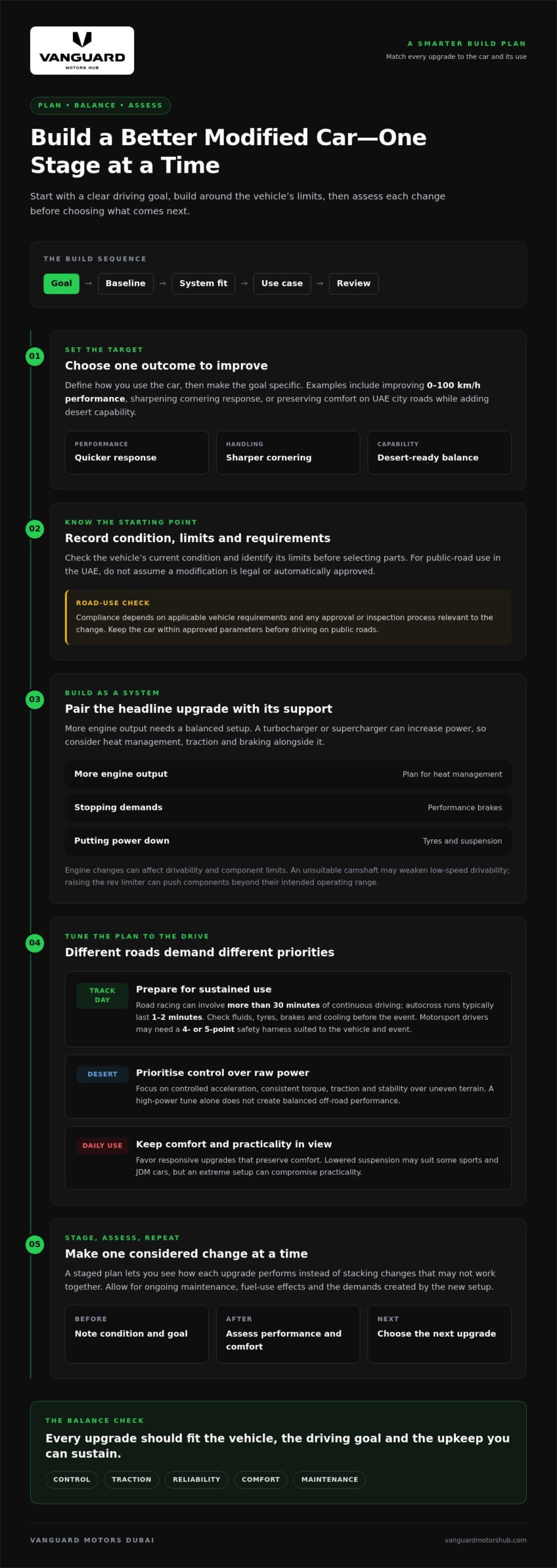
Begin with the vehicle, its intended use, and one measurable goal. That might mean improving 0-100 km/h performance, sharpening cornering response, or maintaining comfort on UAE city roads while building desert capability. Record the car’s current condition and identify its limits before choosing upgrades. A staged plan lets you assess each change instead of stacking modifications that may not work together.
For UAE road use, don’t assume every modification is legal or automatically approved. Road legality depends on compliance with applicable vehicle requirements and any approval or inspection process relevant to the change. Keep the car within approved parameters before driving it on public roads.
For performance and reliability, match upgrades to the vehicle and treat them as a system. A turbocharger or supercharger can increase engine output, so plan for heat management, traction, and braking, not power alone. Performance brakes help meet stopping demands, while tyres and suspension affect how the vehicle puts power down. A camshaft changes engine behaviour, and raising the rev limiter can push components beyond their intended operating range. Consider these changes together rather than as isolated parts.
Engine tuning and aftermarket modifications can create trade-offs. More power may raise fuel use and thermal load; an unsuitable camshaft can weaken low-speed drivability, while poor suspension or wheel fitment can undermine control. Nitrous oxide also demands restraint: an LS1 may run a 150-shot setup, but a 75 or 100-shot is the more conservative choice described for that engine. Avoid extreme output targets unless the supporting systems are designed around them.
For a track day, prepare the vehicle for sustained use, not just a short acceleration run. Road racing can involve more than 30 minutes of continuous driving, while autocross runs typically last 1-2 minutes. Check fluid condition, tyre condition, brakes, and cooling before the event. Motorsport drivers may need a 4- or 5-point safety harness, suited to the vehicle and event requirements.
For desert driving, prioritise controlled acceleration, consistent torque, traction, and stability over uneven terrain. A high-power tune alone won’t deliver balanced off-road performance. For daily use, favour responsive upgrades that preserve comfort. Lowered suspension may suit some sports and JDM cars, but an extreme setup can compromise practicality. Separate aesthetic changes, such as a colour change, from functional upgrades, and decide which result matters most before spending. That discipline helps you get the most out of your modified car without sacrificing usability.
2. Budgeting for modification and upkeep
Build your budget around the full cost of ownership, not just the part or installation. For each upgrade, list the purchase, fitting, supporting changes, and future maintenance separately. A turbocharger, for example, can add demands for cooling, tuning, and drivetrain upkeep. If those related costs don’t fit, revise the setup before committing. This helps prevent one headline modification from using funds needed to keep the vehicle reliable.
Set aside money for routine care based on the vehicle’s service schedule and the demands of its new setup. Higher engine output can put extra load on components, while frequent high-speed driving may increase tyre and brake wear. List the fluids, filters, inspections, and replacement parts that your modifications could affect. For an exhaust change, include periodic checks of its fittings and condition. A written maintenance reserve helps separate the cost of owning an upgrade from the cost of fitting it.
Avoid spending on parts that don’t address a clear limitation. A performance air filter fitted in place of the factory filter requires no modifications, but the gains are marginal. It’s therefore a low priority for a stock vehicle if you want a noticeable transformation. Likewise, performance spark plugs offer little value for a stock or only slightly modified car. Direct your spending toward changes that suit how you use the vehicle.
Consider resale, but don’t treat custom work as an investment. Modifications may not increase resale value because the car’s book value remains the same. An exhaust, wheel setup, or paint treatment may suit your taste without matching a future buyer’s preferences. Keep records of work and maintenance, and preserve original parts where practical. These steps make the vehicle’s history easier to explain, without assuming an upgrade will return its full cost.
Use a simple decision rule before approving each change: identify its purpose, its supporting requirements, and its ongoing upkeep. Then compare that total commitment with the benefit you expect during everyday driving. If an exhaust change remains a priority, you can discuss an exhaust modification as part of your plan. Keep a record of each decision, including the vehicle’s condition before the work and any maintenance that follows.
Maintenance costs vary with the modifications and how the vehicle is used. Set aside funds for affected fluids, filters, inspections, replacement parts, and any additional cooling, tuning, drivetrain, tyre, or brake upkeep.
3. Choosing car modifications wisely
Choose each upgrade to address a specific driving problem, not just for its headline specification. In the UAE, heat management matters for reliability, while dune driving calls for traction, control, and balance rather than raw engine power. Start by identifying where the car struggles: under load, through corners, on uneven ground, or during daily commutes. Then prioritise a change that addresses the limitation without creating a new weakness.
For a stock car that will remain otherwise unchanged, a drop-in air filter fits in place of the factory filter without modifications. The expected gain is only 1-2 horsepower, and its performance benefit is marginal. That makes it a poor choice if your main goal is a noticeable acceleration improvement. An intake upgrade is more useful when it supports a broader, compatible setup rather than serving as a stand-alone promise of major power.
Match exhaust sizing to the engine configuration. A 2.5-inch exhaust is the suggested option for a naturally aspirated car that will stay naturally aspirated; turbocharged or high-power V8 cars are advised to use an exhaust of 3 inches or larger. Bigger isn’t automatically better: the system should suit the engine and its intended use. For GCC driving, intake and exhaust improvements can help an engine perform more efficiently under load, but cooling and tuning also matter.
Prioritise the contact points before chasing power. Tyres strongly influence how a vehicle handles on road and off road, while lighter wheels can reduce rotating mass. Wheels must fit correctly and have an appropriate speed rating. Incompatible or overly wide wheels can create hazards or accelerate wear on bearings and other components. Modest suspension adjustments can support comfort and stability in mixed driving. Strut braces and tower bars reduce flex and can help with grip and stability through corners.
As engine output rises, reassess the rest of the setup. More power calls for more grip, including suitable performance suspension components, and the car’s existing braking power may become inadequate by stage three. Don’t cut springs or heat suspension coils, as these changes can make a vehicle unroadworthy. Engine swaps between vehicles of different sizes and capacities can also make a car unroadworthy. Choose manufacturer-approved parts and accessories to help preserve warranty coverage, and select components developed or provided by companies with suitable standards certifications.
Separate appearance goals from functional ones. A colour change or wheel finish can transform a vehicle’s look, but neither replaces tyres, cooling, or braking improvements. Keep the build suited to daily use: a road car needs predictable handling and usable comfort, while an off-road setup needs controlled torque and stability. This distinction helps keep each modification purposeful, compatible, and easier to maintain.
4. Fuel consumption and maintenance costs
Engine modifications can increase fuel consumption, so compare fuel use before and after each change. A turbocharger, supercharger, or aggressive engine tune can use more fuel, especially under hard acceleration. UAE city traffic, repeated stop-start driving, and frequent high-load use also affect consumption. Track fuel purchases and kilometres travelled in a simple log to see whether a modification changes your real-world running costs.
There’s no single maintenance bill for common modifications. The cost depends on the component, vehicle, parts required, driving conditions, and condition of related systems. For a specific service, pricing depends on the case and is provided after a quote request. A modified exhaust, for example, may need inspection of its connections and condition, while forced induction can add demands for engine, cooling, and drivetrain care.
Use the vehicle manufacturer’s service schedule as your baseline, then account for the parts and usage introduced by modifications. A car driven gently on city roads places different demands on components than one regularly driven at high speeds or under heavy load. Keep a maintenance record for each change, noting the work completed, parts fitted, and symptoms such as unusual noise or heat. Use the record to plan inspections around the car’s actual condition and use.
For UAE conditions, safe tuning starts with calibration suited to the engine, the fuel used, and local heat. Tell the tuner whether the car is used on city roads, carries heavy loads, or sees track use. A conservative setup can reduce unnecessary strain compared with chasing maximum output. After tuning, monitor engine temperature, warning lights, drivability, and fuel consumption. Investigate changes promptly rather than masking them with further adjustments.
Budget by category, not just by upgrade. Set aside separate amounts for routine servicing, consumables, and repairs to supporting components. Tyres and brakes may wear faster if added power encourages harder acceleration or faster driving. A performance air filter fitted to a stock car offers marginal gains, so it may not justify diverting funds from essential upkeep. Spend first on maintenance that protects the engine and other components affected by the new setup.
Review your log after each modification and compare fuel use, service needs, and driving behaviour. If fuel consumption rises noticeably after an exhaust or engine change, consider how often you use the added performance and whether the tune suits your driving. Keep the upgrade if its benefits justify the ongoing demands, or revise the setup before maintenance becomes costly.
5. Gradual modification planning
A staged build makes it easier to understand what each change contributes. Establish a baseline by noting how the vehicle accelerates, handles, brakes, and behaves on your usual UAE journeys. Then choose one priority, such as improving response or preparing for desert use. Record the parts fitted and any changes in fuel use or drivability. This gives you a practical point of comparison before the next upgrade.
Plan the sequence around how components depend on one another. Start with the powertrain only if the engine and cooling system can support the intended use. Then address handling and control, followed by durability and usage-specific enhancements. If an engine modification increases output, assess grip and braking before pursuing further power. Any performance change should prompt a review of the systems that manage acceleration, cornering, and stopping.
Set a clear decision point after each stage. Drive the car in its normal conditions, then assess whether the change delivered the result you wanted. For a UAE commuter, check whether responsiveness improved without making daily driving uncomfortable. For mixed city and desert use, assess comfort on roads and stability on uneven surfaces. Don’t add another component until you understand the previous change’s effect.
Keep the build adaptable. If new wheels alter how the car feels, assess fitment, tyre behaviour, and clearance before changing the suspension. If an exhaust modification changes the sound or engine response, record the result before adding intake or tuning work. Making one change at a time clarifies cause and effect and helps identify a mismatch early, before it becomes part of a larger, more expensive setup.
Plan for durability and maintenance from the start. A vehicle used under load or in desert conditions may need different priorities from a city-focused car. Reassess the plan if your driving changes, such as moving from daily commuting to regular off-road trips. Keep original components where practical and document the setup so future adjustments can be made deliberately. Gradual planning helps improve the car without committing to a complete build before you understand its needs.
For a staged plan that includes exhaust work, discuss an exhaust modification as one part of the wider setup. Connect that decision to your driving goals and the supporting systems, then assess the result before choosing the next change.
Vanguard Motors Dubai: Paint Protection Film (PPF) Installation
Vanguard Motors Dubai offers Paint Protection Film (PPF) Installation for drivers who want to protect their car’s finish while planning performance upgrades. It’s a practical consideration when choosing how to maintain the vehicle’s exterior alongside mechanical changes. For a different visual direction, Colored Sticker Wraps and Peelable Paint Applications offer alternatives focused on changing the car’s appearance.
Choose according to your priority: protecting the paint, refreshing the colour, or selecting a finish you can later change. The Vanguard Premium Package is another option to consider as part of your vehicle plans. Each choice supports a different goal, so think about how you want the car to look and be maintained over time.
Contact Vanguard Motors Dubai to discuss your vehicle, or visit vanguardmotorshub.com.
Make Your Next Upgrade Count
To get the most out of your modified car, choose one improvement that suits how you use and care for it. Give the build a clear direction, then make each decision with the whole vehicle in mind. An exterior finish can be part of that plan, especially if you want the car’s appearance to complement its mechanical setup.
For exterior protection or a visual change, Vanguard Motors Dubai offers Paint Protection Film (PPF) Installation, Colored Sticker Wraps, and Peelable Paint Applications. Each option serves a different preference, from protecting the finish to changing the vehicle’s appearance. Choose what complements your priorities rather than adding a cosmetic change by default.
Ready to discuss an option for your vehicle? Contact Vanguard Motors Dubai and take the next step with confidence.
Frequently Asked Questions
What Are the Most Popular Car Modifications?
Common upgrades include intake and tuning changes, exhaust modifications, tyres, suspension adjustments, and appearance enhancements. The right starting point depends on what you want to change: engine response, cornering feel, desert capability, or the car’s appearance. For example, a driver focused on visual personalisation might choose a colour treatment, while someone seeking better control could assess tyres and suspension before adding engine output.
What Car Modifications Devalue & Increase Value the Most?
Personalised modifications can narrow the pool of interested buyers, while upgrades that support usability may appeal to a wider range. Custom paint, wraps, exhaust changes, and highly individual styling may not return their full cost at resale. Well-maintained tyres and alloy wheels can improve a car’s presentation, and practical technology can refresh an older vehicle. Keep original parts and records to make the car’s condition and changes easier to assess.
What Modifications are Worth Doing?
Modifications are worth considering when they solve a specific issue and suit the car’s regular use. A daily driver may benefit more from a comfortable, well-matched suspension setup than a high-output engine tune. If appearance is the priority, choose a finish you can maintain and that fits your ownership plans. Before committing, consider compatibility, supporting components, maintenance needs, and how easily the change can be reversed.
What modifications provide the best performance gains for the money?
The best value often comes from addressing limitations in the existing setup before pursuing major power gains. Tyres affect how effectively the car accelerates, corners, and stops, while a compatible intake and tune can improve engine response as a package. A drop-in filter alone offers marginal gains, so it may not be worthwhile if you expect a dramatic change. Compare each upgrade’s benefits with its supporting requirements and upkeep.
How can I improve a modified car’s handling, braking, and cooling?
Assess tyre condition, wheel fitment, suspension behaviour, brake response, and engine temperatures as separate systems. If the car feels unstable through corners, it may need suitable tyres or suspension adjustments, not more power. If braking feels inconsistent after an upgrade, inspect the braking system before making further performance changes. In UAE heat and under heavy loads, monitor cooling-system behaviour and address temperature changes promptly rather than relying on a tune alone.
How do modifications affect car insurance, warranty, and resale value in the UAE?
Modifications can affect policy terms, warranty coverage, and buyer interest, so document every change and disclose it to your insurer. Ask how a specific modification affects your policy before driving with the new setup. Manufacturer-approved parts and accessories can help preserve warranty coverage, but they don’t guarantee coverage for every repair. At resale, buyers may value maintenance records and reversible changes, while highly personalised work may not add to the car’s book value.
How much does it cost to maintain common car modifications?
Maintenance costs vary with the modifications and how the vehicle is used. Budget for affected fluids, filters, inspections, and replacement parts, along with any additional cooling, tuning, drivetrain, tyre, or brake upkeep.