

The consequences of illegal car modifications in the UAE can include fines, vehicle confiscation or prosecution, and unapproved changes may affect insurance cover and registration. Dubai’s tint rules are a key example: private vehicles may have up to 50% VLT on side and rear windows, while the front windscreen must remain clear. A sharper look isn’t worth a roadworthiness problem.
A visual upgrade may seem harmless, but the rules depend on what the change affects, whether it has the required approval, and whether the vehicle remains safe and roadworthy. Understanding the limits before work begins can help you avoid legal and insurance complications.
This guide explains which changes are prohibited or may require approval, how the UAE inspection process works, and what can happen to insurance after an unapproved modification. It also gives particular attention to Dubai window tinting, so you can distinguish a compliant finish from one that could put your vehicle’s road status at risk.
Key Takeaways
- Unapproved changes can affect insurance cover after an accident, so understand what your insurer needs to know before modifying your vehicle.
- Significant modifications may require advance approval, an inspection and documentation before the vehicle can be registered for road use.
- Dubai window-tint rules depend on the vehicle and the window. Learn the limits before choosing a darker finish.
- Changes to safety systems, crash structures or vehicle noise can lead to penalties or inspection failure.
- For a visual upgrade without changing core vehicle systems, consider options such as Paint Protection Film, colored wraps or peelable paint applications.
Insurance consequences of unapproved modifications
Unapproved or undeclared changes can reduce or void insurance cover in the UAE. If an accident occurs, the owner may have to meet costs personally. Understanding the consequences of illegal car modifications in UAE matters before changing a vehicle, not only when making a claim.
Insurance risks of undeclared changes
An undeclared modification is a vehicle change the insurer hasn’t been told about. This matters because an insurer may reduce or void cover after a claim involving an unapproved change. For example, an aftermarket exhaust that affects noise or performance may raise questions about disclosure and approval. The consequences of illegal car modifications in UAE can include a claim dispute, reduced compensation, or personal liability for losses.
The insurer’s assessment may depend on the modification and its connection to the claim. A change related to the accident may receive particular scrutiny, but any undeclared modification can complicate the review. Don’t assume that because the vehicle runs normally, the insurer will consider an unreported change immaterial.
Notifying insurers about modifications
Tell your insurer about significant modifications before relying on your existing cover. This lets the insurer assess the altered vehicle and record the change against the policy. Keep the insurer’s response with your vehicle documents, along with any modification approval certificate. If you install an aftermarket exhaust, disclose that specific change rather than assuming it is permitted because the car still runs normally.
Technical approval and insurance notification are separate. Approval from an authority doesn’t automatically update an insurance policy, and notifying the insurer doesn’t make a prohibited modification legal. Keep clear records of what changed, when you informed the insurer, and how it responded. These records can help establish the vehicle’s declared condition when a claim is assessed.
Registration effects on insurance
Registration and insurance are separate checks, but an illegal modification can affect both. A modified vehicle that fails its annual test may not qualify for registration renewal, and it cannot be driven on public roads until the change is reversed or retroactively approved. An active policy doesn’t remove this restriction or make an unregistered vehicle road-legal.
After an accident, disclose the vehicle’s actual condition and provide relevant modification and approval records. If an illegally modified vehicle is impounded, arrange for the prohibited change to be reversed or seek retroactive approval, then complete the required inspection. Follow the applicable impound-release process and keep the approval and inspection documents. Restoring the vehicle alone doesn’t replace these requirements.
Modification approval processes across the UAE
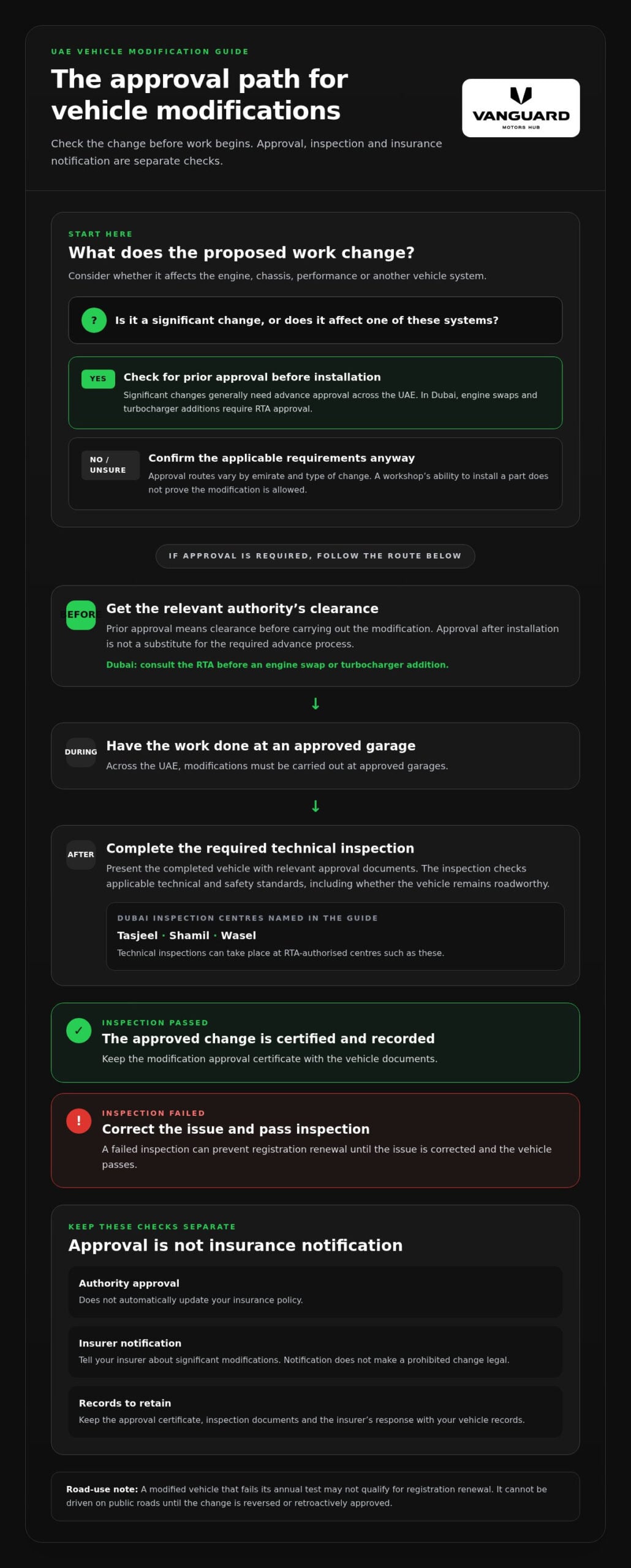
Get approval before making significant vehicle modifications, then complete any required technical inspection. In Dubai, engine swaps and turbocharger additions require RTA approval.
Prior approval for modifications
Prior approval means getting the relevant authority’s clearance before carrying out a modification. Approval after installation isn’t a substitute for the required advance process. In Dubai, engine swaps and turbocharger additions require RTA approval. Across the UAE, significant changes generally need advance approval, and modifications must be carried out at approved garages.
First identify what the proposed work changes: the engine, chassis, performance, or another vehicle system. This helps determine whether the change needs review before installation. An engine swap, for example, is not simply a cosmetic update. In Dubai, consult the RTA before proceeding rather than treating a workshop’s ability to install a part as proof that the modification is allowed.
Post-modification inspection
A post-modification inspection checks whether the completed vehicle meets applicable technical and safety standards. Approval is not complete until the vehicle passes any required inspection. In Dubai, technical inspections can take place at RTA-authorised centres such as Tasjeel, Shamil, and Wasel. A passing result supports certification and recording of the approved modification against the vehicle.
To have a modified vehicle inspected and approved, obtain any required prior approval, have the work completed at an approved garage, and present the vehicle for the required technical inspection. After it passes, the approved changes are certified and recorded against the vehicle. Keep the modification approval certificate in the vehicle.
Bring the vehicle in the condition in which it will be driven, with the modification work complete and relevant approval documents available. The inspection is more than a visual check of the new component. It considers whether the altered vehicle meets applicable standards and remains roadworthy. A failed inspection can prevent registration renewal until the issue is corrected and the vehicle passes.
Approval processes can vary by emirate and by the type of change, so the relevant authority and inspection route matter. Permission to carry out work is different from confirmation that the finished vehicle meets requirements. Skipping the first stage can leave an owner seeking retroactive approval or reversing the modification. Neither should be assumed to replace the required inspection.
- Before installation: establish whether the change requires prior approval.
- During the work: use an approved garage for modifications.
- After installation: complete the required inspection and retain the certificate.
For an appearance-focused change, explore vehicle wrap options separately from mechanical modifications. A styling choice does not replace any approval or inspection required for the vehicle.
What Modifications Are Allowed?
Permitted changes must preserve visibility, safety, and vehicle specifications. Window tint and exhaust noise are practical examples with limits in the UAE.
Window tint visibility limits
Window tint limits control how much light passes through vehicle glass. They matter because darkened windows can reduce visibility for drivers and other road users. For private vehicles, the general UAE standard allows up to 50% tint on side and rear windows.
Front windows must allow at least 50% visibility. Keep the windscreen clear apart from a small sun strip at the top. These rules mean a tint choice should be assessed by window position, not just by how dark the finished vehicle looks from outside.
Before applying tint, identify whether the glass is a side window, rear window, or windscreen. The same treatment across every window may not meet the visibility requirements for each position. Compliance depends on light transmission, so appearance alone is not a reliable guide.
Exhaust noise and emissions limits
An exhaust modification is acceptable only if the vehicle continues to meet applicable noise and technical requirements. This matters because an aftermarket exhaust that exceeds permitted noise levels is illegal in Dubai. Vehicles on Dubai public roads must remain at or below 95 decibels.
The 95-decibel limit concerns vehicle noise, not an emissions allowance. Don’t treat a quieter exhaust as proof that emissions requirements are met, or assume a performance change is permitted because the engine still operates normally. The exhaust and engine must remain consistent with the vehicle’s applicable technical specifications.
Assess the complete exhaust system rather than judging a replacement by its sound at idle. An exhaust that becomes excessively loud on public roads can breach the Dubai limit. Its legality depends on its effect and compliance, not simply on whether it fits the vehicle.
For tint, apply the appropriate visibility limit to each glass position. For exhaust work, assess noise and technical compliance separately. These checks help distinguish a change in appearance from a modification that can affect road use.
Keep the vehicle’s intended use in mind. UAE rules apply on public roads, where visibility and noise affect other road users. A modification that changes a vehicle’s appearance or sound must still meet these requirements.
- Windows: observe the 50% tint standard for private vehicles’ side and rear windows, and maintain at least 50% visibility through front windows.
- Windscreen: keep it clear except for a small sun strip at the top.
- Exhaust: keep public-road noise at or below 95 decibels in Dubai and meet applicable technical specifications.
Prohibited modifications and inspection failures
Changes that compromise safety, roadworthiness, or required standards can fail inspection and lead to penalties. Engine swaps, altered crash structures, and excessive noise deserve particular attention.
Modification checks and inspection failures
A technical inspection checks whether a vehicle’s condition and modifications meet safety and roadworthiness standards. When assessing a used car, look for visible changes to the engine, chassis, suspension, lights, and exhaust, then compare them with available approval records. A mismatch may point to an undeclared upgrade or a modification that needs further review.
Removing airbags, anti-lock braking systems, or electronic stability control is prohibited. Cutting the chassis, removing pillars, or altering crash structures is also prohibited. These changes affect core safety systems, not just appearance, and can make a vehicle unsuitable for public roads. An inspection can identify defects that need correction before registration.
Post-modification inspection and registration
After a modification, the required inspection determines whether the completed vehicle meets applicable standards. This matters at annual renewal: a vehicle that fails its test cannot renew its registration or be driven on public roads until the change is reversed or retroactively approved.
Don’t assume that engine swaps and other substantial upgrades are acceptable just because the vehicle starts and drives. An inspection considers roadworthiness, safety equipment, and the impact of the alteration. Keep approval and inspection documents together, especially when buying a used vehicle with aftermarket parts or a changed engine.
Impoundment and legal penalties
Yes. Illegal engine modifications can bring a 30-day vehicle impoundment, alongside fines and black points. The applicable penalty depends on the violation and location.
Illegal engine modifications may lead to penalties, depending on the circumstances. In Dubai, the listed engine or chassis modification penalty includes a AED 1,000 fine, 12 black points, and 30-day confiscation. Fines for unapproved engine or chassis modifications can reach AED 50,000.
Black points can apply, and illegal vehicle modifications can lead to prosecution. The listed penalties do not make licence suspension automatic; enforcement consequences depend on the violation. For endangering lives through street racing or extreme illegal modifications in Dubai, the listed penalty is 23 black points, with fines exceeding AED 10,000.
Noise and roadworthiness can carry separate penalties. In Dubai, a noisy vehicle exceeding 95 decibels can bring a AED 2,000 fine and 12 black points. A vehicle that fails safety or roadworthiness standards may face penalties. These outcomes show why an aftermarket part needs more than a successful installation.
Before buying a used vehicle, have visible changes to its engine, chassis, and exhaust assessed alongside its approval records. An inspection can help identify discrepancies before purchase, while the vehicle’s registration status indicates whether it passed the required annual test. Treat undocumented engine swaps as a serious roadworthiness concern.
UAE rules for window tinting
National tinting rules depend on vehicle type and glass position. For private vehicles, side and rear windows may have up to 50% Visual Light Transmission (VLT); the front windscreen must remain clear.
VLT describes the percentage of visible light transmitted through glass. A reading of 50% VLT is not the same as saying the film is “50% tint.” Check the stated transmission value for the chosen window tint, because a dark appearance alone can’t establish compliance when considering the consequences of illegal car modifications in UAE.
Private vehicles may have up to 50% VLT on side and rear windows. Company vehicles are permitted 30% VLT. These are different allowances, so identify the vehicle category before choosing a film. Applying the private-vehicle limit to a company vehicle could mean selecting a tint that exceeds its permitted level.
The windscreen has a separate rule. Front windscreen tinting is prohibited, and national regulations require the front windscreen to remain clear. Only a narrow sun strip at the top is permitted, typically 4-6 inches wide. A strip extending farther down the glass may fall outside that allowance.
Some VIPs and professionals may obtain special permits for higher tint levels. This exception depends on having the relevant permit; it doesn’t make darker tint generally permitted. Don’t assume a vehicle qualifies because of its owner’s profession. The permit is what distinguishes an exception from the standard limits.
Exceeding the 50% VLT window-tint limit carries a listed AED 1,500 fine. This makes the distinction between VLT and a film’s marketing description important. Retain the film’s stated transmission information and match it to the relevant vehicle category and glass position to avoid the severe consequences of illegal car modifications in UAE. A clear-looking film can still have a different measured VLT.
- Private vehicle: side and rear windows may have up to 50% VLT.
- Company vehicle: permitted tint is 30% VLT.
- Front windscreen: keep it clear, apart from a narrow 4-6-inch sun strip at the top.
- Special permits: some VIPs and professionals may obtain permission for higher tint levels.
Before choosing a film, match its VLT to the vehicle type and the exact window. For compliant vehicle window tinting at Vanguard Motors Dubai, use the applicable national limits as your starting point.
Vanguard Motors Dubai: Paint Protection Film (PPF) Installation
Vanguard Motors Dubai installs Paint Protection Film (PPF) for drivers seeking a protective, appearance-focused upgrade without changing engine or chassis systems. PPF can help protect a vehicle’s finish while keeping mechanical modifications separate from cosmetic choices.
For a different look, Colored Sticker Wraps and Peelable Paint Applications offer alternatives to changing a vehicle’s appearance. The Vanguard Premium Package is another option. These services don’t replace required approvals for regulated modifications, and appearance changes must still comply with applicable vehicle rules.
If you’re planning a cosmetic update after reviewing the UAE requirements, contact Vanguard Motors Dubai to discuss your vehicle’s finish and choose a suitable option.
Choose a Refined Upgrade for Your Next Drive
Understanding the consequences of illegal car modifications in the UAE can help you personalise your vehicle more thoughtfully. Decide what you want to change, then choose an option that suits your vision without confusing cosmetic styling with mechanical alteration.
Vanguard Motors Dubai offers Paint Protection Film (PPF) Installation, Colored Sticker Wraps, and Peelable Paint Applications. These options let you explore protection or a new visual finish while keeping your project focused on appearance. Choose from a finish that preserves the existing look to one that creates a more individual style.
Bring your preferred look and vehicle goals into the conversation. Contact Vanguard Motors Dubai to discuss your vehicle styling options. Make your next upgrade deliberate, distinctive, and ready for the road.
Frequently Asked Questions
What Is Banned?
Changes that undermine vehicle safety, roadworthiness, or required standards are prohibited. Examples include disabling airbags, anti-lock braking systems, or electronic stability control; cutting a chassis or altering crash structures; and using studded tyres on UAE public roads. Dubai also prohibits police-style sirens, emergency lights, and decals resembling law enforcement. Cosmetic and structural alterations carry different risks, so assess what the work changes, not just how it looks.
Who Makes the Rules?
UAE federal legislation and technical regulations establish the wider framework, while emirate authorities handle applicable vehicle approvals and inspections. In Dubai, the RTA is the relevant authority for changes such as engine swaps and turbocharger additions. Police enforce traffic requirements on roads, and authorised testing centres assess modified vehicles. For a vehicle registered outside Dubai, follow the rules and processes of its registration emirate rather than assuming the Dubai procedure applies.
What car modifications are illegal in the UAE?
Illegal changes include modifications that compromise safety or roadworthiness, such as disabling factory safety systems or cutting structural components. Nitrous oxide systems are illegal for street use without specific racing permits. Other examples include an exhaust that exceeds Dubai’s noise limit, prohibited windscreen tinting, and unauthorised emergency-style lights or markings. A part being sold or fitted doesn’t establish that it is permitted on public roads.
What UAE traffic laws and regulations govern vehicle modifications?
The framework includes UAE Federal Law No. 21 of 1995, as amended, concerning traffic. It also includes UAE Federal Decree-Law No. (20) of 2020 on specifications and standards, Cabinet Resolution No. (45) of 2016 on mandatory standard specifications, and Cabinet Resolution No. (117) of 2024, which establishes a mandatory technical regulation for modified cars. These instruments address traffic, standards, and technical compliance, rather than making every aftermarket change automatically legal.
Which UAE authorities inspect and enforce vehicle modification rules?
In Dubai, the RTA handles relevant approval matters, while RTA-authorised centres such as Tasjeel, Shamil, and Wasel can conduct technical inspections. Police enforce road-use rules. The responsible transport or traffic authority depends on the emirate where the vehicle is registered. A Dubai inspection route, for example, should not be assumed to cover a vehicle registered elsewhere. Approval records and inspection results help show whether a vehicle’s modifications have been accepted.
What are the rules for modified exhausts, window tinting, engine tuning, and suspension?
Dubai public-road vehicles must remain at or below 95 decibels, and an exhaust exceeding permitted noise levels is illegal. Private vehicles may have up to 50% VLT on side and rear windows; the windscreen must stay clear apart from a narrow top sun strip. Engine swaps and turbocharger additions require RTA approval in Dubai. Dubai suspension modifications should maintain approximately 10-13 cm of minimum ground clearance.
Do penalties and rules differ between Dubai, Abu Dhabi, and other emirates?
Some requirements and enforcement details vary by emirate, so Dubai figures should not be treated as nationwide penalties. The UAE also has federal traffic and vehicle standards provisions, including a mandatory technical regulation for modified cars. For a vehicle registered in Abu Dhabi or another emirate, the relevant local authority’s approval and inspection process applies. Confirm the rules for the registration emirate before relying on a Dubai-specific penalty or procedure.
Can illegal modifications affect car insurance claims or vehicle registration in the UAE?
Yes. An undeclared or unapproved change can reduce or void insurance cover after a claim, particularly if the insurer wasn’t told about a significant modification. Registration can also be affected: a vehicle that fails its annual test because of an illegal change cannot renew its registration until the issue is reversed or retroactively approved. Keep insurer correspondence, approval records, and inspection documents together to support a clear assessment of the vehicle’s status.