
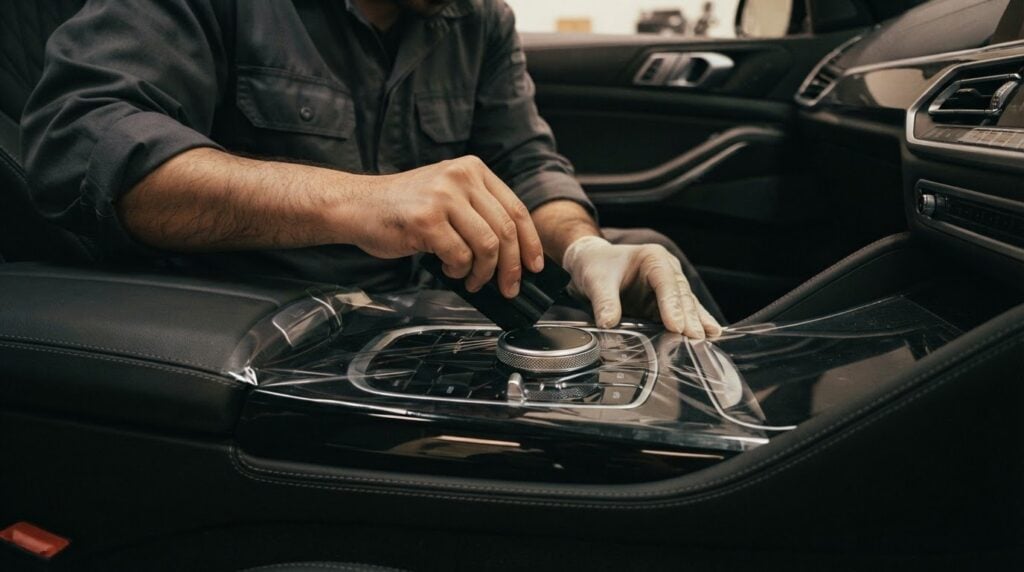
Choose interior protection film for the surface and its use, not simply because it gets touched often. For interior protection film for high-traffic areas, consider material compatibility, finish and how neatly the film can fit around consoles and controls. A suitable match helps protect frequently handled areas without distracting from the cabin’s design.
Frequent contact can wear consoles, switches and trim before the rest of the interior. This guide explains how to assess film suitability, compare gloss, satin and matte finishes, and identify the details a professional installer considers around complex surfaces. You’ll also learn how to balance protection with visibility and usability, so the cabin remains cohesive rather than looking covered up.
Key Takeaways
- Match the film material to the interior surface and the way that area is used.
- Prioritize frequently touched zones, including centre consoles, switches and other controls.
- Choose a gloss, satin or matte finish to complement the cabin while preserving a clear, cohesive appearance.
- Precise installation around edges and controls helps the film fit the surface without disrupting its use.
- Learn how professional Paint Protection Film installation can help protect selected interior surfaces.
Surface protection film materials and applications
Start by matching the film to the surface material, finish and type of contact. A piano-black console needs a different fit assessment from a textured door panel or carbon-fibre insert. Film should follow the surface while keeping its appearance and controls clear. Focus coverage on repeat-contact points instead of automatically covering the largest visible area.
Check the product specifications to confirm which material a marine surface protection film uses. That material fact applies to marine film, not necessarily to every vehicle-interior product. Marine films may offer optical clarity and can be available in gloss, satin or matte. Marine applications include stainless steel, glass, marble, composites and painted surfaces, such as galley worktops and appliance fronts.
For a vehicle in the UAE, a professional assessment should document the cabin materials, existing wear and frequently touched areas. A centre console, door pull, grab handle and glossy trim each have different shapes and finishes. Use the assessment to identify priorities, map film coverage and set suitable cleaning expectations for each surface.
Handrails and stairwell rails are common high-touch marine surfaces; vehicle equivalents include grab handles and door pulls. Film may suit these repeated-contact areas, but assess curves and edges individually. Clear film can preserve the look of piano-black trim, while satin or matte changes its appearance. Carbon-fibre surfaces also need a finish assessment to ensure the film works with the visible pattern.
Careful preparation helps film sit neatly. Professionals first clean the surface using a suitable method, such as a quick wash, detailing spray or isopropyl alcohol. A soapy-water solution or gel can help align the film during application. Pay particular attention to edges, recesses and control openings, where poor placement can affect fit or use.
How much does interior protection film cost in the UAE? The price depends on the vehicle, coverage, surface complexity, film and preparation. Request a quote for your vehicle and selected areas.
How do professionals prepare surfaces and install interior protection film? They assess the surface material and finish, clean away contamination, then position the film using an alignment solution where appropriate. They shape and inspect the application around edges, recesses and controls.
Protective films can create smoother, less porous surfaces that are easier to clean. In marine galleys, this can help manage fingerprints, grease and watermarks on busy work areas. For vehicle interiors, material compatibility and the intended cleaning routine guide film selection. A considered plan protects touchpoints while respecting the cabin’s original design.
Protective film is used in yacht galleys, crew corridors, stairwells, lifts, laundry rooms, pantries, service areas, bridge access routes, tender garages and beach clubs. On yachts, grease, fingerprints, watermarks and other contaminants are less likely to adhere to protective film, which can reduce cleaning time in busy galleys and service areas. Depending on the product, yacht surface protection film may provide optical clarity that preserves the surface’s original appearance and may offer UV resistance to minimise fading and discolouration. Some yacht surface protection films are available in gloss, satin and matte. Protective film can help preserve yacht interior finishes and reduce repairs, polishing, refinishing or replacement.
High-traffic interior applications
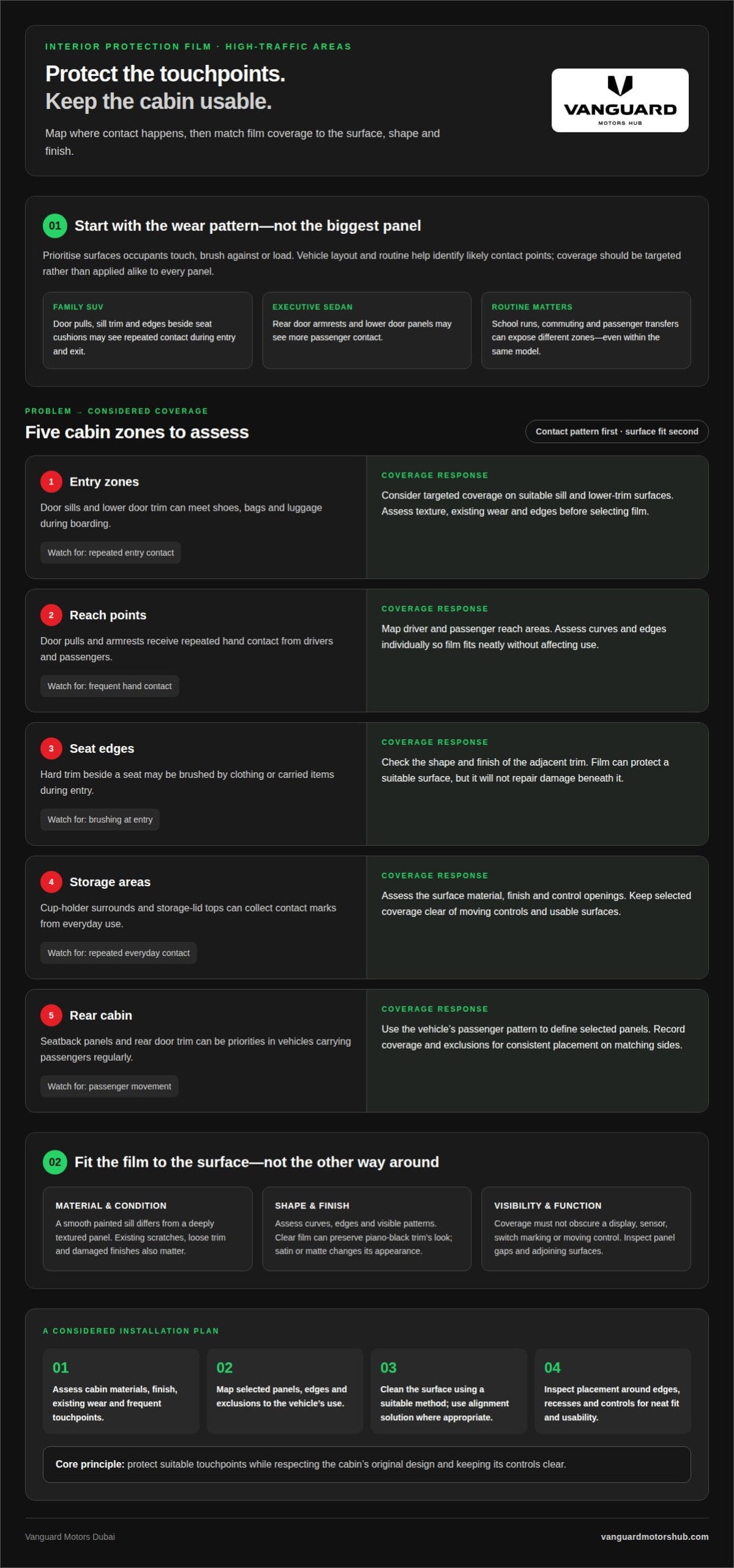
Prioritise surfaces according to how often occupants touch, brush against or load them. In a family SUV, door pulls, sill trim and the edges beside seat cushions may face repeated contact during entry and exit. In an executive sedan, rear door armrests and lower door panels may see more passenger contact. Base coverage on these wear patterns, not on the size of the visible area.
Map the cabin according to occupant movement. The driver’s side has different contact points from the rear passenger area, while frequent passenger transfers can increase wear around entry points. A professional can identify likely contact patterns from the vehicle layout and how it is used, then define targeted coverage. This keeps the plan focused on exposed surfaces instead of treating every panel alike.
- Entry zones: door sills and lower door trim can meet shoes, bags and luggage during boarding.
- Reach points: door pulls and armrests receive repeated hand contact from drivers and passengers.
- Seat edges: hard trim beside a seat may be brushed by clothing or carried items during entry.
- Storage areas: cup-holder surrounds and storage-lid tops can collect contact marks from everyday use.
- Rear cabins: seatback panels and rear door trim can be priorities in vehicles carrying passengers regularly.
Material and shape determine whether a surface is suitable. A smooth painted sill differs from a deeply textured lower door panel, and a curved edge needs a different assessment from a flat trim insert. Existing scratches, loose trim and damaged finishes also matter. Film can protect a suitable surface, but it won’t repair damage beneath it.
In the UAE, a tailored assessment should account for the vehicle’s actual routine, such as school runs, daily commuting or passenger transfers. Those examples point to different contact zones, even within the same model. A clear coverage map can record the selected panels, edges and exclusions, helping the installer maintain consistent placement across matching left and right sides.
Prioritise visibility and function alongside protection. Coverage must not obscure a display, sensor, switch marking or moving control. The installer should inspect panel gaps and adjoining surfaces, then finish the film neatly around each selected boundary. For a tailored discussion of your cabin’s busiest zones, share your vehicle’s interior priorities.
Selective coverage is useful when wear is concentrated in a few areas. For example, door sills may show repeated contact while the rear trim remains clean. Mapping those differences helps match installation to actual use, preserve the cabin’s visual balance and avoid unnecessary coverage on less exposed panels.
Protective film properties and finishes
Compare the film finish with the cabin’s existing materials. Gloss can retain the polished look of piano-black trim, while satin or matte creates a lower-sheen appearance. Clear film may preserve a surface’s visible colour and pattern, but the result depends on the film and substrate. View the finish against the actual panel before planning wider coverage.
Film properties vary by product. Check the product information for any claimed resistance to water or contaminants. Others have self-healing properties that help minor scratches disappear with heat. Don’t assume every film has these features. Consider where spills, fingerprints or light surface marks are most likely in the vehicle, then match the requested property to that use.
UV performance also depends on the film. Modern marine protection films are described as blocking 90-100% of UV, but this figure applies to marine films, not every automotive interior film. For a vehicle’s dashboard or trim, consider the specific product’s stated performance alongside the surface’s exposure. This distinction matters in the UAE, where cabin materials may face strong sunlight through vehicle glazing.
How does protection film compare with wall guards, paint, and protective coatings? Film creates a removable layer over a suitable surface; a wall guard is a more visible physical barrier, paint changes the surface finish, and a coating adds a treatment rather than a fitted film layer. On a curved console or trim insert, film can follow the panel more closely than a rigid guard.
- Clarity: A clear finish suits a panel where preserving the original appearance is the priority.
- Gloss: This finish can complement reflective trim, though it may make the film more noticeable.
- Satin: A restrained sheen can sit between glossy and matte cabin surfaces.
- Matte: This option can coordinate with low-sheen trim, while changing the panel’s look.
What are the risks, limitations, and warranty terms for interior protection film? Poor surface compatibility, visible edges or a mismatched finish can affect the result, and film won’t repair existing damage. Warranty coverage and duration depend on the product and installation terms. Review the written terms for covered defects and exclusions.
Before installation, a professional assesses the surface condition, curves, seams and controls. A film suited to a flat painted insert may behave differently on textured trim or a tightly curved console. Edge placement matters too: film should not obstruct buttons, labels or moving parts. These checks help match the finish and fit to each selected panel while keeping it functional.
For frequently touched areas, choose film properties for a clear purpose rather than defaulting to the option with the most features. Clear film may suit a glossy centre console; a matte finish may better match a low-sheen door insert. The right choice balances protection, appearance and how occupants use the surface.
Centre console and control protection
A centre console combines several functions in a compact space. It may include a touchscreen, rotary selector, climate buttons, cup holders and a storage lid. Consider coverage for each component separately. Film should protect suitable trim without masking labels, restricting movement or limiting access to essential controls.
A professional starts by mapping the console’s fixed panels and moving parts. The installer distinguishes decorative surfaces from buttons, switches, display glass and hinged lids. That distinction matters: film across a button marking can reduce legibility, while coverage over a lid seam can affect opening. Clear boundaries help keep the installation precise.
- Touchscreen borders: Keep the display and its operating area unobstructed unless the film is specifically intended for that surface.
- Button clusters: Align film around symbols and moving buttons so markings remain visible and controls remain accessible.
- Rotary selectors: Preserve the selector’s full movement and avoid edges that cross its operating clearance.
- Cup-holder surrounds: Consider the trim around the opening separately from the inside, where shape and use differ.
- Storage lids: Follow the panel boundary and hinge line rather than bridging a moving joint.
Curves and narrow recesses call for careful pattern placement. A console that narrows towards the gear selector may need separate pieces rather than one broad sheet. The installer checks how each edge meets adjoining trim and whether the film follows the surface without lifting or creating a distracting border. Precision is especially important around frequently handled controls.
Finish also affects the console’s visual balance. Clear film can retain the underlying colour, while gloss, satin or matte can change how light reflects. Fingerprints and overhead reflections may already stand out on dark, reflective panels. Choose a finish that works with adjoining trim, instrument surrounds and the cabin’s overall design.
Surface condition affects the work. Existing scratches, peeling trim or loose components need attention before film is applied, because the film follows the surface beneath it. The installer assesses the panel, identifies damage and defines suitable coverage. Openings, seams and control markings should remain clear during application.
After fitting, a final inspection should check each accessible control and moving feature. The installer tests button travel, selector movement, lid opening, display visibility and edge alignment. A panel-by-panel review can catch a misplaced edge before the vehicle returns to regular use. Plan coverage around the console’s function first, then refine it to preserve appearance.
What is interior protection film and how does it work?
Interior protection film is a thin layer applied to selected vehicle surfaces. It creates a barrier between the underlying finish and everyday contact, such as fingers, light scuffs or items brushing a door sill. On a centre console, film sits over suitable trim while leaving the panel’s shape and controls accessible. It protects the surface beneath but doesn’t repair existing scratches or damaged material.
Think of it as an overlay, not a new panel or a coating applied like paint. Its performance depends on the film, the surface and installation precision. A smooth, clean piano-black insert presents different fitting conditions from textured trim or a curved cup-holder surround. The installer assesses each surface before defining coverage.
Professional installation follows a deliberate sequence:
- Inspect the panel. Identify its material, finish, contours, seams and existing marks. Note openings around switches, displays and storage lids.
- Prepare the surface. Clean away dust and residue so contamination doesn’t sit beneath the film. The preparation method must suit the vehicle’s interior material.
- Position the film. An alignment solution, such as soapy water or gel, can help place film accurately where the product and method call for it.
- Fit and inspect. Shape the film to the selected area, then review its edges, seams and clearance around moving controls.
Placement is central to how film works in daily use. A well-planned piece follows the chosen panel while avoiding button markings, display areas and moving joints. For example, film around a storage lid should not bridge the opening seam. This lets the protected trim and the mechanism function independently.
Some marine surface protection films are described as removable and replaceable without altering the underlying surface. Don’t assume that applies to every vehicle-interior film. Product choice, the underlying finish and the removal method all matter. A professional assesses these factors before recommending film for a painted insert, composite trim or another suitable surface.
After installation, inspect the visible edges, alignment and access to the protected area. Film should not cover a control label or interfere with a switch. Follow the selected product’s care guidance, especially when cleaning a newly installed console or door panel.
For a professional assessment of suitable vehicle surfaces and coverage, discuss your interior film installation.
Vanguard Motors Dubai: Paint Protection Film (PPF) Installation
Vanguard Motors Dubai installs Paint Protection Film (PPF) for drivers seeking a professional way to protect selected vehicle surfaces. Choose this service when you’ve identified frequently handled or exposed areas and want coverage planned around the cabin’s materials, contours and controls. A considered installation plan prioritises suitable panels while preserving access and visibility.
For a broader aesthetic change, Colored Sticker Wraps and Peelable Paint Applications provide options for changing a vehicle’s appearance. The right choice depends on whether your priority is surface protection or visual transformation. Share your vehicle details and the areas you want to address to discuss an approach that suits your goals.
Contact Vanguard Motors Dubai to discuss your vehicle’s protection needs.
Set a Clear Direction for Your Interior
Decide how you want the cabin to look and feel in everyday use. A focused plan for interior protection film for high-traffic areas keeps attention on the surfaces that matter most while preserving the character of your vehicle’s interior.
For broader vehicle customisation, Vanguard Motors Dubai offers Paint Protection Film (PPF) Installation, Colored Sticker Wraps and Peelable Paint Applications. Each serves a different purpose, from surface protection to changing appearance. Consider which outcome fits your priorities, then book a service or request a quote.
Bring your vehicle details and the areas you want to address into the conversation. That gives the installation discussion a clear starting point and helps shape a plan around your goals. Contact Vanguard Motors Dubai to discuss your vehicle and take the next step with confidence.
Frequently Asked Questions
Which interior protection films are best for high-traffic areas?
The best film suits the surface material, shape and desired appearance. Clear film can maintain the look of a glossy console, while a matte option may complement a low-sheen door insert. For interior protection film for high-traffic areas, compare the product’s stated properties and finish with the cabin’s actual wear points, rather than choosing by appearance alone.
What surfaces can interior protection film be applied to?
Film can be applied to suitable, clean interior surfaces, with compatibility assessed for each material. Examples include painted trim, smooth console panels and selected door inserts. Textured plastics, leather and damaged surfaces need a separate assessment before coverage is planned. Curves, seams and moving parts also affect suitability, so define exact coverage boundaries instead of assuming every cabin surface can be filmed.
How durable is interior protection film under heavy daily use?
Durability varies with the film, surface condition, installation quality and type of contact. A door sill exposed to shoes and luggage faces different wear from a console touched by fingertips. Repeated abrasion, sharp objects and cleaning habits can affect film over time. Inspect edges and frequently used areas to assess wear, then follow the product’s care guidance to help maintain its appearance.
How do you clean and maintain interior protection film?
Use the cleaning method recommended for the specific film and vehicle surface. For example, promptly remove a fresh drink spill from a protected console with a soft, clean cloth, then dry the area without scrubbing the film edge. Avoid abrasive pads that could mark the finish. Include covered door trim and console panels in routine cabin cleaning, and have lifting edges assessed rather than pulling at them.