
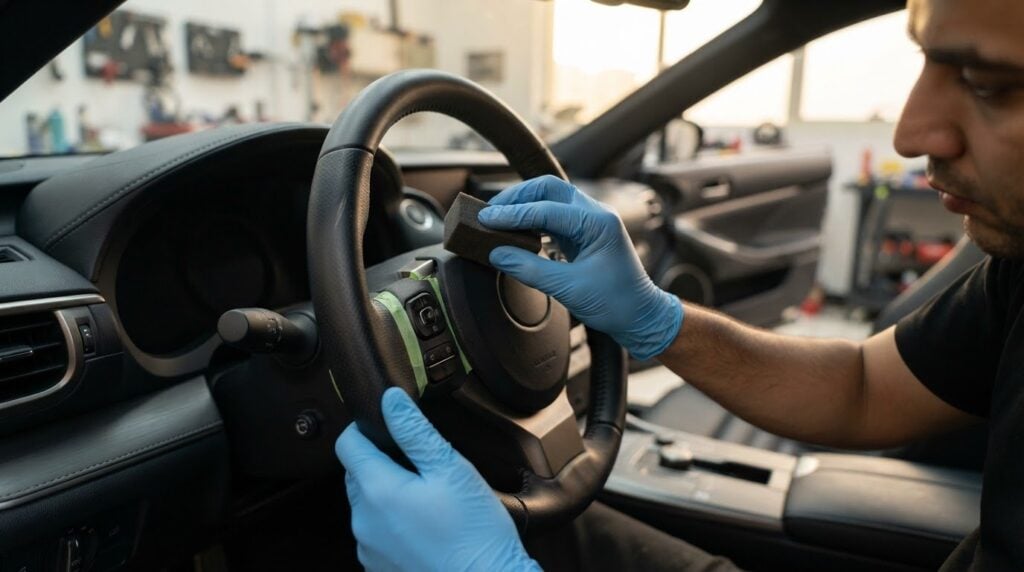
A scratched leather steering wheel doesn’t automatically need replacing. Leather steering wheel scratch repair may involve cleaning the surface, smoothing minor marks, and restoring colour where the leather has worn away. The right approach depends on the scratch’s depth and the condition of the surrounding material.
At Vanguard Motors Dubai, it’s understandable to want a finish that looks refined and feels comfortable in your hands, especially when the UAE’s climate and daily driving take their toll on an interior. Rings or hard objects can also leave marks, while stretched leather is a different kind of damage from a surface scratch.
This guide explains common causes of steering wheel wear and how cleaning, repair, and recolouring work. You’ll also learn what affects repair timing and why warranty treatment may differ between stretched leather and damage caused during use.
From light surface marks to more visible wear, understanding the repair process helps you set realistic expectations and choose the right next step for your steering wheel.
Key Takeaways
- Learn how to distinguish a light surface mark from deeper damage that may need professional restoration.
- Understand how cracks, worn grain and a slippery feel can signal different types of leather wear.
- See how heat, regular handling, rings and objects in pockets can contribute to steering wheel marks.
- Follow the key stages of inspection, surface preparation, repair and colour blending.
- Find out why repair timing depends on the damage and preparation involved, and why warranty treatment can differ for stretched leather and user-caused marks.
Repair duration and warranty
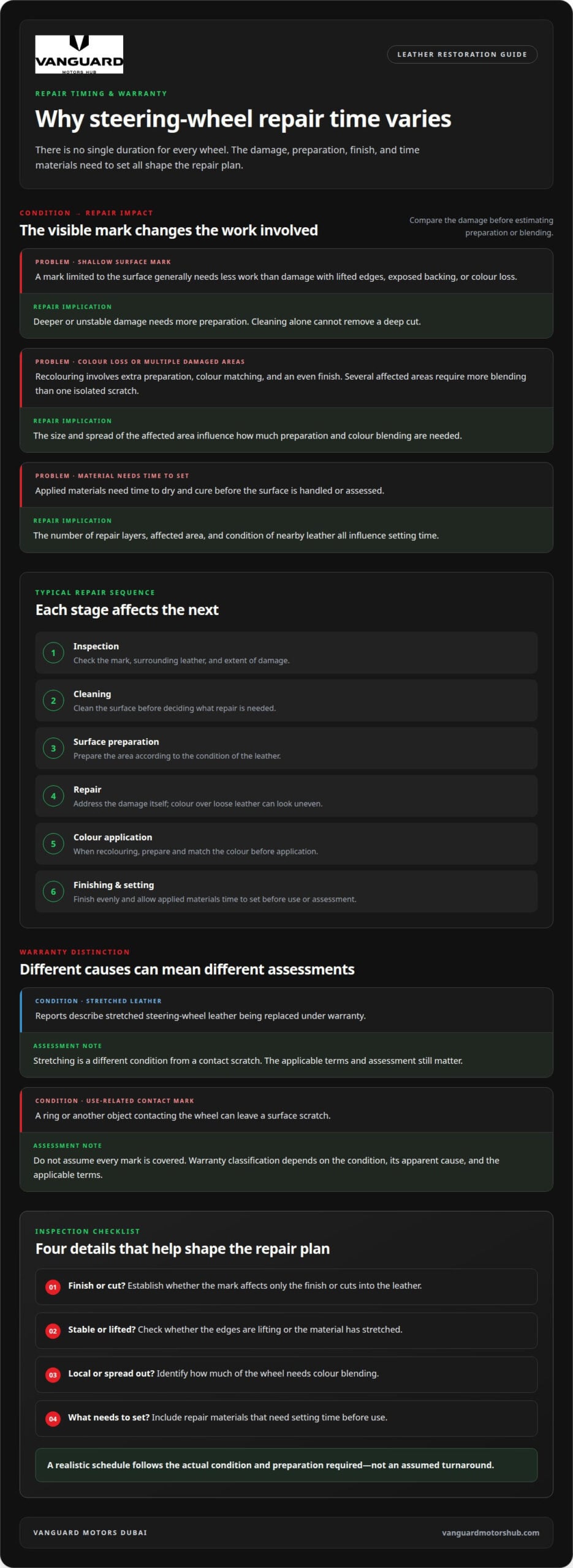
Repair time depends on the damage, preparation required, and finish being restored. A shallow surface mark needs less work than a scratch with lifted edges, exposed backing, or colour loss. Recolouring adds steps because the area must be prepared, colour matched, and finished evenly. There is no single duration that fits every steering wheel.
The process usually includes inspection, cleaning, surface preparation, repair, colour application, and finishing. Each stage affects the next. Cleaner cannot remove a deep cut, for example, and colour applied over loose leather can look uneven. If inspection reveals several damaged areas, preparation and blending may take longer than work on one isolated scratch.
Drying and curing also affect the schedule. Applied materials need time to set before the surface is handled or assessed. The number of repair layers, the size of the affected area, and the condition of nearby leather all influence this stage. A narrow scrape with stable edges needs different preparation from worn leather extending around the wheel.
Warranty coverage raises a separate question: what caused the damage? Reports describe stretched steering wheel leather being replaced under warranty, while distinguishing that condition from scratches caused during use. Stretching and a contact mark are different types of damage. A warranty assessment considers the condition and its apparent cause, as well as the applicable terms.
For example, a surface scratch associated with a ring or another object contacting the wheel is user-caused damage, not the same issue as stretched leather. Don’t assume a warranty claim covers every mark. The repair decision also differs: a scratch may need local surface work and recolouring, while stretched leather can require a different remedy.
To understand the likely schedule, an inspection should establish:
- Whether the mark affects only the finish or cuts into the leather.
- Whether edges are lifting or the material has stretched.
- How much of the wheel needs colour blending.
- Which repair materials need setting time before use.
The repair plan should reflect the actual condition, not an assumed turnaround. If you’re considering warranty coverage, distinguish a material condition from use-related damage. For restoration, the mark’s depth and the preparation required are key factors in timing.
One forum participant says steering wheel damage caused by user error would not be covered under warranty. Treat that as a caution, not a decision about any particular claim: it reflects the participant’s view, while the applicable warranty terms and assessment still matter. Separating the reason for the damage from its visible condition helps clarify the issue.
If coverage is uncertain, ask the warranty provider how the reported issue is classified before choosing a repair. Clarify whether it’s considered user-caused damage or a different condition. The answer can guide whether to pursue a warranty assessment or arrange restoration separately, without assuming either outcome is guaranteed.
Cracks, worn grain and slippery leather
A cracked steering wheel may have surface-level finish damage or a deeper split, and the distinction changes the repair approach. Fine lines around a frequently gripped area look different from an opening that exposes the material beneath. Inspection should follow each crack’s edges and check whether the surrounding leather remains firm. A small mark and a widening split aren’t equivalent.
Worn grain has a different visual clue. Leather grain creates texture, so a smooth, shiny patch can indicate that the texture has worn down. Check where the change appears: a polished area on the upper rim differs from a rough patch near a seam. Colour loss may accompany worn grain, but adding colour alone won’t rebuild missing texture. Repair must address the surface condition as well as its appearance.
A slippery feel also needs careful assessment. Hand oils, cleaning product residue, and a worn finish can all change how the wheel feels. A wheel that feels slick across a broad area, for example, may need cleaning before any repair decision. A localized smooth patch may point to finish wear. Cleaning helps reveal whether residue is masking a material change.
Use these observations to describe the condition clearly:
- Cracks: Note whether lines are shallow, open, or lifting at the edges.
- Grain: Compare the affected patch with the textured leather beside it.
- Feel: Identify whether slickness covers the rim or stays in one spot.
- Location: Mark whether damage sits near a seam, spoke, or gripping area.
These clues help distinguish a surface that needs cleaning from one needing repair and recolouring. A crack beside a seam deserves attention because its edge can affect how the repair blends. A worn, smooth patch may need texture-focused preparation, while a slick surface should be cleaned before assessing colour or finish. Treating every symptom as a scratch risks overlooking the real condition.
Avoid aggressive rubbing on cracked or worn leather. Pressure can disturb loose edges, while abrasive treatment can change the texture around a small defect. If a crack catches on a fingertip or the grain appears visibly flattened, professional assessment can clarify the suitable restoration approach. For guidance on the damage pattern, share details about the steering wheel’s condition.
Heat, daily use and other causes of steering wheel wear
A vehicle’s climate, regular contact, and interior conditions all affect its steering wheel. Repeated outdoor parking exposes the cabin to strong heat, which can contribute to leather drying and surface wear over time. The wheel is also handled during every drive, so its upper rim, lower edge, and grip zones can age differently.
Daily handling leaves oils from a driver’s hands on the leather. Regular handling can change the leather’s surface over time, but visible damage may still need attention. A shiny patch where hands regularly rest indicates a different wear pattern from a sharp, isolated scratch. Repeated gripping also explains why damage often concentrates around frequently held sections.
Hard objects create more localized marks. A ring can scratch the leather as a hand turns the wheel. Keys or another object in a pocket can catch the lower rim when getting into or out of the vehicle. A scrape on the lower edge may appear away from the main grip zones, making its location a useful clue about how contact occurred.
Consider these common patterns when describing wear:
- Broad, smooth patches: Regular hand contact and surface oils can polish frequently gripped areas.
- Short, sharp lines: A ring or hard object can leave a distinct contact scratch.
- Lower-rim marks: Keys or pocket contents can catch the wheel during entry or exit.
- Uneven fading: Heat exposure and repeated handling can affect different areas at different rates.
These clues help distinguish gradual wear from a single impact. A smooth upper section beside a fresh line on the lower edge, for example, suggests different causes on one wheel. A repair assessment should map each area rather than treating the entire rim as one uniform defect. This supports better decisions about cleaning, surface repair, and colour blending.
Prevent damage by reducing avoidable contact. Remove bulky keys from your pocket before getting in, and take care with rings while gripping the wheel. Clean residue with a mild leather cleaner, then apply conditioner as appropriate for the leather. Avoid abrasive scrubbing, which can disturb the finish around a mark. Parking in shade when practical also reduces direct sun exposure inside the cabin.
Heat, handling, and contact leave different signs. A localized scratch needs a different assessment from broad, polished wear. Recording each mark’s position, texture, and shape gives a clearer picture of the steering wheel’s condition before repair.
Inspection and surface preparation
Sandpaper, solvents, and household products can damage leather’s finish or texture. Abrasive rubbing may widen a mark, while unsuitable cleaners can discolour the surface or leave residue that interferes with repair.
Inspection starts by locating every defect across the rim, spokes, and seams. A single scratch near the lower edge needs different preparation from several worn patches around the grip. The surface is checked for loose edges, colour loss, cracks, and residue. This helps determine whether cleaning alone may help or whether repair and recolouring are needed.
Next, the wheel is cleaned with a mild leather cleaner. A clean surface makes the scratch easier to assess and helps reveal whether a shiny area comes from residue or a worn finish. Apply the cleaner carefully, then remove it without soaking the leather. Household sprays and strong solvents are poor substitutes because they can affect the colour and surface coating.
Preparation depends on the defect. Handle loose material around a scratch carefully, since pulling it can enlarge the damaged area. A leather specialist may smooth a scrape and use colour-matched dye to address surface and colour loss. Fine-grit sanding has been used on scratches, but aggressive or broad sanding can remove surrounding texture and leave a larger visible patch.
Before repair, the inspection should establish:
- Location: Mark whether the defect sits on the rim, spoke, or beside a seam.
- Surface condition: Identify loose edges, exposed material, and residue.
- Finish change: Compare the colour and texture with adjacent leather.
- Repair area: Determine whether the defect is isolated or blends into wider wear.
Clean boundaries matter. If colour work extends beyond the scratch, preparation must account for the neighbouring finish. A small mark in dark leather may be less conspicuous than the same defect on a contrasting surface, but colour matching still needs care. Repair material applied over dirt or conditioner may bond unevenly, so clean the surface before filling, smoothing, or dyeing.
Check the surface carefully before applying repair products. Make sure cleaner residue is gone and the leather is dry. Avoid shoe polish, household oils, and untested cleaners; they may temporarily mask a scratch or complicate later colour work. Controlled preparation preserves the surrounding grain and gives the repair a clean starting surface.
Leather steering wheel cleaning, repair and recolouring
A clean surface reveals whether a mark needs conditioning, surface repair, or colour restoration. The method depends on the damage, not just its appearance.
Repair kit or professional service
A leather repair kit may suit a small, shallow mark when the surrounding finish remains stable. Professional repair is better suited to scratches with missing colour, lifted edges, or damage crossing textured areas. The key question is whether the repair can blend into the existing grain and colour. A poorly matched patch may stand out more than the original scratch.
Professional repair cost
In the UAE, pricing for professional repair, reupholstery, or replacement depends on the case and is provided after a quote request. Cost factors include the extent of damage, preparation, colour matching, and whether restoration or replacement is needed. A localized scrape and a wheel needing full re-covering involve different work. An inspection establishes which approach fits the condition.
Reupholstery replaces the covering, while replacement changes the steering wheel assembly. Both differ from restoring a surface scratch, so identify the work required before pricing.
Repair materials and tools
Cleaning and minor care may involve a mild leather cleaner, a soft cloth, and leather conditioner. Surface restoration can include carefully smoothing the damaged area and applying colour-matched dye. Fine-grit sandpaper appears in some repair approaches, but it can remove texture if used too broadly. The materials must suit the defect and surrounding finish.
- Cleaning: Mild leather cleaner and a soft cloth help remove surface residue.
- Conditioning: Leather conditioner supports routine care after cleaning.
- Colour restoration: Colour-matched dye addresses visible colour loss.
- Surface work: Fine-grit abrasive material may smooth a scrape, but needs careful control.
For a light scratch, clean first and reassess the surface before applying other products. Conditioner can improve the feel of treated leather, but it won’t replace missing material. Dye addresses colour, not the shape of a cut. Shoe polish and household oils may temporarily disguise a mark, yet complicate later restoration.
Professional repair brings inspection, preparation, smoothing, and colour blending into one process. Choose it when damage is deep, spread across several areas, or difficult to match. Request a steering wheel repair assessment to identify the appropriate restoration route.
A forum participant recommends cleaning a scratched leather steering wheel with mild leather cleaner, then applying conditioner. Another suggests rubbing paste shoe polish into a scratch with a terry cloth rag to fill it. These are suggestions shared by forum participants, not approaches suited to every mark. A participant also recommends gently rubbing a leather scratch to flatten it, while noting that professional repair may be needed if this doesn’t work.
Other forum suggestions include letting hand oils gradually smooth a scrape, or clipping away loose leather, gently sanding the scratch with fine-grit sandpaper, and applying leather conditioner. A leather specialist may be able to heat and smooth a scratch, according to one participant, but this treatment requires the entire steering wheel to be treated. These accounts describe different approaches; the leather’s condition determines whether a method is appropriate.
Vanguard Motors Dubai: Leather Restoration
Vanguard Motors Dubai provides Leather Restoration for steering wheels with scratches, worn colour, or surface damage. It’s a practical next step when cleaning alone won’t improve the finish or a mark needs careful repair and recolouring.
The right approach depends on the leather’s condition, the scratch’s depth, and how much of the surrounding surface needs attention. An assessment helps determine whether restoration suits the damage and what preparation it requires. This is especially useful when a scratch crosses textured areas or sits beside worn leather.
If your steering wheel needs more than routine cleaning, contact Vanguard Motors Dubai to discuss Leather Restoration.
Give Your Steering Wheel a Refined Finish
A worn steering wheel affects the cabin’s feel every time you drive. Leather steering wheel scratch repair can address visible damage while keeping the rest of the interior in view. Consider the finish you want restored and whether the affected area needs more than routine care.
Vanguard Motors Dubai offers Leather Restoration alongside vehicle enhancement services, including Paint Protection Film (PPF) Installation, Colored Sticker Wraps, and Peelable Paint Applications. Each addresses a different part of a vehicle’s appearance, so the right next step depends on the result you want.
Bring the condition of your steering wheel into focus and decide whether restoration suits its wear. Discuss steering wheel repair with Vanguard Motors Dubai, and take the next step toward a more considered interior.
Frequently Asked Questions
Why Should You Repair Your Leather Steering Wheel?
Repairing leather steering wheel damage can improve its appearance and make the surface more comfortable to hold. Even a small defect can catch your hand during turns if its edges are rough or lifted. Addressing visible wear also helps the steering wheel look more consistent with the cabin. Choose leather steering wheel scratch repair when cleaning doesn’t resolve the mark or the finish has visibly changed.
Can light scratches on a leather steering wheel be repaired at home?
Yes, gentle cleaning and care at home may help with a light surface mark. Use mild leather cleaner first, then assess the mark on a clean surface. Gently rubbing a raised scratch may flatten it, but don’t scrape, cut, or aggressively sand the leather. Conditioner can support routine care, but it won’t replace missing leather or restore lost colour. Stop if the mark deepens or its edges lift.
How to repair deep cuts or gouges in a leather steering wheel
Deep cuts or gouges need inspection for exposed backing, lifted edges, and damage to surrounding leather. They require surface preparation, repair, and finishing; cleaning alone cannot remove a deep cut.
How to match leather dye color on a car steering wheel
Prepare the repair area before matching and applying colour. Blend the colour, then finish it evenly with the surrounding leather.