
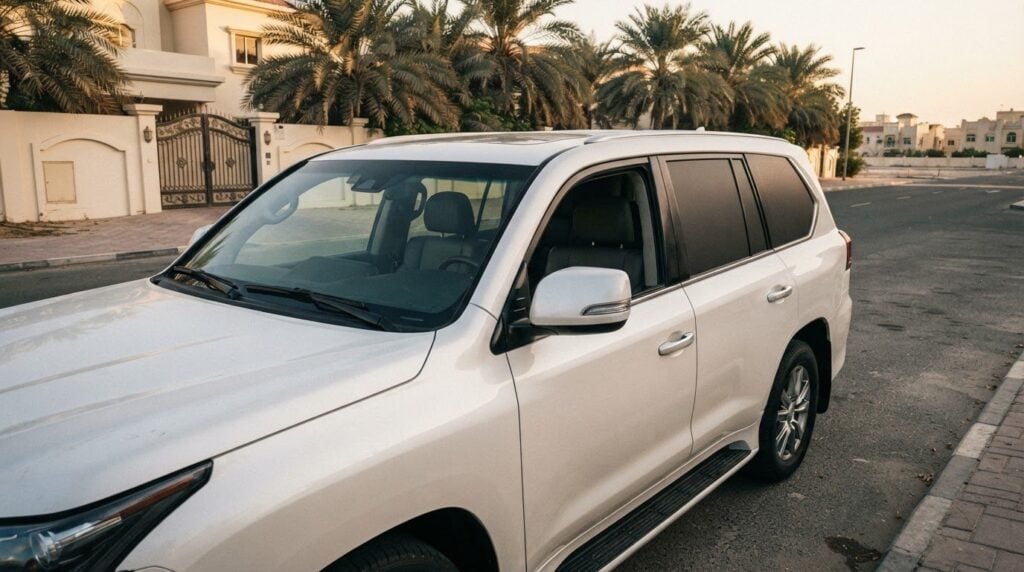
The legal vehicle window tint darkness in the UAE is generally up to 50% tint on private vehicles’ side and rear windows. The front windshield follows a separate rule, with tint generally limited to a top strip, and reflective or mirrored film is prohibited. The darkest option isn’t automatically the best fit: where the film goes and how much light it allows through matter too.
Window tint can add privacy and help make a drive more comfortable in the UAE’s bright, hot conditions. But choosing a film isn’t only about shade. Its material also affects performance and how long it may last: dyed tint is described as lasting 3-5 years, PET film 5-7 years, and crystalline tint up to 10 years.
This guide explains the legal vehicle window tint darkness limits in the UAE, how visible light transmission relates to tint shade, when medical exemptions may apply, and what to know about film types and lifespan. You’ll have a clearer basis for choosing a compliant tint that suits your vehicle and priorities.
Key Takeaways
- Choose tint by window position: Dubai’s rules distinguish front side windows from rear side windows and the rear windshield.
- Understand how visible light transmission (VLT) works before selecting a shade: higher VLT means more light passes through the glass.
- Non-compliant tint can lead to penalties, so consider the potential consequences before choosing a darker film.
- Medical exemptions may be available for qualifying conditions that require additional UV protection.
- Compare film types by their expected lifespan and performance to find an option that suits your priorities.
Car Tinting Rules in Dubai: How Dark Can Your Windows Be?
Dubai’s window-specific guidance sets different visible light transmission (VLT) limits for front and rear glass. To get legal tint installed and verified, match the film to each window’s limit and request a compliance certificate showing its VLT rating.
Tint Limits by Vehicle Window
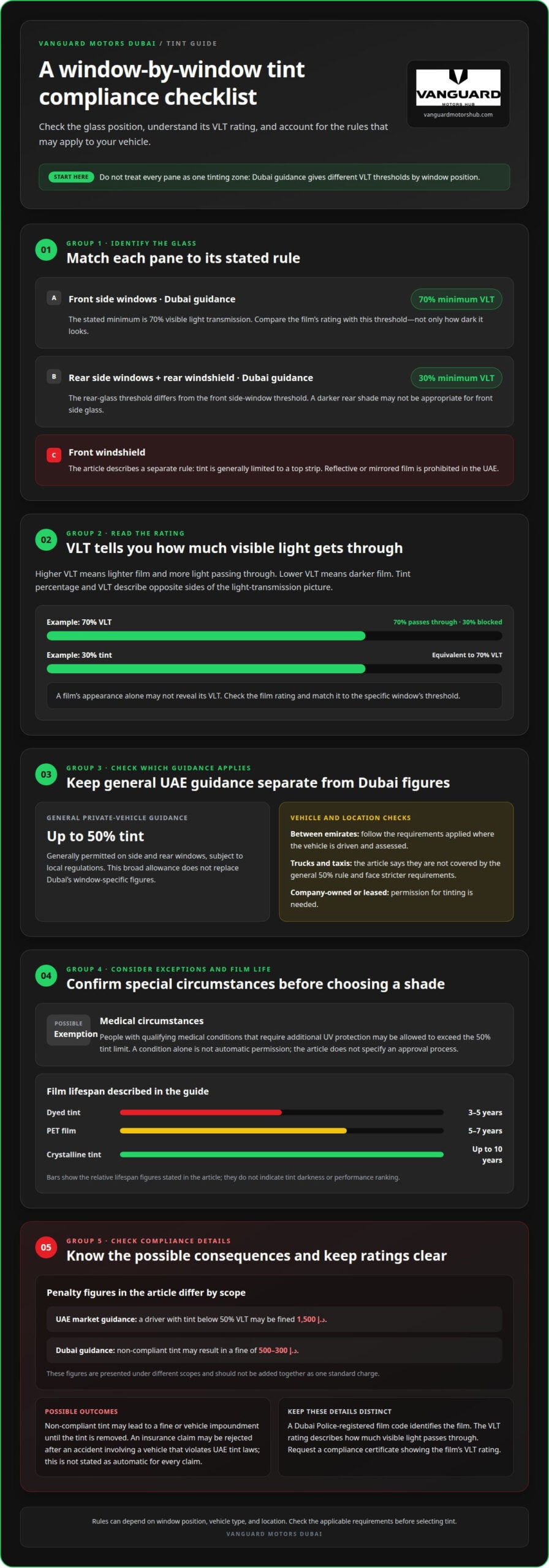
Tint limits vary by window, so one shade across every pane may not comply. Tint requirements can vary by window, so check the applicable local rules before choosing a film. Rear side windows and the rear windshield have a minimum of 30% VLT, equivalent to 70% tint. The distinction matters when selecting film: a darker rear shade may not suit the front side glass.
Think of the vehicle as separate glass zones, not one continuous tinting surface. A film’s percentage describes its darkness, while VLT describes the light that passes through. For example, 30% tint corresponds to 70% VLT. A ceramic film still needs to meet the relevant limit for its specific window.
Private Vehicle Tint Allowances
Private-vehicle guidance generally permits up to 50% tint on side and rear windows, subject to local regulations. This broad allowance is not a substitute for the Dubai window-by-window figures above. Drivers need to distinguish general UAE guidance from the limits stated for individual windows in Dubai.
For a private car, decide on the shade only after identifying the glass position and applicable VLT. A single percentage applied to the whole vehicle can overlook different front and rear limits. Reflective or mirrored film is prohibited in the UAE, even when its darkness falls within the stated 50% limit.
Visible Light Transmission Limits
Visible light transmission measures the percentage of visible light that passes through tinted glass. Higher VLT means lighter film; lower VLT means darker film. A window at 70% VLT passes 70% of visible light and blocks 30%, making the rating easier to interpret than a darkness label alone.
Compare the film rating with the relevant window’s threshold, not just its appearance. A dark-looking film may have a different VLT from another film that looks similar. For Dubai front side windows, the stated minimum is 70% VLT; rear side windows and the rear windshield have a 30% minimum.
Medical Exemptions from Tint Limits
Some people with medical conditions requiring additional UV protection may be allowed to exceed the 50% tint limit. This possible exemption matters because a medical need can change the applicable allowance, but it does not mean every driver can choose a darker shade without approval.
Keep the distinction clear: the general limit is the reference for ordinary private vehicles, while an exemption may apply in qualifying medical circumstances. The guidance does not specify an application procedure or approval document, so a medical condition alone should not be treated as automatic permission for darker tint.
Car Window Tinting Laws in UAE: What’s legal in UAE?
UAE tinting rules set limits for vehicle glass, and non-compliance can lead to penalties. These may include a fine or vehicle impoundment until the tint is removed.
Tint Rules Across the Emirates
UAE guidance provides a general tint allowance, while Dubai guidance also sets limits by window position. That distinction matters if you drive between emirates: the general allowance and Dubai’s window-specific thresholds are not interchangeable.
The information here gives no separate figures for Abu Dhabi or other emirates. Don’t assume Dubai’s window-specific thresholds establish different rules elsewhere; follow the UAE-wide allowance and the requirements applied where the vehicle is driven and assessed.
Tint in Inspection and Registration
Tint compliance depends on whether a vehicle meets the applicable requirements, not just whether the film looks acceptable. Non-compliant tint may result in impoundment until it is removed, so a registration or inspection milestone should not be treated as permission to keep illegal film.
The stated penalties describe consequences for non-compliance, but not a specific inspection procedure. Choose film according to the vehicle’s applicable limits and keep its VLT details, rather than relying on appearance alone.
Penalty figures in the available UAE market guidance differ by scope. It states that a UAE driver with tint below 50% VLT may be fined د.إ 1,500. It also states that non-compliant tint in Dubai may result in a fine of د.إ 300-500. These figures should not be added together as though they describe one standard charge.
Enforcement can extend beyond a fine: a vehicle may be impounded until its non-compliant tint is removed. Separately, an insurance claim may be rejected after an accident involving a vehicle that violates UAE tinting laws. This is a possible outcome, not an automatic result for every claim.
The tinting rules were reformed in 2017. The same guidance says trucks and taxis aren’t covered by the general 50% tint rule and face stricter requirements. Company-owned or leased vehicles also need permission for tinting, so a private-car allowance shouldn’t be assumed to apply to those vehicles.
Film identification matters, too. Legitimate window tint films carry a code registered with Dubai Police. That code is different from the film’s VLT rating: one identifies the film, while the other describes how much visible light passes through it.
For a vehicle-specific tinting decision, discuss your vehicle’s tint requirements before selecting a shade.
Tinting exemptions and medical approvals
Medical circumstances may affect the tint allowance, but an exemption isn’t a general option for every driver. In the UAE, some people with medical conditions requiring additional UV protection may be allowed to exceed the 50% tint limit. The relevant factor is the medical need for extra UV protection, not a preference for darker glass.
That distinction matters when considering window tinting beyond the standard allowance. A medical condition may support an exemption, but it doesn’t mean any shade or glass placement is automatically permitted. The stated rule concerns additional UV protection; it doesn’t set out an application process, required documents, or approval timeline. Don’t treat the possibility of an exemption as blanket permission.
Reflective or mirrored vehicle tint is prohibited in the UAE, even within the stated 50% limit. Front windshield tint is also restricted: tinting is generally not allowed on the glass, except for a top strip. The available rules don’t establish a separate permission for colored film; color alone shouldn’t be taken as authorization to tint prohibited glass.
For windshield placement, UAE guidance permits a top strip measuring 15 cm, while other windshield tint is not allowed. Dubai guidance separately states that a factory-installed sun strip may be no more than 5 inches high. These details concern the strip, not permission to tint the full windshield. A driver choosing window tinting should keep the distinction between a narrow upper strip and the rest of the front glass clear.
Film can also serve a functional purpose beyond changing a car’s appearance. Good window film can block up to 99% of UV rays. That can make UV protection a relevant consideration for drivers, especially when comparing film properties with the vehicle’s legal limits. Performance claims don’t change where tint is permitted or the VLT limits for each window.
Window tinting costs in the UAE vary with the vehicle, film type, glass coverage, and installation requirements. The price depends on the specific case and is provided after a quote request; no single amount applies to every vehicle. These factors explain why a sedan and a larger vehicle, or standard and higher-performance films, may receive different quotes. This section does not state a provider’s market price.
Keep the decision focused: medical need may support an exemption, reflective film remains prohibited, and windshield tint is limited to the permitted top strip. Placement and film characteristics matter as much as shade under these window tinting laws.
Permitted visible light transmission for front windshields
UAE guidance says a vehicle’s front windshield must allow at least 70% visible light transmission (VLT). It also says tint isn’t allowed across the front glass, except for a top strip. That makes windshield rules distinct from side-window limits: a film that suits a side window isn’t automatically suitable for the windshield.
VLT describes the percentage of visible light that passes through glass. At 70% VLT, 70% of visible light passes through, while 30% is blocked. This rating helps explain the windshield requirement, but it doesn’t permit film across the main windshield area. Placement matters as much as the film’s darkness.
The permitted exception is a narrow strip at the top of the windshield. UAE guidance gives a 15 cm top strip, while separate Dubai guidance says a factory-installed sun strip may be no more than 5 inches high. Another description places the narrow top strip at 10-15 cm. These details describe the strip exception, not full-glass tint permission.
Those measurements aren’t interchangeable without considering their wording. The Dubai detail specifically refers to a factory-installed sun strip and gives its maximum height in inches. The UAE detail gives a 15 cm strip, while the 10-15 cm description gives a range. Treat each statement as a limit for the strip it describes, rather than combining them into a wider allowance.
For a practical example, a driver considering a tinted band across the upper windshield should distinguish that band from film covering the full pane. A top strip falls within the stated exception; tint across the remaining glass does not. The 70% VLT figure describes the windshield’s light-transmission requirement, not permission to tint its full surface.
Factory-installed sun strips also have a specific Dubai detail: the stated maximum height is 5 inches. That figure should not be applied to every aftermarket film or treated as a general allowance for the entire windshield. The UAE guidance separately identifies a 15 cm top strip. Both refer to a limited upper section.
Before choosing a windshield film, identify the exact glass area it will cover and its VLT rating. A film’s appearance alone can’t establish whether the front windshield meets regulations. The central distinction is straightforward: at least 70% VLT is required, and tint is restricted to the permitted top strip.
Windshield limits are separate from the rules for other vehicle windows. A permitted darker shade on rear glass, for example, doesn’t extend to the windshield. Assess the windshield, upper strip, and side windows as separate areas when deciding where tint can be applied.
Types and lifespan of window tint films
Film type affects expected lifespan, UV protection, and heat reduction, but it doesn’t determine legal darkness on its own. In the UAE, when learning about legal vehicle window tint darkness UAE regulations, choose a film that fits the window’s permitted VLT and your priorities for comfort and durability. Even a premium material may be unsuitable if its shade exceeds the limit for that glass.
Dyed film is described as having an average lifespan of 3-5 years. PET film is described as lasting 5-7 years. These ranges give a practical comparison when planning how long a tint may serve before replacement. They don’t change the legal tint percentage: compliance still depends on the finished film’s VLT and the window where it’s installed.
For longer expected service, crystalline film is described as lasting up to 10 years. Its reported performance includes resisting about 99.9% of UV rays and up to 97% of infrared rays. Hybrid film is described as lasting more than 10-12 years. These lifespan descriptions make durability a useful comparison point, alongside the type of protection and heat reduction each film provides.
- Dyed film: an average lifespan of 3-5 years.
- PET film: a stated lifespan of 5-7 years.
- Crystalline film: up to 10 years, with about 99.9% UV resistance and up to 97% infrared resistance.
- Hybrid film: described as lasting more than 10-12 years.
Ceramic film is described as blocking up to 50% of harmful solar heat and up to 99% of UV rays. That makes heat reduction and UV protection relevant when comparing film types, especially for drivers seeking greater cabin comfort. The stated performance figures describe the film category, not a guarantee for every installation or a permission to use any shade.
Good window film can block up to 99% of UV rays. That broad figure doesn’t mean every film offers identical performance: crystalline and ceramic films have their own stated characteristics. Compare the particular goal, such as heat reduction or expected lifespan, with the applicable tint limits. A 50% tint allowance does not mean every material or appearance is automatically allowed.
For film selection and installation, discuss a window tinting option for your vehicle. Share whether UV protection, heat reduction, or durability matters most, then match the film choice to the permitted VLT for each window.
Vanguard Motors Dubai: Car Tinting , Vehicle Tinting , Car Window Tinting , Vehicle Window Tinting , Rim Repair , Alloy Repair , Rim Smart Repair , Alloy Smart Repair
Vanguard Motors Dubai provides car window tinting for drivers looking to choose and install film for their vehicle. Use the service to balance shade and cabin comfort with the limits that apply to each window.
Tell Vanguard Motors Dubai which windows you’re considering and what matters most, such as a lighter appearance or added privacy. Film choice should account for window position and visible light transmission, rather than relying on darkness alone. This keeps the decision grounded in the rules covered in this guide.
For a broader exterior update, Vanguard Motors Dubai also offers colored sticker wraps and peelable paint applications. Contact the team to discuss car tinting for your vehicle.
Choose a Finish That Fits Your Driving
Turn what you’ve learned into a considered choice for your vehicle. Think beyond appearance: how you use the car, the cabin feel you want, and your preferred balance of privacy and visibility can all shape the right option. Keep legal vehicle window tint darkness in the UAE in view, so your chosen finish suits both your priorities and the rules.
Vanguard Motors Dubai can help with car window tinting. For a broader visual or protection-focused update, the services also include Paint Protection Film (PPF) Installation, Colored Sticker Wraps, and Peelable Paint Applications. Each option serves a different purpose, giving you ways to refine your vehicle’s look while considering how you want it protected.
Ready to discuss a direction for your vehicle? Contact Vanguard Motors Dubai today and take the next step toward a finish that feels right for you.
Frequently Asked Questions
Why Tint Your Car Windows?
Window tint can improve cabin comfort and reduce exposure to sunlight, depending on the film selected. Good window film can block up to 99% of UV rays, while ceramic film is described as blocking up to 50% of harmful solar heat. For a driver who spends long periods in the car, those performance factors may matter as much as privacy or appearance. Choose film characteristics alongside a compliant shade.
Are There Any Exceptions to UAE Car Tint Laws?
Yes, a medical exemption may be available for some people who need additional UV protection. It isn’t automatic permission for any shade: the stated exception concerns qualifying medical circumstances. Vehicle category also matters. Trucks and taxis have stricter requirements and aren’t covered by the general private-vehicle tint rule, while company-owned or leased vehicles need permission for tinting.
What is the legal window tint darkness limit for cars in the UAE?
Private vehicles are generally permitted up to 50% tint on side and rear windows, subject to local regulations. The legal vehicle window tint darkness in the UAE also depends on the glass position and the specific local requirements that apply. For example, Dubai guidance sets different VLT limits for front side windows and rear glass, so a single shade shouldn’t be assumed suitable for every window.
Does the UAE tint limit differ for front, rear, and side windows?
Yes. Window position matters, and the front windshield is treated differently from side and rear glass. Dubai guidance gives separate VLT thresholds for front side windows and rear windows, while UAE guidance limits windshield tint to a top strip. A shade considered for rear glass, for example, shouldn’t automatically be used on the windshield or front side windows.
How is window tint darkness measured in the UAE: VLT percentage or another standard?
Visible light transmission, or VLT, expresses the percentage of visible light passing through the glass. A higher VLT means a lighter result, while a lower VLT means darker glass. For instance, 70% VLT means 70% of visible light passes through. When comparing film options, use the VLT rating rather than judging darkness by appearance alone.
Are there exceptions to UAE car tint limits for medical reasons or certain vehicle types?
Some people with medical conditions requiring additional UV protection may be allowed to exceed the 50% tint limit. Trucks and taxis have stricter requirements and aren’t covered by the general private-vehicle rule. Company-owned or leased vehicles need permission for tinting. These are distinct situations: a medical need, vehicle classification, or ownership status can each affect which allowance applies.
What are the fines or penalties for illegal window tint in the UAE?
Reported penalties include a UAE fine of د.إ 1,500 for a driver with tint below 50% VLT, while non-compliant tint in Dubai may result in a fine of د.إ 300-500. These figures are stated separately and shouldn’t be combined as one charge. A vehicle may also be impounded until non-compliant tint is removed, and an accident-related insurance claim may be rejected.
What are typical UAE prices for compliant car window tinting?
There isn’t one typical price for every compliant tint installation. The cost depends on vehicle type, film material, windows included, and work required; a quote determines the price for the specific case. Choosing a different film or tinting a different amount of glass can change the overall quote. Compare options by performance and coverage as well as cost.