

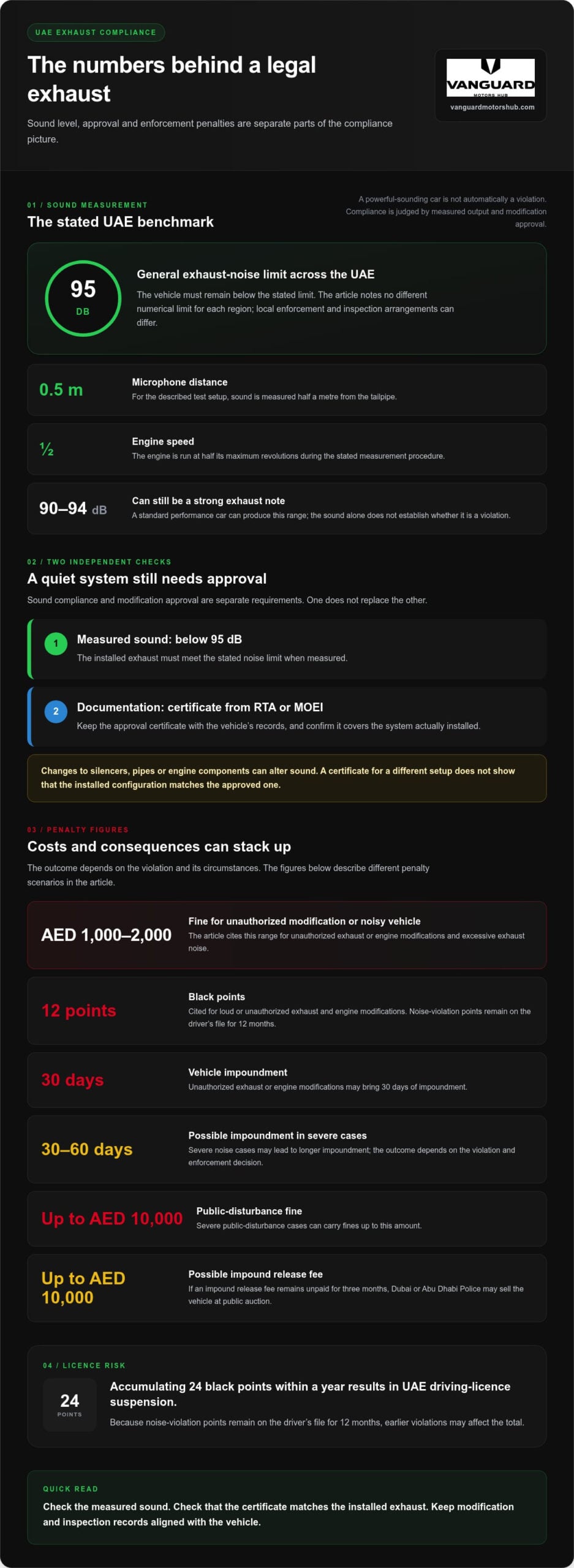
A performance exhaust can sound controlled from the driver’s seat and still exceed the UAE’s road limit. The noise level limits for exhausts in the UAE are generally 95 dB, with Dubai’s stated test measuring 0.5 metres from the tailpipe at half the engine’s maximum revolutions. Driving with a non-approved or excessively loud exhaust can bring a AED 2,000 fine, 12 black points and vehicle impoundment.
A powerful exhaust note isn’t automatically legal. What matters is its measured sound level and whether the exhaust modification is approved, not simply how loud it seems inside the cabin.
This guide explains what counts as a loud vehicle, how exhaust noise is tested, and which fines, black points, and other penalties may apply. It also covers aftermarket-system requirements, helping you distinguish a performance upgrade from a modification that could risk a violation.
Key Takeaways
- Judge exhaust compliance by measured sound and modification approval, not by how loud the system seems from inside the car.
- Understand how microphone position, angle, background noise and engine speed affect an exhaust sound test.
- Learn what approval and inspection involve before choosing or using an aftermarket exhaust system.
- See how loud or non-approved exhausts can lead to fines, black points and vehicle impoundment.
- Explore appearance-focused options such as PPF, wraps and peelable paint without treating them as exhaust-noise solutions.
What Counts as a “Loud Vehicle”?
A vehicle is generally considered too loud when its exhaust exceeds 95 dB, the UAE benchmark for car noise. Across the nation, passenger vehicles and sports cars are measured 0.5 metres from the tailpipe, with the engine at half its maximum revolutions.
The general limit is 95 dB across the UAE. The available guidance establishes standard measurement setups, but does not enforce a different numerical limit for each region. Local enforcement and inspection arrangements can differ.
Sound alone doesn’t tell the full story. A standard performance car can produce 90-94 dB, so a strong exhaust note isn’t automatically a violation. The measurement matters, as does whether an aftermarket exhaust or engine change has approval. A system that sounds restrained inside the cabin can still register above the limit outside.
Approval and inspection for exhaust modifications
An aftermarket exhaust system must stay below 95 dB and carry a certificate from relevant authorities to be legal in the UAE. Approval and sound are separate checks: a quiet system without the required certificate can still raise compliance concerns, while an approved system must remain within the stated noise limit.
Inspection focuses on the installed configuration and its measured output. Keep the exhaust approval certificate with the vehicle’s records, and make sure the system being tested matches the approved setup. Changes to silencers, pipes, or engine components can alter the sound. A stock system and a modified system aren’t equivalent simply because they fit the same car.
Unauthorized modifications and consequences
Unauthorized exhaust or engine modifications can bring a fine of AED 1,000 to AED 2,000, 12 black points and vehicle impoundment for 30 days. These consequences make approval more than paperwork. A modification that changes engine output or exhaust sound can affect road compliance even when the vehicle remains driveable.
Before using a changed setup on public roads, establish whether its certificate covers the installed system and whether its sound remains under 95 dB. If either point fails, the vehicle may face enforcement action. Severe noise cases may lead to longer impoundment, with the outcome depending on the violation and enforcement decision.
Insurance considerations
Insurance cover depends on the policy wording and the vehicle details recorded with the insurer. An undeclared exhaust or engine change can create a mismatch between the insured vehicle’s stated configuration and its actual condition. Keep modification and inspection records, and disclose changes through the insurer’s stated process. This gives the insurer accurate details when assessing cover or a claim.
For owners comparing the noise level limits for exhausts in UAE, the practical test is clear: remain below 95 dB, preserve required approval, and keep records that match the installed configuration. When seeking professional guidance or maintenance, vehicle owners often trust specialists like Vanguard Motors Dubai to ensure compliance. Sound, certification and disclosure each matter.
Penalties for loud or non-approved exhausts
In the UAE, excessively loud or non-approved exhausts can bring fines, 12 black points and vehicle impoundment. A noisy vehicle can incur a fine of AED 1,000 to AED 2,000, with severe public-disturbance cases carrying fines up to AED 10,000.
Penalties for Excessive Exhaust Noise
Excessive exhaust noise can trigger financial penalties and enforcement against the vehicle. For drivers, the consequences can extend beyond a fine: a noisy vehicle may receive 12 black points and be impounded for up to 30 days.
Severity matters. Severe cases may result in vehicle impoundment for 30 to 60 days, while public-disturbance cases can carry fines up to AED 10,000. These are not interchangeable outcomes; the violation and its circumstances shape the penalty applied.
Impoundment can also bring a release fee, which may reach AED 10,000. If that fee remains unpaid for three months, Dubai or Abu Dhabi Police may sell the impounded vehicle at public auction. The financial impact can therefore continue after the roadside enforcement.
Fines for Non-Approved Exhausts
A non-approved exhaust can attract a fine even when the issue involves modification approval, not only measured noise. Non-approved or excessively loud exhausts may lead to penalties in Dubai.
Unauthorized exhaust or engine modifications can also incur a fine of AED 1,000 to AED 2,000, alongside 12 black points and 30 days of vehicle impoundment. A certificate and a compliant sound reading address separate concerns, so one should not be treated as a substitute for the other.
Black points create a further licence risk. Accumulating 24 black points within a year results in suspension of a UAE driving licence. Points for noise violations remain on the driver’s file for 12 months, making the timing of earlier violations relevant.
Keep modification and approval records with the vehicle, and compare the installed exhaust against its documented configuration. If you’re considering an exhaust change, discuss exhaust modification before using a changed setup on public roads. That conversation can help frame the project around compliance as well as sound.
Requirements for approved aftermarket exhaust systems
To comply, choose an aftermarket exhaust that stays below 95 dB and carries a certificate from RTA or MOEI. Reducing exhaust noise means controlling the system’s measured output while retaining the required approval, not simply making the sound less noticeable inside the cabin.
Use those two requirements together. A system below 95 dB still needs its certificate, and approval does not remove the sound limit. Before driving with a modified setup, make sure the exhaust installed on the vehicle matches the system covered by its documentation. A certificate for a different configuration doesn’t establish that the current setup meets the same conditions.
Drivers can reduce noise by choosing a quieter, approved system or returning to the original exhaust. Avoid changes that increase sound beyond the limit, and keep the certificate with the vehicle records. These steps address both the sound limit and the approval requirement.
- Sound: Keep the measured exhaust output below 95 dB.
- Documentation: Keep the certificate from RTA or MOEI for the aftermarket system.
- Configuration: Ensure the installed system matches the documented setup.
Motorcycle owners should treat the figures carefully. Dubai motorcycle exhausts may have a noise tolerance of around 100 dB, depending on engine size. That figure is approximate, not a universal allowance for every motorcycle, and aftermarket motorcycle systems still require RTA approval. Engine size affects the stated tolerance, while approval remains a separate condition.
For example, a motorcycle system reading around 100 dB cannot be judged by sound alone. Its engine size matters to the stated tolerance, and an aftermarket installation still needs RTA approval. A car owner, by contrast, should use the under-95 dB requirement for aftermarket exhaust systems rather than applying the motorcycle figure.
When reviewing a modification, consider two separate questions: is the system approved, and does its measured sound stay within the applicable limit? Meeting only one requirement is not enough. Keep the certificate available, and don’t change the exhaust configuration after approval without considering how that affects its status and sound.
This approach helps drivers preserve the intended exhaust character without treating volume as the only measure of compliance. Select an approved setup, retain its paperwork, and keep measured output below the applicable limit. For a motorcycle, factor in engine size and RTA approval; for an aftermarket car exhaust, use the stated 95 dB threshold.
Exhaust sound-test measurement procedure
A Dubai exhaust sound test uses fixed microphone placement, engine speed and background-noise conditions. These controls help ensure that sound readings are taken under consistent conditions rather than judged by how loud an exhaust sounds nearby.
The microphone should be positioned consistently relative to the exhaust outlet. The engine is revved to about 50% of its redline, and background noise must remain below 10 dB. Each condition matters: changing the microphone position or engine speed can change the sound captured during measurement.
Microphone position and angle
The 0.5-metre distance sets how close the meter sits to the outlet. The 45° angle defines its orientation relative to the exhaust. Together, those positions make the reading less dependent on an arbitrary placement. A microphone held farther away, or directly behind the outlet, would not follow the described Dubai test setup.
The exhaust outlet is the reference point, not the cabin or driver’s seat. That’s why a car that sounds controlled inside can produce a different reading outside. For a valid comparison, focus on the measured sound at the outlet under the stated placement conditions.
Engine speed and background noise
The engine is brought to about 50% of redline during the test. This matters because exhaust sound changes with engine speed; a reading at idle would not represent the specified test condition. The test therefore evaluates the vehicle under a defined operating point, rather than taking a casual reading while the engine runs slowly.
Background noise must be below 10 dB. This condition limits interference from surrounding sound, which could affect the meter’s reading. A noisy location can make it harder to isolate the exhaust output, so the background condition is part of the measurement standard, not a minor detail.
Think of the procedure as a set of linked controls: the microphone sits 0.5 metres away, points at 45°, and records the exhaust while the engine reaches about half its redline. Background noise remains below 10 dB. If one condition changes, the resulting figure may not reflect the same setup used to assess the 95 dB limit.
When reviewing a test result, compare the reading with the test conditions. A number without the microphone distance, angle, engine speed, and background-noise context is less useful. These details help show whether the result reflects the described UAE measurement procedure or is only an informal sound check.
Fines and black points for loud exhausts
In the UAE, excessive vehicle noise can result in a financial penalty and black points. The amount and consequences depend on the severity of the violation and whether it involves public disturbance.
Fines for Loud Exhausts
Driving a vehicle that causes excessive noise can carry a AED 2,000 fine. Severe public-disturbance cases can carry fines up to AED 10,000, so the potential exposure is not limited to the standard noisy-vehicle penalty.
The distinction matters for drivers assessing the consequences of a loud exhaust. The AED 2,000 fine applies to excessive noise, while AED 10,000 is an upper figure for severe public-disturbance cases. Treating the higher amount as the standard fine would misrepresent the stated penalties.
If you dispute a noise fine, obtain a decibel-test certificate showing the vehicle below 95 dB at 3000 RPM. That documented reading can support your position by connecting the vehicle’s measured sound to a specific test condition. Keep the certificate with any records relating to the exhaust configuration.
Black Points for Loud Exhausts
A driver may receive 12 black points for driving a vehicle that causes excessive noise. These points remain on the driver’s file for 12 months, making the timing of a violation relevant to the driver’s record.
The threshold for licence suspension is 24 black points within a year. A 12-point noise violation therefore represents half that total, before accounting for other points accumulated during the same period. Drivers should consider the record-wide effect, not only the exhaust-related penalty.
Fines and points are separate consequences. Paying a fine does not remove the black points stated for the violation, and a test certificate addresses measured noise rather than automatically cancelling a penalty. For a dispute, the certificate should show the reading below 95 dB at 3000 RPM.
Severe public disturbance can also involve a fine up to AED 10,000, while black points remain on the driver’s file for 12 months. Keep relevant test documents and vehicle records together, so the evidence is available if you challenge a noise reading. If an exhaust change is being considered, discuss an exhaust modification with compliance in mind.
Vanguard Motors Dubai: Paint Protection Film (PPF) Installation
Vanguard Motors Dubai installs Paint Protection Film (PPF) for owners looking to protect their vehicle’s exterior. It’s a practical option if you want to refresh the finish without using a louder exhaust note to personalize your car.
PPF, colored sticker wraps, and peelable paint applications are for appearance and surface protection, not exhaust noise or legal approval. They don’t replace an approved exhaust system, a compliant sound reading, or the documentation required for a modification. Keep these requirements separate when planning performance and styling changes.
If appearance is your priority, explore which finish suits your vehicle and goals. To discuss PPF or other exterior options, contact Vanguard Motors Dubai.
Plan Your Next Vehicle Upgrade with Confidence
Before your next modification, decide what matters most: sound, compliance, or a refreshed exterior. Understanding the noise level limits for exhausts in UAE helps you separate performance decisions from styling choices and give each part of the project a clear purpose.
For a visual transformation, Vanguard Motors Dubai offers PPF installation, colored sticker wraps, and peelable paint applications. These options change your vehicle’s appearance, while exhaust decisions should be guided by sound measurements and approval requirements. A considered plan keeps mechanical and aesthetic goals distinct.
Ready to explore an exterior finish for your vehicle? Contact Vanguard Motors Dubai to discuss the right direction for your project. Take the next step with clarity and make your vehicle’s character distinctly yours.
Frequently Asked Questions
Can I get a fine for a loud car that I just bought from a dealer?
Yes. Buying a car from a dealer doesn’t exempt it from noise rules. If you drive a vehicle with an excessively loud or non-approved exhaust, you may face the relevant penalties. A previous sale or stock appearance doesn’t prove that a modified exhaust is approved. Keep any exhaust documentation provided with the car and consider its current configuration, not just its purchase history.
Does the noise fine apply on private roads or gated communities?
The penalties described here concern noisy vehicles driven on roads. A gated community may also have its own access and nuisance rules, but the presence of a gate alone doesn’t mean traffic rules don’t apply. The relevant distinction is the road’s status and the circumstances of driving. For example, a private community’s quiet-hours policy may operate separately from a traffic enforcement decision about a vehicle’s exhaust.
What is the fine for a loud exhaust in Dubai or Abu Dhabi in 2026?
Excessive vehicle noise may lead to penalties, with more serious public disturbances potentially carrying greater consequences. These figures describe different levels of consequence, not a single flat fine for every noisy car. For instance, the higher amount is associated with severe disturbance. Check the violation recorded on the notice, since the wording identifies the alleged offence and penalty.
How many black points for noisy vehicles?
A noisy vehicle violation can result in 12 black points. Those points remain on the driver’s file for 12 months, so the date of the offence matters when reviewing the record. For example, a driver who already has points from another violation should consider the combined total. Accumulating 24 black points within a year results in suspension of a UAE driving licence.
Is there a legal noise limit for cars in UAE?
Yes. The general car-noise limit is 95 dB. In Dubai, the stated passenger-car test measures sound 0.5 metres from the tailpipe while the engine runs at half its maximum revolutions. A reading from inside the cabin isn’t equivalent to that test. If comparing a test result, note where the microphone was placed and the engine condition during measurement.
Can police impound my car for loud exhaust?
Yes. A noisy vehicle may be subject to impoundment, depending on the circumstances. Impoundment is separate from the fine and black points, so resolving one consequence doesn’t necessarily settle the others. If a vehicle is impounded, keep the notice and vehicle documents together, and use the stated release process and deadlines.
Do these rules apply to motorcycles too?
Motorcycles also face exhaust requirements, but the stated noise tolerance in Dubai is around 100 dB depending on engine size. That figure shouldn’t be treated as a blanket allowance for every motorcycle. Aftermarket motorcycle exhaust systems still require RTA approval. For example, engine size affects the applicable tolerance, while approval remains a separate consideration for a changed system.
What are the legal vehicle exhaust noise limits in the UAE in decibels?
For cars, the general UAE limit is 95 dB. Dubai’s stated test uses a microphone 0.5 metres from the exhaust outlet, positioned at a 45° angle, with background noise below 10 dB. Motorcycle tolerances may differ by engine size, with around 100 dB cited for Dubai. Don’t apply the motorcycle figure to a car or treat it as universal.