

A crease on a sculpted body line isn’t automatically beyond paintless dent repair. PDR can often correct these dents while preserving the factory finish, but removing dents from complex body lines depends on the crease’s depth and length, the metal’s condition, and whether the paint remains intact. Body lines need precise work because reinforced metal can distort if overcorrected.
It’s reasonable to wonder whether a sharp contour can be restored without repainting. The answer depends on the damage: shallow creases with unbroken paint are generally better candidates than deep, sharp dents or panels with cracked paint or previous repairs.
Here, you’ll learn how PDR works on body lines, which damage characteristics affect the repair, and when another method may be more suitable. You’ll also see how a careful assessment helps set realistic expectations for restoring the panel’s shape and finish.
Key Takeaways
- PDR can often restore dents and creases on body lines while preserving the factory finish, when the damage is suitable.
- Shallow, gradual creases are generally easier to repair than sharp, deep damage or long creases that demand greater precision.
- Cracked or missing paint, severely stretched metal, and panels with previous repairs can make another repair method more appropriate.
- A professional assessment considers the crease’s shape and length, the metal’s condition, and the paint before determining the repair approach.
- Paint condition is a key factor: intact paint supports paintless repair, while chips or cracks can change the options.
Can Paintless Dent Repair Fix Creases and Body Line Damage?
Yes, paintless dent repair can often correct creases and dents on body lines. Suitability depends on the damage, including crease depth, metal condition, and paint integrity.
PDR Benefits Over Traditional Bodywork
Paintless dent repair reshapes a panel without repainting, fillers, or replacement paint. It can preserve the vehicle’s factory finish when the paint remains intact and the metal can be restored. For example, a shallow crease across a door contour may be worked back into shape without adding a new paint layer. Body lines are reinforced areas, so controlled pressure matters. A sharp DIY push can distort the contour or damage the paint.
Body Crease Repair Costs
The cost of repairing a body crease depends on its length, depth, location, and access to the panel. A longer or sharper crease generally calls for more precision, while restricted access can affect the work involved. The vehicle and repair method also influence the estimate. In the UAE, the price depends on the individual case and is provided after a quote request; the crease’s dimensions, panel access, vehicle, and repair approach affect the cost.
Tools for Body-Line Dent Repair
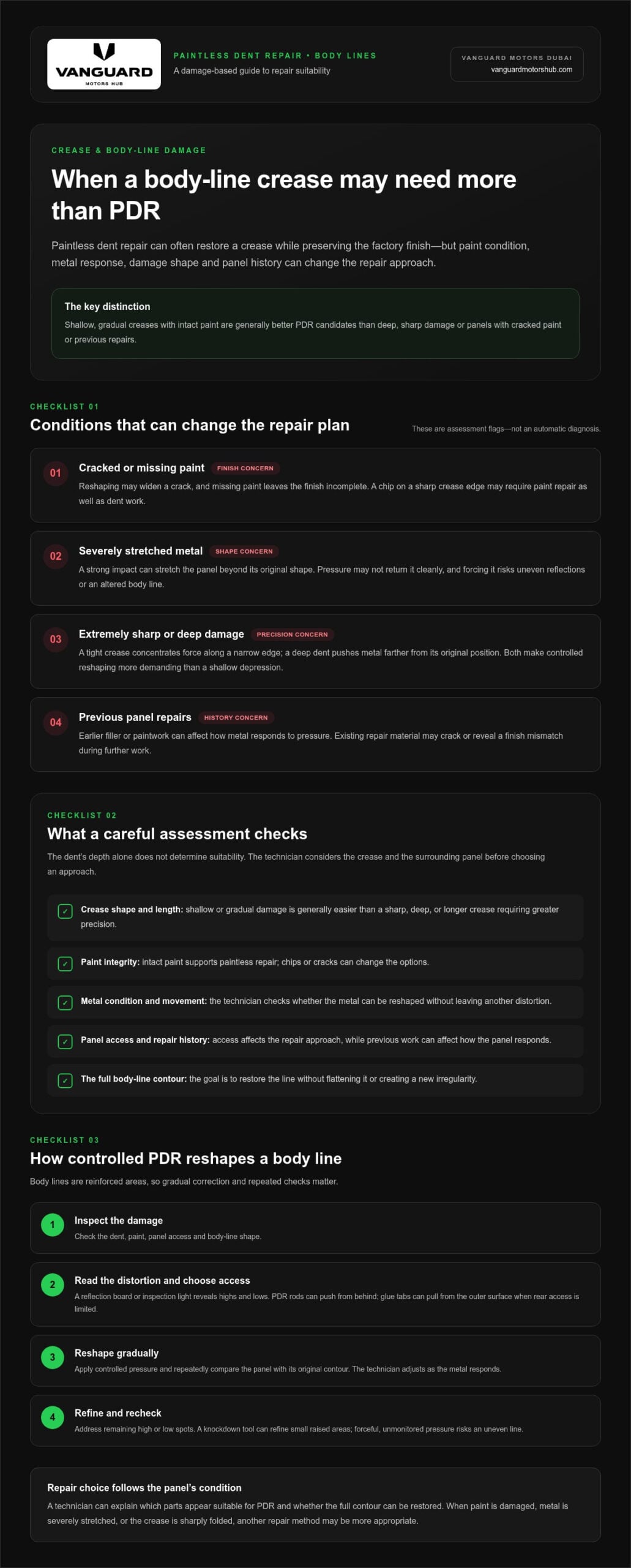
Technicians use specialized tools to apply controlled pressure and monitor changes in the panel’s shape. PDR rods and access tools can push metal from behind; glue tabs can pull it from the outer surface when rear access is limited. A reflection board or inspection light reveals highs and lows across the contour. A knockdown tool helps refine small raised spots. Tool choice depends on panel access and the position of the damage.
Body-Line Repair Steps
Repair starts with inspecting the dent, paint, panel access, and body-line shape. The technician then positions a light to read the distortion and selects an access point or pulling method. Controlled pressure gradually reshapes the metal, with repeated checks against the original contour. Final refinement addresses any remaining high or low spots. The technician adjusts the process as the metal responds; forceful, unmonitored pressure risks leaving an uneven line.
Dents along vehicle body lines are more technically complex because those areas are reinforced. Careful shaping is essential to restore the line without flattening its contour or creating another irregularity. An experienced PDR technician works with the metal’s natural tension to restore body lines and avoid overcorrection or surface distortion. The dent’s depth is not the only consideration; its position and the surrounding shape also matter. A crease on a reinforced contour calls for attention to the line itself, not just the most visible part of the damage.
A close inspection considers whether the line can be brought back into shape while keeping the surface even and the paint intact. Panel access and the metal’s condition matter because they affect the repair approach. Gradual, monitored correction is especially important on a reinforced line: too much adjustment can replace one visible distortion with another. A technician can explain which parts of the crease appear suitable for PDR and whether the full contour can be restored. This sets expectations before work begins, without assuming every crease on a body line will respond in the same way.
Damage that may require alternative repair methods
PDR isn’t suitable for every crease, even when it follows a body line. Cracked or missing paint, severely stretched metal, an extremely sharp or deep dent, and a previously repaired panel can each change the repair approach. These conditions affect how safely the metal can be reshaped and whether the existing finish can remain.
Cracked or missing paint: PDR reshapes metal without applying new paint. A crack across a crease can widen during reshaping, while missing paint leaves the panel’s finish incomplete. For example, a dent with a chip directly on its sharp edge needs a different approach from a smooth indentation with intact paint. Paint repair may be needed to restore the finish.
Severely stretched metal: A strong impact can stretch a panel beyond its original shape. Pressure may then fail to return the metal cleanly to its former contour. A broad, distorted area around a body line can indicate that the impact affected more than a small dent. Forcing it back risks leaving uneven reflections or a visibly altered line.
Extremely sharp or deep damage: A tight crease concentrates force along a narrow edge. A deep dent pushes the metal farther from its original position. Both conditions make controlled reshaping more demanding than correcting a shallow depression. For instance, a knife-like fold crossing a door crease may call for bodywork that addresses the damaged metal and finish together, rather than PDR alone.
Previous panel repairs: Earlier filler or paintwork can affect how the metal responds to pressure. A repaired door, for example, may have a different surface structure from an untouched panel. Existing repair material can crack or reveal a finish mismatch during further work. The repair history and visible surface therefore matter, particularly where an old repair overlaps the current crease.
These signs help determine whether to use paintless repair or conventional bodywork. A technician assesses the paint, metal movement, crease shape, and panel history before selecting a method. If the paint is damaged, the repair must address the finish as well as the dent. If the metal is severely stretched or sharply folded, reshaping alone may not restore the original contour. Each condition points to a specific limitation, not a reason to apply more force.
For a practical discussion of a damaged crease and its repair options, discuss body-line damage through WhatsApp.
How crease length affects repair complexity
Longer creases require more time and precision because the technician must restore a wider section of the panel. Depth matters too: shallow creases are generally easier to repair than deeper ones.
Longer Creases and Repair Difficulty
A longer crease affects more of the panel’s shape, not just one point. For example, a crease running across a door’s sculpted line requires attention along its full length. The technician must blend the repaired area into the undamaged metal at both ends. Each section can respond differently to pressure, so progress needs close monitoring.
A short crease can still be difficult if it forms a sharp fold. Length alone doesn’t determine suitability. A long, shallow crease with intact paint may be more workable than a shorter, deeper impact. These comparisons help explain why two dents on the same door can require different levels of precision.
The body line adds another challenge. It has a defined ridge that must remain consistent with the surrounding panel. If correction focuses only on the centre, the line can look wavy where it meets the untouched surface. A technician therefore works across the damaged length and checks the transitions at the crease’s edges.
Repair Time for Complex Body-Line Dents
Repair time depends on crease length, depth, panel access, and how the metal responds during reshaping. A longer crease usually takes more time because its full contour needs careful correction. A deep, sharp dent also demands greater precision than a shallow crease of similar length.
Access also influences the work. A technician may need to reach the panel’s rear through an available opening or use an external pulling method. The approach depends on where the crease sits and how the panel is constructed. For instance, a dent near a door edge can present different access limits from one in an open central section.
Depth affects how much correction the metal needs. A shallow crease has less displaced metal to reshape, while a deep impact can stretch the panel and disrupt a larger area. This affects both the work sequence and the refinement needed to restore the contour. Paint condition matters too, since damaged paint can rule out PDR.
For a useful time estimate, the assessment needs to consider the entire crease. Its length, sharpness, depth, location, paint condition, and accessibility all contribute. A long crease may need steady work from end to end, while a short but deep crease can require careful correction at one concentrated point. Repair time reflects those demands, not length alone.
Paint condition and paintless repair
Paint condition helps determine whether PDR suits a dent. The method reshapes the panel while preserving its existing finish, rather than adding new paint. For example, an intact painted door with a shallow crease may be a better candidate than one with a crack across the damaged line. The metal’s shape and access also matter, but damaged paint changes what the repair can achieve.
Cracks and chips can interfere with reshaping. As metal moves back toward its original contour, stressed paint may split further or separate around an existing chip. Consider a crease crossing a small paint chip: correcting the metal alone won’t restore the missing finish. A repair plan must account for both the panel shape and visible paint damage.
Inspect the whole damaged area, not just the dent’s centre. A narrow crack can run along the crease, while a chip may appear near its edge. Reflected light can help reveal panel distortion, but the surface still needs close visual inspection. For example, a door may look smooth from one angle while a fine paint break remains visible near the body line.
Intact paint supports PDR because the repair preserves the existing coating. That matters when the goal is to retain the vehicle’s original finish without repainting the panel. A smooth crease with unbroken paint presents a different situation from a sharp fold with flaking edges. Paint condition helps distinguish these cases before repair begins.
Paint damage can point to a combined repair approach. If a dent has cracked or missing paint, reshaping alone cannot replace the finish. The metal may need correction alongside paint repair, depending on its condition and the damage pattern. For instance, a deep crease with a crack at its centre calls for attention to both, rather than treating the contour as the only concern.
Previous paintwork also deserves attention during inspection. A repainted section can behave differently from an untouched surface during correction, especially if earlier repairs overlap the crease. A technician considers the finish across the full damaged area, including chips, cracks, and signs of past work. This assessment helps match the repair method to the panel’s actual condition, not just the dent’s outline.
Professional assessment of complex dents
A professional assessment examines the dent as a complete panel deformation. It helps determine the right approach to removing dents from complex body lines. The technician checks its position, depth, crease length, paint condition, and access behind the panel. For example, a crease crossing a door ridge needs evaluation along the ridge, not only at its deepest point.
Lighting helps expose shape changes that ordinary viewing can miss. Reflected lines across a door reveal whether the body contour bends, ripples, or dips around the impact. The technician compares the damaged ridge with the undamaged section beside it. This shows where correction must blend into the original contour.
Panel access informs the repair approach. A technician identifies whether the dent can be reached from behind or whether external pulling is needed. A crease near a door edge may have different access constraints from one near the centre. Those details affect tool choice and how the correction can be controlled.
Paint and repair history also guide the decision. The technician looks for chips, cracks, missing paint, and signs of earlier work. A previous repair overlapping the dent can change how the panel responds. For instance, visible filler or a repaint line near a crease calls for closer assessment before pressure is applied.
- Shape: A broad depression differs from a narrow fold along a body ridge.
- Metal response: Severe stretching can prevent the panel returning to its former contour.
- Finish: Cracked or missing paint requires attention beyond reshaping metal.
- Access: The panel’s structure determines whether tools can reach the damage directly.
These observations lead to a clear repair decision. PDR suits damage where the metal can be reshaped and the paint remains intact. A deep, sharp crease, stretched metal, damaged paint, or an earlier repair can point to another method. For example, a door dent with broken paint requires a plan for both panel shape and finish.
Assessment also sets a realistic repair scope. The technician can explain which section of the line needs correction and whether paintwork forms part of the repair. A long crease may require work across its full length, while a concentrated dent calls for attention to its impact point and surrounding contour. This supports a considered plan for removing dents from complex body lines, judged against the neighbouring body line, not just the dent’s centre.
Share clear details of the damaged panel to discuss a complex dent assessment.
Vanguard Motors Dubai: Paint Protection Film (PPF) Installation
Vanguard Motors Dubai offers Paint Protection Film (PPF) Installation as a next step after dent repair. PPF doesn’t reshape metal or replace paint. It’s a separate option for protecting a repaired vehicle’s exterior finish. Address the dent and any paint damage first, then consider whether film suits your vehicle’s finish and protection goals.
For example, after a body-line crease has been repaired and the surface restored, PPF can be considered as part of ongoing exterior care. Colored Sticker Wraps and Peelable Paint Applications are also available for drivers considering a different appearance. The right choice depends on whether your priority is paint protection or a visual change.
Contact Vanguard Motors Dubai to discuss PPF installation for your vehicle.
Choose the Right Next Step for Your Finish
Deciding how to approach removing dents from complex body lines can shape more than the panel repair. It can also help you plan the vehicle’s finish once the damaged area has been addressed. Keep those decisions in sequence: assess the panel, establish the repair approach, then consider how you want to protect or refresh its appearance.
Vanguard Motors Dubai offers Paint Protection Film (PPF) Installation, Colored Sticker Wraps, and Peelable Paint Applications. These options serve different goals, from paint protection to a visual change. They complement an exterior-care plan, but they don’t replace the repair needed for a dent or damaged paint.
Share the vehicle’s damage and your priorities to discuss an appropriate next step. Contact Vanguard Motors Dubai for an assessment, then move forward with a clear plan for your vehicle’s finish.
Frequently Asked Questions
How do you remove a dent on a sharp automotive body crease?
A sharp crease needs controlled correction that preserves the ridge’s original profile. A technician studies how the crease meets nearby contours, then selects an access or pulling approach suited to that panel. For example, a fold that crosses a door ridge needs attention to both the ridge and adjacent surface. If the paint is split or the metal is severely stretched, reshaping alone may not be appropriate.
Can paintless dent repair fix dents on complex body lines?
Yes, PDR can repair some body-line dents, particularly when the paint remains intact and the metal can be reshaped. The ridge’s position matters: a shallow dent centred on a contour differs from one that has flattened or sharply folded the ridge. The repair aims to restore the line’s flow into surrounding panels. A dent’s location and condition determine whether paintless correction is suitable.
When is conventional bodywork needed instead of paintless dent repair for a crease dent?
Conventional bodywork may be needed if the crease has cracked or missing paint, severely stretched metal, extreme depth or sharpness, or a previously repaired panel. For example, a crease with a paint break may need both metal correction and refinishing. PDR reshapes metal but doesn’t replace paint. Choosing a method that addresses both the panel and its finish helps avoid treating only part of the damage.
What factors determine whether a crease dent is repairable?
Repairability depends on how the dent’s shape, depth, length, location, paint, metal, and panel access interact. A gradual crease on an accessible panel with intact paint presents different conditions from a deep fold beside a door edge. Prior repairs can also affect how the metal responds. No single feature decides the outcome; the overall damage pattern and panel condition guide the repair choice.
How can you avoid damaging paint when removing a crease dent?
Use a qualified repair assessment rather than pressing or pulling the crease with household tools. Uncontrolled force can distort a sharp ridge, while paint that’s already stressed may crack as the metal moves. Before correction, inspect the full crease for chips, fine cracks, and previous paintwork. A technician can select a controlled method and stop if the finish or metal condition makes paintless correction unsuitable.