
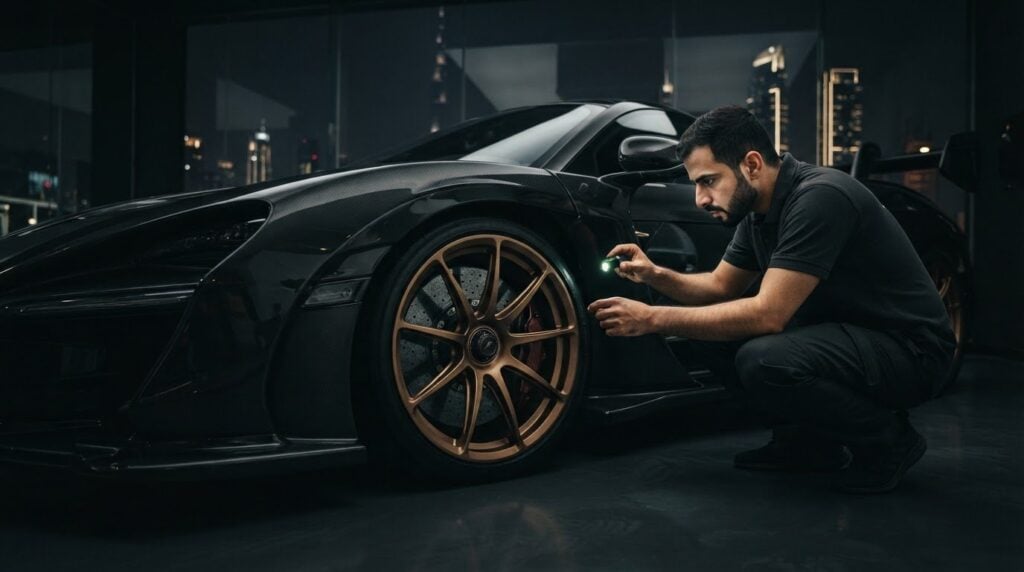
Replacing original wheels with aftermarket alternatives often compromises factory engineering, yet standard silver alloys rarely do justice to high-performance styling. A professional satin bronze rim color change delivers bespoke supercar presence while keeping your vehicle’s structural integrity intact. The real question is which application method provides the most durable finish for aggressive road and track conditions.
You already appreciate the warmth and visual impact of bronze, but lingering doubts are completely justified. Fears of flaking finishes under extreme rotor heat, uncertainty about matching your exterior paint, and anxiety that harsh cleaning chemicals might strip a delicate satin luster keep many owners from pulling the trigger. Elite aesthetics shouldn’t come at the cost of durability.
Discover how a professional satin bronze rim color change elevates your vehicle aesthetics while protecting factory wheel integrity. This definitive 2026 guide breaks down professional refinishing standards, coating comparisons, and proven maintenance steps to ensure your wheels look immaculate on every drive.
Key Takeaways
- Learn how a professional satin bronze rim color change transforms wheel aesthetics while preserving critical factory offsets and load ratings.
- Compare the heat thresholds and longevity of electrostatic powder coating, professional paint, and peelable applications under high-performance driving conditions.
- Discover curated tonal pairings, spanning light champagne hues to deep espresso undertones, that best complement your exterior paintwork.
- Explore the multi-stage refinishing workflow, highlighting the vital role of alloy smart repair and contaminant outgassing before pigmentation.
- Master specialized maintenance routines and pH-neutral wash protocols designed to protect satin micro-textures from accidental glossing or chemical etching.
Why Choose a Satin Bronze Rim Color Change for Your Vehicle?
Automotive enthusiasts often assume that achieving a bespoke look requires ordering expensive aftermarket wheels. Yet replacing factory equipment introduces variables that frequently degrade performance. Investing in a professional satin bronze rim color change transforms your vehicle’s stance while keeping its original structural integrity intact. Instead of generic silver or overplayed gloss black, satin bronze delivers a refined, motorsport-inspired presence that bridges aggressive track utility and modern luxury styling.
Beyond aesthetics, this finish offers undeniable everyday utility. Dark brake dust accumulation quickly ruins the reflective surface of high-gloss alloys, requiring relentless cleaning to look presentable. Satin bronze naturally masks light carbon dust and road film, keeping your wheels looking purposeful between washes without constant detailing intervention.
The Visual Characteristics of Satin Finishes
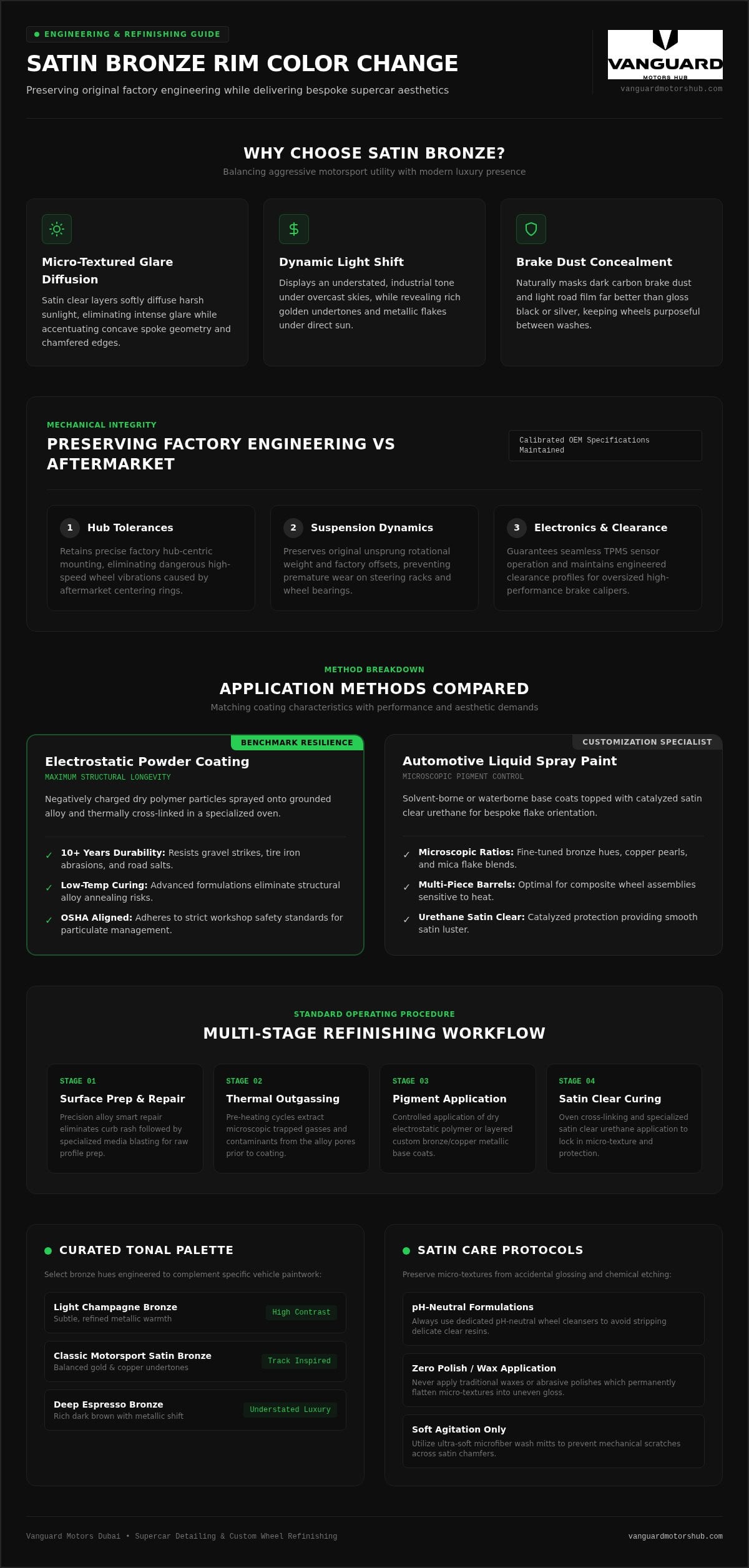
Satin finishes strike a calculated balance between stark matte and reflective gloss. The clear layer contains micro-texturing agents that softly diffuse harsh sunlight, eliminating sharp glare while highlighting the intricate concave geometry and chamfered edges of your spokes. Under overcast skies, the alloy takes on an understated, industrial bronze tone; in direct sun, embedded metallic pigments emerge with deep golden undertones. This dynamic shift ensures the wheel enhances your vehicle’s silhouette rather than fading into the background.
Preserving Factory Engineering vs. Aftermarket Rims
Factory alloy wheels are engineered specifically for your chassis. Original equipment undergoes extensive fatigue, stress, and impact testing to match your car’s exact curb weight, torque output, and suspension dampening. Opting for a bespoke rim colour change preserves these vital mechanical tolerances, avoiding common aftermarket drawbacks:
- Factory Hub Tolerances: Retains precise hub-centric mounting, eliminating high-speed vibrations common with cheap aftermarket centering rings.
- Suspension Dynamics: Preserves original unsprung rotational weight and engineered wheel offsets, protecting steering rack geometry and wheel bearings from premature wear.
- Electronics Integration: Ensures flawless compatibility with original tire pressure monitoring sensors (TPMS) and clearance for oversized factory brake calipers.
Methods like advanced electrostatic powder coating and specialized wheel refinishing allow you to reinvent your vehicle’s aesthetic profile without compromising the calibrated engineering designed by original equipment manufacturers.
Application Methods: Powder Coating vs. Paint vs. Peelable Coatings
Selecting the proper refinishing medium dictates surface hardness, thermal tolerance, and long-term finish life. A lasting satin bronze rim color change relies on picking the right bond for your driving habits. High-stress track days, wet highway commuting, and lease obligations each demand a distinct formulation.
Electrostatic Powder Coating
Electrostatic powder coating represents the benchmark for pure structural resilience. The process sprays negatively charged dry polymer particles onto a grounded alloy wheel before curing the piece inside a dedicated thermal oven. While forum discussions often worry about high baking temperatures weakening forged aluminum, modern technical facilities use advanced low-temperature curing powders. These formulations fully cross-link at lower heat thresholds, eliminating the risk of structural annealing. The resulting shell resists gravel strikes, tire iron abrasions, and corrosive de-icing salts across a decade or more of active driving. Elite workshops follow stringent autobody refinishing safety standards to manage airborne particulates during media blasting and electrostatic staging.
Specialized Automotive Liquid Spray Paint
Liquid spray systems shine when infinite pigment customization is the primary objective. Using precision solvent-borne or waterborne base coats topped with a catalyzed satin clear urethane, liquid application offers unmatched control over metallic flake orientation. Technicians can adjust bronze hues, copper pearls, and mica flakes down to exact microscopic ratios. This method is also the preferred path for multi-piece wheels with delicate composite barrels, titanium hardware, or bonded center caps that cannot endure high-heat curing ovens.
Premium Reversible Peelable Coatings
For leased exotics or short-term styling shifts, professional peelable paint applications provide factory-level satin aesthetics with total reversibility. Sprayable liquid polymers atomize through standard paint equipment, forming a durable, seamless barrier over the underlying alloy. The film seals out stone chips, micro-scratches, and aggressive brake debris while remaining completely removable down the road. If you are exploring temporary finish transformations across body panels alongside your wheels, review our car wrap guide for cohesive styling options.
Whether your priority is extreme rock-chip protection or temporary visual impact, choosing the right method requires an expert assessment of your wheel architecture. If you want tailored recommendations for your vehicle’s specific setup, you can connect directly with a wheel specialist to review your build.
Color Matching Guide: Pairing Satin Bronze with Vehicle Paint Schemes
A successful satin bronze rim color change hinges on selecting the exact tonal profile for your car’s exterior finish. Industry data shows bronze capturing roughly 15% of the wheel aftermarket, serving as the dominant alternative to black. Bronze is not a one-size-fits-all finish. Hues range from radiant champagne golds to deep, earthy espresso tones. Harmonizing these undertones with your factory paint ensures a cohesive aesthetic rather than an accidental visual clash.
Stealth and Monochromatic Paint Pairings
Monochromatic bodywork offers the highest contrast canvas for metallic bronze alloys. Deep gloss black, satin black, and graphite finishes prevent dark exteriors from looking heavy or muted when paired with warm bronze hues.
- Gloss and Satin Black: Medium to rich bronze shades break up all-black exterior schemes, offering visual separation between low-profile tires and dark bodywork.
- Chalk Grey and Nardo Tones: Cool, non-metallic greys benefit from pale champagne-bronze finishes. The subtle yellow-gold flecks inject warmth into an otherwise clinical exterior.
- Pure White and Pearl Finishes: Crisp white exteriors pair naturally with medium matte or satin bronze, generating a sharp, motorsport-derived contrast.
Vibrant and Rich Heritage Colors
Heritage and jewel-tone exterior paints require a calibrated undertone balance. Cool metallic blues demand bronze formulations infused with fine silver flakes to tie into the paint’s underlying cool hue. British racing green, dark emerald, and olive drabs call for deep, warm bronze tones reminiscent of classic endurance racers. In these combinations, the gold and copper flecks inside the wheel finish pick up sunlight, highlighting body curves without overpowering exterior accents.
Achieving this level of harmony often involves looking at vehicle proportions as a whole. When executing a full build, pair your wheel refinishing alongside bespoke body kit installation to align wheel fitment with sculpted aerodynamic carbon components. Mastering the ensures your chosen shade lays down with uniform pigmentation across complex wheel faces, delivering an integrated, factory-plus aesthetic from every viewing angle.
The Professional Refinishing Workflow: From Surface Prep to Curing
Executing an elite satin bronze rim color change requires clinical metallurgical preparation rather than simple cosmetic top-coating. Over 80% of coating failures stem from rushed surface prep or inadequate outgassing. Professional refinishing facilities follow a strict multi-stage protocol to guarantee that the final finish resists extreme rotor heat, torque stress, and corrosive debris.
Chemical Stripping and Alloy Smart Repair
The process starts by stripping the wheel down to raw aluminum. Tires, valve stems, TPMS sensors, and balancing weights are completely disassembled. Technicians submerge the bare rims into dedicated chemical immersion tanks to dissolve old clear coats and base layers without mechanically scarring the metal. Once stripped, wheels undergo fine-media blasting to strip stubborn oxidation and create an optimal mechanical anchor profile.
Technicians then inspect the bare wheel for structural runout, hairline stress fractures, and curb rash. Through specialized cosmetic car repair and alloy smart repair, technicians reconstruct damaged edges using precise metal blending techniques. Before pigmentation, wheels enter a thermal oven for an outgassing phase, driving out porous contaminants and trapped air that cause bubbling.
Precision Pigment Coating and Satin Clear Application
Once cooled to target application temperatures, the alloy receives an epoxy primer engineered for maximum adhesion and corrosion prevention. Base pigmentation takes place inside positive-pressure, climate-controlled downdraft spray booths. This sealed environment isolates the wet coating from airborne dust and moisture.
Applying the satin bronze pigment requires meticulous spray gun passes to distribute the metallic flakes evenly, avoiding cloudy patches or uneven color density. Technicians then apply a specialized satin clear coat formulated with microscopic flattening silicas. These matting agents must be uniformly atomized to prevent glossy halos or uneven sheen across recessed lug holes and spoke pockets.
Controlled Curing and Reassembly Standards
Baking cycles require calibrated temperature regulation. High-temperature ovens or short-wave infrared lamps bake the clear coat into a cross-linked chemical shield, locking in flexibility and rock-chip resistance without annealing the aluminum alloy. After curing and cooling, tires are mounted using touchless mounting machines with nylon-shielded tooling to prevent rim lip abrasion. Assemblies are finished with road-force digital balancing using concealed weights.
When you demand flawless craftsmanship for your factory alloys, trust a dedicated technical team. Schedule your professional wheel refinishing service to transform your vehicle with absolute precision.
Maintaining Satin Bronze Rims: Cleaning, Protection, and Expert Care
Preserving the factory-calibrated luster of a satin bronze rim color change requires a calculated maintenance routine. Standard wheel detailing often relies on aggressive friction or acid-heavy wheel brighteners, but satin clear coats behave differently. Satin finishes utilize microscopic flattening agents that diffuse light. An improper wash cycle can buff down those micro-textures, turning your refined satin finish into an uneven, blotchy gloss.
Safe Cleaning Chemistry and Frictionless Washing
Never spray wheel cleaners onto hot alloys directly after spirited driving. Extreme rotor heat causes cleaning solutions to evaporate instantly, baking active chemicals into the clear coat and creating permanent watermark etching. Allow the brakes to cool to ambient temperature first, then rinse thoroughly with cool water.
- Use pH-Neutral Shampoos: Stick to dedicated pH-neutral wheel formulas that dissolve road film without stripping delicate clear resins.
- Select Soft Microfiber: Swap stiff nylon wheel brushes for plush microfiber wash wands and dedicated wash mitts.
- Skip Conventional Polishes: Traditional carnauba waxes, buffing pads, and rubbing compounds fill the clear coat’s low points, permanently clouding the satin effect.
High-Temperature Ceramic Wheel Coatings
Applying a dedicated ceramic coating provides the ultimate barrier against caustic road debris. High-grade ceramic formulas bond chemically to the wheel face, withstanding rotor temperatures exceeding several hundred degrees without yellowing or degradation. This hydrophobic shield prevents carbon brake dust from fusing into the finish, allowing contaminants to rinse away without high-friction scrubbing. For comprehensive vehicle preservation, pair wheel protection alongside expert supercar detailing to shield every exterior surface.
Elite Refinishing with Vanguard Motors
Maintaining a flawless satin finish starts with factory-grade application standards. At Vanguard Motors, wheel transformations receive meticulous craftsmanship. Technicians correct surface rash through multi-stage alloy smart repair, strip away oxidized layers, and apply precision-matched satin bronze coatings inside controlled cleanroom environments. Each wheel leaves fully balanced, structurally sound, and ready to elevate your vehicle’s performance presence on the open road.
Elevate Your Vehicle’s Stance with Flawless Satin Bronze
A professional satin bronze rim color change does far more than refresh your wheel faces. It protects your suspension geometry, preserves engineered factory load ratings, and delivers an undeniable motorsport presence. By pairing the right coating method with clinical surface preparation and dedicated pH-neutral maintenance, your wheels will easily endure intense rotor heat and abrasive road conditions.
Executing this level of finish requires specialized technical capability. Vanguard Motors brings master craftsmanship to luxury, exotic, and high-performance platforms. Our specialists handle the entire workflow in-house, combining multi-stage alloy smart repair and precision refinishing with complete styling synergy across body kits, bespoke wraps, and ceramic protection. Don’t settle for off-the-shelf compromises when your chassis deserves tailored perfection. Upgrade your rims to bespoke satin bronze with Vanguard Motors and redefine your driving presence today.
Frequently Asked Questions
Can you powder coat factory alloy wheels in satin bronze without weakening the metal?
Yes, professional powder coating does not weaken factory alloys when applied using modern low-temperature curing cycles. Standard automotive alloys withstand thermal bake cycles safely below their metallurgical annealing thresholds. Certified refinishing facilities monitor oven temperatures closely, ensuring the aluminum’s structural strength, tensile limits, and original factory load capacities remain completely intact throughout the process.
How do you clean satin bronze rims without making them glossy or cloudy?
Clean satin bronze wheels using dedicated pH-neutral wheel shampoos, cool water, and ultra-plush microfiber wash mitts. Avoid mechanical buffers, stiff bristled brushes, and traditional carnauba waxes. Those products polish down the clear coat’s microscopic texturing agents, causing patchy gloss spots or chalky white streaks. Always rinse the wheels thoroughly while the brake assemblies are cool.
Is it better to paint or powder coat alloy rims for a color change?
Powder coating offers superior impact resistance for daily driving, while liquid paint provides sharper control over complex metallic flake mixtures. A powder-coated satin bronze rim color change resists rock chips, road de-icers, and tire-mounting stress for years. Liquid automotive paint excels on multi-piece wheels featuring delicate composite barrels or decorative hardware that cannot tolerate thermal oven baking cycles.
Can curb rash be repaired during a satin bronze rim color change?
Yes, professional refinishers eliminate curb rash and surface gouges prior to laying down the satin bronze finish. Technicians inspect the bare alloy, blend out shallow abrasions, or reconstruct deep contact damage through precision alloy smart repair. The repaired area is then media-blasted and primed alongside the rest of the wheel to create a completely seamless base.
Will hot brake dust permanently stain or pit a satin bronze rim finish?
Hot brake dust can etch into unprotected satin clear coats if left sitting for weeks under harsh driving conditions. Ferrous particles embed into the microscopic texture of the finish when rotors run hot. Applying a high-temperature ceramic coating creates an invisible barrier, shielding the bronze pigments and allowing caustic brake dust to rinse away without high-friction scrubbing.
Can a peelable paint rim color change be reversed back to original factory silver?
Yes, premium peelable paint releases cleanly from original factory silver wheels without harming the OEM clear coat beneath. High-grade sprayable polymers form a continuous, durable elastic film over the alloy. When you want to return a leased vehicle or switch styling, the material simply peels off in full sheets, leaving your original finish pristine.
How long does a professional satin bronze rim color transformation typically take?
A comprehensive satin bronze rim color change generally takes between two to four business days depending on surface repair requirements. The workflow demands complete tire dismounting, chemical immersion stripping, alloy damage correction, thermal outgassing, base pigmentation, and controlled curing. Reassembly, touchless tire mounting, and high-speed digital balancing complete the final quality checks.