
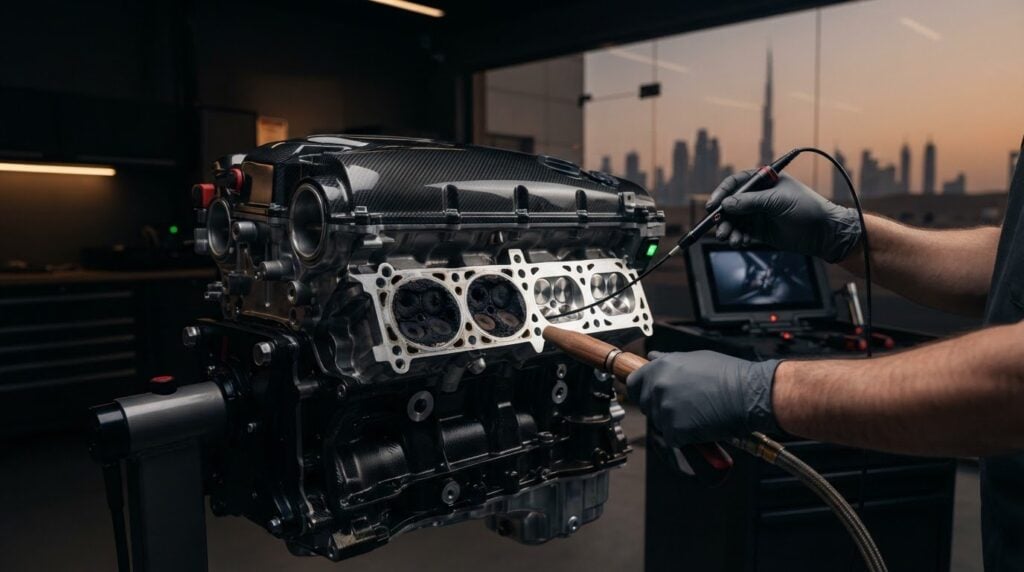
Over 80% of direct-injection engines suffer from choked airflow by 70,000 miles, but carbon build-up isn’t a catastrophic mechanical failure. It’s the predictable byproduct of modern high-output engineering. If your vehicle feels delayed off the line, recognizing the unmistakable signs your engine needs carbon cleaning is the first step toward reclaiming genuine factory precision.
You know the frustration when the throttle hesitates under load, the engine shudders through an uneven cold start, and fuel economy drops without a single warning light on the dash. It feels as though your powertrain has lost its sharp edge, even while standard electronic diagnostics insist everything is fine.
This guide reveals how targeted decarbonization restores lost responsiveness, peak efficiency, and raw horsepower. You’ll learn to diagnose whether restriction sits on your intake valves or inside the combustion chambers, weigh non-invasive hydrogen methods against mechanical walnut blasting, and master the ideal service intervals to protect your engine’s long-term health.
Key Takeaways
- Pinpoint the telltale signs your engine needs carbon cleaning, from sluggish low-end throttle response and hunting idle speeds to silent fuel consumption spikes.
- Understand the mechanical reality of modern direct-injection architecture, where unburned oil vapors bake onto intake valves without a detergent-fuel wash to dissolve them.
- Compare proven decarbonization methods to determine when non-invasive hydrogen cleaning suffices and when mechanical walnut blasting is necessary to restore intake airflow.
- Establish ideal diagnostic and service intervals using borescope inspections to protect valve seats and performance exhaust components before damage occurs.
- Discover how precision engine carbon cleaning eliminates sporadic cold-start misfires, revives lost torque, and sharpens factory powertrain calibration.
The Primary Signs Your Engine Needs Carbon Cleaning
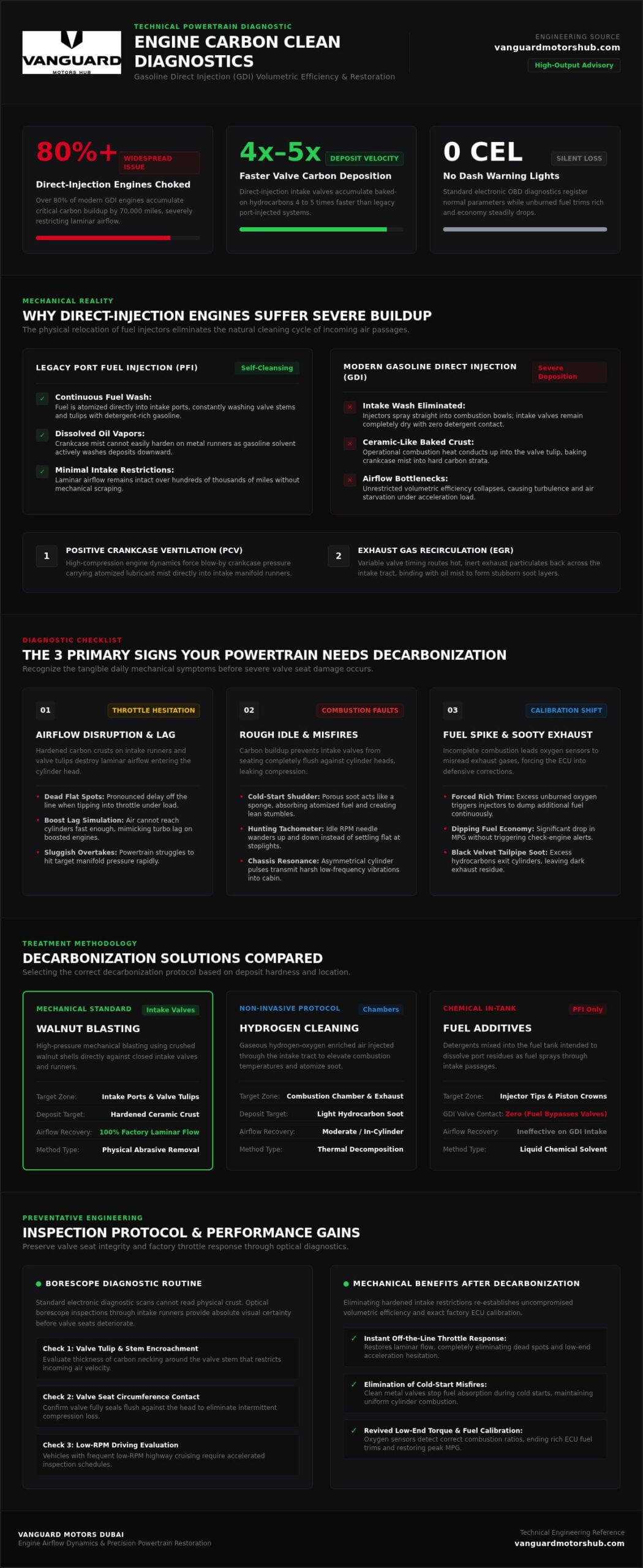
Internal combustion engines rely on precise volumetric efficiency. When baked-on hydrocarbon deposits coat your intake ports and cylinder heads, that efficiency collapses. Over 80% of direct-injection engines accumulate heavy carbon buildup by 70,000 miles, choking airflow and dulling the razor-sharp dynamics engineered into your powertrain. Modern Gasoline direct injection (GDI) architecture and prolonged low-RPM highway cruising accelerate this soot accumulation, creating tangible performance bottlenecks. Recognizing the primary signs your engine needs carbon cleaning protects sensitive valve seats and prevents severe internal damage before standard dash diagnostics illuminate.
Sluggish Throttle Response and Acceleration Hesitation
Crisp acceleration demands instant, unrestricted air delivery. As hardened carbon deposits coat intake runners and valve tulips, they destroy laminar airflow into the combustion chambers. You’ll feel a pronounced flat spot or lag when tipping into the throttle. On turbocharged platforms, this restriction mimics severe boost lag, making overtakes feel sluggish because incoming air cannot reach the cylinders quickly enough to meet the ECU’s target manifold pressure.
Rough Idling, Cabin Vibrations, and Cold-Start Misfires
A finely balanced powertrain should idle with near-imperceptible vibration. Crusty carbon crusts along the valve stems prevent intake valves from seating flush against the cylinder head. This creates intermittent compression loss across specific cylinders. Watch for these mechanical symptoms during daily driving:
- Erratic Tachometer Needle: Idle revolutions wander or hunt instead of settling at a steady baseline at stoplights.
- Cold-Start Shudder: Porous carbon deposits absorb atomized fuel during initial startup, causing momentary lean misfires and stumbling.
- Chassis Resonance: Unbalanced cylinder firing pulses transmit harsh, low-frequency vibrations straight through the engine mounts into the cabin.
Dipping Fuel Efficiency and Black Exhaust Tailpipe Smoke
Restricted airflow forces your engine control unit into an uphill battle. When unseated valves and choked ports cause incomplete combustion, the oxygen sensors detect unburned oxygen and command the fuel injectors to trim rich. This hidden calibration shift causes fuel economy to plummet without an illuminated check engine light. Excess unburned hydrocarbons exit into the exhaust, coating tips in dry, velvety black soot. Pairing clean intake breathing with optimal backpressure is essential, as detailed in our guide at Vanguard Motors, where high-output calibration depends entirely on uncompromised airflow.
Why Modern Direct-Injection Engines Suffer from Carbon Build-Up
Engineering advancements deliver incredible specific output and thermal efficiency, but they also rewrite internal engine dynamics. In older port-injected systems, atomized gasoline washed continuously across the intake ports, constantly cleansing metal surfaces with fuel-borne detergents. Modern Gasoline Direct Injection (GDI) relocated the injector directly into the cylinder head. This leap in precision isolates the intake path entirely, leaving valves bone dry. As highlighted by Jalopnik, severe valve deposit accumulation has become a common side effect of the system. Modern direct injection engines accumulate carbon on intake valves four to five times faster than legacy port platforms, turning mechanical upkeep into a non-negotiable performance requirement.
The Elimination of the Intake Valve Fuel Wash
Direct injection creates an inhospitable cycle for intake runners. Without detergent-treated fuel acting as an automated solvent, incoming air must travel through ports coated in residual lubricant mist. Intense operational heat conducts upward from the combustion bowl into the intake valve tulips. This heat bakes volatile oil particles into a stubborn, ceramic-like crust that mechanical air currents cannot dislodge.
Crankcase Ventilation and Exhaust Gas Recirculation Impact
Two essential emissions systems accelerate this internal restriction behind the scenes:
- Positive Crankcase Ventilation (PCV): High-compression engines generate crankcase pressure that carries atomized oil droplets straight back into the intake manifold runners.
- Exhaust Gas Recirculation (EGR): Variable valve timing and dedicated EGR pathways route scorching, particulate-heavy exhaust gases back across cold intake valves.
When microscopic oil mist collides with dry, hot exhaust soot, it forms a dense, sticky paste. Over thousands of combustion cycles, this sludge petrifies into turbulent obstacles that sap airflow.
Short Commutes, City Congestion, and Low Engine Temperatures
Operating environments dictate the speed of this buildup. Stop-and-go driving and short commutes prevent performance powertrains from achieving sustained thermal equilibrium. Cruising below 2,500 RPM keeps intake velocity low, giving heavy oil vapors ample time to drop out of suspension and stick to valve stems. If your driving profile includes heavy urban traffic, watching for the earliest signs your engine needs carbon cleaning is vital to preserving tight manufacturing tolerances. You can speak with our performance specialists to evaluate your vehicle’s current intake health before minor deposit layers degrade power delivery.
Comparing De-Coking Solutions: Hydrogen, Walnut Blasting, and Additives
Selecting the correct remediation method depends entirely on where deposits reside and how severely they restrict airflow. Official service bulletins from manufacturers document widespread engine performance issues from carbon buildup, ranging from persistent misfires to uneven cold starts. Applying an entry-level chemical wash to a petrified valve obstruction yields negligible results, while unnecessary mechanical disassembly wastes both time and resources. Matching the procedure to the specific mechanical restriction ensures your powertrain reclaims its factory performance profile without compromise.
Oxyhydrogen Decarbonization for Combustion Chambers and Catalysts
Oxyhydrogen (HHO) service introduces enriched gas through the vehicle’s air induction tract while the engine idles. This process elevates localized peak combustion temperatures, pyrolyzing surface carbon resting on piston crowns, spark plug electrodes, and oxygen sensors. Because HHO cleans downstream via high-temperature exhaust gas expansion, it provides an exceptional non-invasive maintenance solution for exhaust flow paths and catalytic substrate without requiring mechanical teardown.
Mechanical Walnut Blasting for Severe Intake Runner Contamination
When physical inspection reveals heavy, tar-like crusting on direct-injection intake ports, mechanical media blasting represents the definitive industry standard. Technicians remove the intake manifold, rotate the crankshaft to ensure the intake valves on the target cylinder are sealed shut, and execute the service using specialized equipment:
- Friable Organic Media: Finely crushed walnut shell media hits carbonized valve faces under regulated pneumatic pressure, pulverizing baked deposits without etching soft aluminum castings.
- Integrated Vacuum Recovery: Dedicated extraction adapters seal directly against the intake runner, instantly pulling shattered carbon grit out of the engine block.
- Proven Volumetric Recovery: Intake valve flow coefficients improve by an average of 22% after walnut blasting on high-mileage direct-injection engines.
Discerning drivers can turn to Vanguard Motors to evaluate specialized mechanical restoration services for performance engines when physical carbon deposits severely restrict volumetric efficiency.
Pour-in Fuel Tank Additives: Preventative Aid Versus Deep Remedy
Bottled polyetheramine (PEA) concentrates circulate through fuel pumps, delivery rails, and high-pressure direct-injection nozzles. They excel at dissolving lacquer deposits inside injector spray tips to preserve fine fuel atomization patterns. Because direct-injection injectors point straight into the cylinder bowl, these chemical detergents never make contact with the backs of intake valves. Fuel tank additives work wonderfully as preventative fuel system care, but once you encounter unmistakable signs your engine needs carbon cleaning along the intake runners, physical or gas-phase decarbonization becomes mandatory.
When to Service Your Powertrain: Recommended Intervals and Diagnostic Checks
Precision calibration requires proactive maintenance scheduling rather than waiting for component failure. High-compression engines running elevated boost levels cannot afford choked induction tracts. Unchecked valve deposits force unburned hydrocarbons downstream, which over-tempers catalyst cores and prematurely degrades exhaust hardware. Tracking diagnostic metrics allows you to intervene before restrictive buildup compromises high-stress powertrain components.
Mileage Benchmarks for Direct-Injection and Turbocharged Vehicles
Modern direct-injection engines benefit from induction service evaluations every 15,000 to 30,000 miles, with dedicated cleaning schedules generally falling between 20,000 and 60,000 miles depending on usage. High-output twin-turbo platforms driven heavily in stop-and-go metropolitan traffic sit at the lower end of that spectrum. In dense urban commuting, reduced airflow velocity accelerates soot deposition, meaning noticeable power deficits emerge far sooner than in vehicles driven primarily at sustained highway speeds.
Diagnostic Borescope Inspections and Diagnostic Trouble Codes (DTCs)
Objective diagnostics eliminate guesswork before any mechanical disassembly begins. High-resolution articulating borescopes enter the intake tract via sensor ports to visually confirm crust depth across the intake valve stems. Technicians correlate optical evidence with live engine telemetry:
- Fuel Trim Drift: Long-term fuel trims (LTFT) pushing past positive 10% indicate the ECU is actively injecting excess fuel to compensate for restricted cylinder airflow.
- Intermittent Misfire Codes: Diagnostic Trouble Codes ranging from P0300 (random/multiple cylinder misfire) through individual cylinder markers (P0301 to P0308) flag uneven combustion during cold-start cycles.
- Rough Running Monitors: Live crank-position sensor readings detect microscopic fluctuations in crankshaft rotational speed caused by unbalanced cylinder compression.
Holistic Powertrain Care and Performance Synergy
Powertrain health forms the foundation of true luxury ownership. Decarbonization eliminates erratic ignition timing and restores balanced cylinder compression across all banks. Elite vehicle stewardship pairs this internal precision with comprehensive preservation across the entire platform. Match sharp mechanical performance with meticulous bodywork care by exploring our detailing standards through Vanguard Motors, or restore painted surfaces via our specialized cosmetic restoration solutions. If you detect hesitation or suspect your direct-injection powertrain is down on power, book a diagnostic carbon inspection today to identify clear signs your engine needs carbon cleaning before minor deposits escalate.
Restoring Factory Precision: Professional Engine Carbon Cleaning Solutions
Performance engines require clinical execution. Clearing intake and combustion chamber restrictions isn’t merely about dislodging soot; it’s about safeguarding micro-tolerances. When you spot the unmistakable signs your engine needs carbon cleaning, turning to specialized workshop facilities guarantees that intake valves, delicate mass airflow sensors, and turbocharger compressor wheels remain completely protected throughout the de-coking process.
The Value of Specialist Automotive De-Coking Equipment
Execution separates amateur attempts from true mechanical restoration. Dedicated technicians utilize model-specific runner adapters that mate seamlessly to the cylinder head, ensuring blasted media never migrates toward open valves. High-volume pneumatic vacuum loops simultaneously collect shattered carbon fragments before loose debris can enter the cylinders. Following mechanical cleaning, diagnostic technicians reset long-term adaptive parameters within the engine management system, prompting the ECU to relearn immediate airflow targets across the restored ports.
Safeguarding Engine Longevity and Fuel Efficiency Long-Term
Restoring unrestricted airflow delivers immediate engineering benefits across the entire operating band:
- Elimination of Pre-Ignition: Removing glowing carbon hotspots within combustion bowls prevents destructive pre-ignition and stops the ECU from retarding spark timing.
- Thermal Stability: Balanced volumetric efficiency lowers exhaust gas temperatures under aggressive load, protecting performance exhaust manifolds and catalytic matrices.
- Restored Stoichiometry: Cylinders achieve clean, complete fuel burn, returning mileage and throttle linearity to precise factory baselines.
Elevating Your Vehicle’s Performance and Care Routine
High-performance stewardship demands a comprehensive philosophy where mechanical perfection matches visual distinction. Integrating scheduled decarbonization into your vehicle’s lifecycle shields expensive forced-induction powertrains from premature degradation and preserves long-term resale value. Once your vehicle exhibits early signs your engine needs carbon cleaning, scheduling professional engine carbon cleaning at Vanguard Motors restores razor-sharp throttle response and unleashes the authentic mechanical power your car was engineered to deliver.
Unlock Peak Powertrain Precision Through Targeted Decarbonization
Tolerating sluggish throttle response, uneven idle hunting, or creeping fuel consumption compromises the driving dynamics your vehicle was engineered to deliver. Recognizing the unmistakable signs your engine needs carbon cleaning gives you the upper hand, allowing you to resolve restricted airflow and compromised cylinder compression before minor deposits trigger costly valve seat wear. Whether your platform requires downstream hydrogen cleaning or deep mechanical walnut blasting, targeted decarbonization restores crisp throttle linearity and factory output.
Powertrain health forms the heartbeat of true driving pleasure. As an advanced automotive customization and mechanical service center, Vanguard Motors provides specialized carbon cleaning, bespoke performance modifications, and meticulous aesthetic protection under one roof. Our technicians utilize specialized diagnostic tools to evaluate intake restrictions and execute clinical de-coking without risking sensitive engine components. Don’t let hardened carbon deposits mute your vehicle’s authentic performance. Restore factory throttle response with engine carbon cleaning at Vanguard Motors and unleash your engine’s true engineering capability today.
Frequently Asked Questions
What are the most common signs your engine needs carbon cleaning?
The most recognizable signs your engine needs carbon cleaning include sluggish throttle response, erratic idle revolutions, and cold-start engine stumbling. Drivers also experience lagging acceleration under load and climbing fuel consumption without a check engine light appearing. As intake restrictions worsen, unburned fuel creates dark soot around the exhaust tips and causes noticeable flat spots during hard acceleration.
Can you clean carbon deposits from intake valves without taking the engine apart?
Non-invasive methods like oxyhydrogen gas decarbonization clear soft deposits from combustion chambers and exhaust tracts without mechanical teardown. However, hardened intake valve deposits on direct-injection engines require removing the intake manifold for direct physical access. Technicians leave the cylinder head bolted in place while using specialized equipment to blast and vacuum the port runners clean.
Do fuel additives remove carbon build-up in direct-injection engines?
Fuel additives cannot clean intake valves on direct-injection platforms. Because direct injectors spray high-pressure fuel straight into the combustion chamber, the detergent-rich gasoline never makes contact with the back of the intake valves. Pour-in additives effectively clean fuel lines, pumps, and injector tips, but they serve strictly as fuel system upkeep rather than a valve de-coking remedy.
How often should a direct-injection engine receive carbon cleaning?
Most direct-injection powertrains benefit from induction diagnostics every 15,000 to 30,000 miles, with dedicated decarbonization typically required between 20,000 and 60,000 miles. Vehicles operated primarily in dense city traffic experience faster soot buildup due to reduced intake airflow speeds. Shorter service intervals keep accumulated oil vapor from solidifying into dense airflow barriers.
What happens if you ignore severe engine carbon build-up?
Ignoring the unmistakable signs your engine needs carbon cleaning eventually prevents intake valves from seating flush against the cylinder head. This incomplete seal leads to compression loss, morning cylinder misfires, and rough running. Over time, unburned fuel washes down cylinder walls and overheats catalytic converters, while dislodged carbon chunks risk damaging exhaust turbine wheels.
Does carbon cleaning improve horsepower and fuel economy?
Carbon cleaning directly restores factory horsepower and optimal fuel mileage. Clearing intake runner restrictions improves valve airflow coefficients by an average of 22%, allowing the cylinders to breathe efficiently again. The engine control unit no longer needs to inject excess fuel to compensate for turbulent air, which sharpens throttle response and restores factory efficiency.
Is walnut blasting safe for high-performance and luxury engines?
Walnut blasting is completely safe and remains the premier factory-approved method for luxury and high-performance engines. Crushed walnut shells are an organic, friable media that fractures instantly upon impact. They strip away petrified carbon without etching aluminum port walls or damaging steel valve stems, while high-volume vacuum systems ensure no media residue remains behind.