
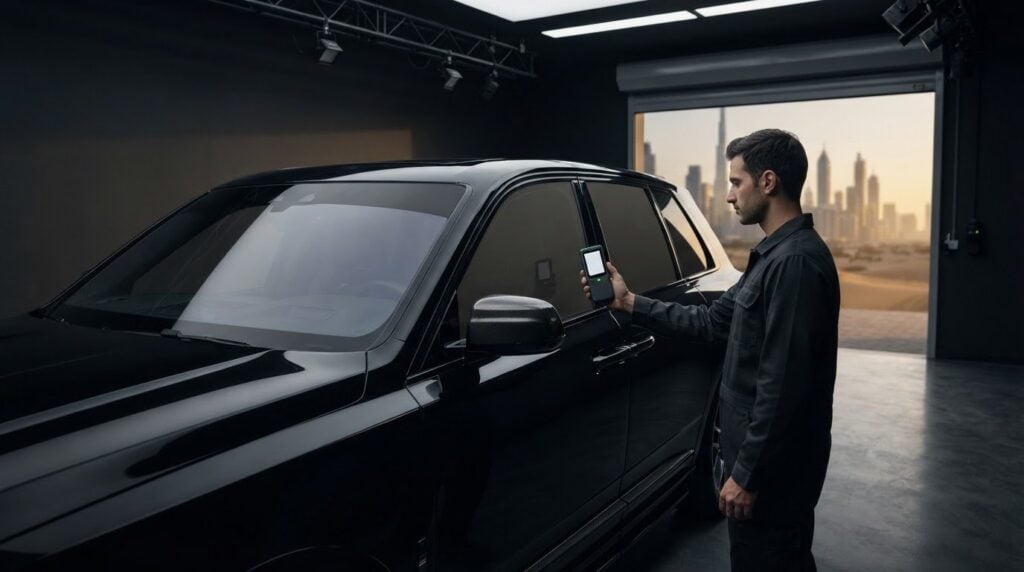
For private cars, the tint darkness regulations for 2026 in the UAE generally permit up to 50% tint on side and rear windows. The front windshield must remain clear apart from a permitted top strip measuring 15 cm, while documented medical conditions may qualify for a darker-tint exception on a case-by-case basis.
It’s easy to assume that a darker film is acceptable as long as it improves comfort and appearance. But the permitted level, the type of window and any applicable exemption all matter, and exceeding the limit can result in a fine of AED 1,500.
This guide explains which windows may be tinted, where windshield exceptions apply, and how to assess a film’s visible light transmission (VLT) before installation. It also covers potential penalties and why factory privacy glass and aftermarket film must be considered together. The goal is to get the appearance and protection you want while staying within UAE regulations.
Key Takeaways
- Private cars are generally allowed up to 50% tint on side and rear windows; the windshield has a separate restriction.
- Windshield tint is generally limited to a permitted top strip measuring 15 cm, with exceptions requiring official approval.
- A qualifying medical exemption may allow darker tint, but keep the required proof in the vehicle.
- Non-compliant tint can lead to a fine of AED 1,500 and, in some cases, vehicle impoundment for up to 30 days.
- Check the film’s VLT rating and account for factory privacy glass, since the combined result affects the final reading.
Car Window Tinting Laws in UAE: What’s legal in UAE?
Private vehicles generally may have up to 50% tint darkness on side and rear windows in the UAE. The tint darkness regulations for 2026 in UAE also distinguish windshield rules, vehicle categories, and approved exemptions, so one film choice may not suit every pane.
Private Vehicle Tint Limits
Private vehicle tint limits define how much tint darkness is permitted on each window. The general UAE allowance reaches 50% darkness on side and rear glass, but reflective or mirrored film remains prohibited even when its darkness meets the limit. This distinction matters because compliance depends on both the film’s appearance and its placement.
The rules changed from a 30% limit to a 50% limit in 2017 and were standardized under Ministerial Resolution No. 178. These details help explain why older advice may differ from current guidance. The tint darkness regulations for 2026 in UAE should be applied alongside any stricter rules for the vehicle category.
Visible Light Transmission by Window
Visible light transmission, or VLT, describes how much light passes through the glass and film. Front-side window tint limits can depend on regional requirements, so check the applicable rules before choosing a film. Rear side windows and the rear windshield must allow at least 30% VLT, equivalent to 70% tint darkness.
For the front windshield, the stated minimum is 70% VLT, with tint generally prohibited apart from the permitted top strip. Drivers should compare a film’s VLT with the relevant window limit, rather than relying only on how dark the glass looks.
National Limits by Window
Across the country, tint limits vary by window, so placement matters as much as film selection. A film that meets the rear-window limit may not meet the higher light-transmission requirement for front side glass. Trucks and taxis also face stricter tint requirements than private cars.
Commercial and fleet vehicles have additional restrictions. Commercial vehicles must keep front side windows and rear windscreens clear, while official authority regulations govern rear side-window tinting. Company-owned or leased vehicles require permission for tinting, and commercial fleets must obtain appropriate transport authority approval.
Medical Exemptions
A qualifying medical condition may allow darker tint on a case-by-case basis. Local traffic authorities and police departments may issue permits for documented medical conditions and certain government, consular, or VIP security vehicles. Keep proof of a medical exemption in the vehicle.
An exemption is not blanket permission for any film or window. Its approved scope matters, and reflective or mirrored tint remains prohibited. For a driver considering darker tint for a medical reason, the required permit and supporting documentation are central to compliance.
Exceeding the permitted tint limit can result in a fine of AED 1,500, and a vehicle may face impoundment for up to 30 days. An insurer may reject an accident claim if the vehicle violates tinting laws. Those consequences make it essential to distinguish the applicable window limit from a film’s darkness label.
Is front windshield tinting ever permitted in the UAE?
The UAE generally prohibits tint on the front windshield, except for a top strip measuring 15 cm. Dubai rules allow a factory-installed sun strip up to 5 inches high; reflective or mirrored tint is prohibited, and colored film does not create an exception for the main glass.
Windshield Tint Restrictions
Windshield tint restrictions keep the main front glass clear, preserving visibility for the driver. In the UAE, the front windshield must allow at least 70% visible light transmission, so aftermarket tint across the main glass isn’t allowed. This matters because a film that darkens the full windshield can breach the rules even if side windows comply.
Dubai also prohibits aftermarket tint on the front windshield, except for a permitted factory sun strip or an official exemption. The restriction applies to the glass area, regardless of how light or subtle a film appears. Even nearly transparent film across the main windshield counts as aftermarket windshield tint, not an approved strip.
Reflective and mirrored window films are prohibited in the UAE, even if they meet a stated tint limit. Distinguish a colored appearance from a reflective finish, and remember that color does not permit tint across the main windshield. Any allowance is limited to the permitted top strip.
Penalties can follow an unauthorized windshield application. Tinting the front windshield carries a fine of AED 1,500, and a vehicle may be impounded for a tinting-law violation. These consequences make the precise placement of film important: a compliant side-window installation does not make a full windshield application permissible.
Permitted Sun Strips
A sun strip is a narrow tinted band at the top of the windshield, not permission to tint the entire glass. The UAE allowance describes a top strip measuring 15 cm. Dubai’s stated rule permits a factory-installed front windshield sun strip no more than 5 inches high.
The measurements are expressed differently, so do not assume one automatically replaces the other. Keep the strip within the applicable allowance and confined to the top edge. Extending it down the glass makes it windshield tint, which is generally prohibited.
In Dubai, aftermarket tint is not allowed on the front windshield, apart from a permitted factory sun strip or an official exemption. A strip’s color or reflective appearance does not remove the restriction on mirrored film. The distinction is straightforward: a limited top band may be allowed, but added film across the main glass is not.
For a vehicle with an official exemption, the exemption applies only within its authorized scope. It shouldn’t be treated as blanket permission for any film, color, or coverage. Car owners considering a windshield strip can use guidance on vehicle window tinting to discuss the planned application against these restrictions.
Fines and possible vehicle impoundment
Illegal window tint can bring a fine, removal requirements, or vehicle impoundment in the UAE. The consequence depends on the violation: listed penalties include AED 300-500 for the wrong tint percentage, and AED 1,500 for front windshield tinting or unauthorized commercial-vehicle tint. Exceeding the permitted limit can also result in a fine of AED 1,500.
These figures do not represent one universal charge for every case. The issue may involve the film’s darkness, its placement, or the vehicle category. For example, overly dark side glass on a private car raises a different compliance issue from unauthorized film on a commercial vehicle. The authority determines the applicable action based on the specific violation.
Impoundment is another possible consequence. A vehicle may be impounded for a tinting-law violation, and non-compliant film may need to be removed before the vehicle is released. In some cases, the vehicle remains impounded until the tint has been removed. A vehicle may face impoundment for up to 30 days for exceeding the permitted tint limit.
A failed tint reading can affect more than the inspection itself. If an RTA inspection records a non-compliant reading, the film must be removed and the vehicle retested before registration renewal. That adds removal and another inspection to the process. For renewal, the measured reading, not the film’s appearance, is the key compliance concern.
Insurance is a separate consideration after an accident. An insurer may reject a claim if the vehicle violates tinting laws. This does not mean every tint violation automatically leads to rejection, but non-compliance may affect the claim assessment. Staying within permitted limits helps avoid adding a regulatory violation to an accident review.
For practical risk control, focus on three details: the window involved, the vehicle type, and the measured VLT of the glass and film together. Factory privacy glass can combine with aftermarket film to produce a reading of 15% VLT, creating a compliance issue despite the added film’s individual rating. A driver should also avoid assuming that a tint chosen for comfort is permitted on every window.
If an authority identifies illegal tint, resolve the non-compliance rather than simply paying a fine and continuing to drive with the same film. Removal and retesting may be required, and impoundment can keep the vehicle off the road. Matching the film and its placement to the applicable limit helps protect registration progress and insurance standing.
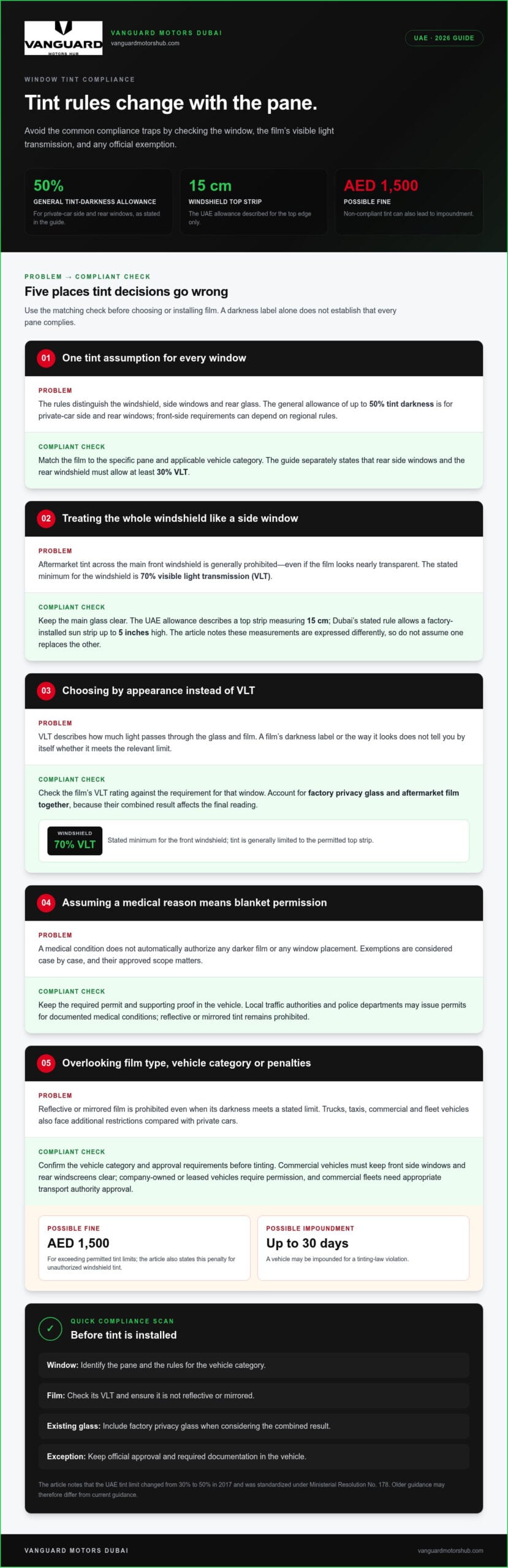
Permitted tint on side and rear windows
For UAE private vehicles, rear side windows and the rear windshield may have tint up to 50% VLT. This figure describes light passing through the glass and film, not the film’s darkness label. The distinction matters because a higher darkness percentage means less light transmission, while a higher VLT means more light enters the cabin.
Dubai’s stated limits use different thresholds by window: front side windows must allow at least 70% VLT, while rear side windows and the rear windshield must allow at least 30% VLT. These Dubai figures differ from the general UAE allowance for rear glass, so drivers should match the tinting rule to the vehicle’s location and window position.
Factory privacy glass also affects the final result. A film’s individual VLT rating does not show the combined reading after installation over existing tinted glass. For example, aftermarket film applied over factory privacy glass can produce a combined reading of 15% VLT. That reading may be too dark, even if the added film seems light by itself.
Check each pane separately: front side windows, rear side windows, and the rear windshield. A film permitted on the rear window is not automatically permitted on front side windows. Reflective or mirrored film is prohibited in the UAE even when its light transmission meets the stated limit. Trucks and taxis also face stricter tint requirements than private cars.
Commercial and fleet vehicles face additional restrictions. Commercial vehicles must keep front side windows and rear windscreens clear, while the RTA trade license regulates rear side-window tinting. Company-owned or leased vehicles require permission for window tinting, and company fleets in Dubai must obtain RTA approval. Private-car limits cannot simply be applied to a work vehicle.
Film selection can also separate appearance from function. Ceramic window tint can block up to 99% of UV rays, according to the market facts, but UV performance does not establish legal VLT compliance. Choose based on both the desired blocking performance and the measured light transmission after installation.
Window tinting costs depend on the vehicle, film type, number of windows, and existing glass, with the cost provided after a quote request. A sedan and an SUV may require different amounts of material, while adding film over privacy glass calls for careful VLT assessment. A price does not replace the compliance check.
Before installation, identify the vehicle category and the limit for each window, then assess the combined glass-and-film reading. This keeps car window tint aligned with the relevant UAE rules, rather than relying on darkness labels or appearance alone.
Choosing tint films and checking compliance
Choose film based on its visible light transmission (VLT), the vehicle category, and the limit for each window. During an RTA inspection, authorities take a reading; the relevant result is the VLT of the glass and film combined.
Choosing Tint Films
Film selection involves balancing light transmission, appearance, and the vehicle’s existing glass. Ceramic film may offer UV protection, but its material type does not establish legal compliance. Match the film’s VLT to the specific window and account for factory-tinted glass in the combined reading.
For example, adding aftermarket film over factory privacy glass can produce a combined reading of 15% VLT. That may be too dark, even when the added film’s individual rating appears suitable. Check the final combination, not just the film label, and avoid reflective or mirrored finishes, which are prohibited.
Regional Regulation Checks
Regulatory checks consider the vehicle’s location and category alongside the relevant RTA requirements. In Dubai, company fleets must follow tint rules and obtain RTA approval; company-owned or leased vehicles require permission for tinting. Commercial vehicles also face restrictions that differ from those for private cars.
Before selecting film, identify whether the vehicle is private, commercial, or part of a company fleet. Then confirm the applicable limits for the front, side, and rear windows. The RTA trade license regulates rear side-window tinting on commercial vehicles, so private-car limits do not automatically apply.
Compliance Inspections
A tint inspection measures how much visible light passes through the window and film. The reading matters because visual darkness alone cannot establish VLT compliance. Factory privacy glass and aftermarket film contribute to the combined result, so assess the complete window rather than the film by itself.
Legitimate tint films carry a code registered with Dubai Police, and owners are advised to obtain a compliance certificate showing the film’s VLT rating. Keep the certificate with the vehicle records. If an RTA inspection records a non-compliant reading, the film must be removed and the vehicle retested before registration renewal.
For a practical compliance-focused installation, discuss car window tinting with the vehicle’s window limits and existing glass in mind. A clear VLT reading, suitable film code, and certificate help owners keep the installation aligned with applicable UAE requirements.
Vanguard Motors Dubai: Paint Protection Film (PPF) Installation
Vanguard Motors Dubai installs Paint Protection Film (PPF) to protect painted vehicle surfaces. PPF is separate from window tinting: it does not change the legal limits for tinted glass or replace a VLT compliance check.
Once your window film complies with UAE rules, consider how to protect or change the vehicle’s exterior. Vanguard Motors Dubai also offers Colored Sticker Wraps and Peelable Paint Applications for drivers seeking a different look. Each option serves a different purpose, so choose based on whether you want to protect the paint or transform the vehicle’s appearance.
For compliant window tinting or a separate exterior enhancement, contact Vanguard Motors Dubai to discuss your vehicle.
Plan Your Vehicle’s Next Upgrade
Once your window tint decision is settled, consider how the rest of your vehicle should look and feel. The tint darkness regulations for 2026 in UAE are one part of a thoughtful ownership plan; exterior protection and a refreshed finish can shape the vehicle’s presence in a different way.
Vanguard Motors Dubai offers Paint Protection Film (PPF) for protecting paint, Colored Sticker Wraps for a visual change, and Peelable Paint Applications for a different finish. Each serves a distinct purpose: choose according to whether you want to preserve the existing paintwork or transform the vehicle’s appearance.
Take the next step with a clear idea of your priorities, then contact Vanguard Motors Dubai to discuss your vehicle. A considered upgrade can bring protection and personal style together with confidence.
Frequently Asked Questions
Are There Any Exceptions to UAE Car Tint Laws?
Yes, qualifying medical cases and certain security-related vehicles may receive exceptions. A person with a documented medical condition may be permitted darker tint on a case-by-case basis, with proof kept inside the vehicle. Certain government, consular, or VIP security vehicles may also qualify for permits. An exception is not automatic permission for any film or window, so follow the conditions attached to the approval.
Are mirror or chrome reflective tints legal in Dubai?
No. Reflective or mirrored car window tints are prohibited in the UAE, including Dubai, even if the tint otherwise meets the stated limit. A chrome-like reflective finish remains a compliance concern regardless of its shade. A non-reflective film is another option, but its VLT and placement must still comply with the rules for the vehicle and window.
Can I get special permission for darker than 50% tint in Dubai?
Yes. Permits may allow darker tint in qualifying cases, including documented medical conditions and certain government, consular, or VIP security vehicles. Keep proof of a medical exemption in the vehicle. Approval applies to the qualifying case, not every driver. A medical document alone does not authorize darker film without the required approval.
Car Tinting Rules in Dubai: How Dark Can Your Windows Be?
Dubai’s stated limits differ by window: front side windows must allow at least 70% VLT, while rear side windows and the rear windshield must allow at least 30% VLT. These light-transmission figures correspond to different tint darkness levels. Check each window separately, and remember that factory privacy glass contributes to the final reading when aftermarket film is added.
What Does VLT (Visible Light Transmission) Mean?
VLT means visible light transmission, the proportion of visible light that passes through the glass and film. A higher VLT means more light passes through; a lower VLT means darker glass. A film’s rating alone may not indicate the finished window’s reading when factory privacy glass is already present. Consider the combined glass-and-film result.
What is the penalty if I fail the annual RTA technical inspection for tint?
If an RTA inspection records a non-compliant tint reading, the film must be removed and the vehicle retested before registration renewal. A failed inspection does not establish one universal fine for every situation; penalties depend on the violation identified. Tint percentage, window location, and vehicle category can affect how the issue is treated under the applicable rules.
What are the UAE’s legal car window tint darkness limits in 2026?
For private vehicles, the general UAE allowance is up to 50% tint darkness on side and rear windows. Windshield rules differ, and Dubai states separate VLT requirements by window. These limits don’t apply uniformly to every vehicle category: trucks, taxis, and commercial vehicles face stricter requirements. Identify your vehicle type and the specific window before selecting a film.
Are there exceptions to UAE car tint limits for medical or government vehicles?
Yes. Qualifying documented medical cases and certain government, consular, or VIP security vehicles may receive permits for darker tint. Proof of a medical exemption must be kept in the vehicle. The permit is essential: a vehicle’s purpose or a driver’s condition alone does not grant unrestricted permission. Follow the authorization’s scope for the vehicle and windows concerned.