
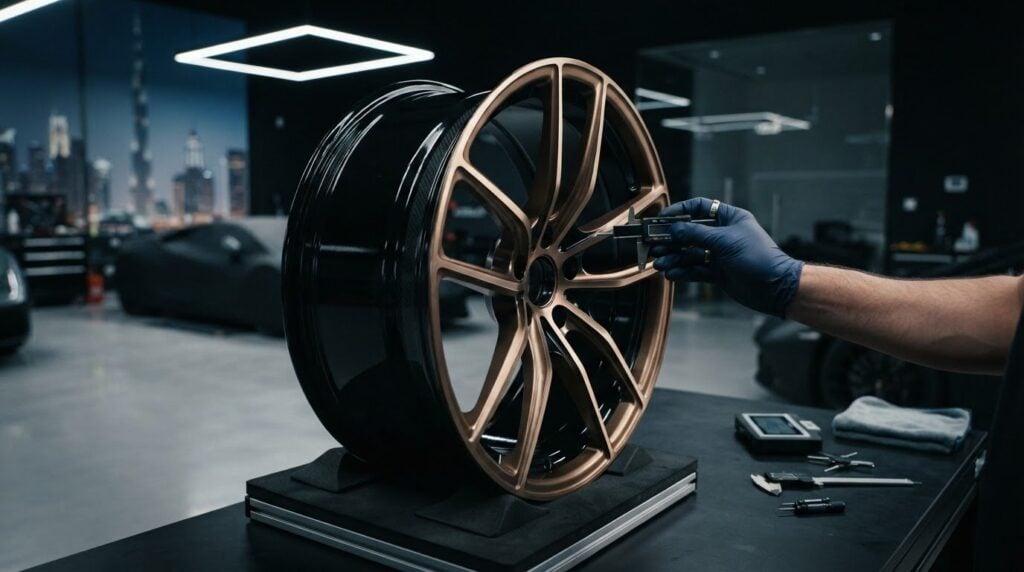
A single millimeter of overspray along a color seam can instantly ruin the stance of a six-figure build. If you’ve ever dealt with peeling clear coat, jagged transition lines, or edges that chipped during tire mounting, you already know standard repair shops rarely meet perfectionist standards. Securing a true OEM-plus aesthetic requires a professional two tone wheel painting service that treats dual-finish refinishing as an exact, multi-stage science rather than a quick cosmetic touch-up.
You don’t have to gamble with compromised finishes or mismatched caliper accents. This guide reveals how professional two-tone wheel painting transforms luxury alloys through precision craftsmanship, multi-stage coating, and bespoke design engineered to resist extreme brake dust and thermal stress. We’ll explore the technical trade-offs between diamond-cut CNC machining and custom masking, map out the rigorous prep protocols required for razor-sharp split lines, and examine the OEM torque safety standards that ensure flawless, enduring performance on the road.
Key Takeaways
- Explore how contrasting face geometries, satin finishes, and deep gloss barrels combine to elevate wheel depth and silhouette lines.
- Compare diamond-cut lathe machining against custom masked painting to determine which method delivers the best resilience against corrosion and brake heat.
- Identify elite shop criteria, from complete chemical stripping and climate-controlled spray booths to critical mounting surface masking.
- Discover dynamic colorway pairings, including brushed bronze faces and deep black barrels, to seamlessly complement exterior paint and carbon accents.
- Learn why choosing a professional two tone wheel painting service ensures structural alloy integrity and razor-sharp color transitions without clear coat failure.
What Is a Professional Two Tone Wheel Painting Service?
Dual-finish alloy customization is not a quick touch-up or an aerosol respray. A professional two tone wheel painting service is an advanced, multi-stage engineering and finishing process designed to apply two contrasting pigments or surface sheens onto a single rim. While basic repair shops treat wheel work as an afterthought, true specialists approach the alloy as a structural canvas. The process integrates industrial chemistry, precise temperature curves, and meticulous masking to separate intricate spoke faces from deep inner barrels.
Every wheel undergoes harsh operating conditions on the road. Factory-grade refinishing provides critical protection against corrosive, hot brake dust and punishing thermal cycles generated under heavy deceleration. High-performance dual-finish applications often integrate multi-stage systems, where foundational durable layers such as powder coating shield the alloy base before custom liquid pigments and chemical-resistant clears seal the transitions. This structural durability ensures the finish won’t peel, yellow, or micro-fracture when pushed hard.
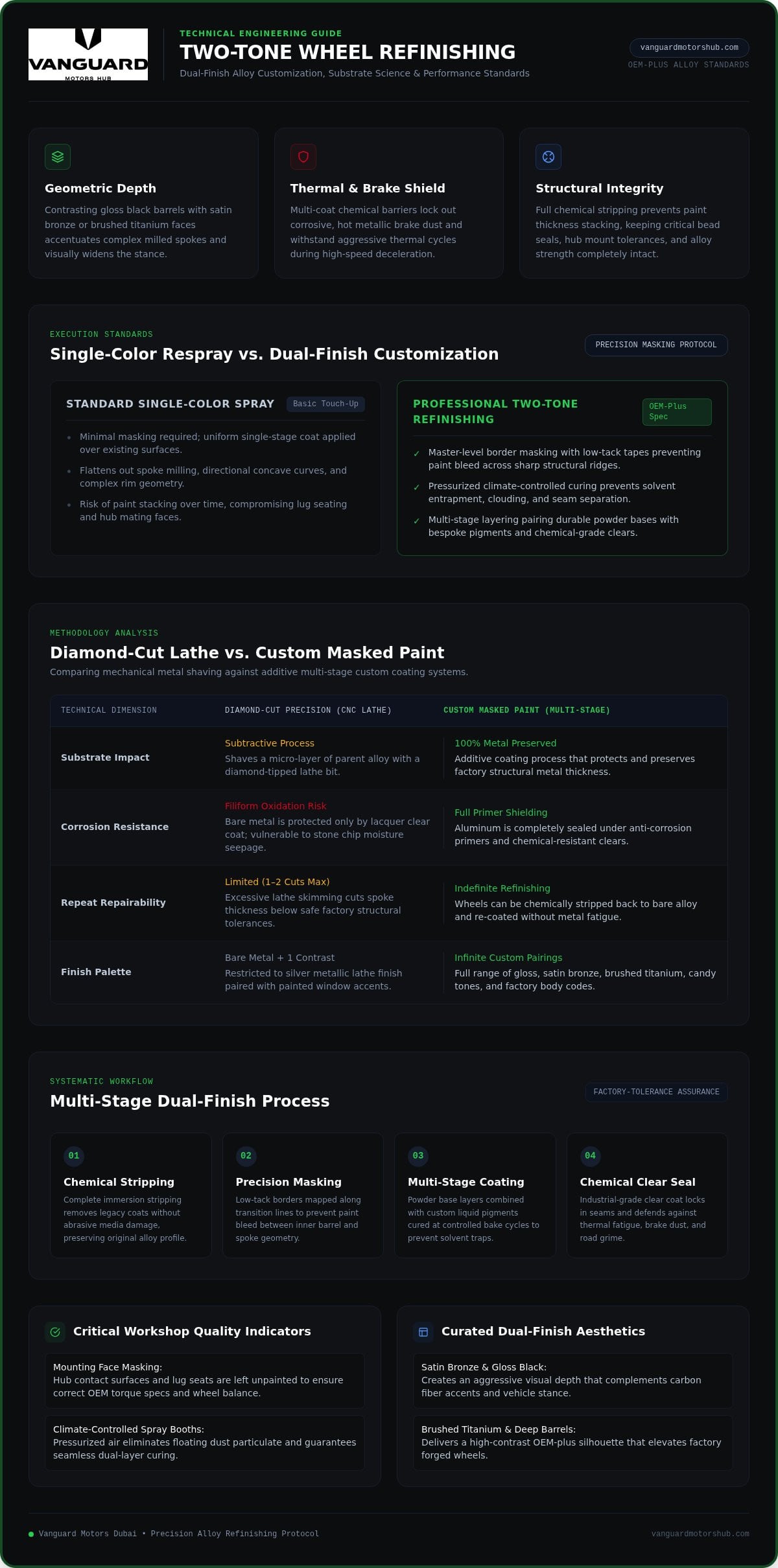
- Enhanced Geometric Depth: Pairing gloss black inner barrels with satin bronze or brushed titanium faces visually widens the wheel track.
- Thermal and Chemical Barrier: Multi-coat clears lock out hot metallic brake dust and road grime that destroy unprotected cast or forged aluminum.
- Structural Longevity: Complete chemical stripping prevents paint thickness stacking, ensuring factory clearances and bead seals remain intact.
The Aesthetic and Value Advantages of Dual-Finish Alloys
Modern luxury and supercar designs rely on rim geometry to balance aggressive vehicle stances. Two-tone finishes accentuate deep spoke architecture, directional concave profiles, and complex milling that single-color resprays flatten out. Incorporating contrasting tones creates an authentic OEM-plus aesthetic mirrored by premier automotive marques. It delivers an unmistakably bespoke profile, amplifying vehicle road presence while protecting rare factory forged options from environmental degradation.
Single-Color Respray vs. Two-Tone Customization
Uniform single-stage sprays require minimal masking and basic prep. In contrast, bespoke two-tone execution demands master-level border masking across razor-thin spoke transitions. Eliminating paint bleed across sharp structural ridges requires specialized low-tack tapes, precise bake times between color applications, and pressurized spray booths that eliminate floating particulate. Without strict climate controls, dual-layer curing can suffer from solvent entrapment, leading to clouding or edge separation along the split lines.
Two-Tone Techniques: Diamond Cut Precision vs. Custom Masked Paint
Selecting the right application method defines both the aesthetic personality and the service lifespan of your rims. While both approaches yield a high-contrast profile, their mechanical execution and long-term resilience are fundamentally different. Understanding these engineering trade-offs helps you determine which route aligns with your vehicle’s demands before booking a two tone wheel painting service.
Precision execution requires technicians with specialized instruction in automotive refinishing to manage substrate adhesion properly. Each method presents distinct operational characteristics:
- Substrate Impact: Diamond cutting removes parent alloy with a diamond-tipped lathe bit, while custom masked painting preserves 100% of the wheel’s structural metal through additive coatings.
- Corrosion Resistance: Masked painting seals the aluminum entirely beneath anti-corrosion primers. Diamond-cut wheels leave bare metal protected solely by a clear coat, increasing vulnerability to stone-chip filiform oxidation.
- Repeat Repairability: Lathe skimming has strict structural limits. Wheels can typically only be cut once or twice before spoke thickness falls below safe factory tolerances. Painted wheels can be chemically stripped and refinished indefinitely.
- Finish Palette: Diamond cutting restricts you to bare metal alongside a painted contrast. Custom paint allows infinite pairings of gloss, satin, metallic, candy, and bespoke factory body codes.
The Diamond-Cut Method: CNC Precision and Bare Metal Accents
This subtractive method maps the wheel face digitally before a CNC lathe shaves a micro-layer of aluminum. The process exposes raw, reflective metal that contrasts sharply against painted spoke insets. However, micro-grooves from the lathe create mechanical vulnerability. When road debris chips the top clear coat, moisture penetrates the interface, creating milky, spider-web corrosion known as white-worm damage across the bare alloy face.
Multi-Stage Masked Painting: Unlimited Palette and Finish Versatility
Custom masked painting relies on an artisanal, additive workflow. Technicians apply an unbroken primer shield, shoot the primary tone across the barrel and recesses, and manually mask every border with high-precision fine-line tape. A contrasting hue is then layered onto the spoke faces. Because the primer and base layers continuously envelope the wheel, the alloy stays completely isolated from environmental chemicals, moisture, and road salts.
If you’re unsure which application best matches your wheels or driving profile, connect with our technical team on WhatsApp to evaluate your rims.
Key Criteria for Selecting an Elite Wheel Refinishing Center
Substandard body shops treat rim painting as an assembly-line touch-up. They scuff the existing clear coat with scotch pads, slap masking tape over the tire, and shoot paint in an open garage bay. That approach leads to premature peeling and visible bleed lines. An elite two tone wheel painting service operates under surgical conditions. It combines chemical stripping, positive-pressure air filtration, and strict mechanical standards to produce an enduring, showroom-level transformation.
When vetting a facility for your high-performance alloys, demand proof of these benchmark capabilities:
- Medical-Grade Fine-Line Masking: Premium vinyl tapes stretch cleanly around tight spoke radii without lifting or leaving adhesive residue under heat.
- OEM Torque Compliance: Clear coats must never touch mounting pads or lug recesses. As outlined in GM’s wheel refinishing guidelines, paint buildup on hub mating surfaces compromises clamping force, creating catastrophic wheel separation risks.
- Touchless Remounting Systems: Nylon-padded, leverless mounting arms ensure cured lips are never marred when reinstalling low-profile performance tires.
- Laser-Guided Dynamic Balancing: High-speed road-force balancers verify true alloy runout, applying stealth, color-matched adhesive weights tucked behind the spokes.
Surface Preparation: Chemical Stripping and Flawless Substrates
Top-tier shops reject quick surface scuffing. Instead, wheels undergo specialized immersion tanks to dissolve old coatings entirely. Mild media blasting follows, cleaning microscopic corrosion pockets without altering the structural alloy profile. This rigorous substrate foundation aligns directly with elite cosmetic car repair methodologies, guaranteeing zero paint delamination under road vibration.
Climate-Controlled Spray Booths and High-Temp Curing
Suspended airborne dust destroys high-gloss piano black barrels instantly. Dedicated downdraft spray booths maintain positive pressure and micro-filtration, keeping the paint environment pristine. Following base application, computer-governed convection ovens heat-cycle the wheels through exact ramp-up curves. This process cross-links automotive polyurethane basecoats and ceramic-fortified clears, forming a rock-hard shield resistant to glowing rotor heat.
Touchless Mounting, Balancing, and Torque Verification
The refinishing journey doesn’t end in the curing oven. Generic tire levers will tear freshly cured paint along outer rim lips. Elite facilities mandate leverless tire-fitting machines, precision bead lubrication, and calibrated digital torque wrenches. Every lug bolt is hand-torqued strictly to factory hub specs, preserving paint borders and mechanical integrity alike.
Designing Your Two-Tone Finish: Color Combinations and Styling Harmony
A dual-color rim should complement your vehicle’s stance rather than clash with its proportions. The most striking setups achieve a deliberate balance between aggressive road presence and factory elegance. Engaging a specialized two tone wheel painting service gives you full creative control, allowing you to sample finishes that emphasize wheel concave depth, complement aerodynamic aero kits, and align with wider styling enhancements like premium car wrap options.
Executing an intentional spec requires coordinating three critical elements: face geometry, barrel depth, and chassis hardware accents. Here are high-impact styling frameworks utilized on modern performance builds:
- Piano Black Inners with Brushed Bronze Faces: Darkening the barrel creates a visual void that makes spoke architecture appear lighter and more aggressive, pairing exceptionally well with dark greens, whites, and satin greys.
- Satin Titanium with High-Gloss Liquid Silver: A refined, monochromatic pairing that replicates the elevated finish of limited-run GT models without drawing loud attention.
- Color-Coded Outer Flange Accents: Layering an ultra-thin perimeter stripe along the rim edge anchors custom caliper pigments, tying massive carbon-ceramic brakes directly into the rolling stance.
- Textured Finishes: Blending satin outer surfaces with gloss recesses offers a practical advantage, as satin faces diffuse brake dust while smooth gloss inners remain simple to wash.
Timeless Monochromatic and Metallic Combinations
Monochromatic contrasts represent the peak of OEM-plus refinement. Gloss black barrels paired with bright metallic silver or diamond-faced spokes deliver high optical motion even when the car sits stationary. For modern sports sedans featuring aggressive body lines, opting for gunmetal pockets alongside satin titanium faces creates mechanical depth without the visual weight of an entirely blacked-out wheel setup.
Bespoke Accent Striping and Caliper Synchronization
Chassis cohesion relies on shared color DNA across components. Mirroring your brake caliper tone through subtle rim-edge striping or custom center-cap lettering bridges the wheel assembly with the suspension hardware. When paired with exposed carbon splitters or rear diffusers, deep carbon-grey or satin black wheel barrels tie the entire performance profile together into a unified build.
Ready to design an OEM-plus wheel package tailored to your build? Schedule your bespoke color consultation via WhatsApp to review custom finish samples with our design specialists.
The Vanguard Motors Two-Tone Refinishing Protocol
Showroom results demand absolute procedural control. At Vanguard Motors, our two tone wheel painting service follows an uncompromising five-stage engineering standard designed to eliminate edge bleed, peeling, and balance vibrations. Every wheel set entering the facility receives the same meticulous craftsmanship applied to bespoke hypercar conversions and widebody builds.
- Structural & Runout Diagnostics: Technicians inspect the alloy for microscopic fatigue fractures, severe curb gouging, and lateral runout variations to confirm structural suitability before applying paint.
- Total Chemical Stripping & Base Priming: Complete immersion baths dissolve all historical coatings down to virgin metal. We then hand-profile rim edges and lay down an epoxy anti-corrosion barrier.
- Multi-Stage Base & Precision Masking: The primary basecoat is applied and thermally stabilized. Fine-line tape templates are laid across spoke recesses, followed by the secondary pigment coat.
- High-Solid Clear & Thermal Bake: An automotive-grade, ceramic-infused clear coat seals both tones. The wheel is baked through dedicated convection cycles before facing multi-angle LED inspection.
- Touchless Reassembly & Calibrated Balancing: Tires are remounted on non-contact changers, laser-balanced with concealed weights, and sealed with a high-temperature protective barrier.
Precision Masking and Multi-Bake Thermal Application
Sharp transition lines demand precise heat management. Rather than spraying wet-on-wet, we bake each color layer independently. This intermediate thermal cycle hardens the base coat, preventing masking tapes from lifting delicate pigments or leaving micro-ridges. Technicians trace complex spoke channels under high-intensity inspection lights to ensure zero bleeding before the final clear coat locks the surfaces together.
Long-Term Preservation and Maintenance Guidelines
Maintaining a dual-finish set requires disciplined wash habits. Never use acidic wheel brighteners, as harsh acids strip UV blockers and accelerate clear coat degradation along masking seams. Stick strictly to pH-neutral cleaners and soft microfiber barrels. Layering ceramic wheel coatings provides an impenetrable glass shield against sintered metallic brake dust, preserving the deep contrast of your alloys. Discover comprehensive aesthetic protection and customization packages through Vanguard Motors.
Transform Your Alloys with Uncompromising Precision
Elevating wheels from standard rollers to bespoke centerpieces requires absolute procedural control. Enduring finish quality hinges on complete chemical stripping, surgical edge masking, and independent thermal curing cycles that prevent color bleed. Choosing full-substrate refinishing over quick surface touch-ups safeguards lightweight performance alloys against punishing rotor heat, road debris, and corrosive brake dust.
Investing in a professional two tone wheel painting service ensures your build achieves seamless styling harmony without compromising structural safety. Backed by climate-controlled spray booths, computerized curing ovens, and touchless laser-guided wheel balancing trusted across exotic supercars and luxury SUVs, our facility guarantees showroom execution on every rim. Elevate your vehicle with bespoke two-tone wheel refinishing at Vanguard Motors and give your car the stance it deserves.
Frequently Asked Questions
How long does a professional two-tone wheel painting service take from start to finish?
A complete dual-finish refinish typically takes two to four working days. Chemical immersion stripping alone requires several hours to fully dissolve previous layers without harming the metal. Technicians then profile curb damage, apply anti-corrosion primer, and execute independent baking cycles for both base pigments before shooting high-solid clear. This methodical schedule prevents trapped solvents and guarantees clean color borders.
Can two-tone wheel painting fix deep curb rash damage on alloy rims?
Yes, cosmetic repair specialists eliminate curb rash before applying any paint. Technicians restore alloy edges using TIG aluminum welding or metal re-profiling rather than weak polyester fillers that fail under thermal stress. Once restored to original factory contours, the wheel proceeds to chemical priming, masking, and multi-stage refinishing, leaving no trace of the prior impact.
What is the durability difference between powder coat priming and wet paint for two-tone wheels?
Powder coat priming delivers exceptional impact resilience and locks out moisture at the metal substrate. Wet automotive polyurethane paints, on the other hand, provide unmatched gloss, sharper masking transitions, and precise metallic flake alignment. Elite refinishing centers combine both, utilizing electrostatic powder primers as an impenetrable foundational barrier underneath hand-masked, high-precision liquid basecoats and protective clears.
Will changing wheel colors void my vehicle manufacturer warranty or wheel structural rating?
Cosmetic refinishing does not void structural ratings or warranties provided OEM mechanical boundaries are observed. Factory standards mandate that mounting pads and lug nut contact surfaces remain completely unpainted to preserve correct clamping torque. Reputable providers mask these mating faces entirely, ensuring your safety systems, runout balance, and factory hub fitments perform as engineered.
Is it better to choose diamond-cut accents or a fully painted two-tone finish?
Custom painted two-tone finishes provide vastly superior corrosion protection and long-term durability. Diamond cutting removes parent alloy on a lathe, leaving bare aluminum shielded only by clear coat, which makes it prone to milky filiform corrosion when chipped. Fully painted wheels seal the aluminum behind unbroken primers and can be refinished indefinitely without reducing spoke wall thickness.
How do I wash and maintain freshly painted two-tone alloy wheels?
Clean your wheels using only pH-neutral automotive shampoos, plush microfiber mitts, and soft barrel brushes. Acid-based spray cleaners and aggressive wheel brighteners degrade the clear coat’s UV blockers, accelerating delamination along fine masked edges. Applying a dedicated ceramic wheel coating adds an ultra-slick barrier that allows hot brake dust to rinse away easily with water.
Can custom painted wheels withstand high-temperature track driving and aggressive braking?
Properly cured dual-finish alloys easily tolerate track conditions and rotor temperatures exceeding 500 degrees Celsius. Our specialized two tone wheel painting service relies on high-temperature cross-linked clears and controlled oven bake cycles engineered to resist thermal degradation. Because the coatings form a unified chemical bond with the substrate, they will not blister, peel, or discolor during hard track sessions.