
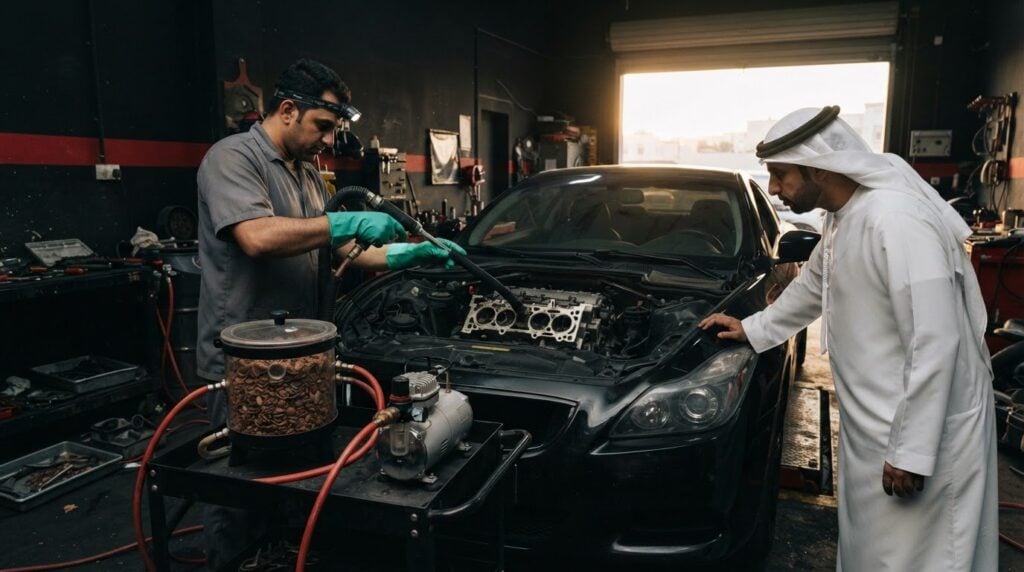
Renting a walnut blaster can make sense, but the equipment is only one part of the job. Walnut blasting for intake valve cleaning uses compressed air to propel crushed walnut shells against carbon deposits, and a suitable compressor needs at least 6 bar of pressure. For direct-injection engines, cleaning is often recommended every 30,000-50,000 km, with the vehicle’s symptoms and service history helping guide the decision.
It’s reasonable to compare renting equipment with using a professional service. The method may sound straightforward, but accessing the valves and controlling the blasting process both require care. Walnut shells are softer than the metal surfaces they clean, yet hard enough to remove deposits. That balance helps clean effectively while protecting intake components.
This guide explains why direct-injection engines accumulate carbon, how walnut blasting works, and why media and air pressure matter. It also covers possible signs that cleaning may be due and practical factors to consider when deciding whether renting equipment is suitable.
Key Takeaways
- Direct-injection fuel bypasses the intake valves, so oil residue can bake onto them and gradually restrict airflow.
- Hesitation, rough running, weaker performance, poor fuel economy, or a check-engine light can point to heavy carbon buildup.
- Use mileage as a guide, not the only trigger: driving pattern, symptoms, and service history help determine when cleaning may be due.
- Walnut media size and a compressor’s ability to sustain airflow both matter when assessing whether a rental setup is suitable.
- Blasting involves more than directing abrasive at a valve; controlled access and careful deposit removal are central to the process.
Carbon buildup on direct-injection intake valves
Walnut blasting uses compressed air to propel crushed walnut shells against carbon deposits on intake valves. It is used on older gasoline direct-injection engines, where fuel bypasses the valves and does not provide the same cleaning effect as port injection.
Engines That Need Walnut Blasting
Gasoline direct-injection engines send fuel straight into the combustion chamber, rather than through the intake ports. That design supports fuel economy, but fuel does not wash the intake valves as it does in port-injected engines. As a result, older GDI vehicles may need periodic cleaning when deposits build up. BMW offered walnut blasting for certain GDI models from 2006 through 2016.
Deposits can form when trace amounts of engine oil seep past valve seals and bake onto the valves. Residue may also collect in the intake runners. As buildup grows, it can narrow the airflow path and affect how air reaches the engine. The process is gradual, so mileage alone may not show how much carbon has accumulated.
Driving patterns can also play a role. A three-minute commute is one example associated with increased intake-valve carbon buildup. Short trips do not prove that deposits have formed, but frequent use in similar conditions can help explain a vehicle’s history. Some manufacturers have added an intermittent intake-manifold injector alongside direct injection to help keep valves clean.
Signs of Intake Valve Carbon
Possible symptoms of heavy buildup include rough running, hesitation, poor drivability, reduced performance, poor fuel economy, or a check-engine light. Restricted airflow from carbon deposits can contribute to these issues, but symptoms alone do not confirm the cause. Note when the behaviour occurs, whether it is worsening, and whether several signs appear together.
Restricted airflow can make engine operation less consistent, while hesitation may be most noticeable during acceleration. A check-engine light can accompany intake-valve deposits, but it may also point to another fault. A diagnostic assessment can help distinguish carbon buildup from a separate engine or sensor issue. Failure to pass emissions is another possible symptom of heavy deposits, but it is not a diagnosis on its own.
When considering walnut blasting for intake valve cleaning, start with the engine’s fuel-delivery design. Port-injected engines direct fuel through the intake ports, while direct-injected engines send fuel into the combustion chamber. In older GDI vehicles, this means intake valves can collect deposits without the same fuel-cleaning effect. Symptoms, engine design, and driving history together help determine whether the intake needs closer assessment.
Recommended cleaning intervals
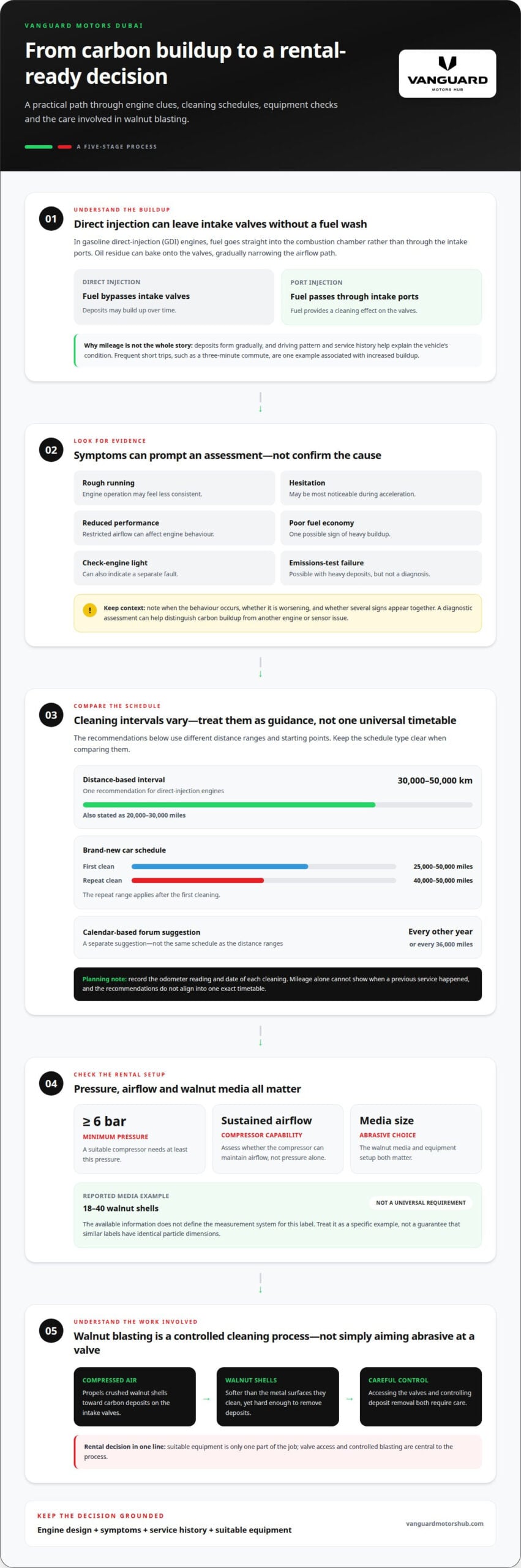
Recommendations for direct-injection engines span several mileage ranges. One interval recommendation is 30,000-50,000 km, or 20,000-30,000 miles. Other schedules use different starting points, so the figures are best understood as guidance rather than one universal maintenance interval.
For a brand-new car, one recommendation places the first walnut cleaning at 25,000-50,000 miles. After that initial cleaning, the same schedule suggests another at 40,000-50,000 miles. These are separate stages: the first interval concerns the initial service, while the second applies after that cleaning has taken place.
A separate forum suggestion is to clean every other year or every 36,000 miles. That calendar-based option differs from schedules based only on distance. It can help drivers who track time more consistently than odometer mileage, but it should not be mistaken for the same recommendation as the 30,000-50,000 km range.
These figures do not align into one exact timetable. For example, a vehicle reaching 30,000 km may fall within one recommended range before reaching the lower end of a 20,000-mile schedule. The practical takeaway is to record both mileage and cleaning history, then compare them with the schedule being followed.
- First cleaning: One recommendation places it at 25,000-50,000 miles for a brand-new car.
- Repeat cleaning: The same schedule places the next service at 40,000-50,000 miles after the first cleaning.
- Distance-based range: Another recommendation gives 30,000-50,000 km, or 20,000-30,000 miles.
- Calendar-based suggestion: One forum participant suggested every other year or every 36,000 miles.
Keep a service record with the odometer reading and date of each cleaning. If a previous owner had the intake cleaned, the record helps distinguish an initial service from a repeat interval. Without that history, the current mileage alone cannot show when the last cleaning took place.
Use the applicable schedule as a planning reference, not a reason to clean automatically at one exact reading. For a UAE vehicle, note its mileage and previous intake-cleaning records together. To discuss the engine’s carbon-cleaning needs, contact Vanguard Motors Dubai about engine carbon cleaning.
Walnut shell abrasive particle sizes
Walnut blasting for intake valve cleaning uses crushed walnut shells, a compressed-air blaster, and a compressor to direct media at carbon deposits. One reported example used 18-40 walnut shells, but that grade should be treated as a specific choice, not a universal requirement for every engine.
The “18-40” label identifies the abrasive range in that example; the available information does not define its measurement system. Avoid assuming every product carrying a similar label has identical particle dimensions. The useful practical step is to select media intended for walnut blasting and match the equipment setup to the engine and access being serviced.
A reported job used about 25 pounds of 18-40 walnut shells. That figure describes one participant’s use, not a fixed quantity for every intake. The amount required depends on the work being performed and how much media is consumed or recovered during the process. A rental decision should account for the abrasive supply as well as the blaster itself.
Media condition matters after use. Walnut shells can typically be reused 5-10 times in a clean, oil-free, dry environment. Dirt, oil, or moisture changes those conditions, so recovered abrasive should not automatically be treated as ready for another pass. Keep used media separate from clean stock, and preserve it dry if reuse is planned.
- Media: Crushed walnut shells, with 18-40 as one reported grade.
- Reuse example: Shells may be reused 5-10 times when kept clean, oil-free, and dry.
- Equipment: A walnut blaster and compressed-air supply propel the abrasive.
Particle size is only one part of the setup. The blaster must feed abrasive consistently, while compressed air carries it toward the deposits. A mismatch between the media and the equipment can interrupt flow, making the cleaning pass less consistent. The 18-40 example provides a reference point, but it does not establish a universal grade for every vehicle.
For a rental, plan the media and recovery process alongside the machine. Confirm that the abrasive is suitable for the blaster, keep clean shells away from oily or damp material, and track how often recovered media is reused. Those steps help preserve the stated 5-10 reuse potential. The 25-pound example can inform planning, but it is not a prescribed amount for another engine.
In short, use walnut shells with a compatible compressed-air blaster, and treat 18-40 as one documented grade rather than a rule. Clean, dry storage supports reuse; contaminated media does not meet the conditions associated with 5-10 uses.
Air pressure requirements
Compressed air carries walnut media through the blaster and toward intake deposits. The equipment needs adequate pressure to propel shells through the nozzle. For individual owners, one recommendation calls for an air compressor capable of at least 6 bar. A separate guideline gives a maximum working pressure of 0.7 MPa, approximately 6 bar, or higher.
These figures are starting points, not a complete measure of compressor performance. Pressure indicates the force available in the air system, while the compressor’s capacity affects how consistently blasting can continue. A gauge reading alone may not show how the setup performs during a sustained pass. The examples below show why pressure and airflow capacity need to be considered together.
- Minimum pressure guidance: At least 6 bar for an individual owner’s compressor.
- Working-pressure recommendation: 0.7 MPa, approximately 6 bar, or higher.
- Reported regulator setting: One participant set the blasting regulator to 90 PSI.
Compressor examples show different operating experiences. One participant used a 35-gallon compressor rated at 3.7 CFM at 90 PSI and reported waiting between blasts. That pause indicates the setup could not maintain uninterrupted blasting in that account. It does not establish a universal compressor size or performance threshold for every walnut blaster.
Another participant reported using a DeWalt compressor with a 4.5-gallon tank and approximately 5.0 SCFM at 90 PSI. These figures describe one setup, not a standard specification for all vehicles or tools. The reported ratings also use different airflow units, CFM and SCFM, so they should not be treated as directly interchangeable without context.
Before a rental job, compare the compressor’s stated pressure with the blaster’s working-pressure needs. Then consider whether its air supply can support the intended use without frequent pauses. A 90 PSI regulator setting, as reported by one participant, is an example only; it is not a universal setting for every unit.
In practical terms, confirm three details in the equipment setup: the compressor’s rated pressure, its airflow rating, and the blaster’s working-pressure requirement. The 6 bar recommendation addresses pressure, while the 3.7 CFM example shows that a compressor may still require waiting between blasts. Both factors shape how smoothly a rental setup operates.
During walnut blasting, pressure below the tool’s requirements can interrupt media delivery. A stated rating, however, does not guarantee continuous operation. The compressor’s output, regulator setting, and blaster requirements all affect performance. Matching them carefully helps determine whether the equipment can sustain the cleaning process.
How walnut blasting cleans intake valves
Walnut blasting removes deposits by directing crushed shells through the intake ports onto exposed valve surfaces. The result depends on access, controlled media delivery, and clearing loosened residue from the work area.
The Walnut Blasting Process
The process starts by accessing the intake valves, which usually involves removing the intake manifold. With a valve positioned for cleaning, compressed air propels walnut media onto its surface. The shells break away carbon deposits, and extraction removes the loosened material. Each intake port is treated in turn, with the valves positioned to keep the work focused.
The mechanism matters: walnut shells are softer than the metal of the intake manifold and valves, yet hard enough to remove carbon. Rather than relying on fuel or liquid cleaner to dissolve deposits, the process physically removes them. Controlled direction and effective extraction are therefore essential.
After blasting, remaining media and loosened carbon must be cleared from the intake area before reassembly. The intake manifold is then refitted, and the engine can be assessed after the work. The key point is that blasting physically removes deposits while controlling where the media travels.
Walnut Blasting Versus Chemical Cleaning
Walnut blasting mechanically breaks deposits from valve surfaces using abrasive shells and compressed air. Chemical intake cleaning uses cleaner sprayed into the intake manifold and may cost less, because it can be performed without removing the manifold. The approaches therefore differ in access and cleaning action, not simply in the product used.
The choice between methods depends on the deposits, access, and engine requirements. Walnut blasting exposes the valves for direct treatment, while chemical cleaning applies cleaner through the intake. The methods are not interchangeable in every case; the engine’s condition and the cleaning objective should guide the decision.
Cleaning Without Cylinder Head Removal
Yes. Walnut blasting can clean intake valves without removing the cylinder head. The intake manifold is removed to access the ports and valve surfaces, while the cylinder head stays installed on the engine. This distinction matters: manifold removal is part of the access process, but cylinder-head removal is not required.
When choosing a UAE workshop, ask whether the proposed method addresses the intake deposits, explains the access required, and includes media removal before reassembly. A clear account of manifold removal and valve-by-valve treatment makes the process easier to understand. The cost depends on engine access, intake-manifold removal, and job scope; the price is provided after a quote request.
There is no single price for every engine because access and required work vary. Before proceeding, understand the proposed cleaning method and what the procedure involves, including how the intake will be accessed and cleaned. This helps clarify the scope of the work.
Vanguard Motors Dubai
Vanguard Motors Dubai offers engine carbon cleaning for vehicles that need attention to carbon-related engine issues. The discussion above can help you understand walnut blasting, media choice, and compressor requirements. The suitable cleaning approach depends on the engine and deposits, so distinguish a general carbon-cleaning need from a specific blasting method.
If you’re considering intake cleaning, share your vehicle’s symptoms and service history when discussing the work. This gives the conversation practical context without assuming that every engine needs the same treatment. For guidance on engine carbon cleaning, contact Vanguard Motors Dubai.
Make Your Next Maintenance Decision With Confidence
Choose the next step based on your vehicle’s needs, not simply on the appeal of a particular tool or method. Renting makes sense only if you can manage the equipment and process; a professional service handles the technical work. For walnut blasting for intake valve cleaning, the key is matching the method to the engine and the condition of its intake.
Vanguard Motors Dubai also offers Paint Protection Film (PPF) Installation, Colored Sticker Wraps, and Peelable Paint Applications for drivers considering broader vehicle care. These services are separate from intake cleaning, but allow you to explore vehicle protection and appearance work alongside maintenance.
If you’re ready to discuss your vehicle’s needs and next steps, contact Vanguard Motors Dubai. Start with the questions that matter to your car, then move forward with a clear plan.
Frequently Asked Questions
Walnut Blaster Rental: Is It Worth It?
Renting can be worthwhile if you already have a suitable compressor and the skills to access and clean the intake. Compare the rental period with the time needed to remove the intake manifold, prepare the engine, blast the valves, and clean up media. A rental is less practical if you lack the required equipment or experience. One recommendation calls for at least 6 bar of compressor pressure.
Can individual car owners use it?
Yes, individual owners can use a walnut blaster, provided they have suitable equipment and can manage the work safely. The compressor should provide at least 6 bar, and the job involves accessing the intake valves, often by removing the intake manifold. Owners should also account for media containment and removal before reassembly. A tool rental alone doesn’t supply the skills or preparation needed for the full procedure.
How often should you walnut blast your intake manifold and intake valves?
One recommendation gives an interval of 30,000-50,000 km, while other schedules use different mileage ranges. Treat these as planning references, not a universal rule for every engine. Keep a record of previous cleaning and mileage, especially when buying a used car with incomplete service history. Engine design and the vehicle’s symptoms also help determine whether cleaning should be considered before a scheduled interval.
Is it safe for turbocharged engines?
Turbocharged engines can also use direct injection, so their intake valves may accumulate deposits. Walnut blasting targets the intake valves, not the turbocharger. The engine’s intake layout and access procedure determine how the work is carried out. A turbocharged model should be assessed according to its specific engine configuration, rather than treated as identical to every other direct-injection vehicle.
Why Clean My Valves?
Cleaning can remove carbon deposits that build up on direct-injection intake valves and restrict airflow. It may be relevant when an engine develops symptoms such as hesitation, rough running, reduced performance, or poor fuel economy. These signs can have other causes, too, so base the decision on the engine’s condition rather than appearance alone. The aim is to address deposits that interfere with normal airflow.
Will it damage the valves or engine parts?
Walnut shells are softer than the metal used for intake valves and manifolds, but still hard enough to remove carbon. This property makes them suitable for the cleaning method, but does not make careless work harmless. Controlled media direction and thorough removal of loosened shells and deposits are essential. Prepare and clean the intake properly before reassembly so residue is not left inside the engine.
How long does walnut blasting take, and how often should it be done?
There isn’t one fixed job duration for every vehicle. Intake-manifold access, engine layout, and the amount of deposit affect the work involved. Cleaning frequency also varies: recommendations include 30,000-50,000 km, while other schedules use different mileages. Track the date and odometer reading after service, then use the vehicle’s history and symptoms to plan future maintenance rather than relying on time alone.
What are the steps involved in walnut blasting intake valves?
The work follows a controlled sequence to expose, clean, and restore the intake area:
- Remove the intake manifold to access the valves.
- Position each valve for cleaning and direct compressed walnut media onto deposits.
- Extract loosened carbon and media from the intake area.
- Repeat the process across the accessible valves, then clear the area before refitting the manifold.
Careful media control and thorough cleanup are essential parts of the procedure.