
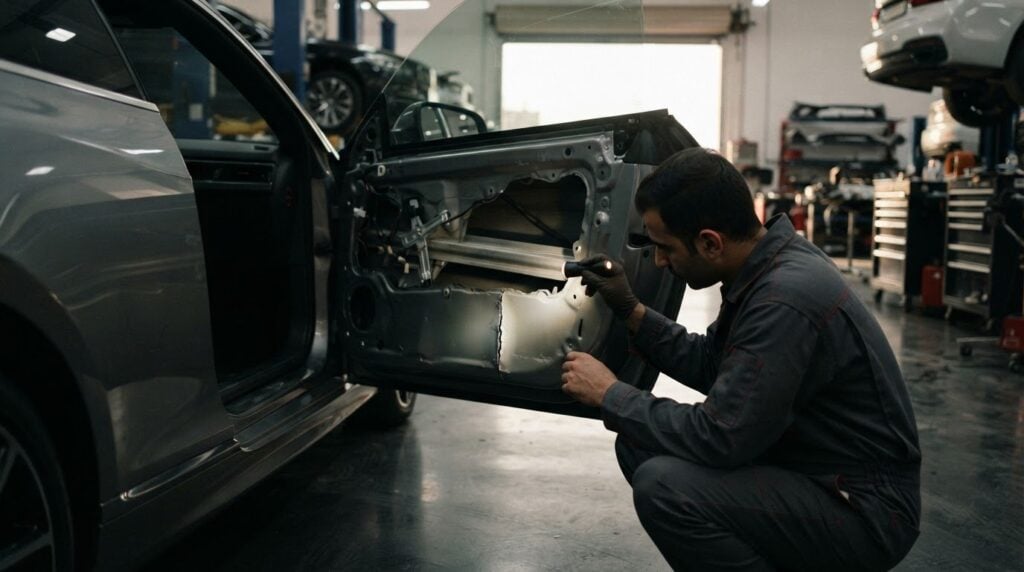
A dent can look minor and still be a poor candidate for paintless repair. Drivers often ask, “When is paintless dent repair not possible?” Common reasons include cracked or chipped paint, stretched or sharply creased metal, previous filler, or blocked access behind the panel. PDR reshapes metal while preserving intact paint, so appearance alone does not determine whether it is suitable.
It’s understandable to expect a small mark to be simple to remove. But the dent’s depth and location, the panel construction, and the paint condition all matter. In the UAE, sun-damaged clear coat can also be more vulnerable to cracking during repair. The answer to “When is paintless dent repair not possible?” depends on these conditions, not just the dent’s size.
This guide explains how paintless dent repair works, how technicians assess access behind a panel, and which damage conditions can rule it out. You’ll also learn how metal distortion or previous bodywork can change the repair approach, and why a panel that needs paint or more extensive body repair may require a different solution.
Key Takeaways
- Paintless dent repair works best when the paint remains intact and the metal can be reshaped without excessive stretching.
- Panel edges, body lines and internal bracing can limit the access needed to work a dent from behind.
- Cracked, chipped or previously repaired paint can change the safest repair approach.
- Sharp creases and stretched metal may remain visibly distorted even after careful reshaping.
- Learn which conditions point toward paintless repair and when conventional bodywork and paint may be more suitable.
What is paintless dent repair, and when does it work?
Paintless dent repair reshapes metal with controlled pressure from behind the panel or pulling from outside, without sanding or repainting. In the UAE, its price depends on dent size, panel access, metal condition and repair time, and is given after a quote request; conventional repair also involves bodywork and refinishing, so the method affects the total cost.
Damage Types Suited to PDR
Paintless dent repair suits shallow dents when the paint is intact and the metal has not stretched sharply. It can address door dings, hail marks, soft creases, and some minor collision dents on steel or aluminium panels. The distinction matters: a broad, shallow depression may respond well to careful pressure, while a deep impact can leave the finish uneven even if the visible area looks small.
Technicians work gradually, using small, controlled pressures to lift the dent and refine the surrounding surface. Glue tabs can pull suitable dents from outside when access behind the panel is limited, but they still rely on sound paint and workable metal. For example, a shallow door ding with unbroken paint is a stronger candidate than one with a sharp, hard edge.
Torn Metal and Misaligned Panels
Torn metal has split rather than simply bent, while a misaligned panel has shifted from its intended position. Neither condition can be corrected by reshaping the dent alone. These signs matter because a repair must address the panel’s integrity and fit, not just its surface appearance.
After a collision, uneven gaps or a panel that no longer sits flush can indicate broader damage. A technician distinguishes a surface dent from a panel-fit problem before choosing a method. If the metal has torn, PDR cannot close the split or restore the original panel edge. If adjacent panels are misaligned, correcting the underlying fit comes first.
Heat-Damaged Paint on Older Cars
Heat- and sun-damaged paint can become more vulnerable during dent removal, especially on older cars in Dubai. Cars over ten years old with sun-damaged clear coat face a higher risk of paint cracking during paintless dent removal. That matters because the method depends on preserving the existing finish while the metal moves.
Before applying pressure or pulling with glue tabs, a technician assesses the paint around the dent for brittleness and existing damage. A clear coat that looks dull or weathered may not tolerate the same movement as intact paint. If the paint is already broken or cracks during shaping, the repair needs a paint-focused approach rather than paintless correction.
Plastic and Structural Damage
Plastic bumper covers are not pressed metal panels, so standard metal rods and picks do not apply to them. Controlled heat can help ease plastic back into shape, but that is a different repair process. Identifying the material matters before selecting tools or applying pressure.
Structural or mechanical collision damage also rules out PDR as a complete solution. Damage affecting chassis integrity, alignment, sensor fitment, or mechanical components requires attention beyond cosmetic dent correction. For example, a dent beside a wheel after an impact may accompany alignment damage. Restoring the visible panel alone will not address that underlying issue.
How do technicians check access behind the panel before choosing repair?
Technicians assess a dent’s position, panel construction, and available working space before selecting a repair method. A shallow depression with unbroken paint may still be unsuitable if internal reinforcement blocks the tools.
Assessing Panel Access and Construction
Panel access is the room available to place a rod or body pick behind damaged metal. Technicians identify the panel’s inner structure and check whether bracing, structural foam, a bonded inner skin, or a fixed liner obstructs the route. This matters because controlled pressure must reach the dent from a useful angle.
For example, a door dent may sit directly over a reinforcement beam. The outer surface can look accessible, while the inner construction prevents safe tool placement. Technicians then assess whether another approach, such as glue pulling from outside, can reach the area without damaging the finish.
Edges, Seams, and Welds
Dents near panel edges, door seams, and welds are difficult to access and may involve stretched metal. These areas matter because joins constrain the metal, making it more resistant to reshaping than an open panel section.
A shallow dent near the centre of a door may allow a rod to work behind it. The same impact beside a seam can leave little room for tool movement. Edges and welds also concentrate force, so technicians assess both the dent’s shape and its distance from the join before choosing a technique.
Access and Repair Suitability
Access affects whether a technician can apply steady pressure without distorting nearby metal. If a brace or fixed liner blocks the route, the repair method must account for that obstruction rather than force a tool into place.
Glue pulling can help when the panel’s outside surface is reachable, but it has limits. Zero-clearance areas may not allow a glue tab or pulling tool to attach and move correctly. Drilling an access hole is not an appropriate shortcut for PDR; the repair method must respect the panel construction.
Aluminium panels can be repaired with paintless techniques, but they need more care than steel. Aluminium has less memory, so it responds differently as pressure reshapes the metal. PDR is also more limited on aluminium, and stretched aluminium usually requires panel replacement, according to I-CAR repairability guidance.
Body lines create another constraint. Their formed contours make the metal stiffer, so a dent across a sharp line can be harder to restore precisely than a similar shallow mark on a broad, flat area. Technicians consider whether tools can reach the back of the line and whether the metal can return to shape without leaving visible distortion.
Price depends on the dent, panel material, access and repair method, and is given after a quote request. Conventional repair may require bodywork and refinishing, so its scope differs from paintless repair. For a panel-access assessment, request an assessment.
How can you tell in 60 seconds whether a dent is a poor PDR candidate?
A quick visual screen can reveal paint damage, but a technician’s closer inspection determines whether the panel can be reshaped safely. Look for cracked, chipped, or scratched coating around the dent, including damage that reaches the primer or metal.
Cracked, Chipped, or Scratched Paint
PDR relies on a coating that stays intact while the metal moves. A crack, chip, or scratch through to the primer or metal means the panel needs refinishing after metalwork. That matters because pushing the dent can extend the damage instead of preserving the vehicle’s finish.
Micro-cracks can be difficult to see on a factory finish, yet they still affect the repair choice. Rivian guidance says a panel with even micro-cracking should be sanded to the substrate and refinished. Repainted surfaces also carry greater risk during glue pulling because the finish may separate from the panel.
Heat and Paint Damage
Controlled heat can increase paint flexibility as the metal moves, helping reduce stress that could cause cracking or chipping. It does not repair existing paint damage or make a brittle coating equivalent to an intact factory finish.
For example, a technician assessing a sun-damaged panel must distinguish surface dullness from cracks around the dent. Heat is not a substitute for that inspection. A bumper cover is a different case: controlled heat can help ease plastic back into shape, but that does not establish that damaged paint on a metal panel is suitable for PDR.
Choosing Conventional Repair and Repainting
Conventional dent repair and repainting are better options when paint is broken, the panel has previous filler, or damage cannot be corrected while preserving the coating. This approach addresses both the metal and the finish, rather than relying on pushing the original surface back into shape.
For example, a chipped dent that exposes metal needs metalwork followed by refinishing. Conventional repair can involve pulling the dent, filling remaining imperfections, then priming, spraying, and clear-coating the panel. Dents with cracked paint, filler beneath the surface, or corrosion are poor candidates for paintless correction.
Technician Assessment of Dent Suitability
Technicians assess suitability by inspecting the coating, dent shape, and panel response before selecting a repair method. A close visual check can reveal chips or hairline cracks that are not obvious from a distance.
GM’s procedure says technicians may use 4x magnification to inspect for paint cracks that are easy to miss. They also consider whether pressure could worsen existing damage and whether the panel has been repainted. A quick look offers an initial screen; magnified inspection helps identify defects that change the repair plan.
Use three visible clues for an initial screen: broken paint, a scratch through the coating, or an area of previous repair. None reveals every hidden defect, but each signals that PDR may not suit the panel. Dents with intact paint and no underlying filler remain stronger candidates, subject to panel access and metal condition.
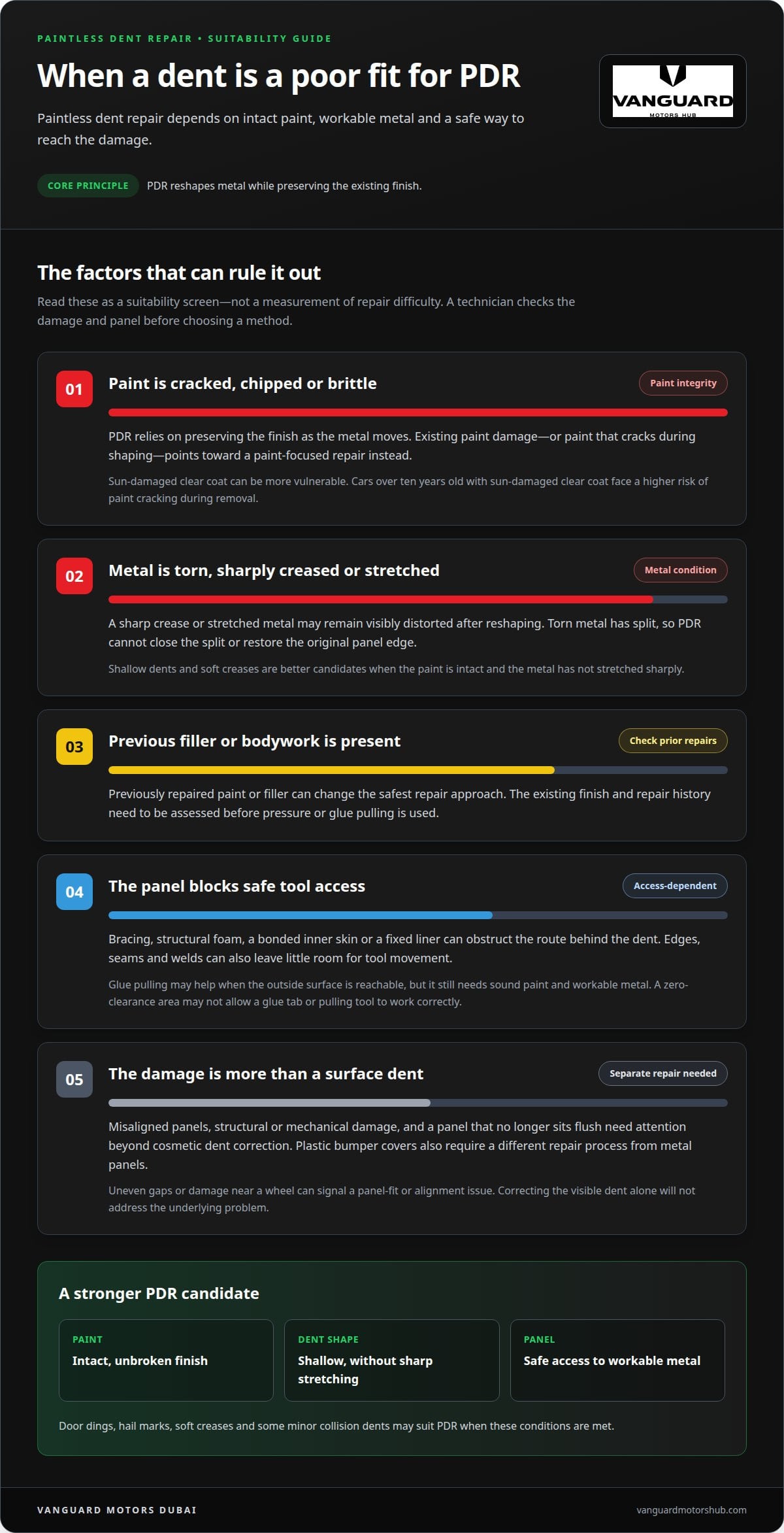
Stretched metal and previous filler repairs
A dent can resist reshaping when an impact has stretched the metal or earlier body repair has added filler. Those conditions affect whether the panel can return to a smooth surface without cracking the paint or revealing defects.
Sharp and Deep Creases
A sharp crease concentrates impact along a narrow line, which can stretch the metal and make it difficult to restore. A deep dent with a hard edge raises the same concern, even if its overall footprint looks small.
For example, a broad, shallow depression may respond better than a short, sharply folded crease. PDR can soften some shallow creases, but forcing a deep crease flat risks paint damage or visible distortion. The crease’s depth and edge shape matter more than its length alone.
Dent Depth and Metal Elasticity
Dent depth indicates how far the panel has moved, while metal elasticity affects how readily it returns toward its original shape. Shallow dents under 2-3 cm deep are generally better candidates when paint remains unbroken and the metal isn’t sharply creased or stretched.
A deep impact may push metal beyond its ability to recover cleanly. Technicians assess the dent’s contour and surrounding surface, then apply controlled pressure in small increments. If the metal remains raised or develops ripples, paintless reshaping cannot deliver a flat finish.
Stretched metal has expanded beyond its original form, so pushing it back does not necessarily restore the panel’s original contour. A large, soft-looking dent can still contain stretched areas. Under reflected light, those areas may appear wavy after repair, even when the deepest point has been lifted.
Previous filler changes the panel’s response, too. Filler is a repair material applied over bodywork to smooth imperfections, not part of the original metal. Pressure from rods or pulling tabs can crack or detach filler, exposing the earlier repair beneath the paint.
Technicians assess suspected prior body repair by examining the dent’s surface and paint condition before applying pressure. A repaint or filler layer may be less tolerant of movement than the original finish. If filler is present, PDR is unsuitable because reshaping may reveal or dislodge that material.
Consider two similar door dents: one is shallow and smooth, while the other has a hard crease and a repaired area underneath. Their size may match, but their repair paths differ. The first may allow careful reshaping; the second may need conventional body repair to address stretched metal, filler, and the final surface together.
Metal distortion also changes the expected finish. A technician may lift the centre yet still find that the surrounding panel will not settle evenly. If the repair would leave ripples or risk cracking the coating, the better approach is to correct the metal and refinish the panel rather than pursue a paintless result.
Conditions required for paintless dent repair
PDR requires more than a dent that appears small. The paint must remain intact, the metal must be workable, and the panel must allow access for controlled reshaping.
Think of suitability as several conditions that need to work together. A shallow dent can still be a poor candidate if it crosses a body line, sits behind reinforcement, or has cracked paint. Conversely, a broader dent may be repairable when the metal has not stretched and tools can reach the affected area.
Intact paint: Cracked, chipped, or scratched paint breaks a core condition. If damage reaches the primer or bare metal, reshaping can worsen the break, and the panel needs refinishing after metalwork. Micro-cracks matter too; Rivian guidance says panels with micro-cracking should be sanded to the substrate and refinished.
Workable metal: Shallow dents under 2-3 cm deep are generally suitable when paint is unbroken and metal isn’t sharply creased or stretched. Depth alone doesn’t decide the outcome. A smaller, hard-edged dent may have stretched the metal, while a wider, soft depression may retain a smoother shape.
Suitable location: Panel edges, body lines, and zero-clearance areas can limit tool access or precise reshaping. Metal is stiffer along body lines, and dents between two lines can challenge glue pulling. Technicians also avoid drilling holes as an access shortcut; GM guidance says drilling for PDR access is inappropriate.
Accessible construction: Bracing, structural foam, bonded inner skins, or fixed liners can block rods behind a panel. Glue pulling may work from outside only when the surface allows secure tab placement and controlled movement. A blocked route does not become suitable simply because the dent is shallow.
Material and corrosion: Steel and aluminium panels can both be repaired, but aluminium offers less margin for reshaping. I-CAR repairability guidance says stretched aluminium usually requires panel replacement. Rust or corrosion beneath the paint may require repair beyond dent removal.
Use these conditions as a decision screen, not a guarantee: intact paint, no sharp crease, no stretched metal, and workable access all need to align. A dent that fails one condition may need conventional body repair and paint. A shallow dent larger than a dinner plate may still be technically repairable, but the time required can make conventional work more economical.
For a dent assessment based on paint, metal and access, request a repair assessment.
Vanguard Motors Dubai: Car body paint , vehicle body paint , car washing , vehicle washing , vehicle washing , car polishing , vehicle polishing , car upholstery , vehicle upholstery , paintless dent repair , pdr
Vanguard Motors Dubai provides paintless dent repair for suitable dents and car body paint when the damage calls for refinishing. If cracked paint, stretched metal or previous filler rules out paintless work, car body paint can address the panel’s finish as part of the repair approach.
The right next step depends on the dent’s paint condition, metal shape, and access behind the panel. Share those details when arranging an assessment so the repair can be considered in context. For broader appearance care, Vanguard Motors Dubai also offers car polishing, Paint Protection Film installation, and peelable paint applications.
Contact Vanguard Motors Dubai to discuss the damage and suitable repair options.
Choose the Right Next Step for Your Vehicle
Deciding when paintless dent repair is not possible is only part of protecting your vehicle’s appearance. The next step is matching the repair approach to your priorities: restoring a damaged panel, refining the finish, or adding a layer of protection. A clear assessment helps turn that decision into a focused plan.
Once the repair path is clear, you can consider how the vehicle should look beyond the dent. Vanguard Motors Dubai offers Paint Protection Film installation, colored sticker wraps, and peelable paint applications. These options support different aesthetic and protection goals, so choose based on the finish you want rather than treating them as substitutes for necessary panel repair.
Bring the dent and your desired outcome into the same conversation. Discuss your vehicle with Vanguard Motors Dubai and move forward with a repair direction that suits its condition and your vision.
Frequently Asked Questions
Are sharp creases and body-line dents different from shallow dents?
Yes. A shallow dent describes depth, while a sharp crease or body-line dent describes where and how the metal is folded. A shallow mark can still cross a stiff feature line, and a narrow crease can concentrate deformation in one spot. For example, compare a smooth depression on a door’s open surface with a sharp fold on its sculpted contour. Their repair challenges differ.
Does dent size matter less than people think?
Size matters, but diameter alone cannot show how much the metal has stretched or how easily tools can reach it. A wide, gentle depression may be more workable than a smaller impact with a hard edge. Technicians also consider the panel’s shape and the finish expected after reshaping. Two dents with similar widths can therefore call for different repair approaches.
Is cracked paint an automatic no for PDR?
For a repair intended to preserve the existing finish, cracked paint is a strong reason not to use standard PDR. The crack may spread as the metal moves, especially if it sits at the impact point. A technician distinguishes an existing surface mark from a crack associated with the dent. If the coating has failed, metal repair followed by refinishing is the more appropriate route.
What should you do next if you’re not sure whether PDR will work?
Arrange a professional assessment before attempting to push or pull the dent yourself. Share where the impact occurred and whether the panel has previous paintwork, since those details can shape the inspection. Clear photographs from straight on and at an angle can help show the dent’s contour, but they cannot reveal hidden reinforcement or tiny paint fractures. Avoid DIY pressure that could worsen the damage.
Which dents can be fixed without paint?
Door dings, hail dents, soft creases and some minor collision dents can be repaired without paint when the surface and metal remain suitable. A common example is a rounded parking-lot ding on an undamaged door panel. The method reshapes the panel rather than covering the dent with filler. The dent’s location, paint condition and underlying metal still determine whether that finish can be achieved.
How does paint damage affect paintless dent repair eligibility?
Paint damage changes the repair objective because PDR is designed to reshape metal while keeping the finish in place. A chip near the dent’s centre may respond differently from an unrelated scuff elsewhere on the panel. Technicians inspect the damaged area and its surrounding coating, including repainted surfaces. If movement could lift or crack the finish, repair planning must include refinishing.
Can paintless dent repair fix dents with sharp creases or stretched metal?
A sharp crease may be softened, but stretched metal can prevent a smooth, factory-like surface. The key issue is how far the metal has been forced beyond its original contour. For example, lifting the centre of a folded crease may leave raised edges or ripples beside it. A technician considers the surface under reflected light, not just whether the deepest point appears level.
Can PDR repair dents on body edges, seams, or near structural parts?
Sometimes, but these locations impose access and panel-shape limits. A dent beside a door seam may leave too little room for a tool, while internal bracing can block access from behind. Near structural parts, the assessment must also distinguish cosmetic panel damage from an impact affecting alignment or chassis integrity. PDR addresses a surface dent, not damage to the vehicle’s underlying structure.