
Approximately 90% of premature vehicle wrap failures are a direct consequence of inadequate surface preparation and ignored technical protocols rather than poor material quality. You invested in a premium aesthetic to command attention on the road, so watching those edges lift and curl is more than a minor annoyance. It’s a visual degradation of a high-value asset that triggers legitimate concerns about dirt ingress and potential paint damage. If you’re asking, “why are my wrapped door edges peeling,” you’re likely witnessing the physical limits of a material that wasn’t properly settled into its final form.
We understand the frustration of seeing a sophisticated finish lose its edge. This guide explores the technical reasons behind vinyl wrap failure and explains how to secure your vehicle’s aesthetic integrity in a high-heat climate. You’ll learn about the physics of material memory, the necessity of post-heating to temperatures as high as 212°F, and how professional precision prevents the common pitfalls of the industry. By the end, you’ll know exactly how to stop the lifting and identify the elite standards required for a permanent, showroom-quality solution that withstands the intensity of 2026 and beyond.
Key Takeaways
- Understand the technical “memory effect” and why over-stretching vinyl during installation is the primary reason why are my wrapped door edges peeling in high-heat environments.
- Learn how the UAE’s extreme daily temperature fluctuations and fine desert sand act as mechanical stressors that accelerate adhesive failure at vulnerable panel returns.
- Identify the specific pressure washer thresholds and chemical cleaning agents that compromise the integrity of your wrap’s perimeter bond.
- Discover why professional post-heating to 2026 industry standards is essential to “kill” the film’s memory and ensure a permanent, secure fit.
- Explore peelable paint as a sophisticated, edge-free alternative for owners who require a seamless finish that eliminates the risk of lifting entirely.
The Science of Adhesion: Why Wrapped Edges Fail
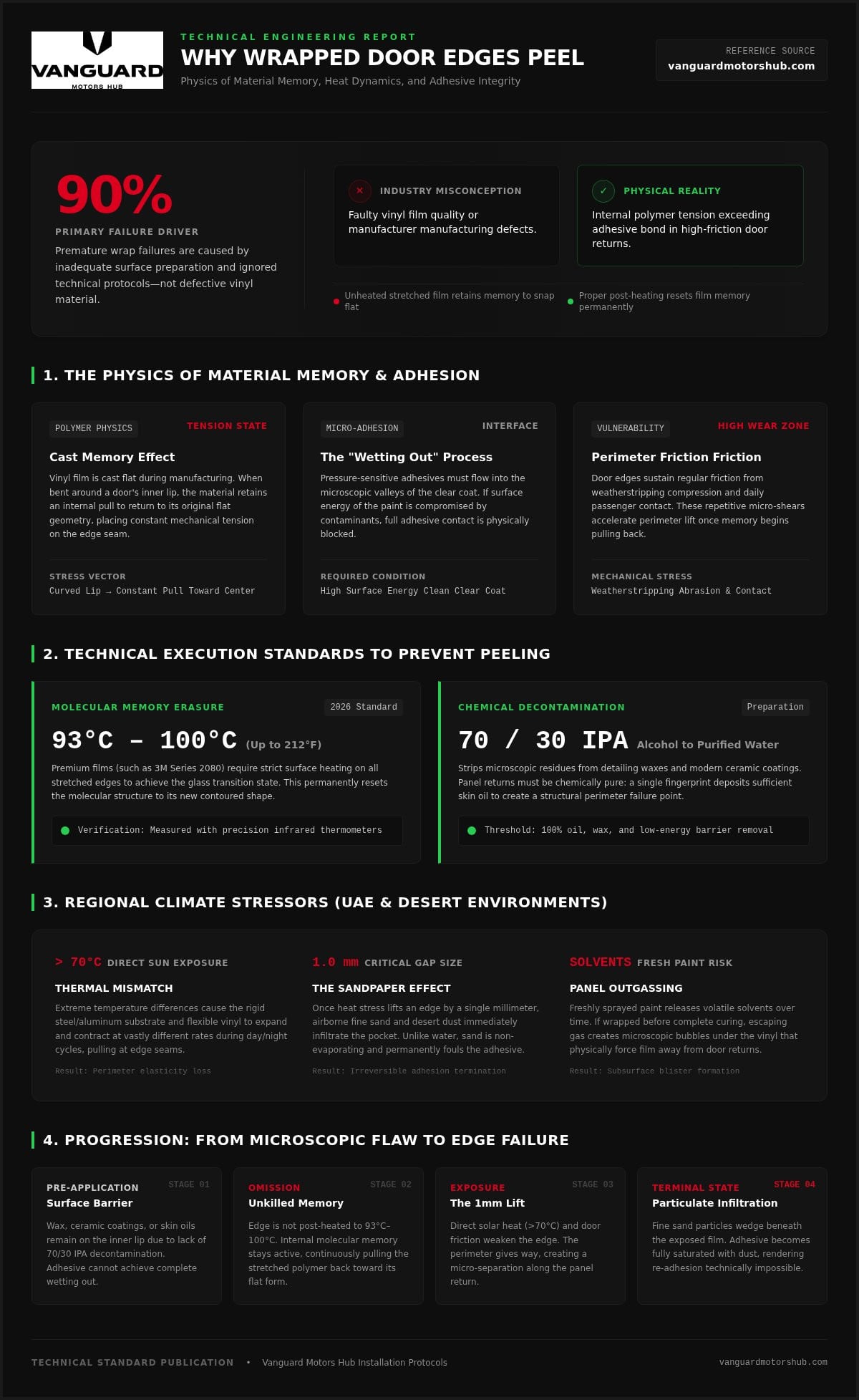
High-performance vehicle vinyl wraps are engineered with sophisticated pressure-sensitive adhesives. Success depends on a process called “wetting out,” where the adhesive flows into the microscopic valleys of your car’s clear coat. If the surface energy of the paint is higher than the film, you achieve a superior bond. However, door edges are high-stress zones. They experience constant mechanical friction from weatherstripping and frequent handling. If you’re wondering why are my wrapped door edges peeling, the answer usually lies in a failure to manage the material’s internal physics during the application process.
Vinyl is a polymer with “memory.” During the manufacturing process, it’s cast to stay flat. When an installer stretches it around a door’s inner lip, the material essentially “remembers” its original shape. It wants to return to that flat state. This creates constant tension at the perimeter. Without specific technical intervention, this tension eventually overcomes the adhesive bond. This leads to the unsightly lifting that compromises your vehicle’s aesthetic integrity, especially in the intense heat of the UAE.
Surface Tension and Contaminants
Adhesion failure often begins long before the film touches the car. Microscopic residues from detailing waxes or modern ceramic coatings create a low-surface-energy barrier. This prevents the adhesive from making full contact. Professional-grade preparation requires a meticulous decontamination process using 70/30 isopropyl alcohol (IPA) to strip these layers. Even a single fingerprint left on the panel return can introduce enough skin oil to cause a failure point. At Vanguard Motors, we ensure every edge is chemically pure to allow for maximum functional surface adhesion.
The Role of Post-Heating
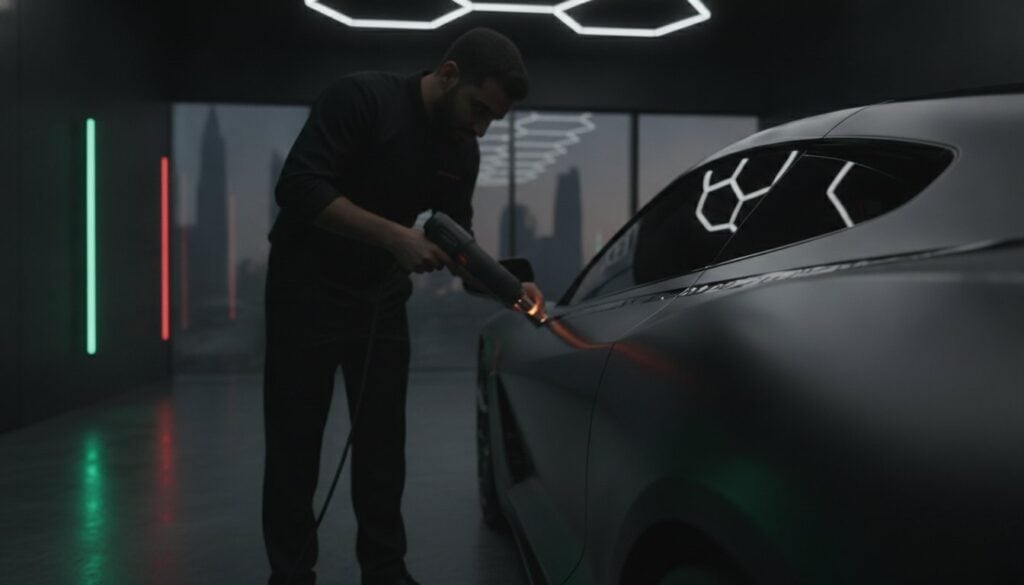
To stop the vinyl from pulling back, we must “kill” its memory. This is achieved through a technical process called post-heating. According to 2026 industry standards, premium films like 3M Series 2080 require a measured surface temperature of 93°C to 100°C on all stretched edges. We use precision infrared thermometers to verify these thresholds. If the film doesn’t reach this glass transition state, the internal stress remains active. Post-heating is the critical final step in wrap stabilization that resets the vinyl’s molecular structure to its new, contoured shape.
Failure to reach these exact temperatures is the leading cause of edge failure. In a climate where surface temperatures can soar, an un-stabilized edge will fail within weeks. Precision is the only antidote to physics.
Environmental Stressors: The Impact of National Climate on Wraps
In the UAE, your vehicle isn’t just a machine; it’s a target for some of the harshest environmental conditions on the planet. While premium vinyl is remarkably durable, the relentless cycle of extreme heat and blowing sand creates a specialized torture test for adhesives. If you’re asking why are my wrapped door edges peeling, you must look at the atmospheric variables that turn a minor installation flaw into a total edge failure. The interaction between high-energy UV rays and fluctuating temperatures creates a volatile environment for any aftermarket film.
Thermal Expansion and Contraction
Metal panels under the direct sun frequently reach temperatures exceeding 70°C. This creates a massive discrepancy in thermal expansion rates between the rigid steel or aluminum panel and the flexible vinyl film. As the panel expands during the day and contracts at night, the bond is pulled in multiple directions. Research into pressure-sensitive adhesive peel mechanics shows that temperature gradients significantly alter the force required for a material to lift. Once the film loses its elasticity from UV exposure, the edges are the first points to surrender. Freshly painted panels can also suffer from outgassing, where solvents escape the paint and create microscopic bubbles that push the film away from the door returns.
Dust and Particulate Infiltration
The national landscape’s fine dust is a silent killer for automotive films. We call it the “Sandpaper Effect.” Once a door edge lifts even 1mm due to heat stress, it creates a microscopic pocket. Desert sand and fine particulates immediately wedge themselves into this gap. Unlike water, which might eventually evaporate, sand is a permanent contaminant. It coats the adhesive, making it impossible to re-stick the material once it has lifted. This is why maintaining a pristine exterior through professional Supercar Detailing is essential. Regular cleaning removes the grit that would otherwise act as a mechanical wedge, prying your wrap away from the panel returns.
UV radiation specifically targets the wrap’s perimeter where the film is often thinnest due to stretching. It breaks down the chemical bonds in the adhesive, turning it brittle over time. Additionally, high humidity during the installation window can interfere with the initial “tack” if the environment isn’t strictly controlled. If the adhesive doesn’t set correctly in a laboratory-grade facility, it won’t stand a chance against the outdoor elements. For a professional assessment of your current wrap’s integrity, you can consult the technical team at Vanguard Motors Dubai to find a durable, high-performance solution.
Installation Errors: When Craftsmanship Falls Short
While environmental factors and physics set the stage for failure, the human element is often the final catalyst. A premium wrap is only as reliable as the technician wielding the heat gun and blade. If you find yourself asking why are my wrapped door edges peeling, the root cause is frequently a compromise in craftsmanship during the initial application. Even the most expensive cast films cannot compensate for a lack of technical precision during the tucking and trimming phases.
The Dangers of Over-Stretching
Vinyl is remarkably resilient, but it has defined physical limits. Industry best practices suggest that stretching cast vinyl more than 10% to 15% significantly thins the adhesive layer and compromises the film’s structural integrity. When a technician forces a single piece of material into deep recesses or around sharp door corners, they trigger the “memory effect” with extreme force. This excessive tension causes “fingering,” where the material bunches and pulls back from the edge. Visual indicators of this error include discoloration or “whitening” of the film, suggesting the pigments have been stretched to their breaking point. For complex curves around door handles, elite installers utilize “inlays” rather than a single over-stretched sheet to maintain a stress-free bond.
Precision Trimming and Edge Tucking
The hidden part of the door panel, known as the “return,” is where most failures originate. Many installers focus solely on the visible exterior, neglecting the deep cleaning required on the inner lip. If this area contains even a trace of road grime or factory grease, the film won’t seat. We’ve found that a controlled environment is essential to prevent static-attracted dust from settling on the adhesive during the trimming phase. A single speck of dust on the return acts as a pivot point for the material to lift.
Precision trimming involves a strategic decision between trimming flush to the edge and “wrapping around the corner” to create a mechanical lock. Proper car wrap maintenance and climate durability start with an installation that prioritizes these hidden perimeters. Some shops use adhesion promoter chemicals as a “crutch” to hide poor technique. These chemicals often lead to permanent paint damage or localized failure when the chemical eventually breaks down. True precision relies on surface energy management and perfect tension, not chemical shortcuts. When these technical standards are ignored, the result is a wrap that looks spectacular on day one but fails at the first sign of UAE summer heat.
Maintenance Mistakes That Kill Your Wrap’s Edges
Owning a wrapped supercar in the UAE requires a shift in your maintenance philosophy. You can’t treat a high-end vinyl finish like factory paint. If you’re currently asking why are my wrapped door edges peeling, the answer might be found in your cleaning routine. Even a flawless installation by elite technicians can be undone by aggressive washing techniques or incompatible chemicals. Maintenance is the final pillar of wrap longevity; ignore it, and you’re essentially inviting the desert environment to dismantle your investment piece by piece.
High-pressure washers are the primary “edge-lifting” tool that every owner should approach with caution. When water is forced at high velocity against a seam, it acts as a hydraulic wedge. This pressure can bypass the adhesive bond, creating a pocket for moisture and heat to expand. Automatic car washes with spinning brushes are equally hazardous. These brushes are designed for durability, not delicacy. They physically hook the micro-lips of the vinyl along door jambs, prying them upward with every rotation. Furthermore, many owners neglect the use of professional edge sealers like 3M Edge Sealer 3950, which provides a liquid barrier that reinforces the perimeter against mechanical lifting.
Safe Washing Techniques for Wrapped Cars
Preserving your wrap starts with a two-bucket hand wash. This is the only standard acceptable for luxury and performance vehicles. If you must use a pressure washer, you must master the 45-degree rule. Never aim the nozzle perpendicular to a seam. Instead, angle the spray so it deflects away from the edge, preventing the water from getting “under” the film. Maintain a distance of at least 30 to 45 cm from the surface at all times. The optimal PSI for washing a wrapped vehicle in 2026 is between 800 and 1,400, never exceeding 2,000.
Chemical Compatibility
Adhesive integrity is a matter of chemistry. Petroleum-based cleaners and harsh degreasers are the sworn enemies of vinyl. These substances act as solvents, gradually dissolving the acrylic adhesive along the exposed edge margins. Once the bond is chemically compromised, the “memory effect” we discussed earlier takes over, and the film begins to curl. Using high-quality ceramic detailers is a superior alternative. These products keep the edges slick and dirt-resistant, reducing the friction that causes lifting. For a deep dive into the specific products we recommend for the UAE climate, consult The 2026 Car Wrap Buying Guide. If you suspect your current cleaning routine has already caused damage, contact our detailing specialists for a professional edge restoration before the lifting becomes permanent.
Professional Solutions: From Restoration to Peelable Paint
Identifying the “point of no return” is the first step in reclaiming your vehicle’s aesthetic integrity. If you are currently asking why are my wrapped door edges peeling, you must assess the level of contamination beneath the film. Once UAE’s fine desert sand infiltrates the adhesive, a simple re-tack is no longer a viable solution. At this stage, the material has lost its functional surface energy, and attempting to glue it down often leads to permanent paint damage. Our technicians specialize in precision restoration, which involves surgical trimming of the failed edge and a reinforced re-sealing process that restores the mechanical lock.
The Vanguard approach centers on a “precision trimming” philosophy that prevents 99% of common industry failures. We don’t just lay film; we manage tension. By utilizing the Vanguard Premium Package, owners benefit from an installation process that prioritizes deep-return cleaning and verified post-heating protocols. However, for those seeking to move beyond the inherent limitations of traditional vinyl, we offer advanced technologies that eliminate the concept of an “edge” entirely.
Peelable Paint: The End of Peeling Edges
Peelable paint represents the pinnacle of automotive transformation for 2026. Unlike vinyl, which is a solid sheet under constant tension, peelable paint is applied as a high-solids liquid. It flows around every door handle, emblem, and panel return, creating a 360-degree seamless bond. This “zero-seam” finish is the preferred choice for Brabus and Mansory kit owners who require absolute perfection. Because there is no tension and no seam, there is nothing for the wind or heat to catch, effectively ending the cycle of edge lifting while remaining completely reversible.
Premium PPF: The Ultimate Edge Security
If you prefer the self-healing properties of a film, Premium Paint Protection Film (PPF) offers a significant upgrade over standard colored wraps. PPF features a much thicker adhesive layer designed to resist the high-energy impacts of road debris. This increased adhesive mass also makes it far more resilient against the thermal expansion we see in the national climate. While thin vinyl might surrender to the heat, the robust bond of PPF stays secure. We further reinforce these installations with liquid edge sealers that create a permanent moisture barrier. If you are tired of compromised aesthetics, you can consult with our experts on WhatsApp to fix your peeling edges and discover a solution engineered for longevity.
Securing Your Vehicle’s Aesthetic Future
Understanding why are my wrapped door edges peeling is the first step toward restoring the elite finish your car deserves. We’ve explored how the intersection of material physics and the intense UAE climate creates a high-stress environment for any film. Success requires a commitment to 2026-standard protection protocols, from surgical-grade surface preparation to verified post-heating temperatures. Whether you’re maintaining a daily driver or a bespoke Brabus or Mansory conversion, the difference lies in the meticulous care of the perimeters.
At Vanguard Motors, we specialize in advanced solutions like our peelable paint technology, which provides seamless, 360-degree coverage without the risk of lifting. For those committed to film, our Vanguard Premium Package ensures every edge is secured with professional precision. Don’t let a minor technical failure compromise your vehicle’s visual impact. Our team is ready to provide the technical expertise needed to preserve your investment’s integrity.
Get a Professional Edge Assessment on WhatsApp
Your vehicle is a masterpiece of engineering and style. We look forward to helping you maintain its showroom-quality presence for years to come.
Frequently Asked Questions
Can I glue down a peeling wrap edge myself?
You should never attempt to glue down a peeling wrap edge with household adhesives or superglue. These chemicals can cause permanent damage to your vehicle’s clear coat and make future removal nearly impossible. Professional restoration requires a chemically pure surface and specific heat thresholds to re-establish the bond. If desert sand has already infiltrated the adhesive, the edge cannot be saved and requires surgical trimming or a panel re-wrap.
How much of a wrap needs to be replaced if only the door edge is peeling?
If an edge failure is extensive, technicians usually recommend replacing the entire door panel wrap. While spot repairs are possible, they often result in visible seams and color mismatches because the existing film has likely experienced subtle UV fading. Replacing the full panel ensures a seamless aesthetic. If three or more panels show signs of lifting, it is often more cost-effective to consider a complete vehicle re-wrap to maintain visual consistency.
Will peeling edges damage my car’s original paint?
Peeling edges themselves don’t damage factory paint, but they create pockets where moisture and abrasive grit become trapped against the surface. Over time, this friction can mar the clear coat. The real risk occurs during removal; if the adhesive has been compromised by heat or improper chemicals, it may leave stubborn residue or pull at the paint. Maintaining a secure edge is the best way to preserve your car’s underlying value.
Is it normal for a wrap to peel after only one year in high heat?
Premature lifting after only one year is not typical for a professional installation, even in the intense heat of the UAE. High-quality cast vinyl is engineered to withstand extreme temperatures when properly post-heated to 93°C or higher. If you’re asking why are my wrapped door edges peeling so early, it usually points to inadequate surface preparation or excessive material tension during the initial application rather than a failure of the film itself.
Does a warranty cover peeling edges at professional shops?
Most elite professional shops provide a workmanship warranty that specifically covers edge lifting and bubbling for a set period. However, these warranties often require the owner to follow strict maintenance protocols, such as avoiding high-pressure washes and automatic brush systems. It’s essential to review the terms of your agreement. At Vanguard Motors, we prioritize precision to ensure our installations meet the highest durability standards for luxury and performance vehicles.
What is the difference between vinyl wrap and peelable paint for edge durability?
The primary difference lies in the application method and tension. Vinyl is a solid sheet that technicians must stretch around corners, creating a “memory effect” that leads to lifting. Peelable paint is applied as a liquid, allowing it to wrap 360 degrees around every door edge with zero internal stress. This creates a seamless, edge-free finish that is physically incapable of peeling in the same way traditional vinyl wraps do.
How can I tell if my wrap was over-stretched during installation?
You can identify over-stretched vinyl by looking for “whitening” or color distortion along the door’s curves and edges. This occurs when the film’s pigments are pulled beyond their structural limits, thinning the adhesive layer in the process. If the texture of the wrap looks “muddy” or the pattern is visibly distorted compared to the flat panels, the material is under too much tension and will likely fail at the perimeter returns.
Can ceramic coating prevent wrap edges from peeling?
Ceramic coatings don’t physically “glue” the edges down, but they provide a critical layer of secondary protection. By making the wrap surface and edges extremely slick, the coating reduces the mechanical friction from weatherstripping and washing tools. It also adds a layer of UV resistance that slows the degradation of the vinyl. While a coating won’t fix why are my wrapped door edges peeling, it acts as a preventative measure for new installations.