

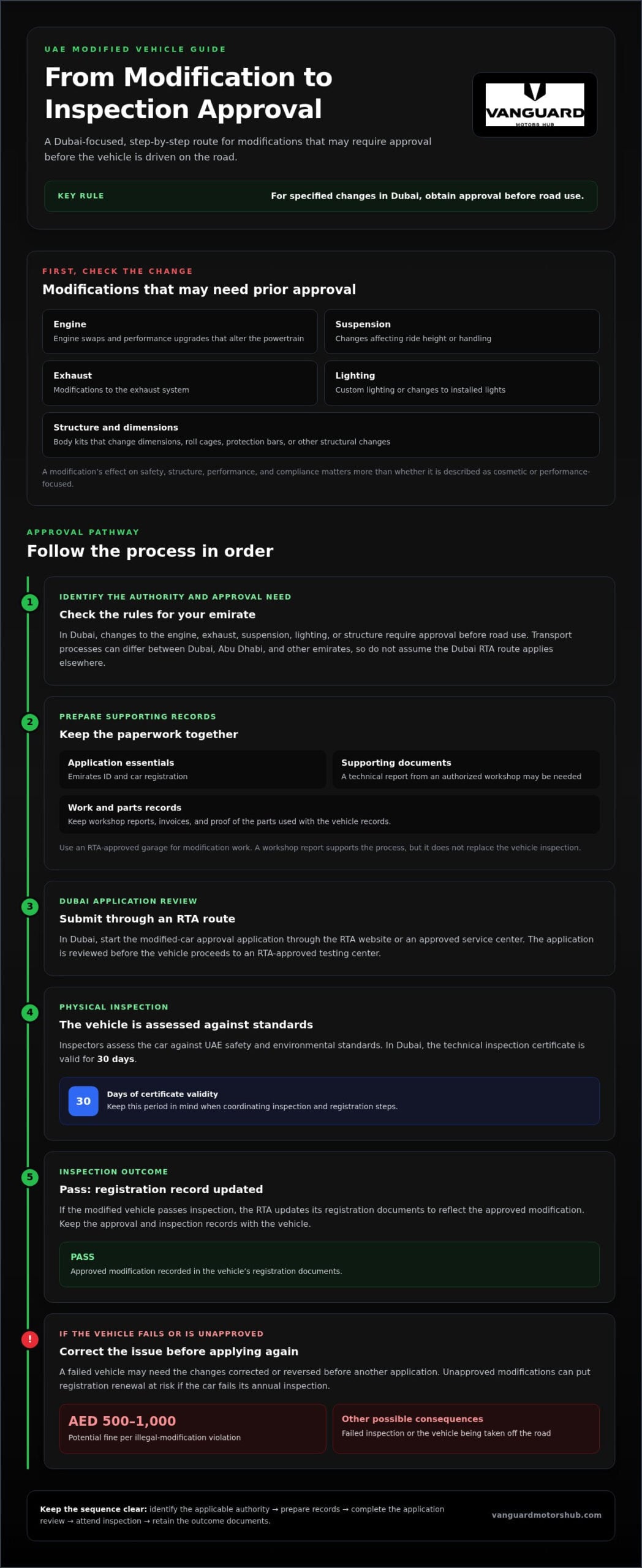
Whether your modified car will pass inspection in the UAE depends on the changes and whether you have the required approval. Across the Emirates, modifications affecting the engine, exhaust, suspension, lighting or structure require approval before the car is driven on the road. Unapproved changes can also put registration renewal at risk if the vehicle fails its annual inspection.
A modification may seem acceptable because it improves performance or appearance. But changes to the engine, chassis or exhaust can affect safety and compliance, so approval matters as much as the work itself.
This guide explains which modifications may need prior approval, which changes are prohibited and what inspectors assess. It also covers how the rules apply to engine, chassis and exhaust work, so you can understand what may stand between your build and a pass.
Key Takeaways
- Approval depends on how a change affects safety, structure, performance and compliance, not simply whether it looks or sounds better.
- Engine, suspension, exhaust, lighting and structural changes may need prior approval; keep workshop reports and parts documents with your vehicle records.
- Learn which lighting and number-plate changes can make a vehicle non-compliant before investing in visual upgrades.
- Engine, chassis and exhaust work can trigger specific inspection and penalty requirements, so understand the rules before driving after a major change.
- Some appearance upgrades have separate requirements: for example, paint or wrap colour changes involve notifying the RTA and updating the Mulkiya.
What Makes a Modification Legal or Illegal?
A modification’s legality depends on its effect on safety and compliance, as well as any required approval. In Dubai, approval and inspection records matter when you renew registration.
Certified Workshops and Required Documents
For modifications that need authority approval, a certified or authorized workshop provides technical documentation. Use an RTA-approved garage for modification work, and keep its reports and parts records. These documents help show what changed and how the work was assessed.
For a modified-car approval application in Dubai, prepare your Emirates ID and car registration. You may also need a technical report from an authorized workshop, along with invoices or proof of the parts used. Keep the records together, as receipts and reports can support the approval process.
After the application is reviewed, take the car to an RTA-approved testing center. The inspection assesses the vehicle against UAE safety and environmental standards. If it fails, you may need to correct or reverse the changes before applying again. A workshop report does not replace the inspection.
Unapproved modifications can prevent registration renewal if the car fails its annual inspection. Documentation is useful beyond the application itself: it can help establish which parts were fitted and what work was completed. For changes that require approval, the relevant transport authority’s decision remains central.
Tint Limits and Certification
Window tint rules set limits on how much light the glass must transmit and whether authority approval is needed. In Dubai, tinting is permitted up to 50% with approval from the authorities. Front side windows typically must allow at least 50% visible light transmission.
The front windscreen is a separate case: tinting it is prohibited in the UAE. A tint that exceeds the permitted percentage in Dubai carries a fine of AED 1,500. Treat tinting as a regulated change, not simply an aesthetic choice; the darkness of the film affects whether the vehicle complies.
Before choosing tint, distinguish the film’s darkness from the visible light transmission through the finished glass. The limit concerns the result, while approval concerns authorization. If inspection or registration processes apply, keep relevant documentation with your vehicle records.
Allowed Vehicle Modifications
Allowed modifications are changes that meet safety rules and any approval conditions that apply. In Dubai, installing alloy wheels does not usually require inspection. That does not mean every wheel change is automatically acceptable: the vehicle must remain safe and meet applicable requirements.
UAE Federal Traffic Law No. 21 of 1995, as amended, sets baseline standards for vehicle safety and modifications. When a change needs approval, submit the application through the RTA website or an approved service center. If the modified vehicle passes inspection, the RTA updates its registration documents to reflect the approved modification.
For a Dubai technical inspection, the certificate is valid for 30 days. Keep that period in mind when coordinating inspection and registration steps. If you’re asking, “Will my modified car pass inspection in UAE?”, focus on the specific change, required approval, supporting records, and the vehicle’s condition during testing.
Modifications that require prior approval
Yes, approval and inspection procedures can differ between Dubai, Abu Dhabi and other emirates. Each emirate’s transport authority administers its own vehicle processes, so do not assume Dubai’s RTA application route applies elsewhere.
In Dubai, changes affecting a vehicle’s engine, exhaust, suspension, lighting or structure require approval before road use. This applies to more than major mechanical work. A body kit that changes vehicle dimensions, custom lighting, a roll cage or off-road protection bars can also affect safety or vehicle specifications.
Examples of changes identified for prior approval include:
- Engine swaps and performance upgrades that alter the vehicle’s powertrain.
- Suspension changes that affect ride height or vehicle handling.
- Exhaust modifications, including changes to the exhaust system.
- Body kits that change the vehicle’s dimensions, plus roll cages and protection bars.
- Custom lighting that changes the vehicle’s installed lights.
Many cosmetic and performance modifications require prior approval from the relevant transport authority. A change’s label does not determine its status; its effect on the vehicle matters. A visual upgrade that alters dimensions, lighting or structure may need approval, while an unchanged appearance does not automatically exempt a mechanical change.
In Dubai, applicants can start a modified-car approval application through the RTA website or an approved service center. The application is reviewed before the vehicle goes to an RTA-approved testing center, where inspectors assess it against UAE safety and environmental standards. The process involves both administrative review and a physical inspection.
Approval matters because an unapproved modification can lead to a failed inspection, fines or the vehicle being taken off the road. Illegal modifications typically carry fines of AED 500 to AED 1,000 per violation. If a modified vehicle passes inspection, the RTA updates its registration documents to reflect the approved modification. That record connects the vehicle’s new specification with its registration.
Keep the approval and inspection documents with the vehicle’s records. If the car fails, correct or reverse the changes before applying again. For planned appearance or performance work, discuss your planned modification before treating installation as permission to drive. Approval is the decision point, not the fact that a modification has been completed.
Prohibited lighting and number-plate changes
If a modified car fails inspection, correct or reverse the changes before reapplying. In Dubai, a light-vehicle re-inspection fee is AED 50.
Lighting changes deserve particular attention because decorative external lighting is banned in the UAE, except amber indicators and red brake or tail lights. A colour that looks distinctive while parked can create a compliance issue on the road. Keep exterior lights within the permitted colours and make sure they work correctly.
Dubai penalties also distinguish between different lighting faults. Driving with non-working lights carries a fine of AED 400 and 6 black points. Non-working lane-change or rear signal lights carry a fine of AED 400 and 2 black points. These examples show why testing every light matters, not just checking that headlights switch on.
- Confirm indicators display amber and brake or tail lights display red.
- Test headlights, brake lights and turn signals before inspection.
- Remove decorative external lights that do not fit the permitted colours.
Take the same care with number-plate changes. Avoid styling that obscures characters or makes the plate difficult to read. Treat a replacement plate, cover or surrounding trim as a change that needs careful review, rather than assuming a cosmetic detail cannot affect inspection. Keep the plate unobstructed and clearly visible.
Sound-system work differs from external lighting, but the installation must still preserve safe vehicle operation. Keep audio equipment clear of controls, required visibility and safety equipment. Do not assume an inspection will ignore an installation just because it is inside the cabin. The key question is whether the vehicle remains fit for safe use.
An inspection checks the vehicle against UAE safety and environmental standards. If it fails, address the issue identified; repeating the same test without correcting the cause will not help. If the problem involves lighting, restore permitted colours and working signals before returning for testing.
For light vehicles, light buses and motorcycles, Dubai’s re-inspection fee is AED 50. This is the fee for the inspection repeat, not a penalty for a lighting violation. A separate fine or black points may apply to non-working lights, as noted above. Keep those consequences distinct when planning the repair.
Before inspection, walk around the vehicle and check that every exterior light works and the number plate is visible. Test the cabin audio installation and confirm that it does not interfere with the controls or safety equipment. These checks can reveal obvious issues early, while the inspection determines whether the vehicle meets the required standards.
Engine, chassis and exhaust modifications
Engine, chassis and exhaust changes can alter a vehicle’s performance, structure and road behaviour. In Dubai, these modifications require approval before the car is driven on public roads. An engine swap, power upgrade, altered chassis or replacement exhaust therefore needs more than workshop installation: both the relevant transport authority’s approval and the vehicle’s inspection matter.
Engine work can change how a vehicle performs. Chassis changes may affect its structure, while exhaust work can alter noise and emissions. The testing center assesses the modified vehicle against UAE safety and environmental standards. Passing an inspection before a change does not mean a later configuration is approved.
The consequences depend on the action involved. In Dubai, modifying a vehicle’s engine or chassis without permission carries a fine of AED 1,000. Engine or vehicle modifications can also result in 12 traffic black points and a Dh1000 penalty. Separately, failing to examine a vehicle after core adjustments to its engine or body carries a fine of AED 400. These are distinct violations, not interchangeable descriptions of one charge.
Exhaust sound is another key consideration. Passenger-car exhaust noise in the UAE is typically limited to 95 dB. A louder system can therefore create a compliance concern, even if the exhaust is securely installed. Approval requirements apply to exhaust modifications in Dubai, so sound alone is not the only factor.
- Engine: An engine swap or performance upgrade changes a core vehicle system and requires prior approval in Dubai.
- Chassis: Structural changes need permission; unauthorized engine or chassis modifications carry the stated AED 1,000 fine.
- Exhaust: Approval is required for the modification, and passenger-car noise is typically limited to 95 dB.
Keep the modification’s technical report, parts invoices and approval records together. These documents identify the work completed and support the application process, but they do not replace inspection. The modified vehicle still needs assessment against applicable standards.
Before driving after core engine or body adjustments, account for the examination requirement. Skipping that examination in Dubai carries an AED 400 fine. Driving with unauthorized engine or chassis changes can bring the separate AED 1,000 fine, while engine or vehicle modifications can also carry 12 traffic black points and a Dh1000 penalty.
For a planned powertrain or exhaust change, treat approval as part of the modification, not a step to consider after installation. The same applies to chassis work: permission, documentation and inspection determine whether the changed vehicle meets road-use requirements.
What vehicle modifications are allowed in the UAE?
UAE rules allow changes that preserve safety and meet applicable approval requirements. UAE Federal Traffic Law No. 21 of 1995, as amended, sets baseline standards for vehicle safety and modifications. The practical distinction is whether the change affects compliance, needs permission, or requires registration details to change.
Some appearance changes still involve official steps. If you change a vehicle’s paint or wrap colour, notify the RTA and update the Mulkiya. In Dubai, changing a vehicle’s colour without permission carries a fine of AED 800. A wrap that changes the car’s colour is not merely a surface detail for registration purposes.
Stickers also need care. In Dubai, writing phrases or placing stickers on a vehicle without permission carries a fine of AED 500. Before adding graphics or text, consider what they display and whether permission is required. A restrained design does not remove the need to follow the applicable rules.
- Paint or wrap colour: Notify the RTA and update the Mulkiya when the vehicle’s colour changes.
- Stickers and writing: Avoid unpermitted phrases or stickers, which can result in a Dubai fine.
- Tyres: Keep all four tyres matching in size and type.
- Windscreen: Front windscreen tinting is prohibited in the UAE.
Tyres are a practical example of why matching specifications matter. All four tyres on a UAE vehicle must match in size and type. Changing a tyre at one wheel position should not leave the car with mixed sizes or types. Check the full set, not just the newly fitted tyre.
Front windscreen tinting is prohibited in the UAE. Other windows have separate limits and approval conditions. A film that looks light or subtle does not make front windscreen tinting permissible. Keep the windscreen free of tint film when planning an appearance upgrade.
These examples show why “allowed” does not always mean “install without conditions.” Colour changes involve RTA notification and a Mulkiya update, tyres must match across all four positions, and front windscreen tinting is prohibited. For other changes, the relevant authority’s approval requirements still apply.
If you’re planning a colour change, discuss a paint or wrap colour change before committing to the new finish. Build the RTA notification and Mulkiya update into your plan, so the vehicle’s recorded colour matches its appearance.
Vanguard Motors Dubai: Paint Protection Film (PPF) Installation
Vanguard Motors Dubai offers Paint Protection Film (PPF) Installation for owners seeking a paint-focused upgrade rather than engine, chassis or exhaust changes. PPF helps protect the vehicle’s finish while retaining its existing colour. For a different look, Colored Sticker Wraps and Peelable Paint Applications offer alternative finish options.
Colour-changing wraps and paint applications have a separate administrative requirement: notify the RTA and update the Mulkiya when the vehicle’s colour changes. Include that step in your plans for the visual modification. These services address appearance and paint protection, not approval for mechanical or structural changes.
For a paint protection or finish option, contact Vanguard Motors Dubai.
Plan Your Next Modification with Confidence
A strong build considers visual direction and compliance together. Before committing to another change, decide whether your priority is protecting the original finish, changing the vehicle’s appearance or altering its mechanical character. That distinction helps you plan the work and keep approval requirements in view.
If you’re asking, “Will my modified car pass inspection in the UAE?”, base your next step on the type of change you want. Vanguard Motors Dubai offers Paint Protection Film (PPF) Installation, Colored Sticker Wraps and Peelable Paint Applications for appearance-focused projects. These options serve a different purpose from engine, chassis or exhaust modifications, which involve separate approval requirements.
Choose a finish that suits your vehicle and your plans, then include any required registration steps in your project timeline. A considered approach lets you pursue a distinctive look while keeping road-use requirements in view.
Contact Vanguard Motors Dubai to discuss an appearance-focused upgrade. Make your next modification a confident, considered choice.
Frequently Asked Questions
What are the Rules of Car Modification in Dubai?
In Dubai, modifications affecting key systems or the vehicle’s structure require approval before the car is driven. Separate requirements apply to appearance changes: changing the paint or wrap colour involves notifying the RTA and updating the Mulkiya. Before installation, compare the planned change with the vehicle’s recorded details and approval requirements. Passing a technical inspection and having the required approval are related but distinct parts of compliance.
Why Do You Need RTA Approval?
RTA approval confirms that a modification has been reviewed for road use and can be recorded against the vehicle. Without required approval, a change may lead to inspection failure or registration-renewal problems. For example, an approved body or mechanical change can be added to registration documents after the vehicle passes inspection. Approval is not simply workshop paperwork; it connects the modified vehicle’s specification with its official record.
Which UAE laws and regulations apply to modified cars?
UAE Federal Traffic Law and relevant local transport authority regulations govern vehicle modifications across the country. The relevant emirate’s transport authority handles local approval and inspection processes, so Dubai’s RTA procedure should not automatically be applied elsewhere. In Dubai, the authority assesses modified vehicles against UAE safety and environmental standards. Distinguish the federal baseline from emirate-specific application, testing and registration arrangements.
What modifications cause a car to fail UAE vehicle inspection?
Changes that compromise safety, environmental compliance or required vehicle equipment can lead to inspection failure. Examples include prohibited decorative external lighting, non-working signals, unauthorized engine or chassis changes, and exhaust modifications that do not meet applicable standards. An unapproved change can cause problems even if the vehicle appears mechanically sound. Before inspection, assess both the modification and whether it has the required approval and documentation.
How do I get approval for car modifications in the UAE?
In Dubai, start a modified-car approval application through the RTA website or an approved service center. Provide the requested vehicle and modification details, then follow the application review process. After review, take the vehicle to an RTA-approved testing center for assessment. If it passes, the RTA updates its registration documents to reflect the approved change. Each emirate’s relevant transport authority administers its own procedures.
What documents are required to inspect a modified car in the UAE?
For a Dubai modified-car approval application, prepare your Emirates ID and vehicle registration. The application may also require a technical report from an authorized workshop, plus invoices or proof of penta parts used. Keep these records together and make sure they clearly relate to the modification under review. For example, an exhaust-change application should include documents for that work, not unrelated repair receipts.
Where can I get a modified car tested or certified in the UAE?
In Dubai, take a modified vehicle to an RTA-approved testing center after the application has been reviewed. The center assesses it against UAE safety and environmental standards. In another emirate, the relevant transport authority administers the local process, so follow its approved inspection route. A workshop’s technical report supports an application but does not replace the testing-center inspection required for approval.
How much does UAE vehicle inspection and modification approval cost?
In Dubai, a light-vehicle technical inspection costs AED 150 plus a AED 20 Knowledge and Innovation fee, totaling AED 170. This is the inspection charge, not a stated modification-approval fee. Inspection amounts depend on vehicle category and service type; for example, heavy-vehicle inspection has a different listed total. The vehicle’s category and whether mobile inspection is used affect the applicable inspection charge.