
A black car in pristine condition is the ultimate statement of automotive excellence, but it’s also the most unforgiving canvas in the world. Even the slightest touch can leave behind a trail of microscopic damage that ruins the optical clarity of your factory paint. If you’ve ever felt the sting of seeing spider-web scratches dancing in the sunlight after a routine cleaning, you know that standard maintenance simply isn’t enough for a high-performance finish.
We understand that maintaining that deep, liquid-black glow is a labor of passion that requires professional-grade precision. This 2026 guide is designed to transform your approach by mastering the elite techniques for avoiding swirl marks on black cars. You’ll learn how to replace outdated, friction-heavy habits with a streamlined, safe routine that preserves your investment. We’ll explore the latest in contactless wash protocols and the transformative power of self-healing Paint Protection Film (PPF). It’s time to move beyond basic care and embrace a sophisticated strategy that delivers a permanent, mirror-like finish with significantly less effort.
Key Takeaways
- Understand the science behind the “spider-web” effect and why black paint requires a specialized approach to clear coat preservation.
- Master the professional contactless wash protocol to remove the majority of surface grit without ever touching the delicate paintwork.
- Discover the elite techniques for avoiding swirl marks on black cars through strict temperature control and high-GSM microfiber selection.
- Evaluate the performance of various sacrificial layers, comparing traditional waxes and ceramic coatings to more permanent protective solutions.
- Explore the benefits of self-healing Paint Protection Film (PPF) as the definitive technology for maintaining a flawless, mirror-like finish.
The Anatomy of Swirl Marks: Why Black Paint is Unforgiving
Swirl marks are not merely a result of poor aesthetics; they are physical defects in your vehicle’s finish. Technically, these marks are microscopic scratches etched into the clear coat, the topmost protective layer of your car’s exterior. While deep scratches might penetrate down to the primer or metal, swirl marks remain on the surface. They appear as circular “spider-webs” because of how light interacts with these jagged edges. Understanding the mechanics of these defects is the first step toward avoiding swirl marks on black cars and maintaining that deep, liquid finish.
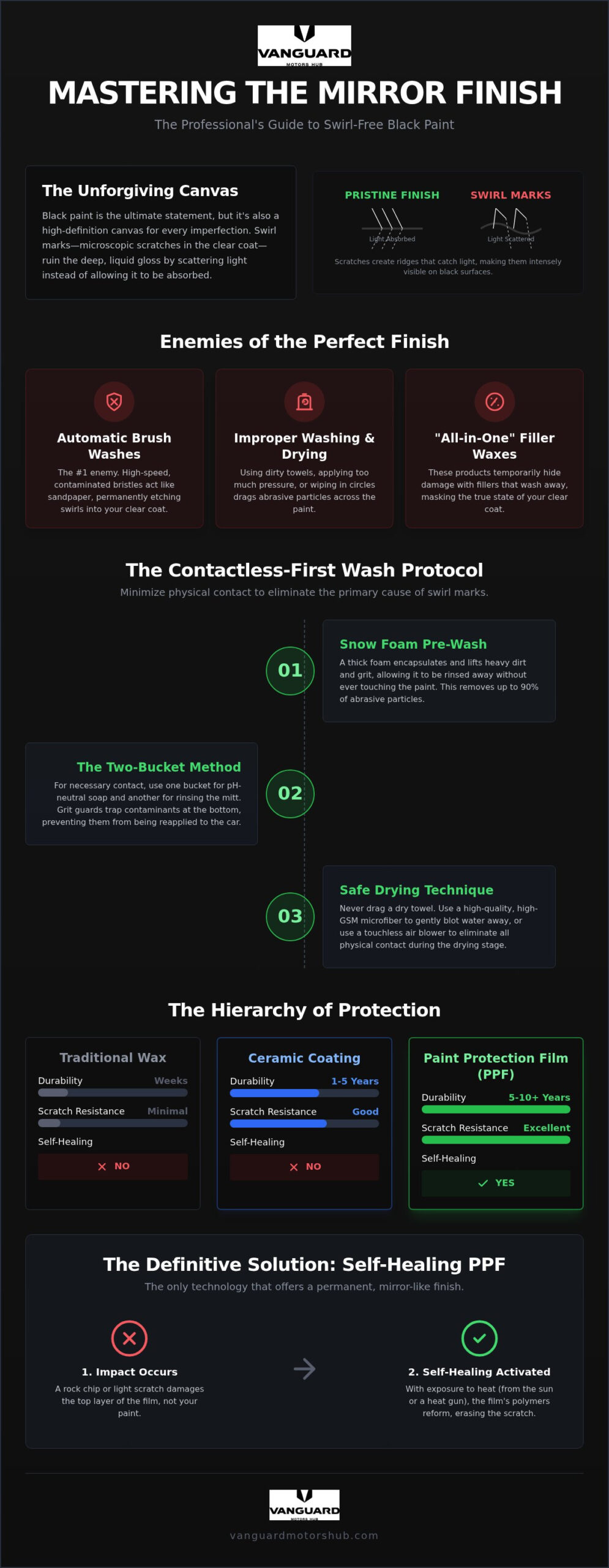
The physics of light is the primary reason black paint is so difficult to manage. A perfectly flat black surface absorbs nearly all visible light, creating a mirror-like depth. However, when a microscopic scratch is introduced, it creates a microscopic ridge. Instead of being absorbed, light hits these ridges and reflects back at the viewer. On a white or silver car, this reflection is lost in the overall brightness of the pigment. On a black car, the contrast between the light-absorbing paint and the light-reflecting scratch makes every single imperfection stand out with high-definition clarity.
The Role of the Clear Coat
Modern Automotive paint is a multi-stage system consisting of a primer, a base colour coat, and a final clear coat. Most swirl marks sit exclusively in this clear layer. It’s vital to recognize that the clear coat is not an indestructible shield. In high-temperature environments, such as the UAE summer, clear coats can actually soften. This makes the surface significantly more vulnerable to mechanical damage during the washing process. The clear coat on a black car acts as a magnifying glass for every mechanical imperfection introduced during maintenance. If you apply pressure to a hot bonnet with a contaminated sponge, you’re effectively sanding your car’s finish at a microscopic level.
Common Misconceptions About Black Paint
A frequent myth among enthusiasts is that black paint is “softer” than other colours. In reality, the hardness of the paint is determined by the clear coat formulation, not the pigment underneath. Black paint is simply more revealing. What might pass for a “clean” wash on a grey SUV will look like a disaster on a black sedan. This is why avoiding swirl marks on black cars requires a total rejection of standard cleaning habits.
- Automatic Brush Washes: These are the primary enemy of black vehicles. The heavy, high-speed bristles carry grit from every previous car, acting like industrial-grade sandpaper.
- One-Step Waxes: Many “all-in-one” products contain fillers that temporarily hide damage. They don’t fix the problem; they merely mask it until the next wash, preventing you from seeing the true state of your clear coat.
- Improper Contact: The #1 cause of swirls is improper contact during washing and drying. Using a circular motion with a dry or dirty towel is a guaranteed way to introduce “love marks” that ruin the paint’s optical clarity.
The Professional Contactless Wash Protocol
The core of avoiding swirl marks on black cars lies in a “contactless first” philosophy. Most damage happens when you drag abrasive particles across the paint during the cleaning process. In the UAE, where fine sand and extreme heat are constant, this risk is amplified. Never wash a black car when the bonnet is hot to the touch. High temperatures expand the clear coat, making it softer and more prone to marring. Always use pH-neutral chemicals to ensure you preserve existing protection while removing environmental fallout.
Step 1: The Snow Foam Pre-Wash
Apply a high-viscosity snow foam to the dry vehicle. This thick lather is designed to encapsulate abrasive dust particles and lift them away from the surface. Allow the foam to dwell for several minutes, ensuring the chemistry works without drying on the paint. This stage effectively removes the majority of surface contaminants before any physical contact occurs. Finish with a thorough pressure rinse to clear away the encapsulated grit.
Step 2: The Two-Bucket Method with Grit Guards
When contact is necessary, the two-bucket method is the only acceptable standard. Fill one bucket with a pH-neutral wash solution and the other with pure water for rinsing. Grit guards are essential in both pails to keep sediment trapped at the bottom. Wash the car in small sections using straight-line wiping motions. Avoid circular movements at all costs. After each section, rinse your wash mitt in the clean water bucket to ensure no trapped dirt is reintroduced to the paintwork.
Step 3: Safe Drying Techniques
Drying is often the stage where the most damage is done. Traditional chamois leathers act like squeegees for microscopic grit, dragging it across the clear coat. Forced air is the superior choice, as it eliminates physical contact and removes water from hidden crevices. If you use a towel, select a high-GSM microfiber and employ a “pat-dry” method instead of wiping. For owners who want to ensure a flawless finish without the risk, our mobile detailing services offer professional-grade maintenance tailored to the local climate.
Essential Tools for Maintaining a Mirror Finish
Achieving a flawless finish is impossible without a specialized arsenal. Many owners make the mistake of using generic accessories, only to find they’ve introduced fresh damage during a routine clean. High-quality tools are a strategic investment; they are significantly more affordable than a professional paint correction service. When avoiding swirl marks on black cars, your equipment must prioritize lubrication and soft contact to protect the clear coat’s integrity.
Chemical selection is equally vital. Avoid “wash and wax” combinations that promise a shortcut to a shine. These products often contain low-grade polymers and surfactants that leave behind hazy streaks on black paint, making the surface look oily rather than clear. Stick to dedicated, high-lubricity shampoos that allow your tools to glide effortlessly across the panels.
Microfiber Excellence
Not all microfiber is created equal. The industry standard for measurement is GSM, or Grams per Square Metre, which indicates the density and plushness of the towel. For drying, you should exclusively use towels with 500+ GSM. These high-density fibers absorb massive amounts of water while providing a thick cushion against the paint. For applying detailing sprays or light buffing, a 300+ GSM towel is appropriate.
Strictly follow the “tag-free” rule. Most commercial towels have plastic or paper labels that act like serrated blades on soft black clear coats. Always remove these or buy laser-cut, edgeless towels. Maintenance of these tools is just as critical. Never use fabric softeners or high-heat drying cycles. Softeners coat the fibers in a water-repellent film, destroying the towel’s absorbency and potentially leaving residues that cause marring.
Advanced Filtration and Pressure
The quality of your water directly impacts the final result. In the UAE, hard water is a persistent challenge. When minerals like calcium and magnesium dry on a black surface, they leave behind white spots that are far more visible than on lighter pigments. Using a deionization filter ensures a mineral-free rinse, which is a cornerstone of avoiding swirl marks on black cars during the drying phase.
- Adjustable Pressure Washers: Use a dedicated machine with an adjustable PSI. You need enough pressure to strip away grit but not so much that you risk damaging delicate trim or forcing water into seals.
- Quick Detailers: These are not just for shine. High-quality detailers act as essential lubricants. If you must remove a light fingerprint or bird dropping, a liberal application of quick detailer provides the necessary “slip” to lift the contaminant without scratching.
For those who demand a showroom standard without managing the technicalities of filtration and tool maintenance, our Luxury Car Detailing services provide the professional precision your vehicle deserves.
Sacrificial Layers: Wax vs. Ceramic vs. PPF
A sacrificial layer is the definitive front line in automotive preservation. It’s a secondary coating designed to absorb environmental punishment, ensuring that the factory clear coat remains untouched. For owners focused on avoiding swirl marks on black cars, the choice of this layer determines whether the finish survives a single dusty afternoon or remains flawless for years. This concept is explored deeply in our Supercar Detailing: The 2026 Reference Guide, where we outline the necessity of choosing protection based on usage and climate.
Traditional waxes offer a warm, organic glow that many enthusiasts love. However, in the high-heat environment of the UAE, carnauba-based products can lose their structural integrity in weeks. Ceramic coatings provide a significant upgrade, offering a permanent chemical bond that repels water and contaminants. While exceptional for chemical resistance, ceramic is often misunderstood. It is a chemical shield, not a physical armor. It cannot stop rock chips or deep mechanical marring. Black cars specifically benefit from thicker physical barriers because the pigment highlights depth, and any deviation in the surface level is immediately visible.
The Limitations of Wax and Ceramic Coatings
Waxes sit on the surface and provide minimal thickness. They offer zero protection against mechanical scratches. Ceramic coatings, while harder than clear coat, are only a few microns thick. They make the car easier to clean, which helps in avoiding swirl marks on black cars, but they don’t make the paint bulletproof. If a contaminated wash mitt is used, the ceramic layer itself can be swirled, requiring a full polish to rectify. It’s a sophisticated solution for maintenance, but it lacks the impact resistance required for total peace of mind.
Paint Correction: The Essential Prerequisite
Applying any protective layer over damaged paint is a fundamental error. You must never “seal in” existing swirls, as the coating will only magnify the imperfections. Paint correction is the process of surgically leveling the clear coat to restore true black depth. This step is mandatory before any elite protection is applied. It ensures the surface is optically flat, allowing the sacrificial layer to bond perfectly. For more on restoring your vehicle’s foundation, read our guide on Cosmetic Car Repair in 2026.
If your black paintwork has already lost its mirror-like clarity, contact us today to discuss a professional paint correction and protection package.
The Vanguard Solution: Self-Healing PPF for Black Cars
While mastering the contactless wash and selecting high-GSM tools are vital steps, they represent a defensive posture. To truly achieve a permanent solution for avoiding swirl marks on black cars, you must shift from defensive maintenance to proactive protection. Paint Protection Film (PPF) is the definitive standard for excellence in 2026. This high-performance polyurethane layer acts as a transparent armor, absorbing the mechanical energy of grit and debris that would otherwise devastate your clear coat. Beyond protection, modern PPF enhances the aesthetic depth of black pigments, providing a “wet look” gloss that often exceeds the quality of factory finishes.
The technical brilliance of PPF lies in its self-healing properties. The film is composed of advanced elastomeric polymers that possess a “memory” of their original, flat state. When the surface is subjected to heat, these polymers reorganize and flow back into their initial configuration. You can learn more about this technology in our comprehensive guide, The Ultimate Shield: Why Paint Protection Film is the Standard for Excellence in 2026.
Eliminating Maintenance Anxiety
The most significant benefit of PPF for black car owners is the total elimination of maintenance anxiety. Even with the best intentions, a stray piece of dust on a drying towel can introduce a visible scratch. With a self-healing film, these micro-swirls are temporary. In the UAE climate, the afternoon sun provides the exact thermal energy required to trigger the healing process. You can watch microscopic marring disappear simply by leaving the vehicle in the heat for a short period. This resilience ensures long-term value retention, as the factory paint remains in “as-delivered” condition beneath the film, a critical factor for the resale of luxury and supercars.
Professional Installation at Vanguard Motors Dubai
The effectiveness of PPF is entirely dependent on the precision of the application. On black panels, an average installation is immediately obvious. We specialize in “wrapped edges,” a technique where the film is tucked behind the panels to ensure a seamless, invisible finish. This prevents the unsightly “white lines” of wax buildup that often plague lesser installations. Our process utilizes custom-cut patterns tailored to your specific model, ensuring perfect alignment around sensors, badges, and intricate carbon fiber trim.
Don’t leave your vehicle’s clarity to chance. Protect your investment with Vanguard Motors Dubai’s Premium PPF services and enjoy the confidence of a flawless, mirror-like finish that heals itself daily.
Securing a Flawless Future for Your Black Paintwork
Transitioning from traditional washing to a contactless, protection-first strategy is the only way to maintain a mirror finish in the UAE climate. By combining the precision of the two-bucket method with the advanced technology of self-healing PPF, you’ll eliminate maintenance anxiety for good. Mastering the elite techniques for avoiding swirl marks on black cars ensures your vehicle remains a benchmark of quality on every journey. This isn’t just about cleaning; it’s about preserving the optical depth that makes black paintwork so prestigious.
As the UAE’s leading specialists in luxury car protection, we combine high-octane passion with technical mastery. Our team consists of certified installers of self-healing PPF technology with extensive experience maintaining elite marques, including bespoke Brabus and Mansory conversions. We understand the meticulous care required to keep a black finish in showroom condition, regardless of environmental challenges. Your car deserves a finish that reflects its high-performance DNA.
Take the definitive step toward permanent clarity and Book a Professional Paint Correction and PPF Consultation today. Let’s transform your vehicle into a lasting masterpiece of automotive excellence.
Frequently Asked Questions
Can you remove swirl marks from black paint without polishing?
You cannot permanently remove swirl marks without a professional polishing process. While some retail products use heavy fillers to temporarily mask defects, these are only cosmetic band-aids that wash away. True restoration requires mechanical paint correction to surgically level the clear coat. This process eliminates the microscopic ridges that reflect light as swirls. Once the surface is optically flat, you can focus on avoiding swirl marks on black cars through proper maintenance.
Is it possible to have a swirl-free black car without PPF?
It is technically possible to maintain a swirl-free finish without PPF, but it requires an uncompromising commitment to contactless washing. You must strictly avoid all automatic car washes and use only high-GSM microfiber towels with the two-bucket method. Even with elite care, the soft clear coat remains vulnerable to environmental fallout and accidental contact. Most owners find that a high-quality Paint Protection Film is the only way to achieve long-term peace of mind.
How often should I wash my black car to avoid dirt buildup?
We recommend a professional wash once a week to prevent abrasive dust and environmental contaminants from bonding to the clear coat. In the UAE climate, fine sand can accumulate quickly, acting like sandpaper if left on the surface. Frequent, safe cleaning reduces the amount of pressure needed during the wash process. This proactive approach is a cornerstone of avoiding swirl marks on black cars by ensuring grit never has the chance to settle.
Does ceramic coating stop swirl marks from forming?
Ceramic coatings provide exceptional chemical resistance and hydrophobicity, but they are not scratch-proof. While the coating is harder than your factory clear coat, it can still be swirled by improper washing techniques or contaminated towels. Think of it as a high-performance chemical shield rather than a physical armor. It makes the car significantly easier to clean safely, which helps reduce the risk of marring during your routine maintenance.
Will a car cover prevent swirls or cause them?
Car covers frequently cause more harm than good on black paintwork. If even a microscopic layer of dust exists between the paint and the cover, the friction of the fabric will act as an abrasive. Wind movement causes the cover to rub against the panels, leading to extensive marring and love marks. Unless your vehicle is surgically clean and stored in a climate-controlled environment, we generally advise against using traditional covers.
What is the best type of microfiber towel for black paint?
The best choice for black paint is a high-density, edgeless microfiber towel with a GSM of 500 or higher. These towels provide a thick, plush cushion that helps trap any remaining particles away from the surface. Always ensure your towels are tag-free to prevent plastic edges from scratching the paint. For drying, a dedicated twisted loop drying towel is superior to a traditional chamois, as it minimizes friction and maximizes absorbency.
Can heat from the sun really heal scratches on my car?
Heat can only heal scratches if your vehicle is protected with a self-healing Paint Protection Film (PPF). Modern films are engineered with elastomeric polymers that return to their original shape when exposed to thermal energy. In the UAE, the intense afternoon sun provides the perfect conditions for this process. Micro-swirls and light abrasions on the film’s surface will literally vanish as the material remembers its flat, mirror-like state.
How much does professional paint correction cost for a black car?
The cost of professional paint correction depends entirely on the current state of the clear coat and the level of refinement required. A multi-stage correction involves several rounds of heavy compounding and fine polishing to restore deep, liquid clarity. While we don’t provide fixed pricing without an inspection, this service is a necessary prerequisite for any high-end protection package. It ensures your black paint is flawless before being sealed under a coating.