
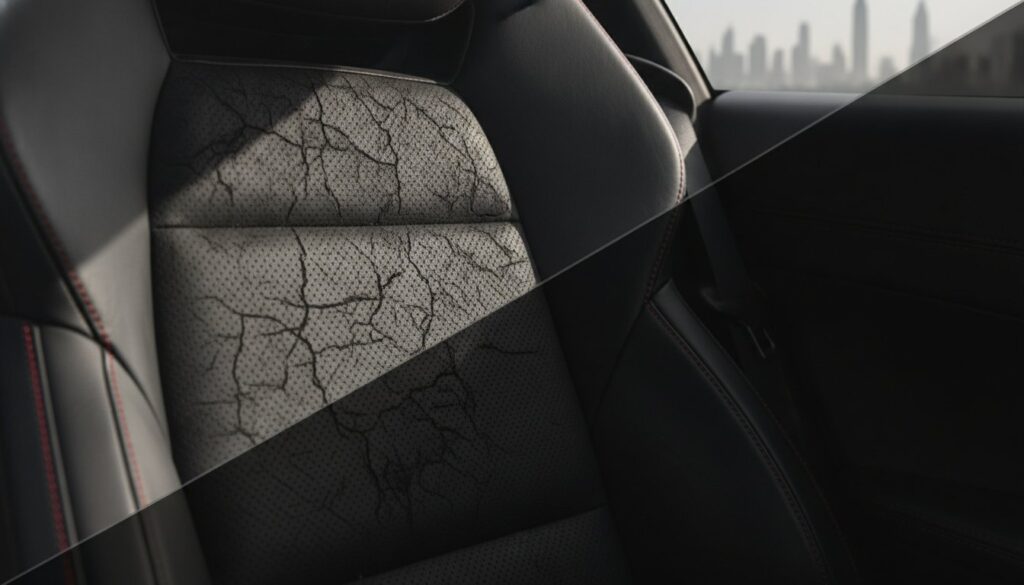
Most drivers believe a standard bottle of retail conditioner can save a parched interior, but in 2026, we know that hydration without molecular UV stabilization is a losing battle. Your luxury car’s greatest enemy isn’t the mileage; it’s the relentless ultraviolet radiation turning your premium hide into a rough, sandpaper-like surface. You’ve likely felt that frustrating texture on your seats or noticed the once-vibrant pigment on your dashboard starting to ghost under the glare. It’s a stressful sight, especially when the fear of leather splitting and requiring a full, costly re-upholstery looms over every high-heat season.
We understand that maintaining a high-performance aesthetic requires more than just superficial cleaning. This guide delivers the definitive strategy for car leather restoration for sun damage, showing you how to reverse years of environmental abuse and reclaim that deep, rich color. We’ll explore the technical precision of collagen fiber stabilization and identify the elite conditioners specifically engineered to thrive in extreme temperatures. By the end of this 2026 guide, you’ll have a professional-grade protection plan to ensure your interior remains as resilient and sophisticated as the machine it surrounds.
Key Takeaways
- Identify the chemical triggers that cause luxury leather to fail under extreme heat and ultraviolet exposure.
- Learn why standard oil-based conditioners often accelerate damage and how to select professional-grade alternatives with UV inhibitors.
- Discover the advanced techniques used in car leather restoration for sun damage to reclaim a factory-soft feel and rich pigment.
- Implement a proactive protection strategy that utilizes high-quality window tinting and specialized maintenance to stop future degradation.
- Recognize the critical signs that your interior requires expert cosmetic repair before permanent splitting occurs.
The Science of Sun Damage: Why Leather Fails in Hot Climates
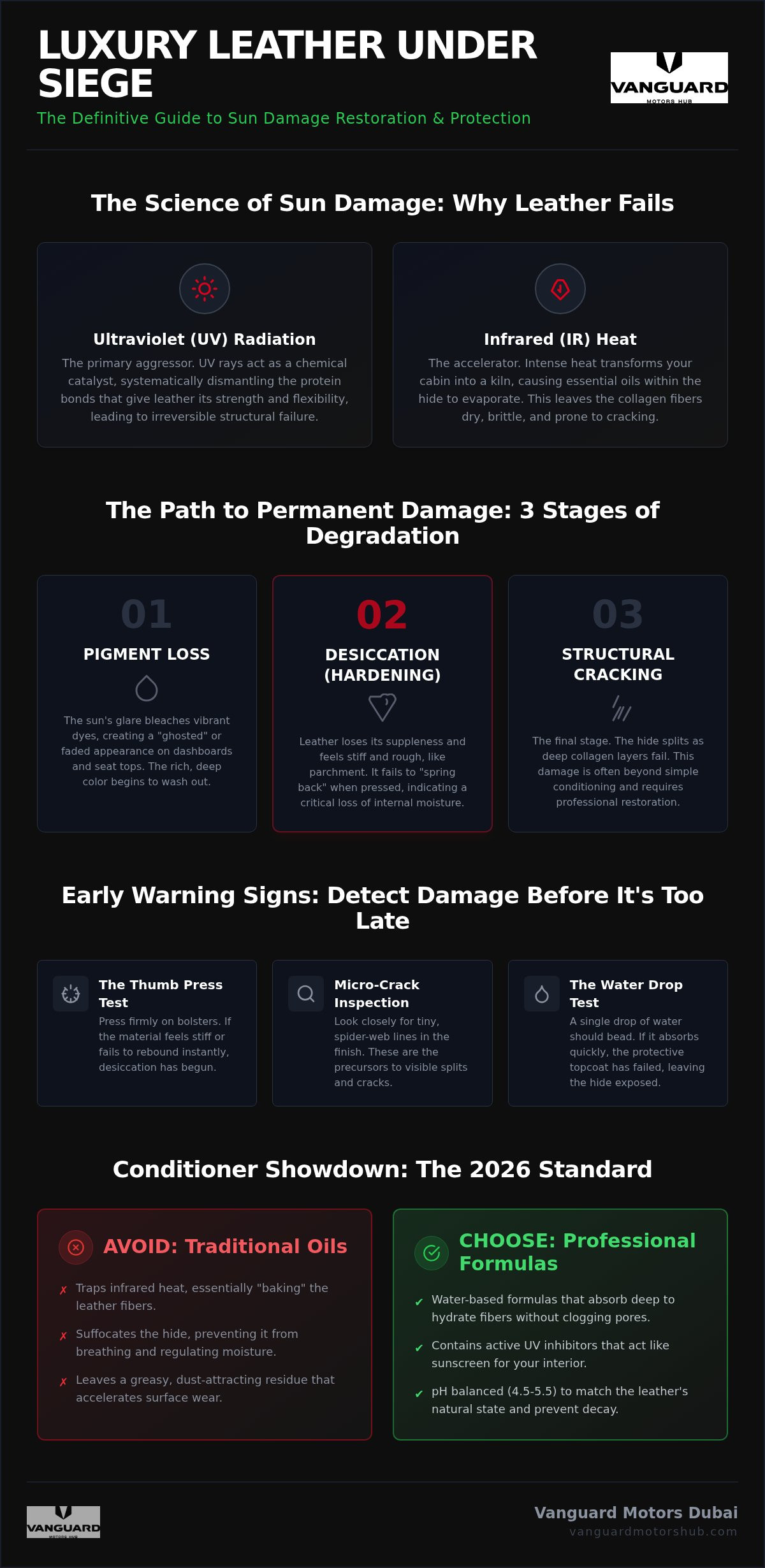
Understanding the molecular breakdown of your interior is the first step toward elite preservation. In 2026, The Science of Sun Damage reveals that ultraviolet (UV) radiation acts as a persistent chemical catalyst, systematically dismantling the protein bonds that give leather its strength. When these bonds fail, the material loses its structural integrity. This process is often accelerated by infrared (IR) heat, which transforms your car’s cabin into a high-temperature kiln. As internal temperatures soar, the essential oils within the hide evaporate, leaving the fibers brittle and prone to failure. For owners of elite vehicles, car leather restoration for sun damage isn’t just a cosmetic choice; it’s a technical necessity to prevent total material collapse.
Damage typically progresses through three distinct, aggressive stages. It begins with pigment loss, where the sun bleaches the rich dyes from your dashboard and seats. This leads to desiccation, a state of extreme hardening where the leather feels like parchment rather than premium hide. The final stage is structural cracking. Once the hide splits, the damage has reached the deep collagen layers, making simple conditioning impossible. Luxury materials like Nappa and Semi-Aniline are particularly vulnerable. Because these leathers feature fewer heavy protective coatings to maintain their soft, natural feel, they lack the “armor” found in standard automotive upholstery, making car leather restoration for sun damage a critical part of their maintenance cycle.
Signs Your Leather is Under Stress
Early detection is the difference between a simple refresh and a full restoration. Test your seat bolsters and headrests by pressing firmly with your thumb; if the material feels stiff or fails to “spring” back instantly, desiccation has begun. Look closely for micro-cracking, which appears as tiny, spider-web lines in the pigment before they become visible splits. You can also perform the water drop test. Place a single drop of water on a discreet area. If the leather absorbs it quickly, the protective topcoat has perished, leaving the porous hide dangerously exposed to the elements.
The Impact of Thermal Expansion
Leather is a biological material that reacts violently to the environment. In extreme climates, the fibers constantly expand and contract as temperatures swing between midday peaks and evening lows. This mechanical stress is most evident on the dashboard, which absorbs the highest concentration of direct radiation. This intense heat also triggers “outgassing,” a process where the bonding agents and plastics within the interior release chemical vapors. These vapors often settle on the windshield as a hazy film, signaling that your leather’s internal chemistry is being compromised by thermal stress and requires immediate intervention.
Choosing the Best Car Leather Conditioner for Hot Climates
Don’t treat your luxury interior like an old baseball glove. Traditional heavy oils are a dangerous relic of the past. In extreme heat, these oils migrate to the surface, trap infrared heat, and accelerate fiber breakdown. Professional car leather restoration for sun damage often starts by stripping away these greasy residues that have essentially baked into the pores. Modern 2026 standards demand water-based formulas. These prioritize breathability and molecular absorption, ensuring the leather doesn’t suffocate under a layer of synthetic wax or heavy petroleum distillates.
High-end interiors require a specific pH balance, typically between 4.5 and 5.5, to mirror the natural state of the hide. Anything else compromises the leather’s structural integrity over time. According to The Science of Sun Damage, the intensity of UVA and UVB radiation necessitates conditioners that function as a high-SPF barrier. Without these inhibitors, the sun’s energy continues to sever protein bonds regardless of how much hydration you provide. This is why car leather restoration for sun damage must include a product that offers active UV blocking rather than just a temporary shine.
Key Ingredients to Look For
Look for ingredients that reinforce the hide’s natural collagen structure. In 2026, elite products include specialized anti-static agents. These prevent fine dust and abrasive particulates from acting as sandpaper against your seats. By reducing the surface’s static charge, you minimize the micro-scratches that allow UV rays to penetrate deeper into the material. Non-greasy finishes are also essential; they prevent the “magnifying glass” effect where a shiny surface intensifies heat absorption.
Application Frequency for Maximum Protection
In national heat levels, a once-a-year approach is a recipe for disaster. Monthly application is the 2026 professional standard for high-performance vehicles. When dealing with perforated leather, apply the product to a microfiber cloth first rather than the seat. This prevents the liquid from pooling in the cooling vents, which can lead to mold or seam rot over time. Over-saturation is a common amateur mistake that softens the leather until it loses its factory-correct shape and firm support.
Consistent, light applications provide a superior defense against the elements without compromising the seat’s internal electronics. If you’re unsure which formula suits your specific Nappa or Semi-Aniline interior, consult with our detailing specialists to build a bespoke maintenance plan tailored to your vehicle’s needs.
Leather Restoration vs. Conditioning: When is it Too Late?
Conditioning is a preventative shield, but restoration is a surgical intervention. Many owners wait until the “Point of No Return” before seeking professional help. You’ve reached this stage when the leather no longer absorbs topical treatments or when the surface begins to flake like old paint. If the cracks have penetrated the hide’s structural core, a standard conditioner won’t provide the necessary molecular bridge to hold the fibers together. In these cases, car leather restoration for sun damage is the only viable path to reclaim the interior’s integrity without resorting to a full, non-factory re-upholstery.
In 2026, the technology behind material recovery has evolved significantly. We now utilize advanced liquid polymers that bond with the remaining collagen fibers to stabilize the material from the inside out. This isn’t a temporary mask; it’s a structural reinforcement. Unlike aftermarket seat covers that trap heat and moisture, professional restoration preserves the original ergonomics and factory-correct feel of your vehicle. It ensures that the specific tactile response of your luxury seats remains intact while providing a renewed defense against future UV exposure.
The Professional Restoration Process
Professional grade car leather restoration for sun damage is a multi-stage technical procedure. It begins with the deep extraction of embedded salts and body oils that have accumulated in the pores over years of use. Once the surface is chemically neutralized, we perform precision sanding to remove the degraded top layer without compromising the hide’s thickness. We then move to re-pigmentation. Using high-resolution color matching, we recreate the exact factory hue. The process concludes with the application of a specialized topcoat that restores the original matte or satin sheen, ensuring the repair is completely invisible to the eye.
Restoring Custom Interiors: Brabus and Mansory Standards
Bespoke interiors from elite tuners like Brabus or Mansory require an even higher level of technical mastery. These vehicles often feature unique leather grains and intricate stitching patterns that are impossible to replicate with generic repair kits. Maintaining the resale value of these high-end kit conversions depends on the quality of the interior’s condition. Expert-level restoration ensures that the custom aesthetics remain flawless. For those looking to integrate these interior fixes into a total vehicle refresh, our guide on Cosmetic Car Repair explores how to coordinate leather work with other high-end aesthetic enhancements.
Actionable Guidance: A Multi-Layered Protection Strategy
Reversing the clock is only half the battle. To ensure the results of your car leather restoration for sun damage endure, you must implement a rigorous, multi-layered defense. In 2026, we view interior preservation as a high-performance discipline that requires a structured maintenance cadence. Follow this five-step strategy to insulate your cabin against the environmental extremes of high-heat climates.
- Install High-Quality Window Tinting: Standard factory glass often fails to block long-wave UVA radiation. High-performance ceramic tints can block up to 99% of UV rays, serving as the primary shield for your dashboard and seat bolsters.
- Perform Regular Vacuuming: Atmospheric dust acts as a microscopic abrasive. Frequent vacuuming removes these particulates before they grind into the leather pores and erode the protective topcoat.
- Execute Quarterly Deep Cleaning: Use a dedicated pH-neutral leather soap every three months. This removes embedded body oils and salts that otherwise accelerate material degradation.
- Apply Monthly Conditioning: In extreme heat, the hide’s internal moisture is under constant attack. A monthly application of a heat-specific conditioner maintains the essential fiber flexibility required to prevent cracking.
- Schedule Annual Professional Inspections: A yearly audit at a specialized detailing center allows experts to identify and treat micro-cracking before it necessitates a full restoration.
The Role of Ceramic Coatings for Leather
Modern ceramic technology has redefined interior care in 2026. These coatings create a sophisticated hydrophobic barrier that repels spills, sweat, and environmental contaminants. It’s vital to understand that ceramic coatings do not replace conditioning. While conditioners nourish the hide, ceramic coatings act as a sacrificial armor. This is particularly effective for light-colored luxury interiors where dye transfer from clothing can permanently stain unprotected leather surfaces.
Interior Temperature Management
Controlling the cabin’s ambient temperature is a critical component of material longevity. Utilize custom-fit sunshades whenever the vehicle is stationary for extended periods to reflect IR heat away from the dashboard. If your vehicle is equipped with ventilated seats, use them frequently during drives. The active airflow helps dissipate the latent heat that would otherwise bake the leather fibers from the inside out. For owners who demand an uncompromising standard of care, our Supercar Detailing guide offers a deep dive into holistic preservation techniques.
Precision care is the only way to safeguard your investment against the relentless sun. If you’re ready to secure your vehicle’s future, connect with our specialist team to design a bespoke protection plan for your luxury interior.
Vanguard Motors: Professional Leather Restoration Excellence
Vanguard Motors Dubai stands as the definitive authority in high-end interior preservation. We don’t just treat surfaces; we engineer long-term resilience. Our technical team approaches car leather restoration for sun damage with the same meticulous precision required for high-performance mechanical tuning. By utilizing professional-grade materials specifically formulated to withstand 2026’s extreme national temperatures, we ensure every restoration meets the exacting standards of the world’s most discerning collectors. Elite owners trust Vanguard Motors Dubai because we prioritize the structural health of the hide as much as its visual perfection.
Our expertise shines in the treatment of bespoke supercar interiors. We understand the complex interplay between different premium materials, often providing specialized solutions that integrate leather restoration with carbon fiber installation and repair. Whether you’re maintaining a factory-original finish or a custom Brabus or Mansory conversion, our technicians possess the specialized knowledge to handle these high-value materials. We provide this elite level of service through both our state-of-the-art facility and our Mobile Detailing Van, ensuring precision cosmetic repair is accessible wherever your vehicle is located.
Beyond Leather: A Comprehensive Aesthetic Suite
Achieving a flawless automotive presence requires a multi-faceted approach. We recommend pairing your interior restoration with Paint Protection Film (PPF) to create a total UV-resistant shield for your vehicle. For owners looking to push their vehicle’s visual impact further, Vanguard Motors Dubai offers professional installation of custom Car Body Kits and performance-tuned exhaust modifications. This holistic focus ensures your car’s performance and sound are always in perfect harmony with its pristine aesthetic, providing a complete transformation that goes far beyond simple maintenance.
Schedule Your Consultation
Every luxury interior has a unique environmental history. To provide the best possible outcome, our specialists at Vanguard Motors Dubai conduct a rigorous assessment of your cabin’s current condition, testing for hydration levels and structural fiber health. This data-driven approach allows us to recommend the most effective restoration or protection path for your specific vehicle. Our process is transparent, efficient, and designed to minimize downtime while maximizing the longevity of your investment. Trust the innovators who understand the intersection of technical skill and creative expression. Experience the Vanguard standard for your vehicle today and secure your interior’s legacy for years to come.
Secure the Legacy of Your Luxury Interior
Protecting a high-performance interior in 2026 requires a shift from reactive cleaning to proactive material engineering. We’ve explored how ultraviolet radiation and infrared heat systematically dismantle the protein bonds of your luxury hide. By prioritizing pH-balanced hydration and molecular UV blocking, you can halt the progression of desiccation before it leads to irreversible structural failure. Your dashboard and seats are more than just upholstery; they’re the tactile heart of your driving experience. Maintaining that environment isn’t just about aesthetics; it’s about preserving the original engineering of the cabin.
When the surface reaches its limit, professional car leather restoration for sun damage becomes the essential intervention to reclaim that factory-soft feel and deep pigment. Vanguard Motors Dubai serves as your premier technical partner in this process. As specialists in supercar detailing with an expert cosmetic repair facility, we provide the precision care your vehicle deserves. Whether you visit our center or utilize our national mobile detailing services, we ensure your cabin remains a sanctuary of elite quality. Take the definitive step toward preserving your vehicle’s aesthetic and functional value today.
Restore your luxury interior with Vanguard Motors Dubai
Frequently Asked Questions
Can cracked leather car seats be truly restored?
Cracked seats can be restored provided the underlying hide remains structurally sound. Professional car leather restoration for sun damage involves using liquid leather polymers to bridge micro-fractures before applying a color-matched pigment. This process stabilizes the material and prevents further splitting. However, if the leather has already separated into deep, jagged holes that expose the foam beneath, the material has passed the point of recovery and may require a partial replacement.
How often should I condition my leather in a hot climate?
You should apply a high-heat specific conditioner at least once a month in extreme climates. In 2026, the standard for luxury vehicle maintenance has shifted toward frequent, light applications rather than heavy quarterly treatments. This consistent cadence ensures that the natural oils lost to infrared heat are replaced before the collagen fibers become brittle. Regular maintenance is the most effective way to avoid the high costs associated with intensive restorative procedures later.
Will a leather conditioner fix faded color?
Leather conditioner cannot restore color that has been bleached by UV radiation. Conditioners are designed to hydrate and protect the internal fibers, but they don’t contain the pigments necessary to reverse sun-induced ghosting. To reclaim a deep, rich hue, you must undergo a professional re-pigmentation process. This involves deep cleaning the surface, neutralizing old oils, and applying a factory-accurate dye that bonds with the leather grain to provide a permanent color correction.
Is steam cleaning safe for sun-damaged leather?
Steam cleaning is generally unsafe for leather that has already suffered significant sun damage. The combination of high-pressure moisture and intense heat can cause brittle, desiccated fibers to swell and then shrink rapidly, leading to immediate cracking or “alligatoring” of the surface. For sun-damaged interiors, we recommend using pH-neutral chemical cleaners and soft-bristled brushes. This controlled approach removes contaminants without subjecting the fragile material to the thermal shock associated with industrial steam equipment.
What is the best way to prevent the dashboard from cracking?
The most effective prevention strategy involves a combination of high-performance window tinting and frequent UV-blocking treatments. Dashboards receive the highest concentration of direct radiation, making them the most vulnerable interior component. Ensure your windshield is treated with a ceramic tint that blocks 99% of UVA and UVB rays. Additionally, apply a non-greasy, water-based conditioner monthly to maintain fiber elasticity and prevent the structural hardening that leads to eventual splitting.
Is professional leather restoration better than replacing the seat?
Professional restoration is almost always superior to replacement because it preserves the original factory fit, finish, and ergonomics. Replacing a single seat often results in a mismatched interior, as aftermarket hides or even new OEM parts rarely match the aged patina of the rest of the cabin. Restoration maintains the vehicle’s resale value and ensures the seat’s internal electronics, such as heating and ventilation sensors, remain undisturbed and fully functional within their original housing.
Does ceramic coating protect leather from sun damage?
Ceramic coatings provide an excellent hydrophobic barrier against spills and friction, but they don’t replace the need for car leather restoration for sun damage inhibitors. While a ceramic layer offers some protection against surface abrasion, it doesn’t nourish the internal collagen fibers. In 2026, the most effective protection plan involves applying a UV-stabilizing conditioner first, followed by a ceramic topcoat to seal in the moisture and provide a sacrificial shield against environmental contaminants.
How do I know if my car has real leather or synthetic vinyl?
You can identify real leather by its irregular grain pattern and its reaction to pressure. When you press your thumb into genuine leather, it creates fine line wrinkles around the point of contact, similar to human skin. Synthetic vinyl typically remains smooth or creates large, stiff folds. Additionally, real leather has a distinct, earthy aroma and will absorb a small drop of water over time, whereas synthetic materials are non-porous and cause liquid to bead indefinitely.