
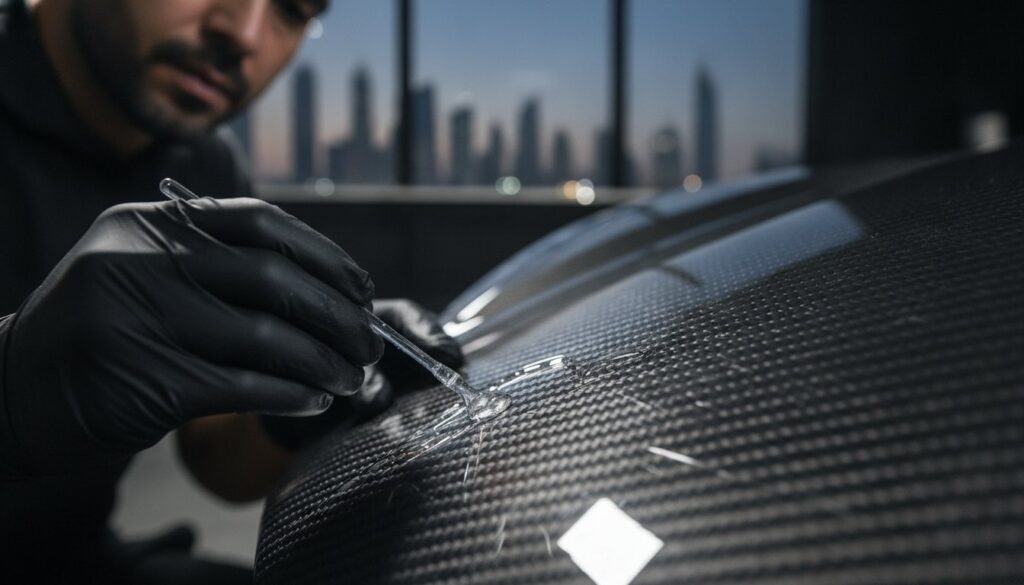
Imagine your Brabus G-Wagon or Mansory-tuned Ferrari catching a stray stone on a drive. That sharp “clack” against the front splitter doesn’t just chip the resin; it feels like a puncture in the car’s soul and its resale value. You know that even a minor blemish on a high-end weave is impossible to ignore. Whether it’s the intense UV exposure in the UAE causing premature cloudiness or a deep scratch disrupting the symmetry of the carbon, the anxiety of a botched carbon fiber cosmetic repair often feels worse than the damage itself.
This guide provides the definitive blueprint for professional restoration, ensuring your components return to their factory-fresh, mirror-like finish. We’ll explore how to assess surface depth, the surgical precision required to align the weave, and the specialized resins needed to preserve the integrity of your investment. From identifying clear coat failure to executing an invisible restoration, you’ll learn how to maintain the elite aesthetic and mechanical excellence your vehicle demands. It’s time to move beyond temporary fixes and embrace the meticulous care your supercar deserves.
Key Takeaways
- Distinguish between surface-level resin chips and critical structural failures to determine if your components are safe for a professional carbon fiber cosmetic repair.
- Evaluate the financial advantages of restoring elite 3k or forged carbon weaves versus the significant expense of importing new OEM parts to the UAE.
- Understand the specialized sanding and resin infusion techniques required to achieve an invisible finish that maintains the symmetry of the original weave.
- Discover how high-solids clear coats and UV-resistant treatments prevent common oxidation and yellowing caused by the intense Middle Eastern sun.
- Learn how meticulous restoration preserves the integrity and market value of premium aerodynamic kits from brands like Brabus and Mansory.
Defining Carbon Fiber Cosmetic Damage vs. Structural Failure
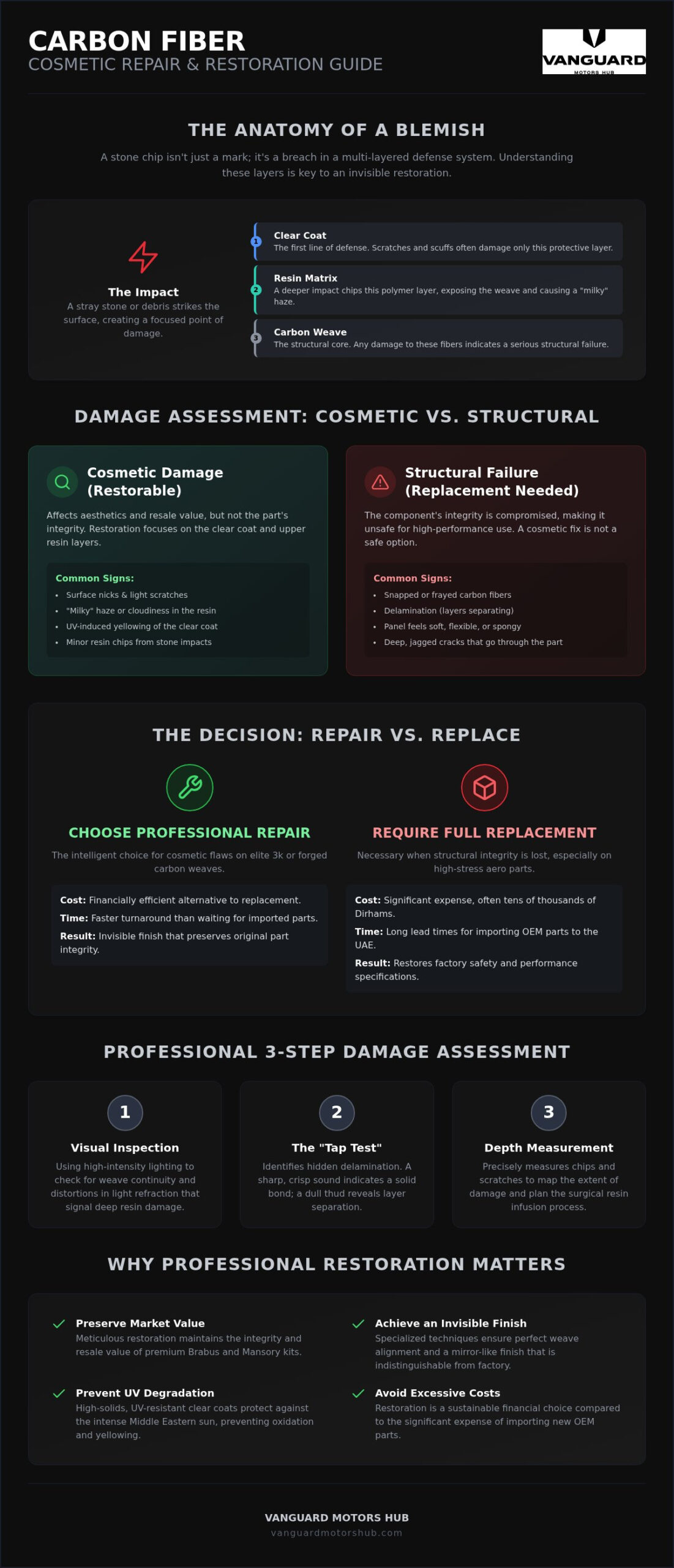
Carbon fiber is a masterpiece of composite engineering. It isn’t a single material but a sophisticated sandwich of structural carbon weave, a polymer resin matrix, and a protective clear coat. For owners of elite machinery in Dubai or Abu Dhabi, maintaining this finish is vital. A stone chip on a Mansory hood isn’t just a mark; it’s a breach in a multi-layered defense system. Professional carbon fiber cosmetic repair focuses on the clear coat and the upper resin layers to restore that deep, three-dimensional look. Understanding the anatomy of your components is the first step in applying advanced composite_repair_techniques to ensure the restoration is truly invisible.
Cosmetic issues differ significantly from structural failures. While a cosmetic flaw affects the aesthetics and resale value, structural damage involves snapped fibers or delamination between layers. If you spot a “milky” haze or a surface nick, you’re likely dealing with a cosmetic concern. However, if the panel feels soft or shows jagged, exposed fibers, the integrity is compromised. For high-performance vehicles, ignoring these minor blemishes can lead to moisture ingress, which eventually weakens the bond between the resin and the weave.
Surface Scratches and Clear Coat Scuffs
Surface marring is the most common headache for supercar owners. You can often identify the severity with the “fingernail test” by gently running your nail across the scratch. If your nail glides over it, the damage is likely limited to the clear coat. If it catches, the scratch has likely penetrated the resin. These nicks disrupt how light hits the weave, killing the visual depth that makes carbon fiber so attractive. High-quality carbon fiber cosmetic repair protocols can level these imperfections, bringing back the mirror finish without the need for a total part replacement.
UV Degradation and the ‘Yellowing’ Effect
The UAE’s intense sun is the primary enemy of epoxy resins. Standard resins can’t always handle the extreme UV indices and high ambient temperatures found in the Middle East. Over time, this radiation triggers a reaction that turns the once-clear resin into a cloudy, yellowed mess. UV yellowing is a chemical breakdown of the top resin layer caused by prolonged exposure to high-energy radiation. This oxidation doesn’t just look aged; it makes the resin brittle. Addressing this early through Vanguard’s specialized restoration services prevents the cloudiness from reaching the deeper structural layers of your aero kit.
Assessing the Damage: When to Repair vs. Replace
Deciding between a full component replacement and a meticulous carbon fiber cosmetic repair is a high-stakes calculation for any luxury car owner. In the UAE, the cost of importing a new OEM carbon fiber bumper or a Brabus hood can reach tens of thousands of Dirhams, often involving long lead times. If the damage is limited to the resin or clear coat, professional restoration is the more efficient and sustainable path. The feasibility of these repairs often depends on weave complexity. A standard 3k twill weave requires surgical precision to align the pattern, whereas forged carbon is more forgiving due to its marbled, non-linear structure. If you’re dealing with a front splitter, which takes the brunt of road debris, consulting a specialist for an expert assessment can save you from unnecessary replacement costs.
Location also dictates the repair strategy. Interior trim pieces and mirror caps are ideal candidates for cosmetic fixes because they aren’t load-bearing. Conversely, if a structural roof panel or a wing shows signs of delamination, a simple surface fix is no longer safe. When the layers of carbon have physically separated, the part’s integrity is lost, and a replacement becomes a necessity for high-speed stability.
The 3-Step Damage Assessment Framework
A systematic approach prevents costly mistakes. First, we perform a visual inspection under high-intensity lighting to check weave continuity. Any distortion in light refraction suggests the resin has been compromised deeper than the clear coat. Second, the “tap test” identifies hidden delamination. A sharp, crisp sound indicates a solid bond, while a dull thud reveals air pockets or layer separation. Finally, we measure the depth of chips. According to advanced carbon fiber repair research, restoring the aesthetic and mechanical properties is most effective when the damage hasn’t severed the primary load-bearing fibers. This data-driven approach ensures the repair is both beautiful and durable.
Resale Value Considerations for Luxury Vehicles
In the supercar market, provenance and condition are the primary drivers of value. A visible, poorly executed patch on a Mansory kit can devalue a vehicle by significant margins. Professional carbon fiber cosmetic repair must meet an “invisible” standard, where the transition between the original weave and the repaired section is undetectable even to a trained eye. Documenting these high-end restorations through a reputable center like Vanguard preserves the vehicle’s history and justifies a premium price tag. Choosing to repair an OEM part is often better than installing a cheap aftermarket replacement, as low-quality carbon usually lacks the correct weave density or UV resistance, which savvy buyers in Dubai will spot immediately.
The Professional Process for Invisible Carbon Fiber Restoration
Executing a flawless carbon fiber cosmetic repair is a surgical procedure that demands extreme patience and specialized equipment. It begins with precision sanding. Unlike traditional bodywork, we don’t just sand to a flat surface; we must carefully remove the compromised resin or clear coat without snagging the delicate carbon filaments. Fraying even a single fiber can ruin the symmetry of a 2×2 twill weave. We utilize high-grit abrasives, often starting at 800 and working up to 3000, to level the damage while preserving the structural “skeleton” of the part. This stage is critical for ensuring the new resin bonds perfectly with the original matrix.
Matching the Weave: Symmetry and Continuity
Aligning replacement patches requires an artisan’s eye for geometry. Whether your vehicle features a classic 2×2 twill or a tight plain weave, the replacement fabric must be clocked to the exact degree of the original pattern. We manage the “overlap” by feathering the edges of the repair site, ensuring no hard seams are visible once the clear coat is applied. Forged carbon presents a different challenge. Since it lacks a repeating pattern, we must hand-place carbon flakes to mimic the marbled texture of the original component. This level of detail is what separates a standard patch job from a Vanguard-level restoration.
Resale Selection for Maximum Clarity
The choice of resin determines the final visual depth of the repair. We avoid standard body shop fillers, opting instead for aerospace-grade epoxy resins that offer superior clarity and strength. The resin refractive index must match the original to avoid ‘ghosting’ at the repair site. This ensures that light passes through the repair and hits the carbon weave at the same angle as the surrounding area, creating that iconic “wet look” that defines premium carbon fiber. Using the wrong resin can result in a visible “halo” effect that instantly devalues the component.
To achieve a void-free finish, we employ vacuum bagging and controlled curing protocols. Vacuum bagging evacuates microscopic air bubbles that would otherwise cloud the resin. In the high-humidity environment of the UAE, temperature control is vital. We cure the components in a climate-controlled environment to prevent the resin from “blushing” or becoming brittle. This disciplined approach ensures the repair isn’t just a temporary fix but a permanent restoration that stands up to the intense Middle Eastern sun.
Advanced Finishing: Clear Coating and UV Protection
The transition from structural restoration to aesthetic perfection occurs in the finishing booth. For a truly invisible carbon fiber cosmetic repair, the final finish must replicate the original manufacturer’s depth and clarity exactly. We utilize a multi-stage wet sanding process, progressing through ultra-fine grits to achieve a mirror-flat surface. This eliminates any microscopic ridges or “witness marks” that might betray the repair site under harsh sunlight. By leveling the surface to a precision standard, we ensure that the subsequent clear coat bonds with absolute uniformity.
In the UAE, the environment is particularly hostile to composite resins. We apply high-solids, UV-resistant clear coats that act as a sophisticated shield against solar radiation. These coatings are specifically engineered to resist the yellowing and cloudiness that plague standard automotive finishes in high-heat climates. Once the clear coat is perfectly leveled and cured, integrating Paint Protection Film (PPF) over the repaired area provides the ultimate defense against the abrasive sands and stone chips common on regional highways.
Achieving OEM-Level Depth and Gloss
Creating that iconic “wet look” requires a meticulous build-up process. We apply multiple thin layers of clear coat rather than a single thick application. This technique prevents “orange peel” textures and ensures the finish remains crystal clear on complex aerodynamic curves. Whether we are matching the high-gloss shine of a Ferrari splitter or the understated satin finish of a Brabus kit, we maintain edge-to-edge consistency across the entire panel. This attention to detail ensures that a repaired hood looks identical to a factory-fresh component.
Long-Term Protection in High-Heat Environments
Extreme thermal cycles in the Middle East can cause inferior finishes to crack or delaminate. We select clear coats with thermal expansion properties that mirror the carbon fiber substrate, ensuring the finish moves with the material as temperatures shift. To further enhance durability, we recommend a professional ceramic coating over the fresh repair. This adds a hydrophobic layer that sheds contaminants and makes routine maintenance effortless. To keep your vehicle in concours condition, book your carbon restoration assessment today and protect your investment from the elements.
Vanguard’s Mastery in Bespoke Carbon Fiber Restoration
At Vanguard, we view carbon fiber cosmetic repair as a form of automotive plastic surgery. It requires a deep understanding of weave orientation and resin chemistry. Our facility isn’t just a repair shop; it’s a center of excellence where we treat every component as a unique piece of engineering. From the subtle textures of an interior dashboard inlay to the aggressive lines of a rear diffuser, we ensure every restoration meets the exacting standards of the world’s most discerning collectors. We don’t just fix parts; we restore the soul of the vehicle. Maintaining your supercar’s exterior to this standard pairs naturally with a commitment to total vehicle preservation, which is why many of our clients also invest in luxury car interior deep cleaning to protect the bespoke Nappa leather and Alcantara surfaces that complement their carbon fiber trim.
Restoring Elite Body Kit Components
High-end aerodynamic packages from Brabus and Mansory feature some of the most complex geometries in the industry. These parts often use specialized weave patterns or forged carbon textures that standard body shops cannot replicate. We specialize in matching these factory specifications perfectly. If your project requires a unique touch, we also offer custom finish options, including tinted carbon resins that add a subtle hue to the weave while maintaining total transparency. Our goal is to make the repair indistinguishable from the original aftermarket addition.
Our expertise extends beyond external panels. We handle carbon fiber restoration for a wide variety of components:
- Intricate interior trim and steering wheel inserts — clients seeking a complete cabin transformation often pair these repairs with a bespoke luxury interior wrap to unify the aesthetic across every surface they touch
- High-gloss mirror caps and side vents
- Large-scale structural components like hoods and roofs
- Precision-engineered splitters and rear wings
Your Consultation for Perfection
Precision begins with the first look. For our clients across the UAE, we offer a streamlined remote assessment process to evaluate the feasibility of a repair. When contacting us, providing high-resolution photos from multiple angles under direct lighting helps our specialists identify clear coat depth and weave continuity. This data allows us to provide a preliminary roadmap for your vehicle’s restoration before it even enters our service center. We look for light distortion and texture changes to determine the exact level of intervention required.
We provide a concierge-level experience that respects your time and your vehicle’s value. Whether you’re maintaining a daily driver or preparing a supercar for a show, our team ensures the process is seamless and the results are flawless. Message our specialists on WhatsApp to start your carbon restoration and experience the Vanguard standard of excellence.
Secure the Future of Your High-Performance Aesthetic
Carbon fiber represents a visual statement of prestige. Maintaining its clarity requires a surgical approach that goes beyond simple polishing. By prioritizing weave alignment and utilizing advanced UV-resistant resin technology, you can reverse the effects of road debris and solar oxidation. A professional carbon fiber cosmetic repair ensures your investment retains its structural integrity and elite market value in the competitive UAE landscape. Precision is the difference between a visible patch and an invisible restoration.
Our concierge-level supercar detailing and restoration services return your vehicle to its peak aesthetic condition. We specialize in Brabus and Mansory kit maintenance, employing specific techniques to handle complex geometries and high-heat environments. We don’t just repair; we restore the factory-fresh finish that defines luxury performance. Book your Carbon Fiber Assessment via WhatsApp today to begin your vehicle’s transformation. Excellence isn’t just about the drive; it’s about the perfection you maintain along the way.
Frequently Asked Questions
Can you repair a deep scratch in carbon fiber without it being visible?
Yes, deep scratches can be made invisible through meticulous resin infusion and multi-stage sanding. The key is ensuring the repair resin matches the refractive index of the original matrix to prevent light distortion. This process levels the surface while preserving the visual depth of the weave. For high-value components, this surgical approach prevents the “halo” effect often seen in amateur work.
How much does professional carbon fiber cosmetic repair typically cost?
Professional costs vary based on the damage severity and the specific component’s weave complexity. Factors like the size of the part, the depth of the resin penetration, and the type of finish required influence the final investment. Because elite kits from Brabus or Mansory involve intricate geometries, the labor-intensive nature of achieving a seamless finish is the primary cost driver. Each assessment is unique to the vehicle’s condition.
Is it better to repair or replace a carbon fiber splitter after a stone chip?
Repairing a high-end splitter is typically the superior choice over replacement. Importing OEM carbon components to the UAE often involves high shipping fees and long wait times. A professional carbon fiber cosmetic repair restores the aesthetic at a fraction of the replacement cost while maintaining the vehicle’s original parts. This approach is especially effective for stone chips that haven’t compromised the underlying fiber structure. It preserves both your time and your budget.
How long does the carbon fiber restoration process take?
The timeline for a full restoration usually spans three to five days. This duration allows for precision sanding, resin application, and the critical curing phase required for chemical stability. In the UAE’s humid climate, we use controlled environments to ensure the resin reaches maximum hardness before the final polishing stages. Rushing this process can lead to “blushing” or micro-bubbles that ruin the visual clarity. Patience is required for a mirror-like result.
Will repaired carbon fiber yellow again in the sun?
Modern restoration techniques utilize high-solids clear coats specifically engineered for the intense UAE sun. These advanced coatings contain UV inhibitors that prevent the chemical breakdown responsible for yellowing or “milking.” When combined with a professional ceramic coating, the repaired area remains crystal clear even under extreme Middle Eastern heat. Proper maintenance and high-grade materials ensure the restoration stands the test of time. Your carbon will stay as vibrant as the day it was installed.
Can forged carbon fiber be cosmetically repaired as easily as woven carbon?
Forged carbon repair requires a different skill set than traditional woven patterns. While it doesn’t have a repeating weave to align, the technician must hand-place carbon flakes to replicate the unique marbled aesthetic. This makes hiding the repair site easier in some ways, but achieving the correct texture and depth requires an artisan’s touch to ensure the new section blends perfectly with the existing forged pattern. It is an exercise in creative reconstruction.
Does carbon fiber repair affect the structural integrity of the part?
Cosmetic carbon fiber repair focuses on the surface finish and does not negatively impact structural integrity when performed by experts. We target the clear coat and resin matrix layers rather than the load-bearing fibers. If our initial assessment reveals fiber breakage or delamination, we will advise on structural reinforcement or replacement to ensure the component remains safe for high-speed performance. Safety is never sacrificed for aesthetics in our service center.
Can I use a DIY carbon fiber repair kit for my luxury vehicle?
Using a DIY kit on a luxury vehicle is a significant risk that often leads to permanent aesthetic damage. Most consumer-grade kits lack the aerospace-grade resins and UV-resistant clear coats necessary for a professional finish. Mistakes like weave fraying or resin cloudiness can devalue your vehicle and make subsequent professional repairs more complex. For elite machinery, the precision of a specialized center is essential for an invisible result. Don’t gamble with your car’s resale value.