
The most expensive ceramic coating in the world won’t stop a single high-speed pebble from scarring your hood on the E11. While many owners mistake aesthetic shine for structural defense, true preservation requires a strategic approach to surface engineering. You likely already know that maintaining a showroom finish in the UAE’s extreme heat and blowing sand is a relentless battle. It’s common to find yourself debating paint protection film vs vinyl wrap when considering aesthetic changes, but for those focused on pure preservation, the choice between liquid nanotech and physical armor is where the real value lies.
We’ll show you how to choose the ultimate defense for your vehicle’s finish by breaking down the technical realities of these elite technologies. You’ll discover the critical differences between the hydrophobic brilliance of liquid nanotech and the self-healing resilience of physical armor. This definitive 2026 comparison explores how to achieve a mirror-like finish while securing the long-term resale value of your asset. We’re diving into the performance metrics of each solution to ensure your vehicle remains pristine under the intense Gulf sun.
Key Takeaways
- Understand why the UAE’s intense UV levels and extreme heat require advanced molecular defense to prevent oxidation and paint degradation.
- Learn how nanoscopic liquid polymers create semi-permanent chemical bonds to repel water and grime with superior hydrophobicity.
- Discover why choosing paint protection film vs vinyl wrap is the essential decision for high-impact defense against rock chips and road debris.
- Compare the long-term ROI of surface protection, contrasting the five-year brilliance of coatings with the decade-long resilience of premium films.
- Explore the Vanguard strategy of layering ceramic coating over PPF to achieve the ultimate combination of self-healing armor and mirror-like gloss.
The Science of Shielding: Understanding Modern Paint Degradation
Modern automotive engineering has reached incredible heights, yet factory clear coats are thinner and more vulnerable than ever. Manufacturers have shifted toward water-based paints to meet global environmental standards, resulting in finishes that lack the structural density of older solvent-based systems. For a high-performance vehicle in the UAE, this means your factory finish is essentially a delicate skin exposed to a hostile environment. Your paint is under attack from the moment it leaves the showroom.
When owners weigh the benefits of paint protection film vs vinyl wrap, they often overlook the fundamental science of paint failure. While a wrap offers aesthetic transformation, it doesn’t provide the same impact-absorbing depth required to combat the relentless abrasion of airborne sand. Across the UAE, the UV index frequently hits extreme levels, leading to rapid molecular breakdown. Paint oxidation is the chemical reaction between UV rays and oxygen. This process doesn’t just dull the shine; it makes the clear coat porous and brittle. Simultaneously, airborne dust acts like a micro-abrasive, scouring the surface every time you drive across the country.
Environmental Stressors in High-Heat Climates
The UAE climate presents a unique set of challenges that most global guides ignore. Surface temperatures on a dark-colored supercar can exceed 80°C during mid-day exposure, followed by a rapid cooling cycle. This constant thermal expansion and contraction stresses the paint’s elasticity, leading to micro-fissures over time. Chemical contaminants, such as bird droppings or industrial fallout, become hyper-reactive in high heat, etching into the clear coat in a matter of hours. Without a dedicated barrier, these acids create permanent scars that no amount of polishing can fully erase.
The Financial Case for Professional Protection
Maintaining a vehicle’s aesthetic integrity is a calculated financial strategy. In the secondary market for elite vehicles, original factory paint is a premium asset that buyers demand. A single round of aggressive paint correction can remove a significant percentage of your clear coat, leaving the vehicle even more vulnerable to the elements. Investing in preventative measures like those offered in the Vanguard Premium Package ensures you’re preserving thousands of dirhams in future resale value. For luxury vehicles, doing nothing is no longer a viable option in 2026. The cost of a full respray or deep correction far outweighs the initial investment in high-tier shielding.
Ceramic Coating: The Nanotechnology of Liquid Brilliance
Ceramic coating represents the pinnacle of liquid surface science. Unlike traditional products that sit on top of the paint, this nanoscopic liquid polymer creates a semi-permanent chemical bond with your factory clear coat. Once cured, it forms an additional sacrificial layer that’s both invisible and incredibly resilient. This isn’t just a surface treatment; it’s a molecular transformation that changes how your vehicle interacts with the harsh Dubai environment.
The primary magic of this technology lies in its extreme hydrophobicity. By creating an ultra-smooth surface, the coating increases surface tension to the point where water, mud, and liquid contaminants cannot cling to the vehicle. In a city where light rain often turns airborne dust into a muddy film, a ceramic-coated car stays cleaner for significantly longer. It also provides a robust chemical defense against high-acidity threats like bird droppings and industrial fallout, which can etch into unprotected paint within hours under the intense Gulf sun.
The aesthetic result is a level of depth and clarity that traditional waxes simply cannot achieve. It produces a permanent “wet-look” gloss that accentuates the body lines of a supercar, making the colors appear more vibrant and saturated. While many enthusiasts spend hours researching paint protection film vs vinyl wrap to change their car’s aesthetic, they often discover that a professional ceramic coating is the essential baseline for maintaining that “just-detailed” brilliance every day.
Nano-Bonding vs. Traditional Wax
The difference between a 2026-grade ceramic coating and a traditional carnauba wax is fundamental. Wax acts as a temporary, sacrificial layer that melts away under high temperatures. In contrast, a ceramic coating integrates with the paint at a molecular level. This structural bond ensures the protection lasts for years, not weeks. Owners typically report that wash times are reduced by up to 50% because dirt and grime slide off with minimal agitation, preserving the finish from wash-induced swirl marks.
Limitations of Liquid Protection
It’s vital to separate marketing hype from technical reality, specifically regarding the “9H Hardness” myth. While a coating provides excellent resistance against light swirl marks and chemical etching, it doesn’t function as physical armor. It cannot stop a high-velocity rock chip or a parking lot door ding. Ceramic coating is an aesthetic and maintenance enhancer, designed to keep your car looking flawless rather than protecting it from heavy impacts. You can consult the experts at Vanguard Motors Dubai for professional detailing insights to determine if a liquid barrier meets your specific driving needs.
Paint Protection Film (PPF): The Ultimate Physical Armor
While ceramic coatings provide a chemical shield, Paint Protection Film (PPF) serves as the vehicle’s structural armor. It’s a high-impact polyurethane film engineered to withstand the brutal reality of Dubai’s highways. Unlike the thin profile often discussed when comparing paint protection film vs vinyl wrap, premium PPF is significantly thicker and more resilient. This thickness allows the film to act as a shock absorber. When a rock or piece of gravel strikes the surface, the film dissipates the kinetic energy across its molecular structure. This prevents the force from piercing the clear coat and causing permanent damage.
This physical resilience is paired with advanced UV rejection. In the Emirates, the sun’s radiation is a constant threat to paint clarity. High-tier films are designed with UV inhibitors that prevent the clear coat from yellowing or fading, ensuring the factory color remains as vivid as the day it was applied. It’s a comprehensive barrier that handles both mechanical impacts and environmental radiation, providing peace of mind during high-speed transit or desert drives.
Self-Healing Innovation and Scratch Resistance
Modern PPF utilizes a specialized top coat made of elastomeric polymers. Heat triggers the self-healing process by allowing these polymers to return to their original, undisturbed state, effectively erasing surface swirls and light scratches. Whether the marks are from improper washing or sand-scouring, a few minutes under the afternoon sun restores the film to a mirror-like finish. This technology represents the Standard for Excellence in 2026, providing a level of durability that was previously impossible. Your vehicle survives gravel, road debris, and minor abrasions without leaving a trace on the factory paint.
Aesthetic Versatility: Gloss, Matte, and Colored PPF
Protection doesn’t have to be invisible. While clear gloss film remains the traditional choice for preserving factory aesthetics, matte PPF allows owners to transform their vehicle’s appearance without a permanent respray. It provides a sophisticated, satin finish while maintaining full impact resistance. We’ve also seen a massive rise in Colored PPF. This innovation bridges the gap in the paint protection film vs vinyl wrap debate, offering the bespoke color changes of a wrap with the heavy-duty protection of polyurethane. At Vanguard, we focus on technical precision, employing seamless, edge-wrapped installations that make the film virtually undetectable even on the most complex supercar contours.
Comparison Framework: Durability, Aesthetics, and ROI
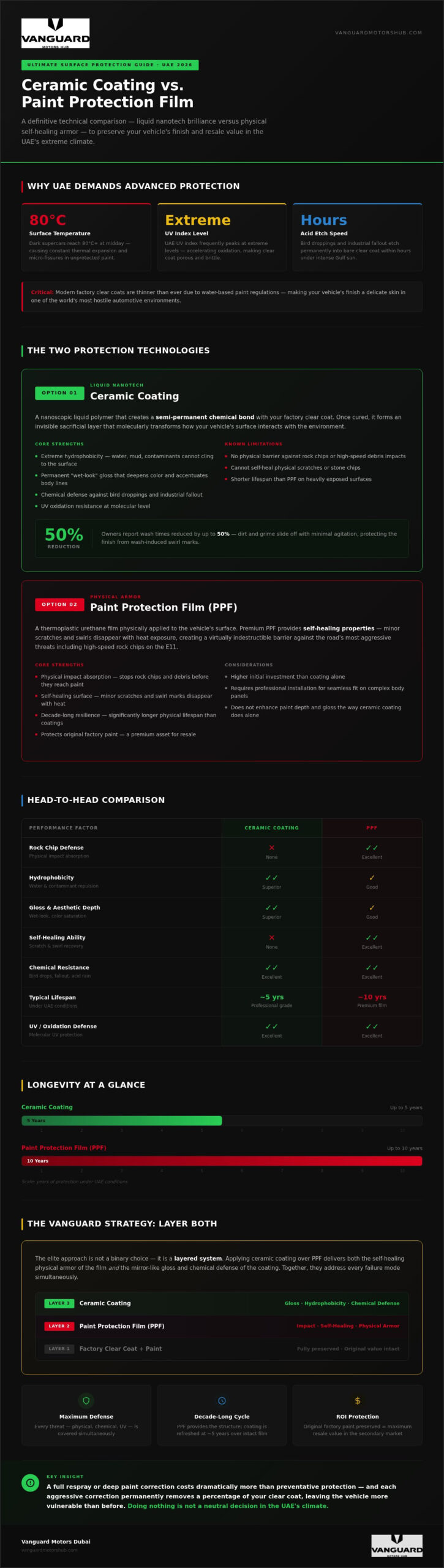
Deciding on the right protection isn’t about finding a single “best” product. It’s about aligning specific technologies with your driving habits and long-term goals. If your daily commute involves the high-speed stretches of the E11 or frequent desert transit, the physical armor of PPF is a non-negotiable requirement. For those primarily navigating city centers like Downtown Dubai, a high-grade ceramic coating might suffice for chemical and UV defense. While many owners initially research paint protection film vs vinyl wrap for aesthetic reasons, the ROI discussion must center on preservation.
Direct Comparison Table
| Metric | Ceramic Coating | Paint Protection Film (PPF) |
|---|---|---|
| Primary Protection | Chemical & UV Rays | Heavy Impact & Abrasion |
| Gloss Level | Extreme ‘Wet-Look’ | High Gloss or Satin/Matte |
| Longevity | 2 – 5 Years | 7 – 12 Years |
| Self-Healing | No | Yes (Heat-activated) |
| Relative Price | Lower Initial Cost | Higher Initial Investment |
The “best” choice depends heavily on your environment and budget. High-quality films are distinguished by their optical clarity and the strength of their adhesive bonds. Budget alternatives often yellow or peel within two years under the intense UAE sun, whereas premium films maintain their integrity for a decade. If you’re unsure which level of defense your vehicle requires, you can request a bespoke protection consultation with our technical team.
The Objection: Is PPF Worth the Investment?
Respray costs for a Ferrari or Lamborghini in Dubai are astronomical. Beyond the immediate expense, a resprayed panel significantly devalues a supercar in the eyes of serious collectors. Original factory paint is a finite resource. While ceramic coating is an excellent entry-level essential for every luxury car, it lacks the physical thickness to prevent rock chips from penetrating the clear coat. When you analyze the true cost of paint correction and the eventual loss in resale value, the upfront investment in full-body PPF becomes a strategic financial move. It’s the difference between merely maintaining a car and actively protecting an asset.
The Vanguard Strategy: Layering and Bespoke Protection
The ultimate realization of vehicle preservation isn’t found in a single product; it’s achieved through a strategic layering of elite technologies. While many owners spend time debating paint protection film vs vinyl wrap, the professional standard involves applying a ceramic coating directly over a premium PPF installation. This hybrid approach creates the “best of both worlds.” You get the physical impact resistance of polyurethane combined with the extreme hydrophobicity and mirror-like gloss of nanotechnology. The coating fills the microscopic pores of the film, making the surface even smoother and significantly easier to maintain under the dusty conditions of the UAE.
Owners of vehicles featuring Mansory, Brabus, or Jetour body kits require a higher level of technical precision. These complex aerodynamic components have intricate edges and recessed vents that standard templates often fail to cover. We utilize precision-cut PPF to ensure every carbon fiber element is shielded from the abrasive environment. For those seeking total color customization without the limitations of traditional films, peelable paint applications offer a high-end alternative. This technology provides a seamless, spray-on finish that looks identical to factory paint but remains fully removable, effectively ending the paint protection film vs vinyl wrap compromise for elite collectors.
The Vanguard Premium Package
Our holistic approach to vehicle care extends beyond the exterior panels to the entire automotive ecosystem. The Vanguard Premium Package integrates paint preservation with wheel protection, leather restoration, and interior detailing. We understand that a supercar is a collection of high-value materials, from forged carbon fiber to delicate upholstery. Our carbon fiber installation and repair services ensure that even the most aggressive aftermarket upgrades are protected or restored to factory standards from day one. This proactive strategy maintains the vehicle’s integrity as a cohesive unit rather than just protecting the paintwork.
Next Steps: Consulting the Experts
The longevity of any protection system depends entirely on the environment in which it’s applied and the technical skill of the technician. Professional installation in a controlled, dust-free environment is the most critical factor in preventing edge peeling or silvering over time. Every vehicle has a unique profile and usage pattern that requires a tailored defense strategy. You shouldn’t settle for a one-size-fits-all solution when protecting a significant investment. You can experience the Vanguard standard in automotive protection by requesting a bespoke consultation for your specific vehicle and driving needs.
Securing Your Automotive Legacy in 2026
Choosing between liquid nanotech and physical armor is the defining decision for any supercar owner in the Emirates. You’ve seen how ceramic coatings provide unmatched brilliance; meanwhile, premium PPF offers the structural resilience needed to survive high-speed debris. While many owners weigh the aesthetic merits of paint protection film vs vinyl wrap, the true goal for elite vehicles is long-term structural preservation through high-performance materials. It’s about ensuring that every curve and contour remains exactly as the designers intended.
As national leaders in supercar detailing excellence, Vanguard Motors Dubai specializes in protecting complex Brabus and Mansory kit conversions with premium self-healing film technology. This technical expertise ensures your investment remains pristine despite the harsh national climate and abrasive road conditions. Your vehicle deserves a protection strategy as sophisticated as its engineering. It’s time to elevate your car’s defense to the professional standard it requires.
Protect your investment with Vanguard Motors Dubai’s elite PPF and Ceramic solutions.
Take the first step toward a flawless finish that stands the test of time and terrain.
Frequently Asked Questions
Can I apply a ceramic coating over my paint protection film?
Yes, applying a ceramic coating over PPF is a highly effective strategy to enhance the film’s performance. The coating adds an extra layer of hydrophobicity, making it significantly easier to wash away the fine sand and dust common in Dubai. It also provides a visible boost in surface gloss and prevents environmental contaminants from staining the underlying film over time.
Does PPF yellow or peel over time in high-heat climates?
High-quality polyurethane films are engineered with advanced UV inhibitors that prevent yellowing and adhesive failure even in the UAE’s extreme heat. While budget films might degrade within two years, premium 2026-grade films are designed to remain optically clear for a decade. Professional installation is essential to ensure edges are tucked and sealed to prevent peeling during intense thermal cycles.
Is ceramic coating enough to protect my car from rock chips?
No, ceramic coating lacks the physical thickness and elasticity to absorb the kinetic energy of a stone impact. It’s a nanoscopic chemical barrier designed to stop UV damage, bird dropping etching, and light swirl marks. If your goal is to survive gravel strikes on the E11, you need the physical thickness of a polyurethane film rather than just a liquid coating.
How much does it cost to combine both PPF and ceramic coating?
The investment for a combined protection package depends on the vehicle’s size, the complexity of its body lines, and the specific tier of film selected. Combining these services provides superior long-term value because it reduces future maintenance needs and preserves the vehicle’s resale value. You should consult with a specialist to get a technical assessment tailored to your specific supercar model.
Can PPF be removed without damaging the original factory paint?
Yes, professional-grade PPF can be safely removed without leaving residue or lifting the clear coat, provided the paint is the original factory finish. The adhesive is designed to bond securely for years but release cleanly under controlled heat. This makes it a superior option when comparing paint protection film vs vinyl wrap, as it leaves the underlying asset in showroom condition.
What is the difference between peelable paint and a traditional car wrap?
Peelable paint is a spray-applied coating that provides a seamless finish with no visible edges or seams. Unlike a traditional vinyl wrap, it’s significantly thicker and offers much higher impact resistance and optical clarity. It allows for total color customization while functioning as a heavy-duty protective barrier that can be peeled away when you’re ready for a change.
How long does a professional ceramic coating installation take?
A standard professional installation typically requires two to four days to complete. This timeline includes a multi-stage paint correction to ensure the surface is flawless before the coating is applied. The curing process is vital, as the nanoscopic layer needs time to form a stable chemical bond with the clear coat in a controlled, dust-free environment.
Does paint protection film require special maintenance or washing?
Maintaining PPF is straightforward but requires specific care to maximize its lifespan in the Gulf. You should use pH-neutral car soaps and avoid using high-pressure sprayers directly against the film’s edges. While the film is self-healing, regular washes are still necessary to prevent a buildup of abrasive desert sand that could eventually dull the top coat’s finish.