
Is the thickest possible barrier truly the elite choice for your vehicle, or is it a tactical compromise on visual perfection? When you’re choosing between 10mil and 8mil PPF, you’re doing more than selecting a film; you’re defining the balance between ballistic defense and optical clarity. It’s natural to feel the tension between wanting total immunity from high-velocity rock chips on national highways and the fear that a thicker film will introduce a distracting orange peel texture. You want your car to remain a masterpiece, not just a protected asset.
This 2026 professional guide settles the debate by providing the technical precision you need to select the ultimate shield for your specific performance profile. We’ll demystify the confusion surrounding mil versus micron ratings while proving that superior protection doesn’t have to sacrifice a mirror-like finish. You’ll discover why the 8.5 mil sweet spot dominates the luxury market and when the heavy-duty 10 mil alternative becomes a non-negotiable requirement. We’re here to ensure your choice maximizes resale value through a sophisticated, data-driven approach to automotive preservation.
Key Takeaways
- Define the mil as the standard unit of polyurethane measurement to accurately assess the defensive capabilities and impact resistance of your vehicle’s protective layer.
- Navigate the technical trade-offs when choosing between 10mil and 8mil PPF to balance factory-finish clarity with high-velocity stone chip prevention.
- Recognize why the superior flexibility of 8mil film is the essential choice for preserving the intricate lines of bespoke body kits and complex aerodynamic components.
- Implement a strategic selection framework that matches film thickness to your specific driving environment, from urban centers to high-speed national highways.
- Understand the necessity of expert installation techniques to manage the reduced pliability of 10mil films and ensure a seamless, professional fit without edge lifting.
Understanding Mil Ratings: The Science of PPF Thickness
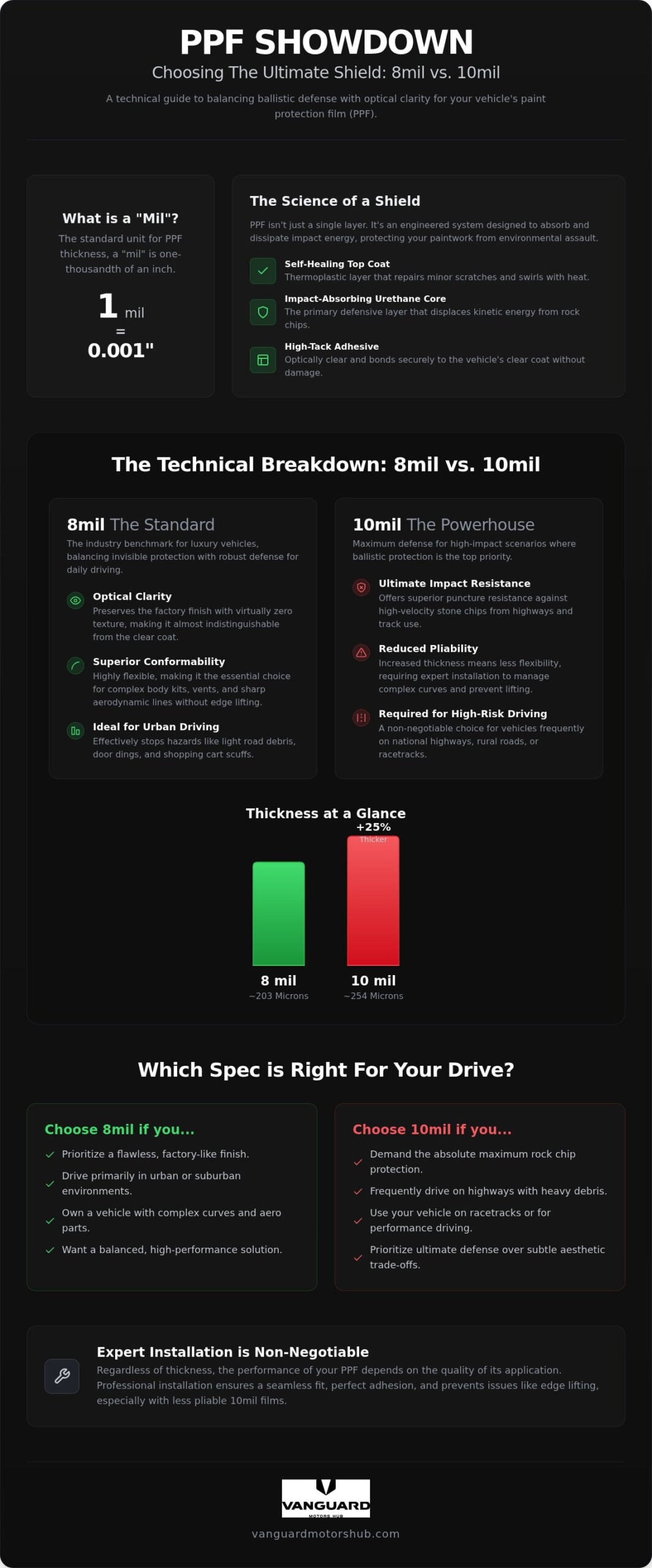
A “mil” isn’t a measurement you’ll find on a standard workshop ruler; it represents exactly one-thousandth of an inch (0.001″). In the specialized field of Paint Protection Film (PPF), this unit is the definitive metric for performance and durability. 2026 engineering has refined these dimensions, allowing owners to customize their vehicle’s defense with surgical precision. When you’re choosing between 10mil and 8mil PPF, you’re evaluating how three distinct layers work in unison. The high-tack adhesive, the impact-absorbing urethane core, and the self-healing top coat must provide a unified front against environmental assault.
Thickness translates directly to kinetic energy displacement. Every piece of gravel kicked up on a national highway carries a specific force. A thicker film spreads that impact across a wider surface area, preventing the energy from penetrating the polyurethane and reaching the clear coat. Modern material science in 2026 means that high-grade 8mil films now provide the puncture resistance once reserved for much thicker, older specifications. This evolution allows for lighter, clearer protection that doesn’t compromise the vehicle’s factory aesthetic.
8Mil vs 10mil: The Technical Dimensions
The physical profile of these films is often measured in microns for global precision. An 8mil film sits at approximately 203 microns, while a 10mil powerhouse reaches 254 microns. This 25% increase in thickness creates a significant shift in tensile strength. While 10mil offers superior ballistic defense, it inherently sacrifices some conformability. The 8mil standard became the global industry baseline for luxury vehicles because it strikes a perfect balance. It remains flexible enough to wrap around complex vents and sharp body lines while stopping the majority of daily driving hazards.
Why Material Density Matters More Than Just Thickness
Advanced films in 2026 rely on high-density aliphatic polyurethane. This specific chemical structure ensures the film remains optically clear and resistant to yellowing or chemical etching from bird droppings and industrial fallout. Density is the silent partner to thickness. A dense, high-quality material manages heat better, which is vital for the self-healing top coat to function effectively. A mil rating is the primary indicator of a film’s puncture resistance and impact absorption capacity. Choosing the right density ensures your protection remains invisible while performing at an elite level for years to come.
The 8mil Standard: Precision, Clarity, and Invisible Protection
Selecting the right protection involves balancing defense with aesthetics. For the majority of luxury vehicle owners, 8mil film represents the pinnacle of invisible protection. It is frequently cited as the “Golden Standard” in the 2026 market because it provides a near-perfect performance-to-price ratio. When choosing between 10mil and 8mil PPF, owners of city-driven vehicles often find that 8mil offers everything they need without the added bulk. It preserves the factory aesthetic so effectively that the film becomes virtually indistinguishable from the clear coat.
This thickness is particularly advantageous for performance-focused supercars. Every kilogram matters in high-performance engineering, and 8mil film provides comprehensive coverage without the weight penalty of heavier alternatives. It is the preferred choice for full-body applications where the goal is to shield against urban hazards like door dings, shopping carts, and light road debris while maintaining the car’s agile profile. It offers the peace of mind required for daily use without altering the vehicle’s carefully tuned power-to-weight ratio.
Superior Conformability for Complex Body Lines
Precision is non-negotiable when dealing with bespoke body kits. High-end conversions from names like Brabus or Mansory feature intricate front fascias and sharp aerodynamic radii that demand extreme flexibility. 8mil film excels here due to its superior conformability. Thicker films carry an inherent risk of “edge lifting” on these complex curves because the material’s internal tension fights the adhesive. Using a more pliable film ensures a seamless fit that stays locked in place for the long term. You can learn more about why Paint Protection Film (PPF) is the standard for excellence in modern vehicle care by exploring our deep dive into film technology.
Optical Clarity and the “Orange Peel” Myth
A common anxiety among collectors is the fear of “orange peel” texture. This visual distortion occurs when the film or its adhesive layer creates a dimpled effect on the paint surface. Modern 8mil films in 2026 utilize advanced thermoplastic urethane (TPU) and refined adhesives to eliminate this issue entirely. These films provide the highest level of transparency, which is vital for maintaining the sharp, crisp lines of matte or satin finishes. If you want to ensure your vehicle receives this level of meticulous care, speak with our technical experts today to discuss your specific protection needs. We focus on delivering a finish that is as durable as it is beautiful.
The 10mil Powerhouse: Maximum Defense for High-Impact Scenarios
When the environment transitions from manicured city streets to the abrasive reality of national highways, protection requirements shift. A 10mil film is the ballistic grade solution for owners who refuse to compromise on vehicle integrity. This specification provides a 25% increase in thickness over the industry standard, creating a massive physical barrier against high-velocity debris. While the 8mil standard is a master of invisibility, the 10mil powerhouse is built for raw endurance. It’s the definitive choice for those choosing between 10mil and 8mil PPF when their itinerary includes frequent long-distance travel or desert-adjacent routes.
The national climate presents unique challenges that standard films struggle to navigate. Intense thermal cycles and the relentless sand-blasting effect of wind-borne grit can degrade lesser materials over time. A 10mil film utilizes a significantly thicker top-coat layer, which enhances its self-healing properties. This extra volume allows the film to absorb deeper abrasions and recover its mirror-like finish more effectively under the heat of the sun. It doesn’t just protect the paint; it maintains its own structural integrity against the most aggressive environmental stressors.
Ballistic Protection for High-Speed Highway Driving
Kinetic energy is a merciless force at speeds exceeding 120km/h. At these velocities, a small stone carries enough momentum to pierce standard films and crater the factory paint. The 10mil powerhouse acts as a mechanical shock absorber, dissipating that energy across its dense polyurethane core before it can reach the clear coat. This makes it the non-negotiable gold standard for high-impact zones like lower front bumpers, rocker panels, and leading hood edges. You can explore how this level of protection fits into a broader preservation strategy in our Supercar Detailing: The 2026 Reference Guide.
Aesthetic Depth and Paint Enrichment
There’s a counter-intuitive aesthetic advantage to going thicker. The additional material volume acts like a magnifying lens for your vehicle’s clear coat, often adding a profound “wet-look” depth to dark and metallic paints. This thickness also serves a functional purpose for cars that aren’t brand new; it’s remarkably effective at masking existing minor factory paint imperfections or light swirl marks. For owners planning on long-term ownership of five years or more, the 10mil option provides a durable, high-gloss shield that keeps the vehicle looking showroom-fresh despite the miles. It’s a strategic investment in both immediate visual impact and future resale value.
The Selection Framework: Choosing the Right Spec for Your Drive
Effective vehicle preservation is a tactical decision, not a one-size-fits-all application. Choosing between 10mil and 8mil PPF requires an honest assessment of your driving environment and performance expectations. A city-bound grand tourer facing urban congestion has vastly different requirements than a track-focused supercar regularly hitting triple-digit speeds. In 2026, the elite standard involves matching the film’s physical properties to the specific kinetic threats your vehicle encounters daily. It’s about optimizing the cost-to-protection ratio while ensuring the aesthetic remains uncompromised.
While raw thickness provides a baseline for defense, the quality of the thermoplastic urethane (TPU) and the precision of the installation are equally critical. A premium 8mil film from a reputable manufacturer often outperforms a low-grade 10mil alternative in both clarity and longevity. We prioritize material density and chemical stability, ensuring that your chosen specification resists yellowing and maintains its self-healing properties over years of exposure to the national climate.
Scenario-Based Recommendations
- The Urban Commuter: For vehicles primarily navigating city centers, a full-body 8mil application is the optimal choice. It provides sufficient protection against door dings and minor abrasions while maintaining a flawless, high-gloss finish.
- The High-Velocity Profile: If your drive involves frequent highway travel or track days, a 10mil “Track Pack” on the front-end is essential. This ballistic-grade barrier absorbs the high-energy impacts that 8mil might struggle to fully dissipate.
- The Collector Profile: For limited-run models or high-value investments, a full-body 10mil application preserves maximum resale value. This comprehensive shield ensures the factory paint remains in “delivery mileage” condition, regardless of road exposure.
The Hybrid Approach: Best of Both Worlds
Strategic layering is the sophisticated solution for owners who want targeted defense without unnecessary bulk. This hybrid method involves mapping the vehicle’s high-impact zones, such as the hood, front bumper, and rocker panels, for 10mil installation. The remaining surfaces, like the doors and roof, receive an 8mil treatment. This ensures maximum protection where it’s needed most while maintaining the superior conformability and weight savings of thinner films on less vulnerable panels.
Executing this transition requires elite craftsmanship to ensure the seams remain invisible and the optical depth stays consistent across different panels. This proactive approach prevents the need for future Cosmetic Car Repair in 2026: The Definitive Guide by stopping damage before it occurs. If you’re ready to engineer a bespoke protection plan for your vehicle, consult with our technical specialists via WhatsApp to determine the perfect mil-spec for your driving profile.
Vanguard Precision: Expert Installation for Every Mil
The final decision when choosing between 10mil and 8mil PPF often rests on the capability of the facility performing the work. Thicker 10mil films present a unique technical challenge because they possess significantly reduced pliability compared to their 8mil counterparts. This inherent rigidity demands a higher level of mastery to prevent visual distortion or adhesive failure during the curing process. At Vanguard Motors Dubai, we bridge this gap through a combination of precision digital plotting and artisanal hand-finishing. This dual approach ensures every edge is perfectly wrapped, creating a truly invisible transition that shields the most vulnerable corners of your vehicle.
Our expertise becomes especially critical when integrating film with complex aerodynamic enhancements. Bespoke conversions like a Brabus or Mansory kit feature aggressive geometries and sharp carbon fibre edges that standard installation techniques cannot accommodate. We treat these vehicles as unique engineering projects rather than simple service appointments. By custom-tailoring the film application to these specific contours, we ensure the protection enhances the aesthetic rather than detracting from it. It’s this commitment to precision that allows the film to remain undetectable even on the most intricate bodywork.
Mastering the 10mil Installation Challenge
Installing a 10mil powerhouse requires sophisticated heat management. Stretching a thicker polyurethane layer without inducing stress marks or “silvering” is a delicate science that only elite technicians can navigate. Our state-of-the-art, climate-controlled facility is essential for this process, providing the stable environment required for optimal adhesive setting and film curing. This meticulous environmental control is what allows us to achieve factory-level results on even the most challenging Brabus Body Kit Installation projects, where precision is the only acceptable standard.
Beyond the Film: The Vanguard Premium Package
Protection is a multi-layered strategy that extends beyond the physical film. While choosing between 10mil and 8mil PPF secures the surface against mechanical impact, the Vanguard Premium Package elevates the results by integrating advanced ceramic coatings. This creates a hyper-hydrophobic finish that repels water, dust, and industrial contaminants, making your weekly maintenance nearly effortless. We back our craftsmanship with a comprehensive long-term warranty and dedicated maintenance support, ensuring your automotive investment remains in showroom condition for years to come. Consult with our protection specialists to design your bespoke PPF strategy.
Mastering the Art of Automotive Preservation
The decision behind choosing between 10mil and 8mil PPF is a commitment to your vehicle’s future. Whether you prioritize the invisible, contour-hugging precision of 8mil for a bespoke body kit or the ballistic-grade endurance of 10mil for high-speed highway protection, your choice defines your driving experience. We’ve explored how material density and strategic layering ensure your car remains a masterpiece. By selecting a specification that matches your unique performance profile, you’re engineering a long-term defense against the elements.
Vanguard Motors Dubai stands as a visionary leader in this specialized field. As authorized installers of premium 2026-grade films, we specialize in luxury supercar protection that balances aesthetic depth with mechanical excellence. Every precision installation comes with a comprehensive warranty, giving you total technical assurance. It’s time to elevate your vehicle’s defense to the elite standard it deserves. Your car represents a fusion of engineering and art; we’re here to ensure it stays that way.
Protect Your Investment: Contact Vanguard Motors Dubai for a Bespoke PPF Consultation
Frequently Asked Questions
Is 10mil PPF noticeably thicker than 8mil once installed?
10mil film is physically 25% thicker than the 8mil standard, but professional installation makes the difference nearly invisible to the naked eye. You won’t see a bulky layer, but you’ll feel the increased density when touching the film. The extra 2 mils are designed for impact absorption rather than visual bulk. Most owners only notice the difference in the enhanced depth of the gloss on dark paint finishes.
Does 10mil PPF offer better self-healing properties than 8mil?
Yes, 10mil film typically features a thicker self-healing top coat, allowing it to recover from deeper abrasions more effectively. Because there’s more material to work with, the film can flow back into place under heat more readily than thinner variants. This makes it an elite choice for vehicles exposed to heavy sand-blasting or aggressive road debris. It ensures your finish remains flawless even after significant environmental stress.
Can I install 10mil PPF on complex body kits like Mansory or Brabus?
Installation on intricate kits like Mansory or Brabus is possible but requires elite technical mastery due to the film’s reduced pliability. Thicker films resist wrapping around sharp radii and deep vents found in these bespoke conversions. We often recommend a hybrid approach, using 10mil for the leading edges and 8mil for the most complex geometric sections. This strategy ensures comprehensive protection without compromising the kit’s aggressive aesthetic lines.
Will 10mil PPF affect the color or clarity of my car’s paint?
High-quality 10mil film in 2026 is engineered for absolute optical clarity and won’t distort your vehicle’s factory color. In fact, the additional thickness can actually enhance the paint’s depth, creating a wet-look finish that makes metallic flakes pop. When choosing between 10mil and 8mil PPF, clarity depends more on the quality of the TPU and adhesive than the thickness itself. Premium films stay crystal clear for years.
Is it worth the extra cost to go from 8mil to 10mil for daily driving?
The upgrade is worth the investment if your daily drive involves high-speed national highways where rock chips are frequent. For purely urban commuting, the 8mil standard provides exceptional protection and value. However, 10mil offers a ballistic level of defense that significantly reduces the risk of paint damage from larger debris. It’s a strategic choice based on your specific risk profile and how much you value long-term resale preservation.
What happens if 10mil PPF is installed by an inexperienced technician?
Poor installation of thicker films often leads to edge lifting, where the film pulls away from the paint due to internal tension. You might also see silvering or stretch marks if the film is forced over curves without proper heat management. Inexperienced shops often struggle with the rigidity of 10mil, resulting in visible seams or trapped air bubbles. Professional precision is non-negotiable when working with heavy-duty polyurethane to ensure a seamless bond.
Can I mix 8mil and 10mil PPF on the same vehicle?
Mixing thicknesses is a highly effective strategy known as strategic layering. You can apply 10mil to high-impact zones like the front bumper, hood, and rocker panels while using 8mil for doors and rear panels. This hybrid method optimizes your protection where it’s needed most while maintaining the weight-saving and flexibility benefits of thinner film elsewhere. It’s a sophisticated way to manage your vehicle’s defense profile without unnecessary bulk.
How does the national heat affect the lifespan of 10mil vs 8mil film?
The intense national heat actually aids the self-healing properties of both films, but 10mil’s thicker construction offers superior thermal stability. Thicker films are more resistant to the drying out effect that can lead to yellowing or cracking in extreme UV environments. When choosing between 10mil and 8mil PPF, both benefit from modern 2026 UV inhibitors. However, the 10mil powerhouse provides a more robust barrier against the long-term abrasive effects of wind-borne sand.