
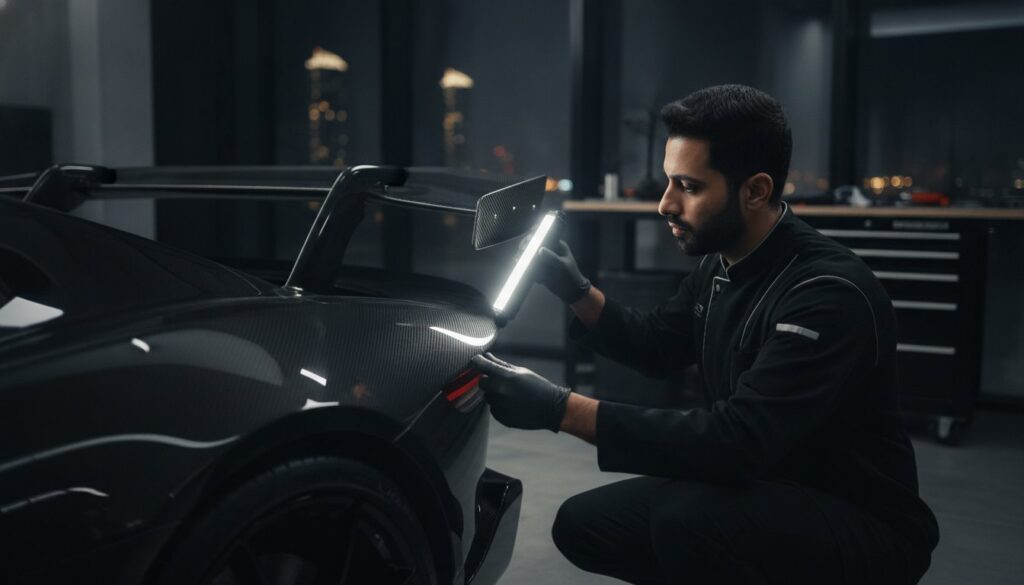
A flawless weave pattern is often the most dangerous distraction when judging the integrity of a new aerodynamic component. While a glossy finish looks stunning under showroom lights, it frequently hides the structural compromises that lead to failure at high speeds. You likely already know that subpar manufacturing can ruin your vehicle’s lines with poor fitment or leave you frustrated when a piece cracks under the intense heat of the Emirates. Assessing aftermarket carbon fiber parts quality requires a technical eye that looks beyond the surface to understand the resin-to-fiber ratio and the curing process.
We’ll help you master the art of distinguishing between high-performance composites and cheap aesthetic imitations to ensure your upgrades deliver both strength and style. You’ll gain a clear framework for evaluating part quality and learn why the distinction between dry and wet carbon fiber is critical for long-term durability. We will also examine the latest 2026 manufacturing standards and show you how to select a professional installation partner who treats your vehicle with meticulous care. By the end of this guide, you’ll have the confidence to invest in components that truly transform your car’s performance and aesthetics.
Key Takeaways
- Identify the structural differences between aerospace-grade “dry” carbon and entry-level “wet” layups to ensure your upgrades provide genuine performance benefits.
- Discover the essential indicators of aftermarket carbon fiber parts quality, focusing on UV-stabilized resins designed to withstand the intense heat and sunlight of the UAE.
- Apply the “2mm Rule” to evaluate panel gaps and mounting point integrity, ensuring your new components align perfectly with factory body lines.
- Understand why professional installation and integrated PPF protection are non-negotiable for maintaining the longevity and finish of elite kit conversions.
Beyond the Weave: The Spectrum of Aftermarket Carbon Fiber Parts Quality
Carbon fiber has evolved from a track-only necessity to the ultimate symbol of automotive prestige across the nation and its diverse automotive regions. While many enthusiasts focus solely on the aesthetic pattern, true aftermarket carbon fiber parts quality is determined by the internal composition and manufacturing precision. High-end vehicles deserve more than just a surface-level upgrade. Genuine Carbon fiber reinforced polymer is a high-performance composite where carbon filaments are bound within a polymer matrix to provide immense structural rigidity. This material is the gold standard for those who refuse to compromise on either form or function.
Selecting lower-tier components often leads to hidden costs that appear months after installation. In the extreme heat of the UAE, inferior resins can suffer from thermal expansion, leading to heat deformation or surface clouding. Cheap parts often vibrate at high speeds, creating an unrefined driving experience that contradicts the engineering of a supercar. In 2026, the market has matured; price now correlates directly with manufacturing precision and the quality of the raw materials used during the layup process.
The Role of Carbon Fiber in Modern Supercars
Deciding between weight reduction and aesthetic enhancement is the first step in your customization journey. If your goal is track performance, every gram saved through high-quality composites translates to sharper handling and better power-to-weight ratios. Beyond performance, elite parts maintain your vehicle’s resale value by ensuring the upgrades match the factory’s structural integrity. We are seeing a significant shift toward forged carbon patterns in bespoke kits for brands like Mansory and Brabus. This non-directional weave offers a sophisticated, marble-like finish that represents the pinnacle of modern carbon technology.
Common Pitfalls of ‘Budget’ Aftermarket Options
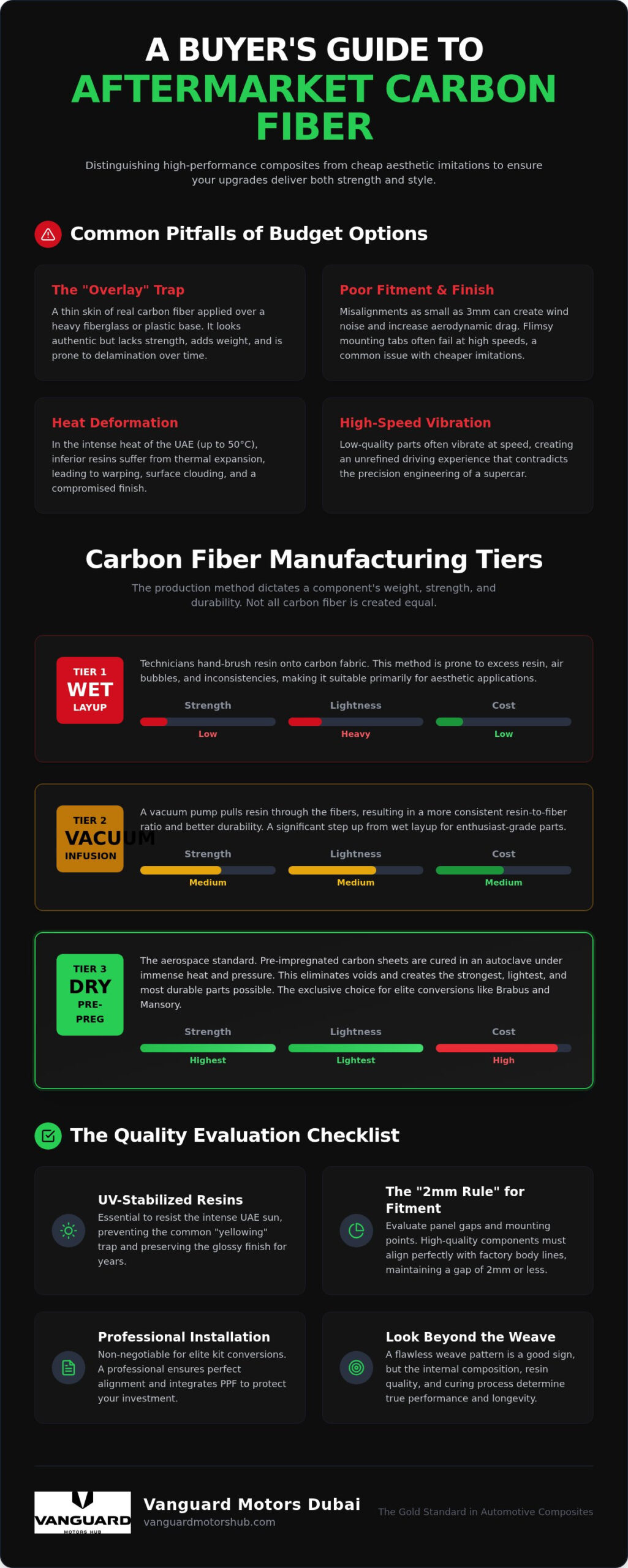
Many entry-level suppliers use the “overlay” trap to lower costs. This involves applying a thin skin of real carbon fiber over a heavy fiberglass or plastic base. While it looks authentic from a distance, it lacks the strength of a full composite and is prone to delamination over time. Poor fitment is another frequent issue with budget options. Even a 3mm misalignment can generate annoying wind noise or increased aerodynamic drag during highway cruising. High-quality aftermarket carbon fiber parts quality ensures that every mounting point is reinforced, preventing the flimsy tab failures that often occur with cheaper imitations at high speeds.
Dry vs. Wet Carbon Fiber: Comparing Manufacturing Standards
Manufacturing standards dictate whether a component is a structural masterpiece or a heavy liability. Distinguishing between these methods is the definitive way to verify aftermarket carbon fiber parts quality. The industry generally splits production into three tiers: wet layup, vacuum infusion, and dry carbon. Each method offers a different balance of weight, strength, and cost, but only one truly belongs on a high-performance supercar.
Wet layup represents the entry-level tier. Technicians brush resin onto the fabric by hand, often resulting in a “rich” mixture where excess resin adds unnecessary weight without increasing strength. These parts are primarily aesthetic. They are prone to trapped air bubbles and can warp under the intense 50°C summer heat common in the UAE. Vacuum infusion serves as a middle ground. By using a vacuum to pull resin through the fibers, manufacturers achieve a more consistent resin-to-fiber ratio than hand-pouring. It’s a significant step up in durability, though it still falls short of aerospace requirements.
The Pre-preg Advantage: Why Professionals Choose Dry Carbon
Dry carbon, or pre-preg, is the undisputed standard for elite performance. The material comes pre-impregnated with a precise amount of resin and is cured under immense pressure and heat in an autoclave. This intense process eliminates voids and ensures a high-density structure. It’s why brands like Brabus and Mansory almost exclusively utilize dry carbon for their conversion kits. The result is a part that can be significantly lighter than its wet-layup counterpart while maintaining superior rigidity. For those demanding the highest aftermarket carbon fiber parts quality, dry carbon is the only choice that preserves the vehicle’s engineering integrity.
Identifying Manufacturing Methods at a Glance
You don’t need a laboratory to spot the differences. Weight is the most immediate indicator. A dry carbon spoiler or mirror cap will feel startlingly light, often manageable with just a few fingers. Inspect the back-side of the component. Wet layup parts usually have a rough, fiberglass-like texture or a messy resin finish on the interior. In contrast, dry carbon features a clean, consistent matte or textured finish on both sides because it was cured in a precision mold.
Surface clarity is another hallmark of high-end production. Technical research into surface defect classification highlights how inconsistencies in the weave or “waviness” in the resin often signal a rushed manufacturing process. If the weave looks distorted or stretched near the edges, the part likely won’t survive long-term thermal stress. If you’re unsure about the integrity of your current components, you can speak with our technical experts to evaluate your vehicle’s carbon fiber upgrades.
UV Resistance and Resin Stability: Avoiding the Common ‘Yellowing’ Trap
The relentless ultraviolet radiation in the United Arab Emirates acts as a catalyst for chemical degradation in lower-tier composites. When assessing aftermarket carbon fiber parts quality, the stability of the resin system is just as vital as the weave itself. Standard epoxy resins without proper stabilization will undergo a process called photo-oxidation. This results in the dreaded “yellowing” effect, where the once-crisp carbon pattern takes on a murky, aged appearance. High ambient temperatures, often exceeding 45°C in the summer, accelerate this breakdown, causing the resin to become brittle and eventually delaminate from the fibers.
To combat this, elite manufacturers utilize automotive-grade 2K clear coats. These coatings provide a robust, high-gloss shield that filters out harmful UV wavelengths before they reach the structural resin. Without this specialized topcoat, even a well-constructed part will lose its luster within a single season of exposure. High-quality finishes don’t just look better; they provide the chemical resilience needed to survive the harsh Gulf climate.
Resin Systems: Epoxy vs. Polyester
Epoxy resin is mandatory for high-performance automotive applications due to its superior bonding strength and thermal stability. In contrast, polyester resins are often found in maritime or budget-grade components. They lack the heat deflection temperatures required for engine-adjacent parts like hoods or air intakes. A high-quality carbon fiber hood must maintain its shape while subjected to extreme engine bay heat without sagging or warping. Manufacturers enhance aftermarket carbon fiber parts quality by integrating UV-inhibiting additives directly into the resin matrix to provide deep-level protection against sunlight.
The Synergy of Carbon Fiber and PPF
While a 2K clear coat is the first line of defense, Paint Protection Film (PPF) serves as a secondary, sacrificial barrier. It absorbs the impact of stone chips that would otherwise crack the brittle clear coat and expose the raw carbon to moisture and oxidation. For enthusiasts with carbon-heavy builds, we recommend a full body PPF application to ensure comprehensive coverage across all aerodynamic surfaces. This integrated approach preserves the mirror finish and prevents the micro-abrasions that dull the weave’s visual depth over time. Regular maintenance with pH-neutral cleansers and ceramic-infused detailers will keep the surface looking like it just left the showroom.
The Precision Fitment Protocol: How to Evaluate Structural Integrity
High-performance aesthetics are worthless if the component fails to align with your vehicle’s original engineering. When assessing aftermarket carbon fiber parts quality, the physical fitment is the ultimate litmus test for manufacturing excellence. We utilize the “2mm Rule” during every inspection. Panel gaps must be uniform and mirror the factory spacing across the entire seam. If a part requires excessive force or “shaving” to fit, the mold was likely compromised during production. Precision in alignment isn’t just about looks; it’s about maintaining the aerodynamic profile intended by the manufacturer. This is especially crucial for vehicles operating in the high-speed environments of the UAE, where even a slight misalignment can cause significant turbulence or whistling.
Mounting point integrity is a critical safety factor that many owners overlook. Flimsy plastic or thin carbon tabs often fail under the intense aerodynamic loads generated at highway speeds. For larger components like hoods or trunks, internal reinforcement is non-negotiable. Quality parts feature integrated structural bracing to prevent fluttering or collapse under high-speed downforce. A front splitter that looks aggressive but lacks rigid mounting will eventually become a dangerous liability rather than a performance enhancer. We often see budget parts that look identical to high-end versions but lack the internal skeleton required to handle 200+ km/h wind resistance.
Pre-Installation Inspection Checklist
Conduct a thorough visual audit before any component is permanently mounted. Look for these specific indicators of manufacturing haste:
- Weave Distortion: Stretched or “pulled” fibers indicate a rushed layup that weakens the part’s structural structure.
- Edge Finishing: Inspect the perimeter for raw or uneven edges. High-quality parts are trimmed and sanded to a smooth, factory-level finish.
- Surface Pitting: Tiny pinholes in the resin reveal trapped air. This suggests poor vacuum pressure during the curing process and can lead to premature cracking.
The Importance of Laser-Scanned Molding
Modern precision relies on 3D laser-scanning technology rather than traditional hand-made plugs. Laser-scanned molds capture every nuance of the factory bodywork to ensure “bolt-on” compatibility without permanent modification. This level of accuracy is foundational to the Vanguard Motors Dubai approach for Brabus Mercedes kits. Our technicians ensure that every conversion maintains the sophisticated lines of your vehicle while enhancing its aggressive stance. If you want to ensure your carbon upgrades meet the highest aftermarket carbon fiber parts quality standards, book a professional fitment consultation with our specialist team.
Bespoke Carbon Fiber Integration: Elevating Performance with Professional Installation
The most sophisticated dry carbon component remains a liability until it’s perfectly integrated into the vehicle’s architecture. While sourcing high-tier materials is the first step, the final aftermarket carbon fiber parts quality is heavily dependent on the expertise of the installer. Professional installation ensures that structural adhesives are applied at the correct temperature and that mounting hardware is torqued to factory specifications. This level of precision is vital for components that must withstand the extreme aerodynamic pressures found on Dubai’s highways.
DIY attempts at carbon fiber modification carry significant risks. Amateurs often face bonding failures that lead to parts detaching at high speeds, creating severe safety hazards for everyone on the road. Additionally, improper handling can cause permanent paint damage or micro-fractures in the brittle clear coat. Beyond the exterior, high-end integration often includes exhaust modifications and interior carbon wraps to create a cohesive aesthetic. Professional shops provide the technical skill needed to align these various elements into a singular, high-performance vision that looks and performs like a factory finish.
Expert Kit Conversions: Brabus, Mansory, and Jetour
Executing a full-body kit conversion for elite brands like Brabus, Mansory, or Jetour is a complex engineering task. These kits replace significant portions of the vehicle’s exterior, requiring the seamless relocation of parking sensors, radar systems, and cameras. You can choose between gloss, matte, or the marbled depth of forged carbon finishes to match your personal style. A professional conversion ensures that all electronic safety systems function perfectly while maintaining the aggressive aerodynamic balance these kits are designed to provide. At Vanguard Motors Dubai, we treat every conversion as a technical masterpiece, ensuring that the structural integrity of your supercar remains uncompromised.
Long-Term Care and Restoration
Preserving your investment requires a dedicated maintenance protocol. Professional carbon fiber repair can often save a damaged splitter or diffuser that might otherwise require a costly replacement. Our technicians specialize in restoring both the structural and aesthetic integrity of compromised parts. We use advanced detailing protocols to prevent oxidation and keep the weave visible under a crystal-clear finish. If you are ready to elevate your vehicle, Consult with the Vanguard Motors Dubai team on WhatsApp to discuss your bespoke carbon fiber project and ensure the highest aftermarket carbon fiber parts quality for your build.
Securing Your Investment in Elite Performance
Investing in high-end composites is about more than just visual impact; it’s about engineering a vehicle that stands up to the road and the intense sunlight of the Emirates. You now understand that true aftermarket carbon fiber parts quality is found in the density of dry carbon and the chemical stability of UV-resistant resin systems. By applying the precision fitment protocol and prioritizing expert integration, you avoid the costly pitfalls of cheap alternatives that fail under aerodynamic load.
Vanguard Motors Dubai specializes in the technical precision required for elite Brabus and Mansory kit conversions. We don’t just install parts; we provide a holistic service that includes professional carbon fiber repair and integrated PPF protection to preserve your mirror finish for years. This meticulous approach ensures your vehicle remains a masterpiece of both form and function. Your vision deserves the highest standards of craftsmanship and care.
Start Your Bespoke Carbon Fiber Transformation with Vanguard Motors Dubai today. Let’s build something extraordinary together.
Frequently Asked Questions
How can I tell the difference between ‘dry’ and ‘wet’ carbon fiber?
Dry carbon is significantly lighter and features a clean, textured finish on both sides because it is cured in an autoclave. Wet carbon fiber usually has a glossy front but a rough, hand-poured resin finish on the back. You can often feel the weight difference immediately; a dry carbon piece feels like a thin shell, whereas wet layup parts are noticeably heavier and thicker.
Why do some aftermarket carbon fiber parts turn yellow over time?
Yellowing occurs when ultraviolet radiation and intense heat break down the chemical bonds in low-quality epoxy resins. This is a common issue with budget-grade components that lack proper UV-inhibiting clear coats. In the UAE, where temperatures often exceed 45°C, ensuring high aftermarket carbon fiber parts quality means choosing components with automotive-grade 2K clear coats to prevent this oxidation.
Can damaged carbon fiber parts be repaired, or do they need to be replaced?
Professional carbon fiber repair can often restore a damaged part to its original structural and aesthetic state. Minor cracks in the clear coat or surface abrasions are fixable through precise sanding and re-coating. However, if the carbon weave itself is shattered or the structural mounting points are compromised, a full replacement is usually necessary to maintain vehicle safety and integrity.
Is it safe to install a carbon fiber hood for daily driving?
Installing a carbon fiber hood is perfectly safe for daily driving provided it includes internal structural bracing and a reliable latching system. High-quality hoods are engineered to handle extreme engine bay heat without warping or sagging. You should always verify that the part uses a reinforced skeleton to maintain its shape at high speeds and under significant thermal stress.
Does aftermarket carbon fiber improve my car’s performance?
High-quality aftermarket carbon fiber improves performance by reducing the vehicle’s overall weight and optimizing its aerodynamic profile. Replacing heavy factory panels with dry carbon components lowers the center of gravity and improves the power-to-weight ratio. These upgrades, when combined with precision-engineered splitters and spoilers, also increase high-speed downforce and stability during spirited driving sessions.
How do I maintain the gloss finish on my carbon fiber exterior parts?
Maintaining the gloss finish requires regular cleaning with pH-neutral automotive soaps and the application of Paint Protection Film (PPF). PPF acts as a sacrificial layer against stone chips and provides an additional UV filter to preserve the resin. Avoid using abrasive polishing compounds that can thin the clear coat and expose the delicate weave beneath the surface.
Are Brabus and Mansory kits made of the same quality carbon as factory parts?
Elite conversion kits from brands like Brabus and Mansory typically meet or exceed factory aftermarket carbon fiber parts quality standards. These manufacturers utilize aerospace-grade pre-preg materials and precise molding techniques to ensure perfect integration. Because these kits are designed for supercars, they prioritize structural rigidity and a flawless finish that matches the vehicle’s premium engineering.