
The darkest windshield tint isn’t necessarily the one that keeps your cabin coolest. Choose a high heat rejection windshield tint by comparing verified performance data, visible-light clarity, and suitability for your vehicle, not by appearance alone.
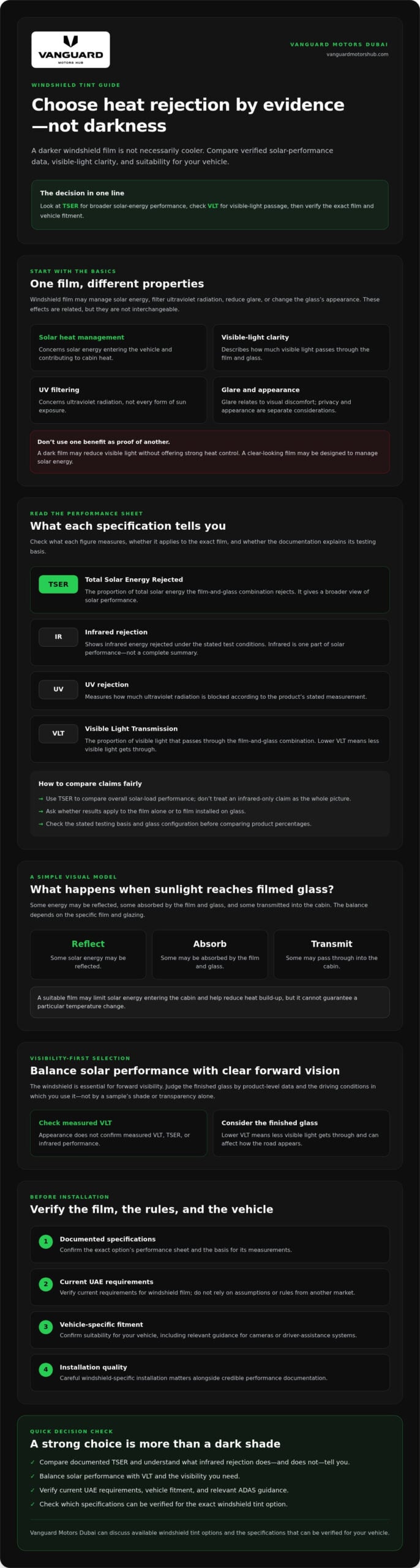
Film specifications can be confusing. Infrared rejection may sound impressive, but it doesn’t show how much total solar energy a film blocks. Total Solar Energy Rejected (TSER) gives a broader measure, while Visible Light Transmission (VLT) indicates how much visible light passes through the film and glass.
This guide explains how to compare these figures, balance heat control with visibility, and assess windshield-specific installation quality. Before booking, confirm the film’s documented specifications, current UAE requirements, and any vehicle-specific guidance for cameras or driver-assistance sensors. For an assessment, ask Vanguard Motors Dubai about available tint options and which specifications can be verified for your vehicle.
Key Takeaways
- Compare films using documented performance data, not darkness or a single headline claim.
- Check what TSER, infrared rejection, UV rejection, and VLT each measure.
- Balance a high heat rejection windshield tint’s solar performance with the visibility you need.
- Before installation, confirm current UAE requirements, vehicle fitment, and relevant ADAS guidance.
- Ask Vanguard Motors which windshield tint options are available and what specifications can be verified for your vehicle.
What Does High Heat Rejection Windshield Tint Actually Do?
Windshield tint is a transparent or tinted film applied to vehicle glass. Depending on the product, it may help manage solar energy, filter ultraviolet radiation, reduce glare, or change the glass’s appearance. These effects are related, but they are not interchangeable. A dark film may reduce visible light without offering strong heat control, while a clear-looking film may be designed to manage solar energy.
High heat rejection windshield tint is intended to reduce the solar energy that passes through the windshield and contributes to cabin heat. Judge its performance using verified specifications, not shade or appearance. Film construction affects its characteristics; Window film technology provides background on common film types and uses.
Keep the different benefits separate when comparing products. Glare reduction relates to visual discomfort from bright light. UV filtering concerns ultraviolet radiation. Privacy depends on the appearance of the glass and how much can be seen through it. Heat management concerns solar energy entering the vehicle. A film may address several concerns, but a claim in one category doesn’t prove performance in another.
How windshield film changes solar heat entering the cabin
When sunlight reaches filmed glass, some energy may be reflected, some absorbed by the film and glass, and some transmitted into the cabin. The balance depends on the specific film and glazing. Don’t assume that one mechanism explains the result. A suitable film may limit the solar energy entering the cabin and help reduce heat build-up, but it can’t guarantee a particular temperature change.
Why windshield tint needs a visibility-first approach
The windshield is essential for clear forward vision, so appearance alone is not a sound selection test. Compare visible light transmission (VLT), the proportion of visible light that passes through the film and glass. Lower VLT means less visible light gets through, which can affect how the road appears. Request product-level data and consider how the finished glass may look in the conditions in which you drive.
Before installation, verify the current UAE requirements for windshield film rather than relying on assumptions or rules from another market. Confirm fitment for your specific vehicle, including any relevant guidance for cameras or driver-assistance systems. A vehicle-specific assessment and careful installation matter alongside credible performance documentation.
Which Windshield Tint Specifications Reveal Real Heat Rejection?
A film’s performance sheet may list several percentages, each describing a different property. For a useful comparison, check what each figure measures, whether it applies to the exact film you’re considering, and whether the documentation explains the testing basis. The International Window Film Association provides consumer information on window-film performance and solar-control terminology.
| Specification | What it tells you |
|---|---|
| TSER | The proportion of total solar energy the film-and-glass combination rejects. |
| Infrared rejection | How much infrared energy is rejected under the stated test conditions; it represents one part of solar performance. |
| UV rejection | How much ultraviolet radiation is blocked according to the product’s measurement. |
| VLT | The proportion of visible light that passes through the film-and-glass combination. |
TSER versus infrared rejection: which figure should buyers prioritize?
TSER is useful for comparing overall solar-load performance because it covers solar energy more broadly than an infrared-only figure. Infrared rejection still matters, but it describes one component and shouldn’t be treated as a complete performance summary. A high infrared claim alone doesn’t establish how the film performs across the full solar spectrum.
Compare figures only when product-specific documents identify the testing basis and glass configuration. If manufacturers measure or present results differently, headline percentages may not be directly comparable. Ask whether the data applies to film alone or film installed on glass, and request the specification sheet for the exact option being considered.
VLT and UV rejection: balancing comfort, clarity, and protection
VLT indicates how much visible light passes through the glass and film together. A film can look nearly clear and still require scrutiny: appearance doesn’t confirm its measured VLT, TSER, or infrared performance. Check the figures instead of estimating them from a sample’s shade or transparency.
UV rejection measures ultraviolet radiation, not every form of sun exposure or all sources of cabin heat. Treat it as a separate measure, not a substitute for TSER or a visibility check. For a high heat rejection windshield tint, compare the full set of verified specifications and make sure the selected VLT suits your visibility needs.
To compare available options, you can ask Vanguard Motors about windshield tint options and verified specifications for your vehicle.
Ceramic, Dyed, or Metalized Windshield Tint: How to Compare Options
Ceramic, dyed, and metalized describe broad film categories, not guaranteed performance levels. Construction can offer clues, but the specific product’s documented TSER, infrared rejection, UV rejection, and VLT are more useful than its category name. Results also depend on the glass and test method, so don’t compare headline claims without checking their basis.
| Film category | Heat-control claims | Clarity and appearance | Signals and systems | What to request |
|---|---|---|---|---|
| Ceramic | Often marketed for solar control; confirm the product’s measured results. | Appearance and optical clarity vary by product and VLT. | Ask about compatibility with your vehicle’s electronics and systems. | Product-specific TSER, infrared, UV, and VLT data, plus test basis. |
| Dyed | Claims vary; don’t infer heat rejection from the film’s shade. | Ask how the sample looks from inside and outside the vehicle. | Confirm suitability for the vehicle rather than assuming based on category. | Measured performance data and details on appearance and limitations. |
| Metalized | Performance depends on the particular film, not its label alone. | Check clarity and reflectivity on a representative sample. | Ask whether its construction has any product-specific compatibility considerations. | Full specification sheet and installer guidance for windshield use. |
What buyers should know about ceramic windshield film
Ceramic is a marketed construction category, not proof of a particular level of heat rejection or clarity. Request specifications for the exact film under consideration, including TSER, infrared and UV rejection, and VLT. Check whether the figures apply to film alone or film combined with glass, then ask the installer to explain the test basis before comparing options.
How dyed and metalized films differ in the comparison
Dyed and metalized refer to different film-construction approaches, but products within either category can vary. Compare documented performance and inspect appearance, clarity, and reflectivity rather than assuming every film behaves alike. Ask about vehicle-system compatibility and product limitations, and have the installer confirm whether the particular film is suitable for your windshield.
Vanguard Motors offers automotive tinting, but confirm which windshield film types are currently available and what specifications can be verified before choosing. A vehicle-specific assessment can help clarify suitability and installation considerations. Window film is also different from exterior paint protection: the paint protection film guide covers a separate application for painted surfaces, not windshield solar control.
Choose a high heat rejection windshield tint by verified data, suitable visibility, and confirmed fitment, not by category or darkness alone.
How to Choose Windshield Tint Without Sacrificing Visibility
Use this checklist to assess a high heat rejection windshield tint for performance and clear driving. Don’t approve a film based only on a sample’s shade. Request written product details and vehicle-specific guidance before installation.
- 1. Define your priorities. Decide how you’ll balance solar-heat reduction, visibility, glare management, and UV filtering. These are distinct goals, so identify what matters most before comparing products.
- 2. Review the test data. Request the exact film’s specification sheet. Check TSER, infrared and UV rejection, and VLT. Also check the test basis and whether figures refer to film alone or film installed on glass.
- 3. Assess visibility. Ask to review a sample from the driver’s seat and consider how the glass may look in the conditions you typically drive in. Confirm the recommended VLT for the finished glass-and-film combination.
- 4. Confirm fitment. Check that the film is suitable for your vehicle’s windshield. Verify applicable UAE requirements and ask the vehicle manufacturer or a qualified installer about any camera, sensor, or ADAS considerations.
- 5. Inspect the installation. Discuss preparation, film shaping, application, aftercare, and how workmanship defects or product issues are handled. After installation, check for visible distortion, contamination, lifting edges, or anything that obstructs your view.
Questions to ask before approving windshield film
Request the specification sheet and ask how each performance figure was measured. Confirm the recommended VLT for your vehicle and the final glass-and-film combination, and establish who will verify applicable rules and system compatibility. Before work begins, ask about curing time and care instructions, including when and how to clean the glass.
What professional windshield tint installation should include
A careful process should begin with glass inspection and clean preparation, followed by precise film shaping and controlled application. Ask how the installer checks the finished result and handles concerns. Follow the care guidance for the specific film; for broader vehicle-care context, see this supercar detailing guide.
Vanguard Motors offers automotive tinting. Ask Vanguard Motors about available windshield tint options and a vehicle-specific assessment before booking.
Where to Get High Heat Rejection Windshield Tint Assessed and Installed
A considered choice rests on four checks: verified product performance, suitable VLT, compatibility with your vehicle, and careful installation. Vanguard Motors offers automotive tinting, but confirm specific windshield film options and their specifications before deciding. Explore its automotive tinting and protection services, then ask which options may suit your vehicle.
What to prepare for a tint consultation
Have your vehicle’s make, model, and year ready, along with any known details about windshield-mounted cameras or sensors. Explain your priorities, whether reducing heat, preserving clarity, improving glare comfort, or balancing several goals. This keeps the discussion focused on relevant film characteristics rather than appearance alone.
Ask which specific windshield films are available and request documentation for measured TSER, infrared rejection, UV rejection, and VLT. Confirm how the figures were tested and whether they describe the film alone or the finished glass-and-film combination. If a specification can’t be verified, treat it as an open question rather than a confirmed performance claim.
How to move from comparison to a confident decision
Compare written specifications and vehicle-specific installation recommendations side by side. A prominent headline figure isn’t enough if its testing basis is unclear or the film’s VLT doesn’t suit your visibility needs. Before authorizing work, confirm the tint’s legal suitability under current UAE requirements and check vehicle-specific guidance for cameras, sensors, and ADAS features with the manufacturer or a qualified installer.
Discuss the installation process, aftercare instructions, and how concerns about workmanship or the film itself are handled. An assessment can clarify available options and what still needs verification; it isn’t a guarantee of a particular result. The right high heat rejection windshield tint is the option that aligns with documented performance, visibility, fitment, and installation requirements.
Discuss your windshield tint requirements with the Vanguard Motors team, including your vehicle details and the priorities you want the film to address.
Choose Your Windshield Tint with Confidence
The right high heat rejection windshield tint isn’t defined by a dark appearance or one impressive percentage. Compare product-specific performance data, including TSER and infrared rejection, then weigh VLT against the clarity you need behind the wheel. Confirm windshield suitability, current UAE requirements, and vehicle-specific camera or sensor guidance before authorizing installation.
Installation quality matters too. Ask which film options are currently available, request verified specifications, and clarify how the finished glass will be assessed. These checks help you make a considered choice without assuming every film category delivers the same result.
Vanguard Motors offers automotive tinting as part of its vehicle-protection and customization services. Share your vehicle details and priorities to discuss suitable options, and confirm availability and specifications directly with the team. Ask Vanguard Motors about windshield tint options for your vehicle. A vehicle-specific assessment can help you make a more informed decision.
Frequently Asked Questions
Does high heat rejection windshield tint have to be dark?
No. Darkness alone doesn’t determine heat rejection. A lighter-looking film may be designed to reduce solar energy, but its appearance can’t confirm performance. Compare the exact product’s TSER, infrared rejection, and VLT data, and check that the finished glass-and-film combination supports clear forward visibility. Request product-specific documentation rather than choosing by shade or relying on one headline claim.
Which is more important for windshield tint: TSER or infrared rejection?
TSER is generally more useful for comparing overall solar-energy rejection because it covers solar energy more broadly. Infrared rejection describes one part of performance, not the complete heat-control picture. Review both where available and check how each was measured. A high infrared figure by itself doesn’t show total solar rejection or establish that two films can be compared fairly.
Can clear windshield tint still reject heat?
Yes, a clear-looking film may be designed to manage solar energy, but appearance isn’t proof of performance. Request measured TSER and infrared rejection, along with VLT, for the specific film. Clarify whether the figures apply to film alone or film installed on glass. UV rejection is a separate specification, and a transparent appearance doesn’t guarantee a particular level of heat or UV reduction.
Will windshield tint affect cameras, sensors, or ADAS?
It depends on the vehicle’s equipment and the specific film and installation. Before approving work, identify any cameras or sensors mounted near the windshield and ask the vehicle manufacturer or a qualified installer about compatibility and restrictions. Confirm that installation won’t obstruct the equipment’s field of view or interfere with its operation. Broad claims about signal transparency are not a substitute for vehicle-specific guidance.
Is windshield tint legal in the UAE?
Confirm current UAE requirements before applying any film to a windshield. Applicable rules may depend on the vehicle and the film’s placement or specifications, so don’t rely on advice based on another country or assume a product is permitted because it’s sold locally. Ask the installer which requirements they can verify, and check with the relevant UAE authority if anything remains unclear before authorizing installation.
How do I compare heat rejection figures between tint films?
Compare product-specific TSER, infrared rejection, UV rejection, and VLT, then check the test basis and glass configuration behind each figure. If one specification describes film alone and another describes film combined with glass, the numbers may not be directly comparable. Request technical documentation for each exact film, and be cautious of a headline percentage that doesn’t explain what was tested or which part of performance it represents.
How long should I wait before cleaning newly tinted windshield film?
Follow the installer’s care instructions for the specific film rather than relying on a generic waiting period. The appropriate interval can depend on the product and installation conditions, and no confirmed timeframe is available here. Ask when cleaning can begin, which products and tools are suitable, and whether temporary haze or moisture should be left undisturbed during curing. Avoid scraping or pressing on the film unless instructed.