

What if your dream build became a 50,000 AED liability overnight? In the Emirates, the line between an elite automotive masterpiece and a heavily penalized violation is thinner than a layer of ceramic coating. Mastering the landscape of legal car modifications in UAE is no longer just about avoiding a 2,000 AED noise fine or 12 black points; it’s about protecting your investment and your passion. You want a vehicle that reflects your status and performance standards without the constant anxiety of a roadside inspection or a voided warranty.
We understand that the regulatory shift between MoIAT standards and RTA enforcement can feel like a complex maze. You deserve to customize your vehicle with total legal certainty and professional precision. This 2026 guide provides a clear roadmap for every aesthetic and performance upgrade, from high-end body kits to precision exhaust systems. We’ll examine the 95-decibel noise limit, clarify the 50% tinting threshold, and identify the professional partners who manage compliance documentation so you don’t have to. It’s time to transform your car into a compliant icon of engineering excellence.
Key Takeaways
- Master the framework of legal car modifications in UAE by understanding the essential synergy between MoIAT certification and local RTA enforcement.
- Identify “zero-risk” enhancements like Paint Protection Film (PPF) and distinguish them from modifications like vinyl wraps that require mandatory registration updates.
- Understand the compliance standards for elite body kits, including Mansory and Brabus conversions, to ensure your vehicle remains road-legal and fully insurable.
- Protect your investment from severe penalties, such as the 2,000 AED noise fine or the 10,000 AED impound release fee, by respecting the 95-decibel exhaust limit.
- Follow a professional five-step approval process that prioritizes technical design reviews and authorized workshop installations for guaranteed compliance.
Understanding the UAE Automotive Regulatory Landscape
The UAE Automotive Regulatory Landscape is a sophisticated framework designed to balance high-octane passion with public safety. Every regulation serves a dual purpose: maintaining road safety and upholding strict environmental standards. Understanding legal car modifications in UAE starts with recognizing that the government isn’t stifling creativity; they’re ensuring that every enhanced vehicle remains a precision instrument on the road. The Ministry of Industry and Advanced Technology (MoIAT) acts as the central authority, setting the national technical standards that all aftermarket components must meet.
Securing an RTA registration update is the final, vital step in your modification journey. While MoIAT certifies the parts, local transport authorities and police forces manage the enforcement and final inspections. Skipping this process turns a premium build into a legal liability. Non-compliance often leads to failed annual inspections, heavy fines, or the immediate impoundment of your vehicle. It’s a risk that can easily be avoided through professional planning and authorized installation.
The Difference Between Aesthetic and Performance Mods
Personalization in the Emirates falls into two distinct categories. Aesthetic modifications focus on visual identity and protection. This includes colored sticker wraps, Paint Protection Film (PPF), and bespoke interior upgrades like leather restoration. These are generally viewed as low-risk, though any change to the base color requires an official update to the vehicle’s registration. Performance modifications involve the mechanical heart of the machine. Engine tuning, suspension upgrades, and custom exhaust systems fall under this umbrella. Because these changes directly impact vehicle dynamics and emissions, they face significantly higher scrutiny than cosmetic enhancements.
Key Regulatory Bodies You Need to Know
Successful customization requires navigating three specific entities. MoIAT serves as the gatekeeper, certifying that parts and workshop standards meet UAE law. National police forces and local transport authorities act as the enforcers, conducting roadside checks and technical inspections. To bridge the gap, you must obtain a ‘Certificate of Conformity’. This document is your proof that the upgrades were performed by an authorized workshop and meet every safety benchmark. The stakes for ignoring these protocols are high:
- Noise Violations: Exceeding the 95-decibel limit results in a 2,000 د.إ fine and 12 black points.
- Structural Changes: Unauthorized engine or chassis modifications carry a 1,000 د.إ penalty.
- Impoundment: Illegal modifications can lead to a 30-day impound. Release fees for impounded vehicles can be substantial, with some reaching 10,000 د.إ.
Partnering with an elite workshop like Vanguard Motors Dubai ensures your vision is executed with technical precision. Professional teams handle the complex documentation and MoIAT standards, so you can drive with total legal certainty.
Legal Aesthetic Enhancements: Wraps, PPF, and Color Changes
Aesthetic personalization represents the most accessible entry point for legal car modifications in UAE. Unlike mechanical overhauls, these cosmetic enhancements focus on visual distinction and surface protection. Clear Paint Protection Film (PPF) is the premier choice for owners seeking a “zero-risk” upgrade. Because clear PPF preserves the factory finish without altering the vehicle’s recorded color, it typically requires no special permits or registration updates. It’s a sophisticated investment that maintains resale value while offering elite durability. Similarly, interior restorations involving leather or carbon fiber trim are generally permit-free. These upgrades enhance the cabin’s luxury atmosphere without impacting the vehicle’s structural integrity or safety profile.
The landscape changes when the modification alters the vehicle’s base appearance. Any change to the exterior color, whether permanent or temporary, must be officially documented. Authorities maintain a strict stance on visibility and identification, ensuring that every car on the road matches its digital record. Failing to synchronize your car’s physical look with its registration can lead to complications during annual inspections or roadside checks. Professional workshops bridge this gap by handling the technical compliance and ensuring the finish meets national standards.
The Legal Nuances of Colored Wraps and Peelable Paint
Transforming your vehicle’s exterior through colored sticker wraps or peelable paint applications is a bold move that requires administrative precision. The authorities treat these methods identically. You must obtain approval before the application begins to ensure the chosen shade is permissible. Once the transformation is complete, a visit to the RTA or police inspection center is mandatory to update your vehicle’s registration card, known as the Mulkiya. Be mindful of restrictions; reflective finishes, chrome effects, and colors reserved for emergency services are strictly prohibited. For those seeking style inspiration that stays within the law, The 2026 Car Wrap Buying Guide offers a deep dive into compliant aesthetic trends.
Protective Films and Tinting Standards
While clear films are hurdle-free, window tinting follows rigid 2026 standards. Private vehicle owners can legally apply up to 50% tint on side and rear windows. This provides essential thermal protection and privacy without compromising the driver’s visibility. However, the front windshield must remain largely untinted to ensure road safety. Violating these limits can lead to immediate fines and the requirement to remove the film. Choosing the right protection is about balancing performance with compliance. You can explore why Paint Protection Film is the standard for excellence in 2026 to understand the technical benefits of high-end shielding. If you’re ready to enhance your vehicle’s aesthetic profile legally, consult with our aesthetic specialists today.
Body Kits and Structural Conversions: Staying Compliant
High-end transformations like Brabus, Mansory, or Jetour conversions represent the pinnacle of automotive expression in the Emirates. While these kits significantly alter a vehicle’s silhouette, they remain firmly within the realm of legal car modifications in UAE when executed by authorized professionals. The core challenge lies in maintaining the vehicle’s structural integrity and aerodynamic stability. MoIAT standards require that lightweight carbon fiber components meet specific durability benchmarks to prevent shattering during high-velocity impact. Professional installation is non-negotiable; an incorrectly fitted spoiler or diffuser can compromise high-speed handling and attract immediate scrutiny from authorities during technical inspections.
Width and length restrictions are critical factors in the approval process. A body kit becomes a structural hazard if it extends beyond the vehicle’s original track width in a way that endangers other road users or obscures essential lighting. Every component, from flared arches to aggressive splitters, must be securely fastened using manufacturer-approved mounting points. Authorities prioritize road safety, meaning any modification that interferes with the car’s crash-test rating or structural crumple zones will be rejected. Elite customization is about enhancing the machine, not compromising its engineering foundation.
Bespoke Conversions: Brabus and Mansory Standards
Authorized workshops ensure that aggressive aero kits don’t interfere with essential safety sensors, such as parking radars, blind-spot monitors, or autonomous braking systems. Wide-body conversions require precise registration updates because they change the vehicle’s physical dimensions on the Mulkiya. Bespoke conversions are a blend of elite styling and safety compliance. If you’re planning a high-performance transformation, consult the Brabus Body Kit Installation Guide to understand the technical requirements for 2026. This ensures your investment is both visually stunning and fully road-legal.
Wheels, Rims, and Suspension Legality
Upsizing your wheels is a popular upgrade, but the law is specific about rim diameter and tire protrusion. Tires must not extend beyond the wheel arches, as this creates a hazard for other motorists and pedestrians. Suspension modifications also face strict limits. While lifting a 4×4 for off-roading or lowering a supercar for a sleeker profile is permitted, the changes must stay within manufacturer-approved tolerances for road use. Wheel spacers are frequently a point of contention during annual inspections. If they’re deemed to compromise the vehicle’s track width or bolt integrity, they’ll likely result in a failed certificate and a requirement for immediate removal.
Maintaining this balance requires a partner who understands the intersection of form and function. By choosing a workshop that prioritizes MoIAT-certified parts, you ensure that every carbon fiber wing and forged wheel meets the highest standards of excellence. This proactive approach protects you from the 1,000 AED fine for unauthorized chassis modifications and the risk of vehicle impoundment.
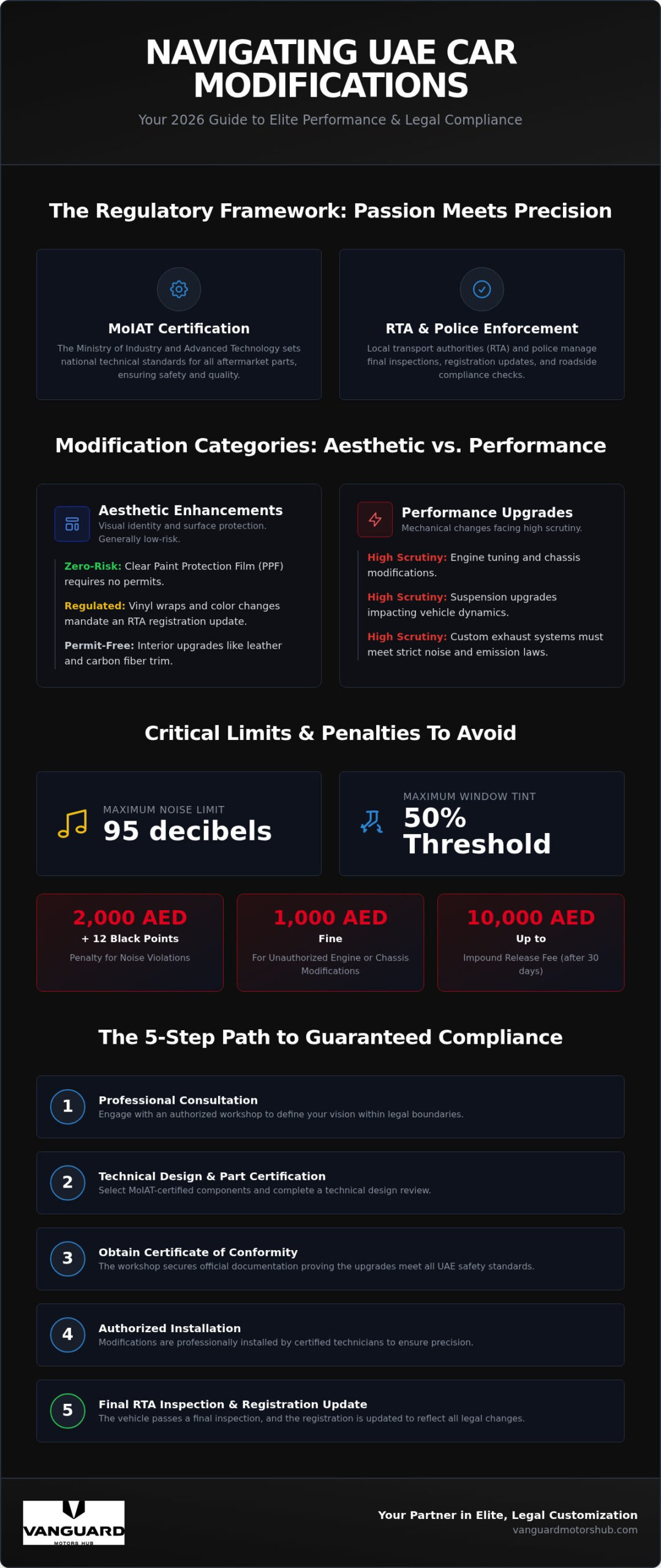
The 5-Step Approval Process for Car Modifications in 2026
Executing legal car modifications in UAE requires more than just a vision for performance; it demands a rigorous adherence to a multi-tiered approval system. In 2026, the process is streamlined but unforgiving to those who skip steps. This roadmap ensures your vehicle moves from the workshop to the open road with total regulatory certainty. Every phase is designed to verify that your enhancements enhance, rather than compromise, the vehicle’s engineering integrity.
- Step 1: Partner Selection. You must choose a MoIAT-approved workshop. This is the foundation of your build, as only authorized centers can issue the necessary technical certifications.
- Step 2: Technical Design Submission. Before a single bolt is turned, you must submit a detailed modification plan for initial review. This preview prevents you from investing in components that authorities may deem non-compliant.
- Step 3: Precision Installation. The work is carried out following certified safety protocols. Elite workshops document every stage of the process to prove that structural and aesthetic standards are met.
- Step 4: Compliance Verification. Your vehicle undergoes a technical inspection, typically costing between 150 AED and 200 AED for light vehicles. Upon passing, you receive a Certificate of Conformity.
- Step 5: Registration Update. The final step is updating your vehicle’s Mulkiya with the licensing authority, such as the RTA. This ensures your digital record matches your car’s new physical profile.
Documentation and Technical Certificates
The Certificate of Conformity is your most powerful asset. It serves as definitive proof to the RTA and police forces that your upgrades meet national safety benchmarks. In 2026, managing this paperwork is increasingly digital. You can use the MOI and RTA apps to store and present your modification permits during inspections. Always keep your original invoices; they act as a secondary layer of proof that the installation was performed by a licensed professional rather than an unauthorized garage.
Handling Failed Inspections
Modifications often fail the annual renewal test due to excessive noise or unauthorized chassis changes. If your vehicle fails, don’t panic. You can rectify non-compliant mods by returning to an authorized workshop to bring the components back within MoIAT limits. Professional consultants can help resolve complex disputes, especially when dealing with high-end bespoke kits. Resolving these issues early prevents the risk of the 10,000 AED impound release fee common in certain emirates. If you’re ready to start your build with a team that guarantees compliance, speak with our compliance experts today.
Vanguard Motors Dubai: Your Partner in Elite, Legal Customization
Vanguard Motors Dubai operates at the intersection of technical skill and creative expression. We understand that the path to legal car modifications in UAE is paved with stringent MoIAT standards and precise RTA requirements. By choosing an elite workshop, you bypass the anxiety of non-compliance and the risk of the 10,000 د.إ impound release fee. Our team handles the technical documentation and design submissions, ensuring that every carbon fiber upgrade or bespoke kit meets national safety benchmarks. We prioritize quality materials, such as aerospace-grade carbon fiber and premium vinyl, because superior components facilitate a smoother approval process during technical inspections.
High-end customization shouldn’t compromise the manufacturer’s original safety profile. Whether we are installing a Jetour kit or a complex Mansory conversion, our technicians meticulously align every component with factory sensors and structural crumple zones. This meticulous care extends to our aesthetic protection services. Clear PPF remains the gold standard for preserving your vehicle’s value without the need for permit updates, acting as a zero-risk entry point for new owners. We reduce owner stress by managing the entire lifecycle of the modification, from the initial engineering plan to the final registration update.
Precision Engineering and Aesthetic Protection
Our commitment to excellence is embodied in the Vanguard Premium Package. This holistic approach combines elite detailing with compliant structural enhancements, ensuring your vehicle is road-ready and show-room perfect. We treat leather restoration and forged carbon repair with the same precision as a full engine carbon cleaning. By maintaining factory safety standards during bespoke conversions, we protect your warranty and your peace of mind. Our restoration services for interior leather and carbon fiber are recognized as a national standard for durability and aesthetic brilliance.
Start Your Legal Customization Journey Today
The most successful builds begin with professional guidance. Before you commit to a specific modification, consult with our experts to ensure your vision aligns with 2026 regulations. We provide tailored advice on which kits are optimized for your specific vehicle model, whether you are looking for a Mercedes Brabus kit or a Lamborghini Mansory kit. Our proactive approach ensures 100% legality from the initial design to the final registration update on your Mulkiya. Take the first step toward a compliant, high-performance masterpiece by reaching out to our team.
Consult our customization experts on WhatsApp
Drive the Future of Compliant Automotive Excellence
Customizing a premium vehicle in the Emirates is a sophisticated pursuit that balances high-octane passion with professional precision. By prioritizing MoIAT-compliant installation standards and official registration updates, you ensure your investment remains an asset rather than a liability. You’ve seen how the right approach to legal car modifications in UAE protects you from unnecessary penalties while allowing for elite personalization. Success isn’t about avoiding the law; it’s about utilizing the established framework to showcase your unique style with confidence.
As a nationwide leader in premium automotive customization, Vanguard Motors Dubai specializes in the authorized installation of Brabus and Mansory kits. We manage the complex documentation and safety protocols, giving you the freedom to focus on the high-performance results. Your vehicle’s transformation is a statement of status and engineering integrity; don’t leave it to chance. Partner with experts who understand that every detail matters, from the first design submission to the final registration update.
Start your legal car modification journey on WhatsApp
Your vision for an elite build is within reach. We’re ready to bring your automotive masterpiece to life with total legal certainty and meticulous care.
Frequently Asked Questions
Is car wrapping legal in the UAE for 2026?
Car wrapping is fully legal in 2026 provided you obtain prior approval and update your vehicle’s registration card, known as the Mulkiya. If the wrap changes the base color, you must visit an RTA or police inspection center to ensure the new aesthetic matches the official record. Reflective or emergency-style colors remain strictly prohibited to maintain road safety standards.
Can I legally install a Brabus or Mansory body kit on my car?
You can legally install high-end body kits like Brabus or Mansory if the work is performed by a MoIAT-approved workshop. These conversions require a technical design review to ensure they don’t interfere with safety sensors or structural integrity. Once installed, the vehicle must pass a technical inspection to receive a Certificate of Conformity for final RTA registration.
What is the maximum legal window tint percentage in the UAE?
The maximum legal window tint percentage for private vehicles in the UAE is 50% for side and rear windows. Front windshields must remain largely untinted to maintain clear driver visibility and safety. Exceeding these limits can result in immediate fines and the requirement to remove the non-compliant film at your own expense during technical inspections.
Do I need a permit for Paint Protection Film (PPF)?
Clear Paint Protection Film (PPF) typically does not require a special permit because it doesn’t alter the vehicle’s recorded color. It’s considered a protective enhancement rather than a structural modification. However, if you opt for colored PPF that changes the car’s appearance, you must follow the same registration update process required for a standard vinyl wrap.
Are exhaust modifications legal for road-going vehicles?
Exhaust modifications are legal as long as the noise level does not exceed 95 decibels. Operating a vehicle that produces excessive noise can lead to a 2,000 د.إ fine and 12 black points on your license. It’s essential to use MoIAT-certified components and have them installed by professionals who can verify compliance using calibrated decibel meters before you hit the road.
What happens if I modify my car without RTA approval?
Modifying your vehicle without RTA approval can lead to severe consequences, including fines of 1,000 د.إ and 12 black points for unauthorized engine or chassis changes. Your vehicle may be impounded for 30 days, and in Abu Dhabi, reclaiming it requires a 10,000 د.إ release fee. Additionally, unauthorized mods often void your insurance coverage and manufacturer warranty.
Can I change my car’s color to a matte or chrome finish legally?
Matte finishes are legal if they are registered and the color matches the Mulkiya, but chrome or highly reflective finishes are typically restricted. These finishes can create dangerous glare for other motorists, which violates safety protocols. Always consult with a professional workshop to verify if your specific color choice meets current standards before beginning the application process.
Is it legal to add carbon fiber parts to my car’s exterior?
Adding carbon fiber parts to your car’s exterior is legal provided the components meet MoIAT durability and safety standards. These parts must be securely fitted by an authorized workshop to ensure they don’t compromise aerodynamic stability or structural integrity. Forged or traditional carbon fiber upgrades are a popular way to execute legal car modifications in UAE while enhancing aesthetic appeal.