
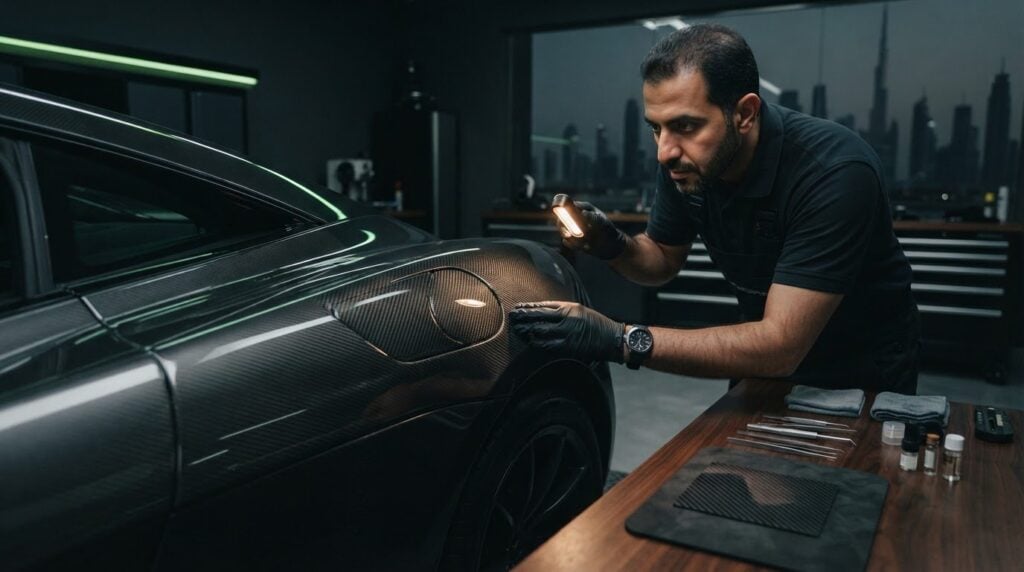
Can carbon fiber be repaired once and then forgotten? The appeal of a long-lasting maintenance-free carbon fiber repair is clear, especially if you’re concerned that damage could spread or a once-seamless finish might later crack, lift, or discolor. But “maintenance-free” is a claim to examine, not an assumption to make.
It’s reasonable to expect a repair to hold up and look refined. Its durability depends on what’s damaged, whether the issue is cosmetic or structural, whether the repair suits the part, and how the vehicle is used and cared for. Repair may be appropriate in one case; refinishing or replacement may make more sense in another.
This guide explains what durability claims can realistically mean, which factors influence carbon fiber repair longevity, and what aftercare a premium finish may still require. You’ll also learn why a professional assessment is the first step. Vanguard Motors Dubai offers carbon fiber installation and repair, with the next step guided by the component’s condition and your priorities for appearance, function, and ongoing care.
Key Takeaways
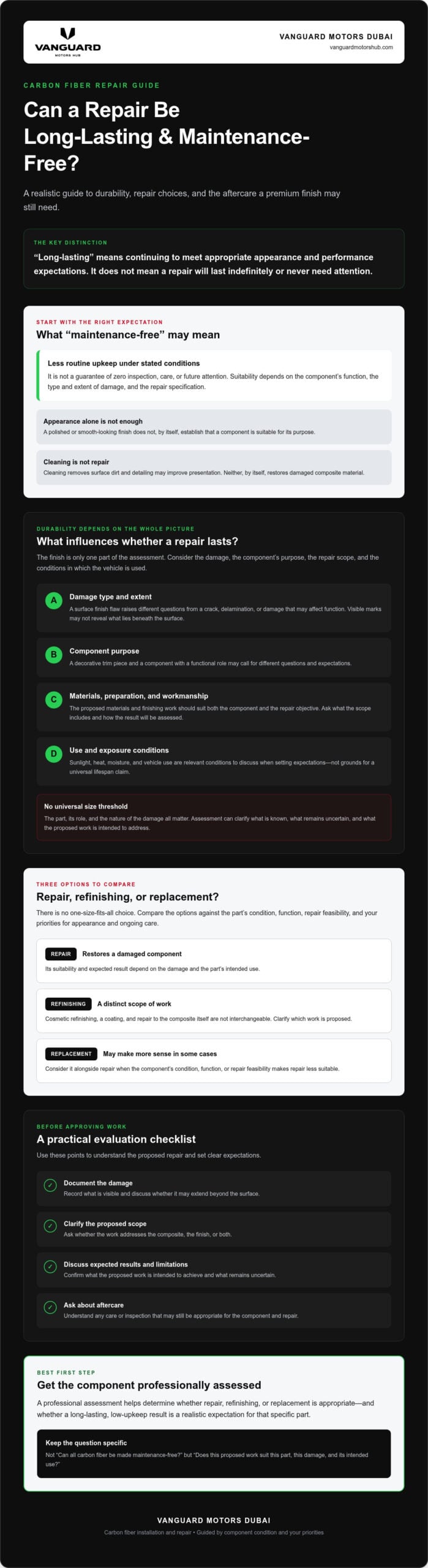
- “Long-lasting” means a repair continues to meet suitable appearance and performance expectations, not that it will never need attention.
- Look beyond visible marks: damage, component purpose, material compatibility, preparation, and finish can all influence durability.
- Compare repair, refinishing, and replacement based on the part’s condition, function, repair feasibility, and your priorities.
- Before approving work, document the damage and clarify the proposed scope, expected results, limitations, and aftercare.
- Get a professional assessment to decide whether long-lasting maintenance-free carbon fiber repair is a realistic expectation for your component.
What Does Long-Lasting Carbon Fiber Repair Actually Mean?
Carbon fiber repair restores a damaged component, but the suitable approach and expected result depend on the damage and the part’s intended use. A surface flaw on a decorative trim piece raises different questions from damage to a component with a functional role. In either case, a polished appearance alone doesn’t establish that the component is suitable for its purpose.
Carbon-fiber-reinforced polymer (CFRP) combines carbon fibers with a polymer matrix. That construction helps explain why an assessment must consider more than what’s visible on the surface. “Long-lasting” describes a repair that continues to meet appropriate performance and appearance expectations over time. It doesn’t promise that every repair will last indefinitely or remain unchanged in all conditions.
What does maintenance-free mean for a repaired carbon fiber part?
In practical terms, “maintenance-free” may mean less routine upkeep, not a guarantee that no inspection or care will ever be needed. Suitability depends on the component’s function, the type and extent of damage, and the repair specification. A visual check may not answer every question, particularly if damage could extend beyond the visible area.
Realistic expectation: A maintenance-free claim should mean reduced routine upkeep under stated conditions, not a promise of zero inspection, care, or future attention.
Keep repair separate from routine cleaning and cosmetic detailing. Cleaning can remove surface dirt; detailing can improve presentation. Neither, by itself, restores damaged composite material. Likewise, don’t judge a repair intended to address a component’s condition only by whether its finish looks smooth.
Why is automotive carbon fiber different from industrial composite repair?
Industrial composite repair may address tanks, pipes, or infrastructure, where the asset, operating conditions, repair specification, and performance criteria differ from those for a vehicle part. Automotive components also have visible finishes and fit within a vehicle’s design and function. An industrial coating described as maintenance-free isn’t evidence that a repaired automotive component will need no inspection or care.
Claims should be specific to the application. A coating, a repair to the composite itself, and cosmetic refinishing are different scopes of work, so their durability expectations shouldn’t be treated as interchangeable. For more context on structural restoration, see this carbon fiber repair guide. The key question isn’t whether all carbon fiber can be made maintenance-free, but whether the proposed repair suits the particular part, damage, and intended use.
Which Factors Determine Whether Carbon Fiber Repair Lasts?
Repair durability isn’t determined by the finish alone. It depends on the damage, the component’s purpose, whether the proposed materials suit that part, and how the repair is prepared and completed. The vehicle’s use and exposure conditions also matter when setting expectations.
A visual check can reveal a scratch or visible crack, but it may not establish whether damage extends beneath the surface or affects structural function. That uncertainty makes an assessment important before choosing a repair approach. Don’t treat a smooth appearance as proof that the component is suitable for every use.
How does damage type affect repair suitability?
Surface-level finish damage may call for a different solution from a crack, delamination, or damage that could affect a component’s function. Deeper or less clearly defined damage may require specialist assessment to determine whether repair is appropriate or replacement should be considered.
There’s no universal size threshold that determines the right choice. The part, its role, and the nature of the damage all matter. A professional assessment can clarify what is known, what remains uncertain, and what the proposed work is intended to address.
How do materials, preparation, and finish influence longevity?
Materials and finishing work should suit both the component and the repair objective. Preparation and workmanship are also worth discussing. Ask what the proposed scope includes and how the result will be assessed instead of assuming every repair follows the same process. No specific material or procedure should be treated as suitable for every carbon fiber part.
Sunlight, heat, moisture, and vehicle use are relevant conditions to raise during an assessment, not grounds for a universal lifespan claim. Their effects depend on the component and repair details, so technical conclusions should be verified for the part in question.
Quotable takeaway: Damage, component purpose, material compatibility, preparation, workmanship, finish, and use conditions all influence repair longevity. Technical specifics should be verified for the individual part.
Use this checklist to make the discussion more precise:
- Damage: Is the issue limited to the visible finish, or could it extend deeper?
- Purpose: What function does the component serve, and how is the vehicle used?
- Conditions: What sunlight, heat, or moisture exposure should be considered?
- Scope: What materials, preparation, and finish are proposed, and what limitations apply?
- Expectations: What should be monitored, and when should the part be reassessed?
These questions help you assess claims about long-lasting maintenance-free carbon fiber repair without relying on unsupported guarantees. If you’re considering a repair, ask Vanguard Motors about carbon fiber repair options and share details about the component and damage.
Carbon Fiber Repair, Refinishing, or Replacement: How Do You Compare Them?
These options address different problems. Repair aims to restore a damaged component; refinishing focuses on its appearance; replacement means removing the existing part and fitting another. A fresh-looking surface doesn’t confirm that damage affecting the component’s function has been resolved. The right choice depends on an assessment, the part’s role, repair feasibility, and your priorities for appearance, function, and ongoing care.
| Option | Damage or condition | Primary goal | What remains uncertain | Care considerations |
|---|---|---|---|---|
| Repair | Damage that an assessment finds suitable to address through restoration. | Restore the existing component while considering its intended use and appearance. | Whether the damage and component allow a suitable repair, and what result is achievable. | Ask what to monitor and whether any follow-up care or reassessment is advised. |
| Refinishing | A finish that needs cosmetic attention, once the component’s condition has been considered. | Improve surface appearance, such as the visible finish. | Whether the concern is only cosmetic or is linked to deeper damage. | Clarify care for the finish and remember that cosmetic work alone doesn’t restore structural function. |
| Replacement | Damage that may not be suitable for repair, or uncertainty that needs to be resolved before committing to restoration. | Replace the existing part rather than restore it. | Whether replacement is the appropriate choice for the vehicle and component. | Ask about care requirements for the replacement part and its finish. |
When might repair be worth assessing?
Repair is worth discussing when the component and damage appear potentially suitable for restoration. Consider what matters most: retaining the existing part, improving its appearance, or meeting the demands of its intended use. An assessment can help weigh those priorities against the visible condition and any uncertainty. It doesn’t guarantee that repair will be recommended or that every appearance goal can be achieved.
When should replacement or further inspection be considered?
If damage appears extensive, its depth is unclear, or the part has a functional role, seek further evaluation before deciding. The more important the component’s function is to your decision, the more useful it is to understand what an assessment can establish and where uncertainty remains. Replacement discussions should consider both the part’s role and confidence in the proposed repair outcome, not appearance alone.
There’s no universal rule that repair always outperforms replacement, or that replacement is automatically the safer choice. Before expecting a long-lasting maintenance-free carbon fiber repair, establish what the work is intended to address, what limitations apply, and what care may still be needed. Then compare the options against your priorities.
How Can You Evaluate a Carbon Fiber Repair for Long-Term Care?
Before approving work, make sure you understand what’s damaged, what the repair is meant to achieve, and what care may be needed afterwards. A clear discussion helps you compare the expected appearance with the component’s intended function, without treating “maintenance-free” as a promise that no future attention will ever be required.
What should you ask before approving a repair?
Use this checklist to structure the conversation and record the answers:
- 1. Document the damage. Photograph the visible area and note when or how you noticed it, if known. Ask what can be seen and whether anything needs further assessment.
- 2. Clarify how the part is used. Explain the component’s role and how the vehicle is driven or used. Function can influence which results matter beyond appearance.
- 3. Request an assessment. Ask what the assessment can establish and what may remain uncertain. A visible inspection alone may not answer every question about damage beneath the surface.
- 4. Understand the proposed scope. Ask what the work is intended to achieve, how the result will be evaluated, and what limitations you should understand beforehand. Clarify whether the goal is cosmetic, functional, or both.
- 5. Confirm aftercare. Request care and cleaning instructions for the specific repair. Ask which changes, such as a new crack, lifting, or a visible change in the finish, should prompt follow-up inspection.
What aftercare is sensible without over-maintaining the component?
Follow the repair provider’s guidance for the specific component and finish. If cleaning is advised, use only a method and products confirmed as suitable for that repair. Don’t assume general advice for paint, plastic, or another composite automatically applies.
Periodic visual checks can help you notice changes, but there’s no need to invent a fixed inspection schedule if the provider hasn’t recommended one. If you see a change or aren’t sure whether it matters, ask whether the part should be reassessed. Cleaning, coatings, or detailing products can’t substitute for a repair suited to the damage.
These steps make expectations clearer than an unqualified promise of long-lasting maintenance-free carbon fiber repair. You’ll know what the work is designed to address, what care is recommended, and when to seek another opinion. To discuss a carbon fiber component and its repair considerations, contact Vanguard Motors about carbon fiber repair.
How Can Vanguard Motors Help Assess Carbon Fiber Repair Options?
Vanguard Motors offers carbon fiber installation and repair as part of its automotive customization services. If a component is damaged, a conversation can help identify a sensible next step: whether repair may be suitable, whether further assessment is needed, or whether another option should be considered. Start with the specific part and your priorities before settling on a direction.
Expectations should be specific to the component. Suitability, achievable finish, functional considerations, limitations, and aftercare depend on the part and what an assessment can establish. No discussion should be treated as a promise of a particular result or a guarantee of long-lasting maintenance-free carbon fiber repair.
What information helps start a repair conversation?
A clear description gives the discussion a useful starting point. Share:
- The vehicle: Include its make, model, and year if you know them.
- The component: Identify the affected carbon fiber part and where it is fitted.
- The visible damage: Describe what you can see, such as a scratch, crack, or change in the finish, and when you first noticed it if known.
- Your priority: Say whether appearance, function, or both are most important to you.
Clear photographs can help communicate the visible condition. They may not show the full extent of damage or replace an in-person inspection, so ask what can and can’t be concluded from images alone. If you’re uncertain about the part’s function or the damage, say so. That context helps keep expectations grounded.
How do you take the next step with Vanguard Motors?
Start by identifying what you want the component to achieve and what matters most in the result. Then discuss the part and damage, ask about an appropriate assessment, and clarify the proposed scope before deciding. Find out what outcome is intended, what limitations remain, and which care guidance applies if work proceeds.
This sequence helps separate a visual improvement from a repair intended to address the component itself. It also gives you a basis for comparing repair with other options, without assuming repair is automatically suitable. Vanguard Motors offers carbon fiber installation and repair; discuss specific methods, outcomes, and aftercare for your component rather than assuming them.
Share your vehicle details, the affected part, and your priorities to begin the conversation. Discuss your carbon fiber repair options
Make Your Next Carbon Fiber Repair Decision with Confidence
A durable repair starts with understanding the damage and the component’s purpose. Appearance alone can’t confirm whether a part’s function is unaffected, so compare repair, refinishing, and replacement only after considering the condition and repair feasibility. Keep expectations realistic too: “maintenance-free” shouldn’t mean that no inspection or care will ever be needed.
Before approving work, clarify the proposed scope, intended result, limitations, and provider-specific aftercare. These details help you judge whether a long-lasting maintenance-free carbon fiber repair is a realistic expectation for your vehicle, without relying on an absolute promise.
Vanguard Motors offers carbon fiber installation and repair alongside automotive customization and cosmetic repair. Share details about your vehicle, the affected component, and your priorities to start a focused conversation about possible options.
Discuss your carbon fiber repair options to get a clearer view of what your component may need. A considered assessment puts appearance, function, and ongoing care in focus.
Frequently Asked Questions
Can carbon fiber be repaired instead of replaced?
Yes, some carbon fiber components may be suitable for repair, but an assessment should guide the decision. The damage, component’s function, and intended use all matter. A surface blemish may call for a different approach from a crack or damage that could affect the part’s role. Vanguard Motors offers carbon fiber installation and repair, but suitability and the appropriate option must be considered for the specific component.
Is carbon fiber repair maintenance-free?
Not as a universal promise. A repair may need little routine attention, but that doesn’t mean the component will never need care or inspection. Ask the provider what the repair is designed to achieve, what limitations apply, and which changes should prompt reassessment. Treat the phrase long-lasting maintenance-free carbon fiber repair cautiously unless the claim clearly explains its conditions and doesn’t imply zero future attention.
How long does a carbon fiber repair last?
There isn’t a single lifespan that applies to every carbon fiber repair. Longevity can depend on the original damage, the component’s purpose, the suitability of the repair, and how the vehicle is used and cared for. Ask the provider what durability expectations are reasonable for your particular part and what those expectations depend on. Be cautious of a fixed lifespan stated without an assessment and explanation.
What can cause a carbon fiber repair to fail or become visible?
A repair may be less durable or more noticeable if the damage wasn’t fully understood, the approach or materials don’t suit the component, or the desired finish is difficult to achieve. Preparation, workmanship, use, and exposure conditions may also be relevant, depending on the part and repair. Ask which factors apply in your case, how the result will be evaluated, and what changes should lead you to seek reassessment.
Can a cracked carbon fiber part be repaired safely?
Possibly, but assess a crack before concluding that repair is suitable. Its visible appearance alone may not show the full extent of damage or whether the component’s function is affected. The right decision depends on the part, its role, and what an inspection establishes. Ask what is known, what remains uncertain, and whether repair or replacement is appropriate before relying on the component.
How should I care for a repaired carbon fiber part?
Follow the care instructions provided for the specific repair and component. Ask which cleaning methods and products are suitable, and check the surface periodically for changes such as a new crack, lifting, or a visible change in finish. Seek guidance if you notice anything concerning. Don’t assume general detailing advice, coatings, or cleaning products are appropriate for every repair, or that cosmetic care can substitute for sound restoration.
How do I choose between carbon fiber repair and replacement?
Choose based on an assessment of the damage, the component’s function, repair feasibility, and your priorities for appearance and ongoing care. Repair may be worth considering if the part and damage are suitable; replacement may warrant discussion if damage is extensive or uncertainty remains. Ask what each option is intended to address, what limitations apply, and how the outcome will be evaluated before deciding.