
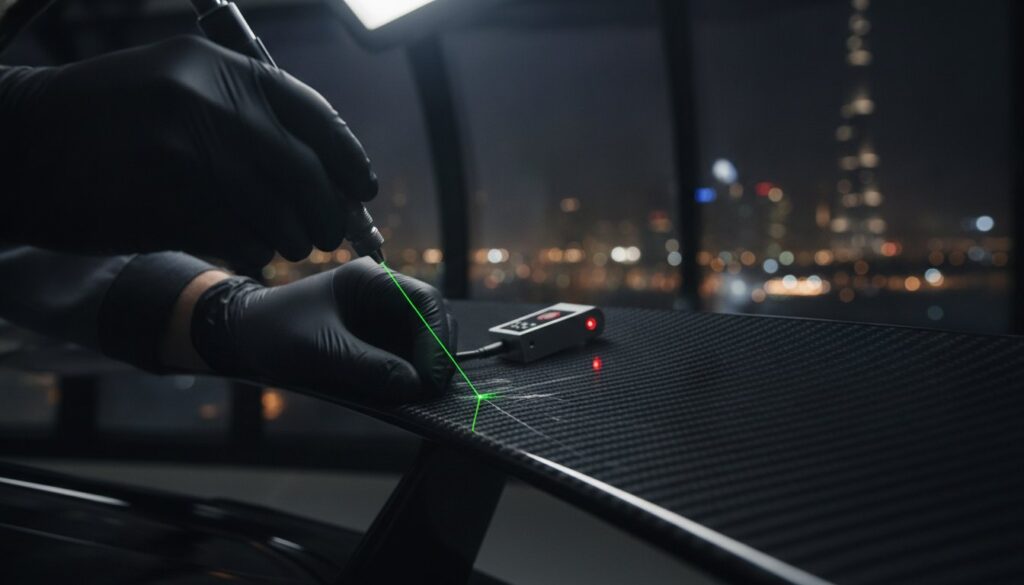
A single hairline fracture in a carbon fibre weave is more than a cosmetic blemish; it is a silent threat to your vehicle’s structural integrity and market value. You invested in a high-performance machine because you demand the pinnacle of engineering, yet harsh environmental elements and high-speed road debris often lead to yellowing, clouding, or dangerous cracks. The prospect of a structural failure at high speeds is a legitimate concern, while the cost of replacing a full Mansory or Brabus component can easily exceed 20,000 dollars.
Professional carbon fiber car parts repair has evolved into a precise surgical science that prioritizes molecular bonding over simple cosmetic patching. You don’t have to settle for aesthetic degradation or the extreme expense of total replacement. This 2026 guide, presented by Vanguard Motors Dubai, explores the technical precision required to restore high-performance components to their original glory. We will detail the advanced resin systems engineered for diverse environmental demands, the structural restoration process that ensures safety, and how the right expertise can fully recover your vehicle’s elite aesthetic and resale potential.
Key Takeaways
- Distinguish between surface-level UV yellowing and critical structural fractures to ensure your vehicle remains safe for high-speed performance.
- Understand the technical precision of carbon fiber car parts repair, specifically the role of vacuum bagging and resin infusion in restoring molecular integrity.
- Evaluate the cost-efficiency of professional restoration compared to the significant investment required for new Brabus or Mansory carbon components.
- Learn why utilizing UV-stable resins specifically formulated for the UAE climate is vital for preventing future clouding and aesthetic degradation.
- Discover how to maintain your vehicle’s elite resale value by integrating expert composite restoration with advanced protective finishes.
Understanding Carbon Fibre: Why Precision Restoration Matters
Carbon fibre is the backbone of modern supercar engineering. It isn’t just about the look; it’s about the physics of speed and the pursuit of weight reduction. High-end manufacturers like Brabus and Mansory rely on these composites because they can be up to 50% lighter than traditional steel. A 10% reduction in vehicle weight can lead to a 6-8% improvement in fuel economy, but for luxury owners in the UAE, the real draw is the drastic improvement in power-to-weight ratios and aerodynamic stability. Understanding the complexity of this material is the first step in successful carbon fiber car parts repair.
The Composite Structure: Weave and Resin
At its core, carbon fibre is a two-part system: the carbon weave and the epoxy resin matrix. The weave provides the tensile strength, while the resin holds the fibers in place and distributes the load. You’ll encounter “dry carbon” in high-performance kits, which is cured in an autoclave under high pressure for maximum density. “Wet carbon” is more common for aesthetic parts where resin is applied manually. Carbon fiber reinforced polymer is a high-strength, low-weight material used in elite automotive engineering to maximize performance without sacrificing structural rigidity. The orientation of these fibers is critical; they are designed to handle forces in specific directions. If a repair ignores this orientation, the part may look perfect but fail under the stress of high-speed driving.
Why Standard Body Shop Methods Fail
Traditional collision repair relies on body fillers and sanding techniques designed for metal, which are disastrous for composites. Sanding carbon fibre requires surgical precision. If a technician sands too deep, they sever the structural fibers and permanently weaken the component. You can’t just “fill and paint” a crack in a front splitter and expect it to hold at 300 km/h. High-performance carbon fiber car parts repair requires a deep understanding of chemical bonding and specialized resins that can withstand the intense heat of the Middle East. Specialized composite technicians at Vanguard Motors Dubai use vacuum bagging and specific curing cycles that standard body shops simply cannot replicate. Precision isn’t an option; it’s a requirement for safety and performance.
Identifying Damage: Cracks, Yellowing, and Delamination
Recognizing the severity of composite damage is a skill that separates elite owners from those who risk catastrophic failure. Damage generally falls into two categories: cosmetic surface wear and internal structural compromise. While a scratch in the clear coat might only offend your aesthetic sensibilities, a fracture in the weave can lead to total component failure at high speeds. This distinction is critical when evaluating the necessity of carbon fiber car parts repair for your supercar or luxury vehicle.
Delamination is perhaps the most insidious form of damage. It occurs when the individual layers of carbon fabric begin to separate from the resin matrix or each other. This internal separation often results from manufacturing defects or localized impacts. In the high-performance world, impact damage usually manifests as spider-web cracks or shattered fibers, often caused by track debris or road hazards at high velocities. These aren’t just scratches; they’re interruptions in the load path of the part. If the weave is visible and looks “fuzzy” or frayed, the structural integrity has been compromised.
UV Degradation and Resin Clouding
The UAE’s climate presents a unique challenge for composite longevity. Intense UV radiation and ambient temperatures exceeding 50°C accelerate the molecular breakdown of standard epoxy resins. This chemical degradation leads to yellowing or a “cloudy” appearance, often referred to as “dead” carbon. When the resin loses its clarity, it isn’t just an eyesore; it’s a sign that the matrix is becoming brittle. High-quality, UV-stable clear coats are your first line of defense, acting as a sacrificial barrier to preserve the resin’s chemical structure. If you notice a milky haze on your Mansory hood or Brabus trim, the protective layers have likely failed. Understanding the full scope of surface-level damage is essential, and our guide to carbon fiber cosmetic repair and invisible restoration techniques provides a detailed blueprint for addressing these precise issues.
Structural Cracks and Impact Voids
High-velocity debris acts like a projectile, creating micro-fractures that penetrate the weave. These impact voids are particularly dangerous because they allow moisture ingress. In the humid coastal air of Dubai, water can seep into these cracks, causing the fibers to swell or the resin to weaken from the inside out. Visual cues like localized bulging, “bruising” of the weave, or cracks that catch a fingernail indicate the part is no longer safe for high-speed use. Ignoring these signs can lead to the part shattering under aerodynamic load. If you suspect your aero-kit has suffered an impact, it’s vital to consult a specialist for a structural assessment before your next track day. Professional carbon fiber car parts repair ensures these fractures are sealed and the structural integrity is fully restored.
The Science of Carbon Fibre Repair and Refinishing
Restoring a composite component is a meticulous technical ballet that demands absolute precision. The process begins with a surgical cleaning and controlled removal of the damaged matrix. Unlike metal, you cannot simply hammer out a dent. For structural integrity, we utilize resin infusion and vacuum bagging. This technique involves sealing the part in a vacuum-tight bag to extract every pocket of air, ensuring the new resin penetrates the weave without voids. It creates a bond that is often stronger than the surrounding material, which is the gold standard for carbon fiber car parts repair.
Heat-cycled curing is a non-negotiable step for any vehicle operating in the Middle East. If the repair isn’t cured at specific temperatures, the intense Dubai sun will cause the resin to expand and contract at different rates than the original part. This leads to “print-through,” where the weave texture becomes visible through the clear coat. Proper curing ensures the repair remains stable and durable even when the asphalt hits 60°C. It’s about ensuring the molecular structure can withstand the extreme thermal cycles of the UAE.
Weave Alignment and Aesthetic Matching
Matching the visual signature of a supercar is the ultimate test of a technician’s skill. Whether it’s a traditional 2×2 twill or the chaotic beauty of forged carbon, the alignment must be perfect. We use specialized techniques to “step” the repair, overlapping new layers of carbon cloth so the transition is invisible to the naked eye. Achieving a seamless result requires matching the exact weight and thread count of the original fabric. Precision is paramount when matching 2×2 twill or forged carbon patterns to ensure the repair doesn’t disrupt the visual flow of a Mansory or Brabus body kit. For a deeper understanding of how specialists achieve a truly invisible finish, the professional approach to carbon fiber cosmetic repair outlines the exact surgical steps required to align weave patterns and match resin tints flawlessly.
Advanced Clear Coating and Polishing
The final stage is where the transformation truly happens. We employ a multi-stage sanding process, starting with coarse grits and finishing with ultra-fine polishing compounds to achieve a mirror finish. Using high-solids, UV-resistant automotive clears is essential to lock in the repair and prevent future yellowing. To maintain this factory-standard finish, we often recommend applying Paint Protection Film (PPF) as the ultimate post-repair safeguard. This final layer of protection ensures your carbon fiber car parts repair remains pristine against the harsh desert environment and road debris.
Repair vs. Replacement: Making the Right Investment
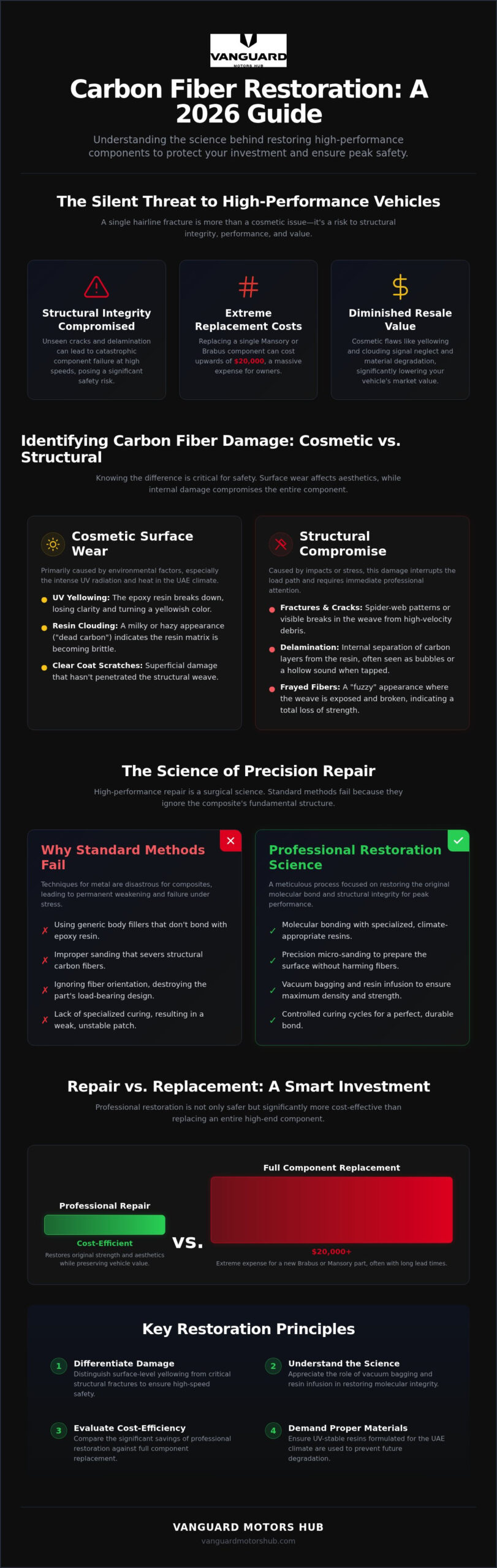
The decision to restore or replace a composite component is a high-stakes calculation involving safety, cost, and logistics. For owners of elite marques, the financial gap is significant. A full body kit from a premier tuner like Mansory or Brabus can represent an investment ranging from 20,000 د.إ to over 75,000 د.إ. Choosing professional carbon fiber car parts repair over a total replacement often yields a factory-standard finish at a fraction of the cost. Beyond the immediate savings, repairing a part locally in Dubai eliminates the weeks of downtime associated with international shipping and customs for bespoke European kits. For collectors who demand invisible results that preserve their vehicle’s original DNA, understanding the full scope of cosmetic car repair techniques for luxury automotive restoration is essential to making the right investment decision.
Provenance is another critical factor. For limited-edition vehicles, maintaining the original parts that were factory-fitted or installed during a specific conversion period is vital for the car’s history. A meticulously restored original part preserves the vehicle’s “period-correct” status, which is a major driver of resale value in the collector market. If the damage is manageable, restoration is almost always the superior path for both your portfolio and your vehicle’s legacy. A comprehensive approach to vehicle preservation extends beyond the exterior; pairing composite restoration with professional luxury car interior deep cleaning ensures every dimension of your supercar reflects the same standard of excellence and protects its overall investment value.
When is Replacement Mandatory?
Safety is the only metric that overrides cost. Certain “critical failure points” make replacement the only responsible choice. Aerodynamic components that endure extreme downforce, such as active rear wings or front splitters on track-focused supercars, must be replaced if the internal weave is shattered. If a part has suffered a major fracture that disrupts the primary load path, the risk of it disintegrating at 300 km/h is too high. We generally follow the “50% rule”: if the cost of a complex, structural carbon fiber car parts repair approaches half the price of a new OEM component, replacement becomes the more logical investment for long-term peace of mind.
The Value of Restoring Limited Edition Kits
Finding replacement panels for older or discontinued kits from Brabus or Mansory can be nearly impossible. In these scenarios, professional restoration isn’t just a choice; it’s a necessity to keep the car on the road. Specialist technicians can reconstruct missing sections of the weave and match the unique resin tint used by specific tuners years ago. This level of craftsmanship ensures that your investment remains visually and structurally cohesive. To determine if your specific component is a candidate for restoration, consult with Vanguard Motors Dubai experts via WhatsApp for a detailed damage assessment and a bespoke restoration plan.
Professional Carbon Fibre Installation and Care at Vanguard Motors
Vanguard Motors Dubai stands at the zenith of automotive composite care for the region’s most discerning collectors. Our facility is engineered to provide a seamless transition from structural restoration to aesthetic perfection. We understand that a supercar is more than a vehicle; it’s a high-stakes investment that requires a technician who respects the original engineering. Whether you are recovering from track-day impacts or reversing years of sun exposure, our approach ensures that every carbon fiber car parts repair meets the exacting standards of elite European tuners.
Bespoke Kit Conversions and Installation
Our expertise is rooted in the precision installation of elite aerodynamic systems. We specialize in the fitment of Brabus Body Kits and Mansory components, utilizing factory-spec hardware and specialized bonding agents that resist the intense vibrations of high-speed travel. Proper installation is as critical as the repair itself; incorrect mounting can lead to stress fractures or aerodynamic instability. By ensuring every panel aligns with factory mounting points, we maintain the vehicle’s original aero-balance while delivering a transformative visual presence.
Long-term Care and Protection Strategies
Preserving the depth and clarity of your carbon fibre requires a dedicated maintenance protocol. Standard alkaline soaps can accelerate resin degradation, so we recommend pH-neutral cleaning agents that protect the epoxy matrix. Beyond cleaning, ceramic coatings provide a hydrophobic barrier that repels the abrasive sand and industrial fallout common in Dubai. This protection, combined with our expert carbon fiber car parts repair services, creates a holistic care ecosystem. For owners seeking a complete preservation strategy, our supercar detailing reference guide to meticulous automotive preservation outlines the full spectrum of advanced techniques required to maintain showroom-grade excellence in the UAE environment. To ensure your vehicle remains a benchmark of excellence, we invite you to book a consultation for your supercar with our specialist team.
Elevating Your Vehicle’s Performance Legacy
Your supercar is a masterpiece of engineering that deserves more than temporary fixes. We’ve explored the critical difference between surface clouding and structural fractures, highlighting how specialized vacuum bagging and weave matching preserve your vehicle’s soul. By choosing precision over compromise, you ensure that every component remains safe for high-speed performance while retaining the elite aesthetic that defines your lifestyle. Maintaining the provenance of your machine is a strategic investment in both its history and its future market value.
Vanguard Motors Hub offers a comprehensive supercar detailing and protection ecosystem designed specifically for the unique challenges of the UAE. We specialize in Brabus and Mansory kit restoration, utilizing advanced UV-resistant resin technology to combat the intense desert sun. Our approach to carbon fiber car parts repair prioritizes molecular integrity and visual perfection, allowing you to drive with total confidence. You don’t have to settle for degraded composites when factory-standard restoration is within reach.
Connect with our Carbon Restoration Specialists on WhatsApp to restore your vehicle’s factory-standard finish today. Your pursuit of automotive excellence deserves a partner who values precision as much as you do.
Frequently Asked Questions
Can carbon fibre car parts be repaired if they are cracked?
Yes, most carbon components are repairable if the internal weave hasn’t suffered a catastrophic load failure. Technicians use advanced resin infusion and vacuum bagging to bridge fractures and restore the part’s original rigidity. Minor cracks and surface chips are standard candidates for restoration. However, a professional assessment is vital for aerodynamic parts like splitters to ensure they remain safe under the extreme pressures of high-speed driving.
Why does my carbon fibre look yellow or cloudy?
Yellowing or clouding is the visual result of UV degradation within the epoxy resin matrix. The intense UAE sun breaks down the chemical bonds in standard resins if they aren’t protected by a high-quality, UV-stable clear coat. This “cloudy” appearance indicates the resin is becoming brittle and losing its protective qualities. Professional refinishing can strip away the dead layers and restore the deep, three-dimensional luster of the original weave.
How much does it cost to repair carbon fibre car parts?
The investment required depends entirely on the damage severity and the complexity of the weave pattern. Cosmetic clear coat restoration is significantly more accessible than structural repairs involving carbon cloth overlays and heat-cycled curing. For owners of elite Brabus or Mansory kits, the cost of a precision repair is a fraction of the expense required for a full component replacement and international shipping to Dubai.
Is a repaired carbon fibre part as strong as a new one?
A professional carbon fiber car parts repair can restore a component to its original structural integrity. By matching the fibre orientation and using industrial-grade resins, technicians ensure the part handles stress exactly as the manufacturer intended. While a repaired part is structurally sound for high-performance use, parts that have suffered total internal shattering are usually replaced to maintain the absolute safety standards required for supercars.
Can forged carbon be repaired as easily as woven carbon?
Forged carbon is often easier to restore aesthetically because it lacks the repetitive geometric pattern of traditional weaves. The randomized orientation of chopped carbon fibers allows technicians to blend new material into the damaged area with nearly perfect invisibility. This makes forged carbon an excellent candidate for seamless repairs, as there’s no risk of a “misaligned” pattern disrupting the visual flow of the component.
How long does a professional carbon fibre restoration take?
A meticulous restoration typically requires three to seven working days. This timeframe allows for the essential cleaning, resin application, and critical heat-curing cycles necessary for the Dubai climate. Curing cannot be rushed; the resin must stabilize at specific temperatures to prevent future “print-through” or shrinking. This disciplined approach ensures the finished repair remains stable and flawless even when the vehicle is exposed to extreme summer heat.
Will the repair be visible on my supercar?
When executed by elite composite specialists, a carbon fiber car parts repair is virtually invisible. Achieving this result requires surgical precision in weave alignment and bespoke resin tinting to match the existing finish. Once the part is clear-coated and polished to a mirror shine, the transition between the original material and the repaired section disappears. It’s a process that prioritizes aesthetic perfection alongside structural restoration.
How can I protect my carbon fibre from the UAE heat?
The most effective strategy is a multi-layered defense. Combining a UV-resistant clear coat with a high-grade ceramic coating creates a powerful barrier against solar radiation and environmental contaminants. For maximum longevity, many owners opt for Paint Protection Film (PPF), which provides a physical shield against road debris. Regular maintenance using pH-neutral cleansers will also prevent the chemical etching and resin degradation common in high-heat environments.