
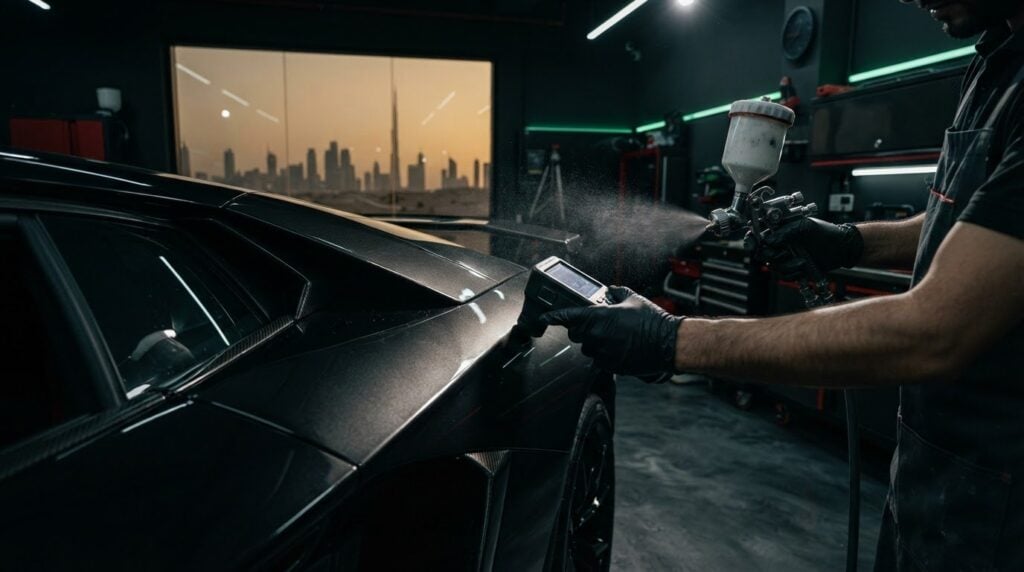
The exact factory paint code is often the primary reason an automotive repair ends up looking like an obvious patch job. When dealing with real-world UV exposure and clear coat aging, simply spraying factory-spec color leaves telltale halo lines that slash a vehicle’s secondary value. Successfully blending new paint with factory paint is an exacting chemical and environmental calibration, not a basic color-matching exercise. You already know the dread of spotting a mismatched panel in direct sunlight, where harsh flop angle shifts ruin an otherwise pristine exterior.
You shouldn’t have to gamble your vehicle’s finish on visible repair borders or compromised clear coats. Discover the technical engineering and professional techniques required to create an invisible transition between fresh automotive coatings and original OEM panels. We examine how master technicians use multi-angle pigment alignment, modern waterborne blending agents, and durable surface protection to deliver a flawless, showroom-grade result that withstands the most discerning inspection.
Key Takeaways
- Understand why OEM color codes are merely a baseline, requiring digital multi-angle analysis to compensate for real-world UV exposure and clear coat degradation.
- Discover how mechanical feathering and specialized step-down techniques achieve an undetectable transition when blending new paint with factory paint.
- Learn how extreme ambient heat cycles and thermal expansion impact clear coat adhesion along critical blend zones.
- Evaluate the performance boundaries of professional cosmetic repair and smart repair versus high-risk DIY touch-up attempts.
- Explore how post-finish Paint Protection Film (PPF) installation and modern peelable paint applications safeguard your investment and preserve vehicle resale value.
The Science of Color Theory: Why Blending New Paint with Factory Paint is Essential
Automotive paint blending is the controlled process of tapering fresh basecoat into adjacent factory panels to create an imperceptible visual transition. Many DIY touch-up systems promise a flawless match based solely on an OEM paint code. In practice, relying strictly on a formula code guarantees a visible discrepancy. Factory finishes change chemically from day one, subject to heat, wash chemicals, and environmental degradation.
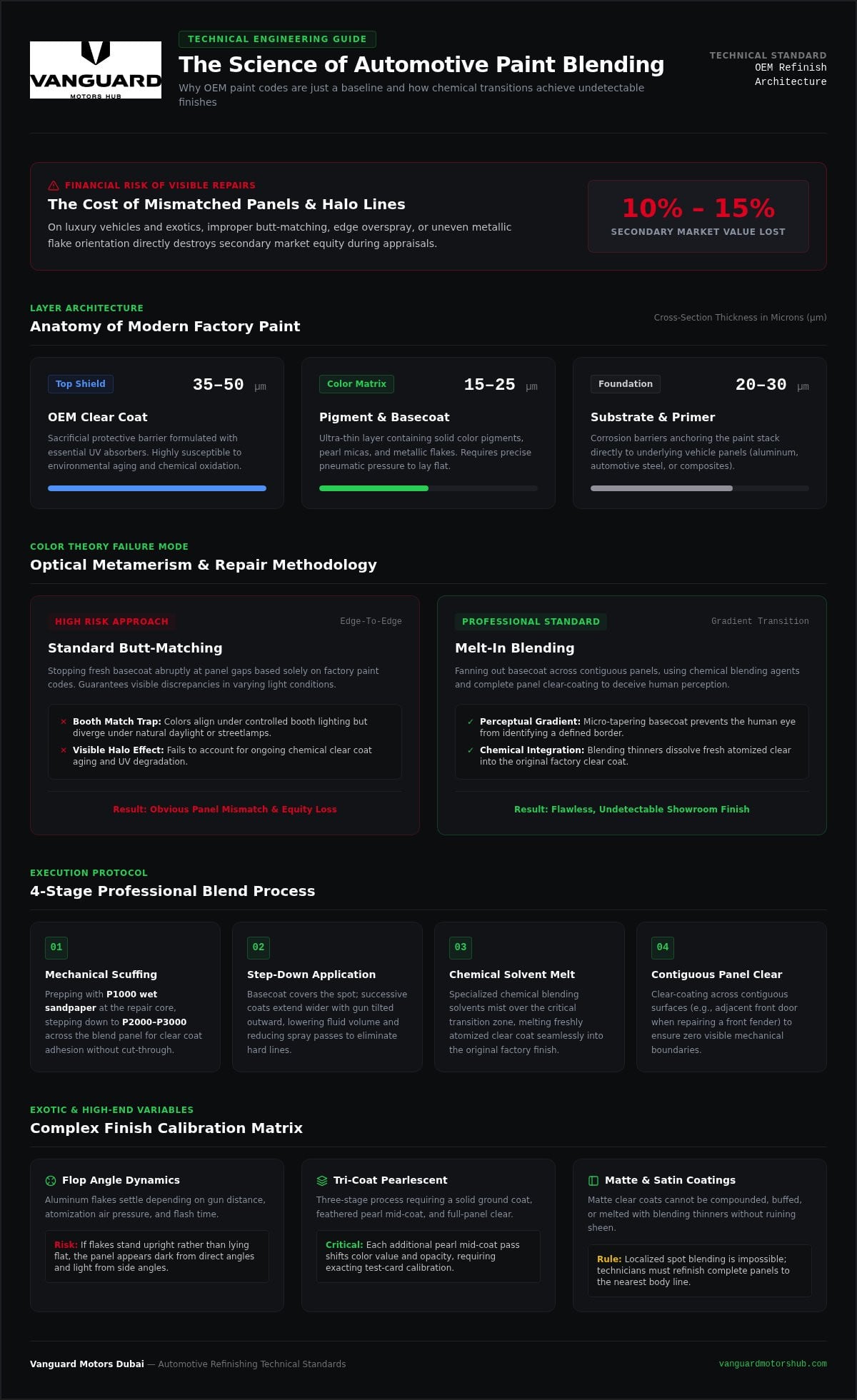
A major challenge stems from optical metamerism, an effect where two pigment formulations match under controlled booth lighting yet diverge sharply in direct daylight or under high-pressure sodium street lamps. Standard butt-matching, which stops fresh paint abruptly at a panel gap, exposes this phenomenon immediately. Professional technicians rely on melt-in blending techniques instead, fanning basecoat across original clear coat and clear-coating entire panels to fool human perception.
The Anatomy of Modern Factory Paint
Factory coating stacks require precise mechanical understanding before applying fresh materials:
- Substrate & Primer: Corrosion barriers measuring 20 to 30 microns that anchor the finish to aluminum, steel, or composites.
- Basecoat: Color, metallic flakes, and pearl micas packed into a thin layer of 15 to 25 microns.
- OEM Clear Coat: A sacrificial 35 to 50-micron protective shield containing essential UV absorbers.
Automated electrostatic bell applicators at the factory lay clear coat with uniform film builds that manual HVLP guns cannot mirror without custom adjustment. Modern waterborne refinish lines must also integrate over older solvent chemistries. Without balanced solvent flash-off and pressure calibration, visual defects like excessive orange peel become obvious.
Why ‘Close Enough’ Isn’t Enough for Supercars
A poor cosmetic repair directly harms vehicle equity. On exotics and luxury vehicles, visible panel mismatch or overspray lines can erase 10% to 15% of secondary market value during private sales or dealer evaluations. Inexperienced technicians often leave dry spray along panel edges or produce dark halos where metallic flakes stack unevenly at the blend boundary.
The blend zone serves as the critical transition area where fresh basecoat and aged factory clear coat chemically and visually converge. Mastering this intersection separates amateur touch-ups from professional restoration. Flawless execution requires disciplined mechanical sanding, balanced pneumatic pressures, and refined chemical carriers to keep the vehicle authentic to its original assembly standard.
Professional Techniques for Achieving an Invisible Transition
Seamless execution begins long before filling a spray gun. Technicians start by scuffing the target area with fine abrasive pads, progressing from P1000 wet sandpaper around the repair perimeter to P2000 or P3000 across the wider blend panel. This creates micro-scratches that grant new clear coat a durable mechanical anchor without cutting through the factory clear. Cleanliness is paramount; even microscopic grease spots ruin inter-coat adhesion.
To eliminate hard lines, painters apply the step-down technique. The initial color coat covers the repaired spot completely. Successive coats extend slightly wider with the gun tilted at an outward angle, progressively lowering fluid volume and reducing spray passes. Modern chemical blending solvents then mist over the transition zone, melting the freshly atomized clear coat into the original finish. This is why professionals blend the adjacent front door when repairing a front fender; tricking human vision requires carrying that gradient across contiguous surfaces.
Tackling Complex Finishes: Metallics and Pearls
Complex finishes demand extreme spray discipline:
- Controlling Flop: Aluminum flakes settle based on gun distance, atomization air pressure, and flash time. If flakes stand upright instead of lying flat, the panel appears dark from direct angles and light from side angles.
- Tri-Coat Calibration: Three-stage paints require laying a solid ground coat, feathering a translucent pearl mid-coat, and sealing with full-panel clear. Each additional pearl pass shifts the color value.
- Matte and Satin Finishes: Because matte clear coats cannot be compounded, buffed, or melted with blending thinners without polishing out the flattening agents, localized spot blending is impossible. These finishes require refinishing the complete panel to the nearest body line.
Equipment and Environment: The Clean Room Standard
Achieving perfection demands surgical environmental control. Sealed downdraft spray booths pull air vertically from ceiling filters down through grated floor pits at constant airflow speeds, instantly removing airborne overspray. Within this clean space, high-precision HVLP spray guns atomize paint at low cap pressures, maximizing transfer efficiency while keeping flake dispersion remarkably consistent.
Booth temperature and humidity management prevents the blushing effect caused by moisture trapped under rapidly curing resins. Owners wanting to restore factory aesthetics without clear coat degradation can consult Vanguard Motors specialists for high-precision vehicle paint repair tailored to factory tolerances.
Environmental Impact: How National Climate Affects Factory Paint Aging
Paint does not age uniformly across geographical regions. In regions subjected to punishing ambient heat and relentless solar intensity, factory clear coats face rapid photochemical degradation. Ultraviolet radiation dismantles polyurethane molecular chains over time, resulting in chalking, micro-fissures, and clear coat yellowing. Horizontal surfaces like hoods and roofs endure surface temperatures exceeding 80 degrees Celsius, while vertical door skins remain noticeably cooler. When blending new paint with factory paint, this uneven degradation makes spraying stock paint code mixtures disastrous.
Thermal expansion dynamics also complicate the interface between old and new finishes. Vehicle panels expand under direct solar heat and contract rapidly during cool desert nights. Freshly sprayed refinish materials often possess different resin crosslink densities than cured factory coatings. If the mechanical bond along the blend boundary lacks sufficient prep or flex tolerance, these continuous expansion cycles induce micro-shearing, exposing the repair outline over time.
Micro-pitting introduces another major hurdle. High-velocity sand and highway dust blast front fascias and fenders, creating microscopic craters across the OEM clear coat. These micro-pits alter light refraction, making an unpolished factory panel appear flatter and more diffuse than freshly laid, mirror-smooth clear coat.
Pre-Blend Paint Correction
Technicians must correct the surrounding bodywork before introducing spray equipment. A thorough session of Supercar Detailing removes surface contaminants, road film, and oxidized resin layers, exposing the authentic pigment shade beneath. Because modern OEM clear coats measure just 35 to 50 microns thick, and removing more than 7.5 to 8 microns risks UV failure, technicians rely on precision depth gauges during multi-stage compounding to preserve clear coat integrity while leveling adjacent panels.
Long-term Stability of the Blend
Preventing repair visibility months down the road requires understanding chemical solvent release. Freshly applied refinish resins shrink as volatile organic carriers evaporate. Rushing this stage leads to “shrink-back,” where micro-scratches beneath the repair telegraph through the cured surface once exposed to the sun. Technicians utilize shortwave infrared curing lamps to thoroughly crosslink the paint film from the substrate outward, ensuring the repair withstands harsh climate shifts without delaminating.
Evaluation Framework: DIY Kits vs. Professional Cosmetic Restoration
Minor stone chips on lower rocker panels can occasionally be masked using a precision touch-up pen, but larger abrasions demand extensive spray integration. Attempting DIY aerosol repairs across broad surfaces like door skins or quarter panels creates severe visual defects. While localized smart repair techniques effectively isolate damage on curved bumper edges, attempting localized spot blends in the center of flat panels often leaves visible ring transitions where fresh clear coat terminates over aged OEM clear.
Preserving vehicle equity hinges on seamless cosmetic execution. An amateur repair or mottled blend zone signals previous structural trauma to appraisers, instantly depreciating exotic vehicle valuations. When selecting a refinishing facility, vehicle owners must evaluate the shop’s color-matching technology, looking specifically for multi-angle spectrophotometers and climate-controlled curing booths rather than simple paint code mixing tables.
The Limitations of Consumer-Grade Kits
Retail touch-up bottles rely on single-stage lacquers or enamels that try to mimic complex multi-stage finishes. These formulations lack dedicated clear coat chemistry and solvent carriers designed for controlled atomization:
- The “Blob” Profile: Surface tension causes brush-applied paint to pool into an uneven dome that sits proud of the original clear coat surface.
- Premature Dullness: Consumer-grade aerosols lack the resin crosslinking required to resist high heat, leading to rapid hazing.
- Structural Mismatch: DIY kits cannot replicate factory pearl densities or metallic flake suspension.
For high-value automobiles, choosing professional Cosmetic Car Repair ensures every paint layer matches factory film build specifications without leaving telltale ridges.
The Professional Advantage
Modern professional facilities rely on hardware like PPG DigiMatch or BASF ScanR spectrophotometers. These multi-angle optical sensors capture 5 to 6 distinct imaging angles to analyze color, metallic coarseness, and surface texture under multiple illuminants before a single drop of paint is mixed. Even with cloud-connected algorithms, master painters hand-tint formulations, fine-tuning the mixture to compensate for actual paint fade before beginning the process of blending new paint with factory paint.
Vanguard Motors applies this exact standard of meticulous craftsmanship to exotic and luxury vehicles. If your vehicle shows panel damage or surface imperfections, schedule an assessment with Vanguard Motors to restore your vehicle to immaculate showroom condition.
Securing the Result: PPF and Peelable Paint as the Final Shield
Completing an invisible repair is only half the battle. A freshly blended panel remains vulnerable to high-speed road debris, UV radiation, and atmospheric fallout unless properly protected. Once the meticulous craft of blending new paint with factory paint is complete, safeguarding that restored finish becomes the top priority. Beyond physical defense, applying Paint Protection Film (PPF) optically levels micro-texture variations between factory orange peel and fresh clear coat, ensuring an uninterrupted, mirror-like reflection across adjacent panels.
For vehicles requiring extensive aesthetic preservation, combining cosmetic repairs with the Vanguard Premium Package establishes a unified defensive shield across vulnerable bodywork. This layered methodology guarantees that fresh transitions remain permanently locked beneath resilient surface protection.
The Role of PPF in Aesthetic Preservation
Applying urethane film too quickly ruins an otherwise flawless respray. Modern clear coats require an adequate outgassing window, often up to 30 days depending on the curing cycle, to let residual solvents evaporate fully without causing film bubbles or clear coat hazing. Once cured, high-grade PPF acts as self-healing armor against rock strikes and scratch damage. Learn more in our breakdown on The Ultimate Shield: Why PPF is the Standard for preserving high-end automotive surfaces.
Peelable Paint: Innovation in Color Change
For drivers who want radical aesthetic transformation without permanently altering factory panels, peelable paint offers an advanced alternative to traditional repainting:
- Zero Surface Compromise: Eliminates the aggressive sanding, etching, and mechanical scuffing required for permanent blending.
- OEM-Grade Depth: Sprayed through precision HVLP guns in downdraft booths, achieving true clear-coat gloss and flake alignment that vinyl wraps cannot match.
- Total Reversibility: Provides 8 to 10 mils of sprayable protection that peels away cleanly, leaving underlying factory paint completely intact.
Vanguard Motors utilizes advanced peelable paint applications to let owners experiment with bold styling while fully safeguarding original factory provenance and resale value.
Elevating Automotive Preservation Into an Exact Science
Achieving an undetectable finish requires moving past basic paint codes and embracing optical physics. Perfecting the art of blending new paint with factory paint demands multi-angle color analysis, surgical surface preparation, and the discipline to clear entire panels rather than cutting corners. Whether navigating complex tri-coat micas or compensating for intense UV weathering, professional execution protects both your vehicle’s aesthetic presence and its long-term financial equity.
Precision cosmetic repair demands the highest standard of technical skill. Vanguard Motors leads in supercar and luxury vehicle restoration, utilizing state-of-the-art digital spectrophotometers, controlled down-draft environments, and pioneering peelable paint and Paint Protection Film installations. Our specialists treat every curve with uncompromising attention to detail, ensuring your automobile retains its original showroom prestige. Restore your vehicle’s perfection with Vanguard Motors’ precision cosmetic repair services today.
Frequently Asked Questions
Is it possible to perfectly match 10-year-old factory paint?
Yes, but only through digital optical formulation rather than relying solely on original paint codes. Over a decade, ultraviolet rays and oxidation shift clear coat tint and pigment saturation. Master refinishers measure current paint degradation using multi-angle spectrophotometers, then manually tint the replacement basecoat to mirror the aged hue. Successful integration relies on blending new paint with factory paint across adjacent sections to fool the human eye completely.
Will the blended area become visible over time due to sun exposure?
A properly executed blend will not become visible over time if technicians clear-coat the entire panel. Problems like ring lines or edge hazing occur when painters attempt spot clears without proper mechanical prep or infrared curing. High-grade urethane clears feature robust UV absorbers that age synchronously with original finishes, ensuring seamless integration throughout long-term thermal expansion and intense solar exposure cycles.
How long should I wait after blending before applying PPF?
You should wait between two to four weeks before installing Paint Protection Film over fresh clear coat. Fresh refinish materials release volatile solvent molecules during the curing cycle. Trapping these outgassing vapors beneath an impermeable urethane film causes micro-bubbling, clouding, or clear coat softening. Once full chemical crosslinking completes and technicians inspect the surface, applying film locks in the finish safely.
What is the difference between a spot repair and panel blending?
A spot repair treats localized damage within a small zone, melting clear coat into the surrounding area on the same panel. Panel blending repairs the damage point, feathers the basecoat color across adjacent panels, and reclears entire body sections to natural seams. While spot repairs work well on sharp bumper contours, blending new paint with factory paint across full panels is essential on doors and hoods.
Can metallic and pearl paints be blended as easily as solid colors?
No, metallic and pearl finishes require substantially more technical precision than non-metallic solid pigments. These complex paints contain aluminum flakes or mica particles that reflect light directionally. Painters must calibrate spray gun distance, fluid delivery, and air atomization pressure precisely to match factory flake orientation. Any slight variation in gun angle alters the flop effect, causing noticeable color shifts from off-axis viewing angles.
Why does the new paint look different under LED lights compared to sunlight?
This visual variance is caused by optical metamerism, where two paint formulas match under one light spectrum but diverge under another. Natural sunlight provides a continuous daylight spectrum, whereas narrow-band shop LEDs or sodium streetlights highlight microscopic chemical differences in pigment formulations. Refinishers prevent this issue by inspecting test spray-out cards under standardized multi-illuminant light sources before applying paint to bodywork.
Does blending new paint affect the manufacturer’s bodywork warranty?
Refinishing bodywork typically supersedes the original manufacturer paint and anti-corrosion warranty on the specific panels repaired. However, it does not void the mechanical, electrical, or structural warranty of the rest of the vehicle. Reputable cosmetic restoration centers provide their own craftsmanship and adhesion warranties on refinished surfaces, matching or exceeding factory standards to protect your long-term ownership experience and vehicle equity.
How much does professional paint blending cost for a luxury vehicle?
Professional costs vary depending on vehicle surface area, paint complexity, and whether multi-stage tri-coat finishes or adjacent panel fading are required. Simple single-panel touch-ups require less labor than extensive multi-panel blend procedures that demand complete disassembly, spectrophotometer analysis, and full clear-coat reapplication. Premium facilities inspect each vehicle individually to determine the exact labor and material scope required for an invisible result.