
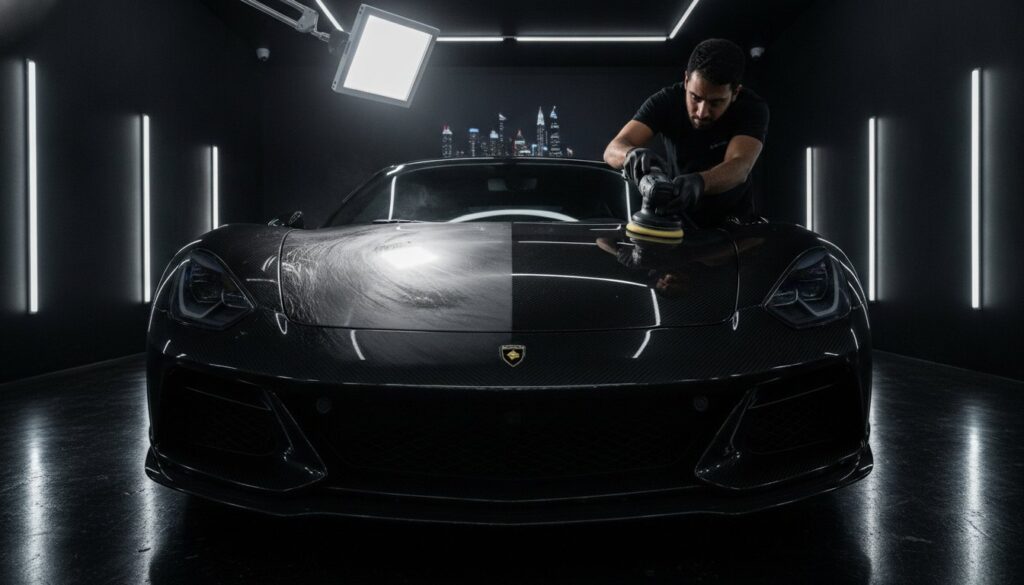
Your vehicle’s gloss isn’t found in a bottle of wax or a spray-on sealant; it’s forged within the microscopic level of the clear coat itself. When you stand under direct sunlight and see those frustrating spider-web swirl marks or a hazy finish, you’re looking at light refracting off damaged paint rather than reflecting off a smooth surface. Deciding between one-step vs two-step paint correction is the most critical choice you’ll make in your detailing journey. It’s the difference between a quick aesthetic boost and a deep, structural restoration that prepares your car for elite protection.
It’s understandable to feel overwhelmed by industry terminology or the gap in service pricing. You want a mirror-like finish without compromising the integrity of your clear coat. This article promises to help you master the technical differences between single and multi-stage correction so you can achieve a flawless, showroom-ready foundation. We’ll explore how these processes eliminate defects, maximize depth of color, and create the essential surface for high-performance applications like PPF or ceramic coatings. By the end, you’ll know exactly which path leads to the elite results your vehicle deserves.
Key Takeaways
- Understand how paint correction mechanically levels your clear coat to restore perfect light refraction and eliminate surface dullness.
- Master the technical differences between one-step vs two-step paint correction to choose the right level of restoration for your vehicle’s specific paint condition.
- Learn how to assess paint hardness and defect depth to avoid over-thinning your clear coat while achieving a mirror-like finish.
- Discover why a flawless surface is the non-negotiable first step for successful Paint Protection Film (PPF) or vehicle wrap application.
- Explore the professional-grade tools and meticulous decontamination steps required to maintain clear coat integrity during the transformation process.
The Science of Paint Correction: Understanding Clear Coat Restoration
Paint correction is a transformative process that goes far beyond a standard detail or a simple wax application. It’s the mechanical leveling of the clear coat to remove surface imperfections that rob your vehicle of its natural brilliance. Unlike temporary fillers that hide scratches, correction removes them permanently. Choosing between one-step vs two-step paint correction requires a deep understanding of how abrasive compounds interact with your vehicle’s specific clear coat density to restore optical clarity.
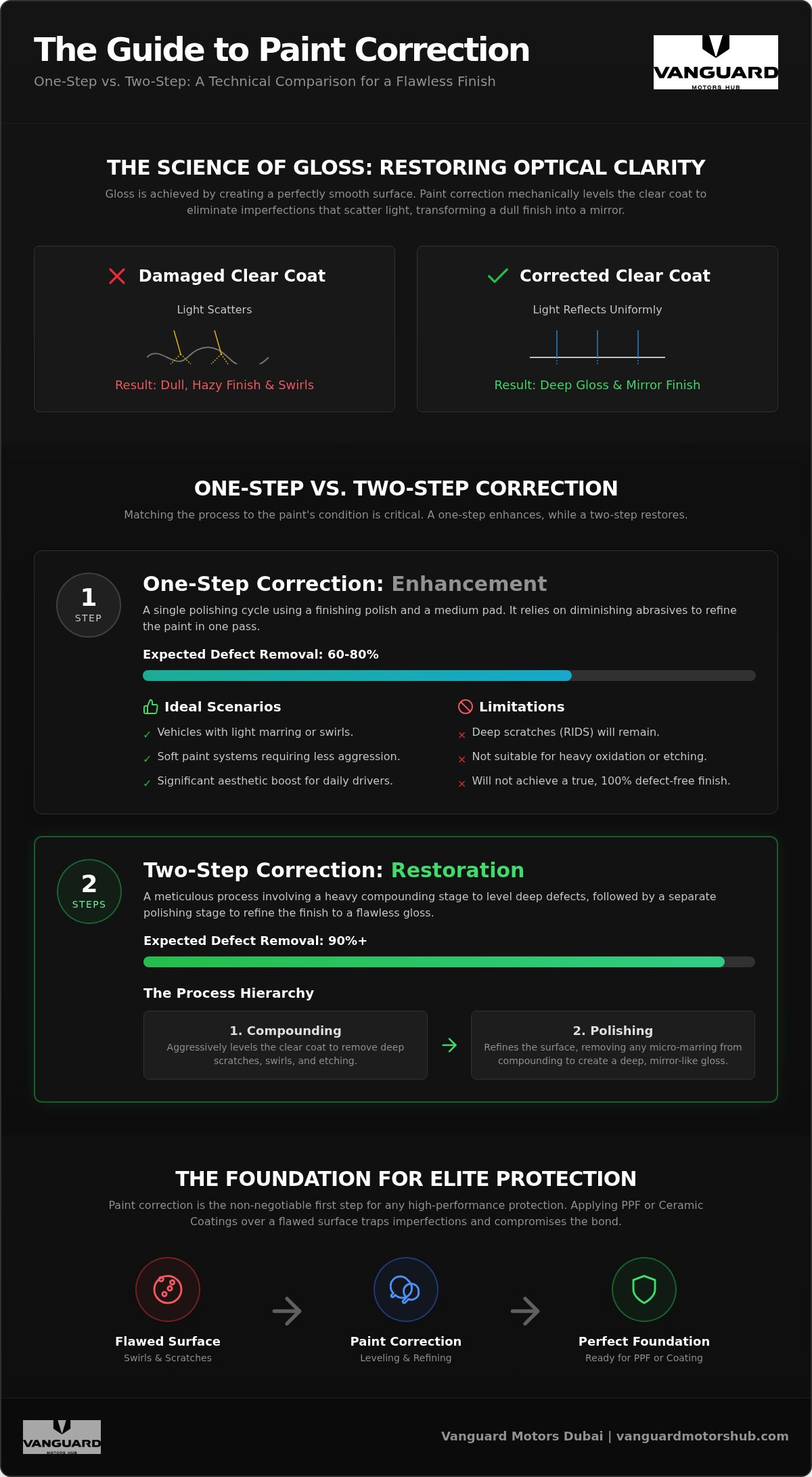
Gloss is a byproduct of physics. When light hits a perfectly level surface, it reflects back to the eye in a straight line, creating that coveted mirror effect. However, when your paint is covered in swirls or “RIDS” (Random Isolated Deep Scratches), light refracts and scatters in multiple directions. This diffusion makes the paint appear dull, hazy, or greyed out. True correction restores the surface to a state where light can reflect with total precision. Even factory-fresh cars often arrive with “delivery defects” from transit or poor dealership prep, making professional correction a necessary foundation for the Vanguard Premium Package.
Common Paint Defects Explained
Precision begins with identification. Swirl marks, often called “spiderwebbing,” are typically the result of improper washing techniques or automated brush washes. These fine circular scratches are visible under direct sunlight or bright LED inspection lamps. More aggressive defects include holograms or buffer trails, which are ghostly patterns left behind by inexperienced detailers using high-speed rotary tools. We also frequently encounter chemical etching. These are deep, structural marks caused by bird droppings or acid rain that have eaten into the clear coat, requiring strategic leveling to repair.
The Anatomy of the Clear Coat
Every correction project is a delicate balance of transformation and preservation. Understanding the complex arrangement of automotive paint layers is essential for any high-end restoration. The clear coat is surprisingly thin, often measured in microns. Professional-grade detailing relies on paint depth gauges to measure exactly how much material is available. We don’t just aim for a shine; we aim to preserve the UV-protective layer that prevents long-term oxidation and failure. By accurately assessing the paint’s health, we determine if a one-step vs two-step paint correction is the safest path to achieve a showroom finish without compromising the vehicle’s future durability.
One-Step vs. Two-Step Paint Correction: A Technical Comparison
Choosing the right restoration path is a matter of mechanical precision and clear coat management. The debate between one-step vs two-step paint correction isn’t about which service is superior in a vacuum; it’s about matching the abrasive hierarchy to your vehicle’s specific needs. While both methods utilize dual-action or rotary polishers, the chemistry of the compounds and the physics of the pad interface differ significantly. A one-step process focuses on efficiency and enhancement, while a two-step approach is a relentless pursuit of perfection.
The One-Step Approach: Efficiency and Enhancement
The one-step correction utilizes a single polishing cycle to improve the paint’s optical clarity. This method often employs an “All-In-One” (AIO) product or a versatile finishing polish paired with a medium-duty foam pad. It relies on diminishing abrasive technology, where the particles break down into smaller, finer fragments as they work, moving from a light cut to a high-gloss finish in a single pass.
- Ideal scenarios: Vehicles with light marring, soft paint systems, or daily drivers requiring a significant aesthetic boost without the intensity of a multi-day project.
- Expected results: You can anticipate 60-80% defect removal. It effectively eliminates light swirls and restores a vibrant, deep gloss.
- Limitations: Deep scratches, heavy oxidation, and “RIDS” will remain visible, as the single pass lacks the aggressive leveling power required for structural paint damage.
The Two-Step Approach: Total Transformation
For those who demand a mirror-like, defect-free finish, the two-step approach is the only logical choice. This is a precision hierarchy that begins with a heavy compounding stage. Using aggressive microfiber or wool pads, we level the clear coat to remove deep imperfections. This stage often leaves a slight “haze” or “marring” on the surface, which is why the second stage is vital. The refining stage uses a fine finishing polish to remove that haze, restoring absolute clarity and depth.
The final result is often referred to as the “jeweling” effect. By using ultra-fine foam pads and low-speed machine passes, we burnish the clear coat to a level of brilliance that often exceeds the original factory finish. This creates a surface so smooth that light reflects with almost zero diffusion. If you are preparing a high-performance vehicle for long-term protection, you can consult our technical team via WhatsApp to determine if your paint requires this level of transformation.
- Stage 1 (Cutting): Eliminates heavy swirls, etching, and deep scratches through aggressive mechanical leveling.
- Stage 2 (Refining): Restores the mirror finish and maximizes color depth by removing cutting-stage haze.
- Expected results: 90-95%+ defect removal, creating a flawless foundation for the Vanguard Premium Package.
The Decision Matrix: Which Correction Level Does Your Vehicle Require?
Selecting the optimal restoration level isn’t a matter of guesswork; it’s a strategic calculation based on your vehicle’s physical reality. When you’re weighing one-step vs two-step paint correction, the first variable is paint hardness. European marques, particularly German manufacturers, often utilize “ceramic” clear coats that are notoriously resilient. These hard surfaces usually demand the aggressive mechanical leveling of a two-step process to see a meaningful difference. In contrast, many Japanese vehicles feature softer clear coats. While these respond quickly to abrasives, they are also more delicate, often making a precision one-step correction the more responsible choice to preserve paint thickness.
Your vehicle’s history also dictates the approach. If a car has been polished multiple times over several years, the remaining clear coat may be thin. We use digital gauges to verify these levels. If the clear coat is compromised, pushing for a heavy two-step correction can be dangerous. For deep scratches that you can feel with a fingernail, paint correction may not be enough. In these instances, integrating the process into a cosmetic car repair workflow ensures that structural damage is addressed before the final polishing begins.
Diagnostic Questions for Owners
Before booking a service, inspect your vehicle under direct, concentrated light. Ask yourself these three questions to narrow down your needs:
- Does the paint look “grey” or hazy? This usually indicates a high density of micro-swirls that a one-step correction can significantly improve.
- Are there deep water spot etchings? If minerals have eaten into the surface, the heavy compounding of a two-step process is required to level the surrounding area.
- What is the ultimate goal? If you’re preparing for a high-level event or a car show, the “jeweling” effect of a two-step finish is the only way to achieve that elite, liquid-like depth.
Budget vs. Benefit: Evaluating the ROI
For supercar owners, a two-step correction is rarely an expense; it’s an investment. Removing 95% of defects and restoring absolute clarity can significantly bolster the vehicle’s resale value and collectibility. However, for a high-mileage daily driver, a one-step correction often provides the best return on investment. It delivers a massive visual transformation while leaving more clear coat on the car for future maintenance. The goal is always to achieve the maximum aesthetic impact while maintaining the long-term health of your vehicle’s exterior.
The Foundation for Protection: Why Correction Precedes PPF and Wraps
Many owners mistakenly view paint correction as a final cosmetic flourish. In reality, it’s the invisible foundation that determines the success of every high-end protection layer. Applying paint protection film over uncorrected paint is a critical error that can compromise your investment. The adhesive layer of the film acts like a magnifying glass. Rather than hiding surface defects, the high-gloss finish of the PPF can amplify underlying swirl marks, holograms, and etchings, locking them beneath the surface for years.
The choice between one-step vs two-step paint correction at this stage depends on the intended protection and the vehicle’s condition. For a colored car wrap, a one-step enhancement is often sufficient to remove surface oils and provide a clean, level surface for the vinyl to grip. However, for clear PPF on a high-value asset, a two-step correction is frequently the standard. It ensures the finish beneath the film is nothing short of perfect, preventing the “cloudy” look that occurs when film is applied over micro-marring.
Beyond aesthetics, correction is vital for mechanical adhesion. Factory clear coats often carry silicones, waxes, or transport films that prevent PPF or vinyl from bonding correctly. The mechanical leveling process strips these contaminants away completely. This ensures the edges of your film or wrap stay secure, preventing premature lifting or “silvering” at the corners that often plagues lower-quality installations.
Correction and PPF Synergy
A truly “invisible” film installation requires a surface free of “orange peel” texture and micro-defects. Correction smooths the clear coat, allowing the film to lay perfectly flat. This synergy creates a finish so deep it looks like wet paint. At Vanguard, we perform a mandatory surface inspection before any protection layer is applied. We verify that the clear coat is chemically pure and physically level, ensuring the film bonds at a molecular level for maximum durability.
Preparing for Bespoke Conversions
When installing a Brabus body kit or other bespoke components, new panels must match the existing paint’s gloss level perfectly. Correction bridges the gap between old and new. It’s a key component of a comprehensive supercar detailing regime, ensuring a cohesive, factory-plus look across the entire vehicle. This precision is also critical before applying peelable paint solutions, where the underlying surface quality dictates the final texture and ease of removal. To ensure your vehicle is ready for its transformation, secure your precision consultation via WhatsApp today.
Professional Precision: The Vanguard Approach to Paint Correction
At Vanguard, we view paint correction as an exacting discipline where technical mastery meets high-performance aesthetics. Our methodology isn’t defined by speed but by the relentless pursuit of clear coat perfection. Whether your vehicle requires one-step vs two-step paint correction, the process always begins with a rigorous decontamination protocol known as “Step Zero.” We utilize specialized iron removers to dissolve embedded metallic fallout and professional-grade clay bars to lift microscopic surface contaminants. This ensures the machine polishing stage is performed on a chemically pure surface, preventing the introduction of new defects during the leveling process.
Our facility utilizes an arsenal of high-end rotary and dual-action (DA) polishers to achieve heat-controlled correction. We don’t rely on standard overhead shop lights. Instead, we employ multi-spectrum LED arrays that replicate different solar conditions. This specialized lighting allows our technicians to identify micro-defects, such as “tick marks” or faint holograms, that are invisible under normal conditions. This level of scrutiny is a core component of the Vanguard Premium Package, where we integrate correction, protection, and long-term preservation into a single, cohesive service tier.
Our Technical Protocol
Precision requires a systematic approach to every panel. We begin each project with a “test spot” protocol. By testing various pad and polish combinations on a small area, we identify the least aggressive method that delivers the best result. This philosophy preserves as much of your factory clear coat as possible while achieving the desired level of defect removal. We take the additional time to tape off all sensitive trim, rubber seals, and plastic components to prevent any abrasive staining or damage.
The “moment of truth” in our protocol is the post-correction wipe-down. We use high-purity Isopropyl Alcohol (IPA) solutions to strip away any residual polishing oils. Many shops skip this step, leaving behind oils that temporarily “fill” scratches. Our IPA wipe-down ensures that the finish you see is the true state of the paint. This provides a chemically receptive surface for the molecular bonding required by our PPF and ceramic coating applications.
The Final Inspection
Every vehicle undergoes a multi-stage quality control check before we proceed to the next phase of customization. We inspect the surface under varied lighting angles to verify that the finish is uniform, deep, and entirely free of machine-induced marring. This ensures the foundation is perfectly prepared for bespoke conversions or high-end protection films. If you’re unsure which level of restoration your vehicle requires, you should contact Vanguard Motors Dubai for a professional paint assessment to determine the most effective path for your asset’s transformation.
Elevate Your Automotive Foundation Today
Your vehicle’s aesthetic potential relies on the structural integrity of its clear coat. Mastering the nuances of one-step vs two-step paint correction allows you to choose a restoration path that balances immediate brilliance with long-term durability. Whether you’re seeking a single-stage enhancement for a daily driver or a multi-stage restoration for a high-value asset, the objective remains the same: absolute optical clarity. This process is the essential prerequisite for any elite protection layer.
Vanguard Motors Dubai specializes in luxury and supercar preservation. We utilize advanced paint depth measurement technology and multi-spectrum lighting arrays to ensure every micron of clear coat is respected. Our integrated correction and PPF solutions provide a seamless transition from mechanical restoration to permanent protection. Don’t leave your car’s finish to chance. Trust a team that understands the intersection of technical precision and automotive passion.
Book Your Professional Paint Assessment at Vanguard Motors Dubai
Your car’s transformation begins with a single, expert evaluation. We’re ready to unlock the true depth and vibrance of your vehicle’s finish and prepare it for a future of flawless performance.
Frequently Asked Questions
What is the difference between paint correction and a standard car polish?
Paint correction is a permanent mechanical leveling of the clear coat, whereas a standard polish often uses fillers to temporarily hide defects. While polishing enhances surface gloss, correction utilizes professional abrasives to remove swirl marks, etchings, and scratches. This structural restoration ensures that the finish remains flawless even after multiple washes. It’s the difference between masking a problem and solving it through technical precision.
How long does a two-step paint correction typically take?
A two-step paint correction typically requires between 12 and 20 hours of meticulous labor. This duration accounts for the initial heavy compounding stage and the subsequent refining stage. Factors like vehicle size, paint hardness, and the severity of existing defects influence the timeline. At a professional facility, this process ensures every panel meets a showroom standard before any final protection layers are applied.
Will paint correction remove deep scratches that I can feel with my fingernail?
Paint correction cannot safely remove scratches that have penetrated the clear coat and reached the base paint. If you can feel a scratch with your fingernail, it’s likely too deep for mechanical leveling. In these instances, we recommend our specialized cosmetic repair or car damage repair services. These solutions address structural paint loss that abrasives alone cannot resolve without compromising the surrounding clear coat integrity.
Is it necessary to correct the paint on a brand-new car?
Most brand-new vehicles require correction to eliminate “delivery defects” acquired during transit or poor dealership preparation. Factory paint often exhibits “orange peel” texture or light marring from automated assembly lines. Performing a one-step vs two-step paint correction on a new car ensures a perfect foundation for long-term protection. This step is mandatory at Vanguard before we install any premium Paint Protection Film (PPF).
Does paint correction damage the clear coat of my vehicle?
Professional correction preserves clear coat integrity by using paint depth gauges to measure available thickness before work begins. We utilize a “least aggressive” protocol to achieve the best result while removing only a few microns of material. This precision ensures your vehicle’s UV-protective layer remains intact. Only inexperienced operators using high-heat rotary techniques without proper measurements pose a risk of damaging the clear coat.
How often should a luxury vehicle undergo paint correction?
Luxury vehicles should undergo paint correction sparingly, typically once every two to four years if maintained with proper washing techniques. Frequent correction can thin the clear coat unnecessarily. The most effective strategy is to perform a comprehensive correction once and immediately lock in that perfection with a high-quality PPF or ceramic coating. This approach minimizes the need for future abrasive leveling and preserves the factory finish.
Can I apply ceramic coating immediately after a one-step correction?
You can apply a ceramic coating immediately after a one-step correction, provided the surface has undergone a thorough IPA wipe-down. This chemical cleaning removes residual polishing oils that would otherwise prevent the coating from bonding at a molecular level. A one-step process is often the ideal preparatory phase for daily drivers, delivering a high-gloss surface that is chemically receptive to long-term ceramic protection.
Why is paint correction more expensive than a regular detail?
Paint correction is more expensive than a regular detail because it requires specialized technical skill, multi-spectrum lighting arrays, and significantly more time. A regular detail focuses on cleaning and protection, while correction involves the actual restoration of the clear coat’s surface. The investment reflects the use of professional-grade dual-action polishers and the meticulous care required to achieve a mirror-like, defect-free finish on high-value assets.