
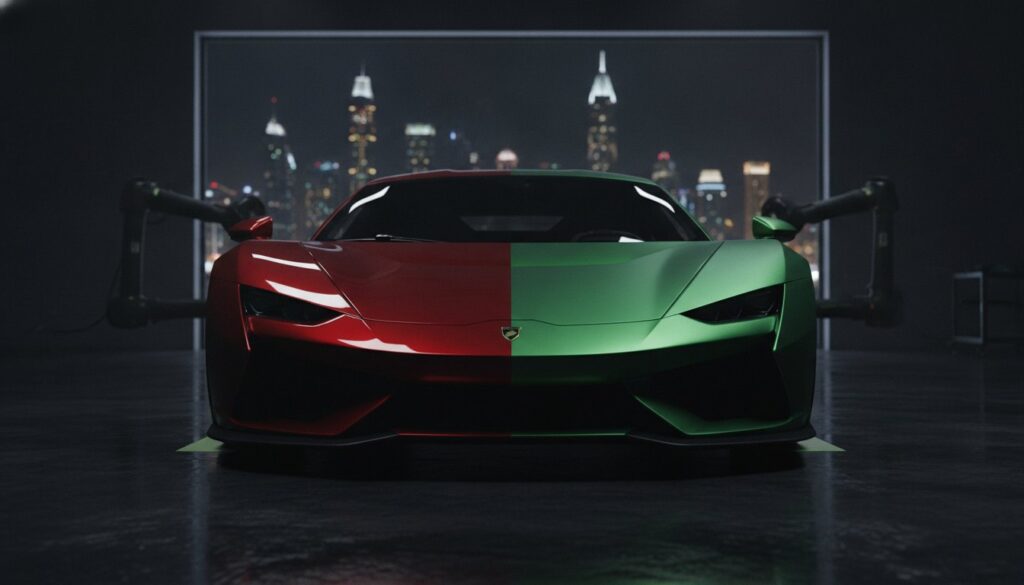
In 2026, the traditional trade-off between protecting your vehicle’s value and achieving a bespoke aesthetic has officially been rendered obsolete. You shouldn’t have to choose between a stunning color change and the long-term integrity of your original factory clear coat. Most owners of high-performance vehicles still fear the ghost of adhesive residue or the unsightly “orange peel” texture associated with lower-tier finishes. Understanding the nuances of peelable paint cost vs vinyl wrap is the first step toward a transformation that looks like it rolled off a factory line, rather than a temporary modification that reveals its seams under the sun.
We understand that for an elite vehicle, the finish must be flawless and the protection must be absolute. You deserve a showroom-quality result that remains 100 percent reversible while offering superior defense against road debris and UV rays. This article delivers the definitive technical and financial breakdown required to choose your vehicle’s ultimate finish. We will examine the microscopic precision of liquid-applied coatings, the tactical versatility of modern vinyl films, and the maintenance requirements that define the total cost of ownership for world-class automotive aesthetics.
Key Takeaways
- Distinguish between high-build liquid coatings for a seamless factory aesthetic and premium adhesive-backed films for diverse textures and graphic precision.
- Understand how spray-on application differs from hand-stretched techniques and why professional facility standards are non-negotiable for achieving a flawless finish.
- Evaluate how different materials handle thermal expansion and UV stability to ensure your vehicle remains protected even in extreme heat.
- Break down the long-term financial implications of peelable paint cost vs vinyl wrap, accounting for durability and the ease of 100 percent reversible removal.
- Gain clarity on when to choose liquid wraps for an indistinguishable “factory paint” look versus vinyl for complex patterns or specific matte finishes.
Aesthetic Evolution: Understanding Peelable Paint and Vinyl Wrap
For the modern automotive enthusiast, selecting a vehicle finish is a strategic decision that balances identity with asset protection. Traditional permanent repainting, once the only path to a custom color, frequently compromises the resale value of elite vehicles by altering their original state. Today’s market favors reversible technologies that offer the depth of premium paint or the tactical precision of specialized films. Both peelable paint and vinyl wraps share a critical, high-performance objective: 100 percent reversibility. They act as a sacrificial barrier against road debris and UV rays while keeping the factory clear coat in pristine condition.
Choosing between these two technologies often comes down to the desired texture and the specific application environment. While both provide a transformation that is entirely removable, they achieve their results through vastly different chemical and mechanical processes. Understanding the nuance of peelable paint cost vs vinyl wrap requires a technical look at how these materials bond to your vehicle and how they perform over a multi-year lifecycle.
The Rise of Liquid Wraps in Automotive Customization
Peelable paint has undergone a radical transformation in recent years. What began as basic rubberized coatings has evolved into sophisticated, high-build liquid systems engineered specifically for supercars and luxury sedans. These modern automotive-grade liquid wraps are applied using professional spray equipment in controlled, dust-free environments. The material flows into every curve and crevice before curing into a durable, removable film that is often indistinguishable from factory paint. One of the most significant advantages is the total absence of seams or relief cuts. Because it is a liquid application, there are no edges to lift or peel, even on complex aerodynamic components or intricate grille work.
Vinyl Wrap: The Standard for Graphic Versatility
While liquid wraps excel at mimicking a factory-painted look, vinyl wraps remain the gold standard for graphic complexity and textural variety. High-end cast vinyl films are thin, highly conformable layers designed to withstand the rigors of high-performance driving. These films utilize advanced adhesive technology with air-release channels, ensuring a secure bond that remains easy to strip when you’re ready for a change. Owners who desire specific aesthetics, such as brushed metal, deep satin, or carbon fiber effects, often find vinyl to be the superior choice. The precision of hand-stretched application allows for sharp, defined lines and the ability to incorporate complex branding or patterns that liquid systems cannot replicate with the same level of tactical detail.
When you evaluate the investment, it’s clear that both options represent a proactive approach to vehicle maintenance. They allow for total creative expression without the permanent commitment of a traditional spray booth. Whether you prefer the seamless flow of a liquid coating or the textured precision of a cast film, the goal remains the same: a stunning transformation that protects your vehicle’s underlying value.
The Technical Breakdown: How Application Defines Quality
The distinction between a standard application and an elite finish begins in the environment. While vinyl requires physical tension and heat to conform to panels, liquid-applied coatings demand the precision of a high-volume, low-pressure system in a strictly regulated booth. Achieving a mirror-like surface is impossible without advanced air filtration to eliminate dust particles that could mar the finish. When comparing peelable paint cost vs vinyl wrap, the technical expertise required for a dust-free, leveled application is a primary factor in the final quality.
Professional leveling remains the best defense against the “orange peel” texture that often compromises lower-tier finishes. This phenomenon occurs when the coating fails to flow out smoothly before curing. Master technicians calibrate their equipment based on the local humidity and temperature to ensure the material settles into a glass-like state. This meticulous control is what allows liquid wraps to indistinguishably mimic the depth of a factory paint job.
Precision Spraying vs. Strategic Wrapping
The application of liquid wraps involves a sophisticated multi-stage build-up. It is a process of layering that creates a durable, flexible membrane over the vehicle’s bodywork. Conversely, vinyl wrapping relies on strategic “tucking” and the use of specialized tools to hide seams behind trim and panels. While vinyl technicians use heat to manipulate a solid film, paint specialists focus on atomization and overlap to create a unified surface. The final aesthetic depends heavily on the technician’s ability to manage these physical properties without leaving visible edges.
Edge-to-Edge Perfection for Supercars
Modern supercar designs, particularly those with aggressive aerodynamic profiles, often feature deep recesses and sharp fins that challenge the limits of vinyl film. Stretching a solid film into these tight geometries can lead to material thinning or premature lifting. Liquid coatings flow naturally into every crevice, providing a seamless protective barrier that is essential for bespoke Brabus or Mansory conversions at Vanguard Motors Dubai. This ensures that even the most complex body kits receive total coverage without the need for unsightly relief cuts.
If you’re evaluating which method best suits your vehicle’s specific design, connect with our technical experts today to discuss a tailored protection plan.
Performance in High Heat: Durability and Protection Comparison
Extreme heat serves as the ultimate proving ground for automotive finishes. In environments where surface temperatures frequently climb above 70°C, the chemical resilience of your coating isn’t just an aesthetic concern; it’s a structural one. When comparing peelable paint cost vs vinyl wrap, you’re investing in how well these materials withstand relentless UV radiation and thermal expansion. Modern automotive-grade coatings are engineered with high UV stability to prevent the color fading that often plagues standard finishes after just a few seasons in the sun. Understanding the performance gap in peelable paint cost vs vinyl wrap ensures your investment survives the harshest driving conditions.
Beyond the heat, your vehicle faces a constant barrage of chemical threats. Fuel spills at the pump, industrial fallout, and acidic bird droppings can etch into a factory clear coat within hours. Both peelable paint and vinyl wraps act as a sacrificial shield, but their ability to neutralize these contaminants differs based on their top-coat technology. Premium liquid wraps often feature a denser chemical structure that resists staining more effectively than porous, lower-grade vinyl films. This density is a key factor in maintaining a showroom shine over a multi-year lifecycle.
Thermal Stability and Adhesive Integrity
The primary risk with traditional vinyl in high-heat climates is adhesive “baking.” Over time, extreme temperatures can cause the adhesive backing of a wrap to bond too aggressively with the paint. If the film is left beyond its recommended service life, removal becomes a labor-intensive process that risks leaving residue. Peelable paint avoids this specific failure point because it cures into a singular, flexible membrane without a separate adhesive layer. This flexibility allows it to expand and contract alongside the vehicle’s metal and carbon fiber panels without lifting or cracking. Adding a ceramic coating over your finish further enhances heat rejection and simplifies maintenance.
The Shielding Effect: Impact Resistance
Regarding physical defense, thickness is the deciding factor. A standard vinyl wrap typically measures around 3.5 mils, which provides basic scratch resistance but limited protection against high-velocity rock chips. Professional liquid wraps are high-build systems, often reaching 10 to 15 mils of thickness depending on the number of layers applied. This creates a much more substantial sacrificial barrier. While some premium films offer self-healing properties that disappear under heat, the sheer mass of a liquid wrap provides superior energy displacement. For owners who prioritize the highest level of impact defense, exploring the Paint Protection Film pillar is a logical next step in a comprehensive protection strategy.
Evaluating the Investment: Peelable Paint Cost vs Vinyl Wrap
Managing a high-value automotive asset requires a clear understanding of the financial trajectory beyond the initial application. In 2026, professional peelable paint cost vs vinyl wrap investments have reached a level of parity where the choice is driven by technical preference rather than budget alone. While entry-level wraps exist, elite vehicles demand premium materials and expert labor that align both options within a similar price bracket. The true return on investment lies in the preservation of the factory clear coat, which directly impacts the resale value of supercars and luxury sedans.
Factors that influence the final quote include the complexity of the vehicle’s geometry and the choice of pigments. For instance, door jamb coverage and specialized “OEM-matched” liquid pigments will increase the project’s scope. However, this level of detail is what separates a standard color change from a showroom-quality transformation. High-end finishes also offer a cleaner “Cost of Removal,” ensuring that the transition back to the original paint is seamless and leaves no adhesive residue behind.
Labor vs. Material: Where Your Money Goes
The allocation of your investment differs significantly between these two mediums. Labor accounts for approximately two-thirds of the total cost of a professional vinyl wrap. This is due to the extensive disassembly required; technicians must remove door handles, mirrors, and light clusters to ensure edges are tucked and secured. Peelable paint shifts that labor toward meticulous masking and precision spraying in a multi-stage process. While high-quality vinyl films are expected to last between 5 and 7 years with proper care, a professional liquid finish often provides a more consistent aesthetic throughout its 3 to 5 year lifespan without the risk of edge lifting.
Maintenance and Repair Costs
Calculating the total cost of ownership over a 36-month period reveals the practical advantages of each system. One major benefit of peelable paint is its repairability. If a single panel is damaged, a skilled technician can often perform a localized blend, whereas a vinyl wrap typically requires a full panel replacement to avoid visible seams or color mismatches. This surgical approach to cosmetic repair can significantly reduce long-term maintenance expenses. Adding a high-gloss or ceramic-infused top-coat to your finish further enhances chemical resistance and simplifies the cleaning process, protecting your investment against the elements.
Ready to see the numbers for your specific vehicle? Request a detailed financial breakdown for your custom finish today and discover the best path for your car’s protection and style.
Choosing Your Signature Finish: The Vanguard Approach
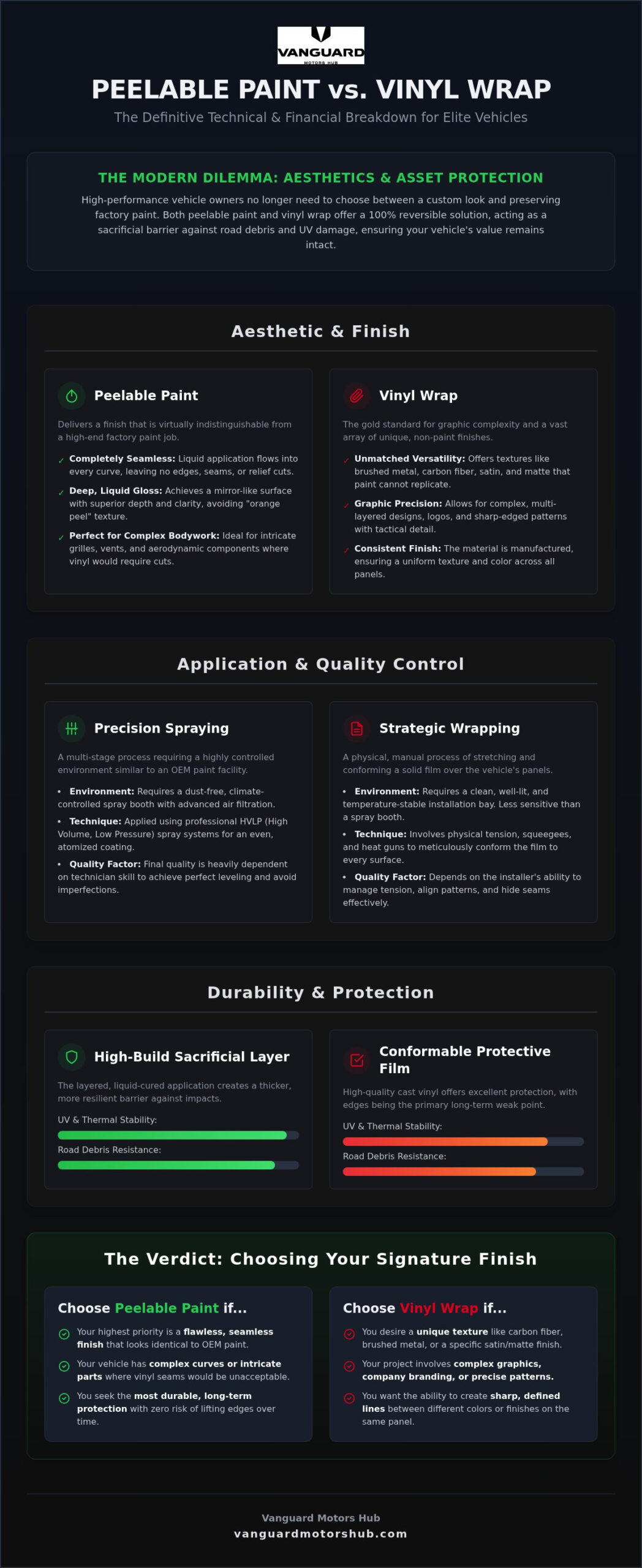
Selecting the definitive finish for your vehicle is a final act of curation. Your choice between these two advanced technologies should align with your aesthetic vision and the functional demands of your lifestyle. If your objective is a seamless, indistinguishable “is it paint?” look that flows over every complex curve, peelable paint is your undisputed winner. It offers a factory-level depth and clarity that eliminates the visual compromise of seams. Conversely, if you desire specific matte textures, satin finishes, or complex graphic patterns for branding, high-performance vinyl remains the gold standard for tactical versatility.
Navigating the nuances of peelable paint cost vs vinyl wrap ultimately leads to a single question: what is the final objective for your vehicle? A holistic protection strategy doesn’t end at the exterior panels. Elite automotive care requires a comprehensive approach that includes luxury car detailing and interior leather restoration to ensure the cabin matches the pristine quality of the new finish. At Vanguard Motors Dubai, we treat every project as a total transformation where technical precision meets high-octane passion.
Bespoke Customization for High-Performance Models
For owners of supercars featuring aggressive aerodynamics, the finish must complement high-end modifications. Peelable paint applications provide a flawless synergy with carbon fiber installations and bespoke body kit conversions. Whether you’re refining a Brabus or Mansory build, the liquid application ensures that the transition between the new finish and exposed carbon elements is sharp and professional. For those seeking the ultimate standard in vehicle care, the Vanguard Premium Package offers a unified solution. This package integrates our most advanced protection technologies with meticulous detailing to deliver a result that is both visually stunning and structurally resilient.
Final Decision Framework
For daily drivers prioritizing maximum impact resistance and a factory look, peelable paint offers the most robust long-term value; for show cars or weekend vehicles requiring specific textures and rapid aesthetic changes, vinyl wrap provides unmatched creative flexibility. We invite you to visit our facility to experience these textures firsthand under professional lighting. Seeing the depth of a liquid coating next to the precision of a cast film allows you to make an informed decision based on your personal standards of excellence. Our technicians are ready to guide you through the technical specifications of peelable paint cost vs vinyl wrap to ensure your vehicle receives the elite treatment it deserves.
Consult with Vanguard Motors Dubai today for a bespoke customization quote.
Elevating the Standard of Automotive Excellence
Securing the perfect finish for an elite vehicle requires a balance of visionary aesthetics and technical resilience. Whether you prioritize the seamless, liquid-applied depth of a sprayable coating or the tactical, textured precision of a high-end cast film, the objective remains the same: absolute protection and 100 percent reversibility. Understanding the technical nuances of peelable paint cost vs vinyl wrap ensures you select a finish that preserves both your car’s identity and its long-term resale value. As national leaders in premium vehicle protection, we specialize in high-performance results that meet the most meticulous standards.
Our team brings elite luxury and supercar detailing expertise to every project, from daily drivers to bespoke Brabus and Mansory kit conversions. We don’t just apply a finish; we engineer a shield that withstands the elements while fueling excitement for the road ahead. Your vehicle is a statement of excellence, and it deserves a protection strategy that reflects that same commitment to quality. Take the final step toward a showroom-quality result that defines your signature style.
Elevate Your Vehicle’s Aesthetic with Vanguard Motors Dubai and experience the intersection of high-octane passion and professional precision today.
Frequently Asked Questions
Is peelable paint really as durable as a vinyl wrap?
Peelable paint often exceeds the durability of standard vinyl due to its significantly thicker sacrificial layer. While a premium cast vinyl typically measures around 3.5 mils, a professional liquid wrap can reach 10 to 15 mils in thickness. This provides superior protection against high-velocity rock chips and abrasive road debris. When evaluating peelable paint cost vs vinyl wrap, consider that the liquid application’s lack of seams also eliminates the common issue of edge lifting over time.
Can peelable paint be washed with a pressure washer?
You can safely wash your vehicle with a pressure washer if you follow specific maintenance protocols. Always maintain a distance of at least 30 centimeters from the surface and avoid high-pressure nozzles directed at panel edges or trim. Using a wide-angle spray pattern and a pH-neutral automotive shampoo ensures the integrity of the coating remains intact. This careful approach prevents the pressurized water from undermining the bond between the material and the bodywork.
How long does it take to apply a professional liquid wrap vs a vinyl wrap?
A professional installation for either medium generally takes between three and five business days. Vinyl wraps require extensive time for vehicle disassembly and precision hand-tucking around every panel. Liquid wraps demand a similar timeframe for meticulous masking and the curing of multiple high-build layers. This duration ensures a dust-free finish and allows the material to bond correctly, delivering the meticulous quality required for luxury and supercars.
Will either option damage my original factory paint upon removal?
Neither professional option will damage your original factory clear coat if the paint was in good condition prior to application. These materials are specifically engineered to be 100 percent reversible, acting as a protective barrier rather than a permanent alteration. Professional removal techniques ensure that no adhesive residue remains behind. This preservation of the original state is a primary reason why elite owners prefer these methods over traditional repainting.
Can I change the color of my wheels and trim with these methods?
Both methods are exceptionally effective for customizing wheels, grilles, and exterior trim components. Peelable paint is particularly advantageous for intricate wheel designs because the liquid flows into every recess, providing a seamless finish that vinyl films struggle to replicate. Whether you’re looking for a “chrome delete” or a specific rim color change, these technologies allow for a unified aesthetic that complements your vehicle’s overall transformation.
What happens if the peelable paint or vinyl gets scratched?
Repairing a scratch is often more efficient with peelable paint because a technician can perform localized blending. If a vinyl wrap is deeply scratched, it usually requires the removal and replacement of the entire affected panel to ensure a perfect color match. The ability to surgically repair small areas of a liquid wrap can lower the long-term maintenance portion of the peelable paint cost vs vinyl wrap equation, especially for daily-driven vehicles.
Does the extreme heat in the UAE affect the lifespan of these coatings?
Extreme heat can impact any automotive finish, but modern UV-stable coatings are designed to resist thermal degradation. Surface temperatures exceeding 70°C can cause lower-tier vinyl adhesives to bake onto the paint, making professional-grade materials a non-negotiable requirement. Peelable paint remains more thermally stable under these fluctuations, expanding and contracting with the vehicle’s panels without cracking or lifting, which is essential for maintaining a showroom-quality appearance in desert climates.
Can I apply a ceramic coating over my peelable paint or vinyl wrap?
Applying a ceramic coating over your finish is highly recommended for enhanced protection and simplified maintenance. A ceramic layer provides an additional hydrophobic barrier that repels water, dirt, and chemical contaminants like bird droppings. It also adds a deeper gloss to the finish and provides extra UV protection to prevent color fading. This synergy between the base wrap and the ceramic top-coat is the ultimate strategy for preserving a high-end automotive customization.