
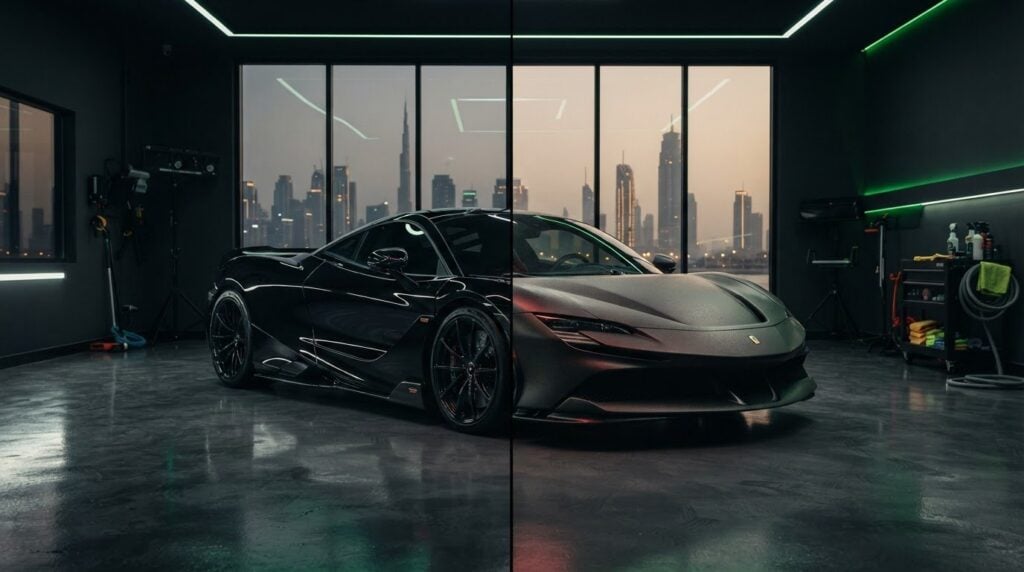
If you believe a rubberized coating is the only way to transform your luxury vehicle without a permanent commitment, you’re settling for technology that’s already a decade behind. For owners of high-performance machinery, the choice between peelable paint vs Plasti Dip isn’t just about cost. It’s about the integrity of your factory clearcoat and the pursuit of a flawless aesthetic. You’ve likely worried about the “orange peel” texture of entry-level coatings or how they’ll withstand the relentless heat of the UAE sun. It’s a valid concern when your vehicle’s resale value and visual impact are on the line.
In this 2026 guide, you’ll discover how professional-grade peelable paint has evolved into a liquid PPF that offers more than just a color change. We’ll compare the technical specifications of these two systems, from micron thickness to chemical resistance against fuels and UV rays. You’ll learn why elite finishing requires a cross-linked polyurethane clearcoat that can be wet-sanded and polished to a mirror finish. We’re breaking down everything you need to know to achieve a bespoke, 100% reversible result that protects your investment while making a bold statement on the road.
Key Takeaways
- Identify the critical technical shift from basic rubberized coatings to high-solid automotive polymers that provide genuine, long-term protection.
- Compare the visual outcomes of peelable paint vs Plasti Dip, focusing on how to achieve a mirror-like finish without the dreaded orange peel texture.
- Learn why professional peelable paint offers superior thermal stability and UV resistance, ensuring your vehicle’s aesthetic holds up against the intense UAE sun.
- Discover how a professional application acts as a liquid PPF, shielding your factory paint from stone chips while preserving the car’s ultimate resale value.
- Realize why a controlled, dust-free environment is essential for a 5-year finish that remains indistinguishable from a custom factory respray.
The Evolution of Temporary Colour: Defining Peelable Paint and Plasti Dip
The automotive landscape has shifted. What began as a niche hobby for enthusiasts has evolved into a sophisticated industry where temporary transformations rival factory finishes. When evaluating the merits of peelable paint vs Plasti Dip, you aren’t just choosing a brand; you’re selecting an entirely different chemical philosophy. One is a utility-focused elastomer designed for versatility, while the other is a high-performance polymer system engineered for the world’s most prestigious supercars. Understanding the molecular DNA of these coatings is the first step in protecting your vehicle’s legacy.
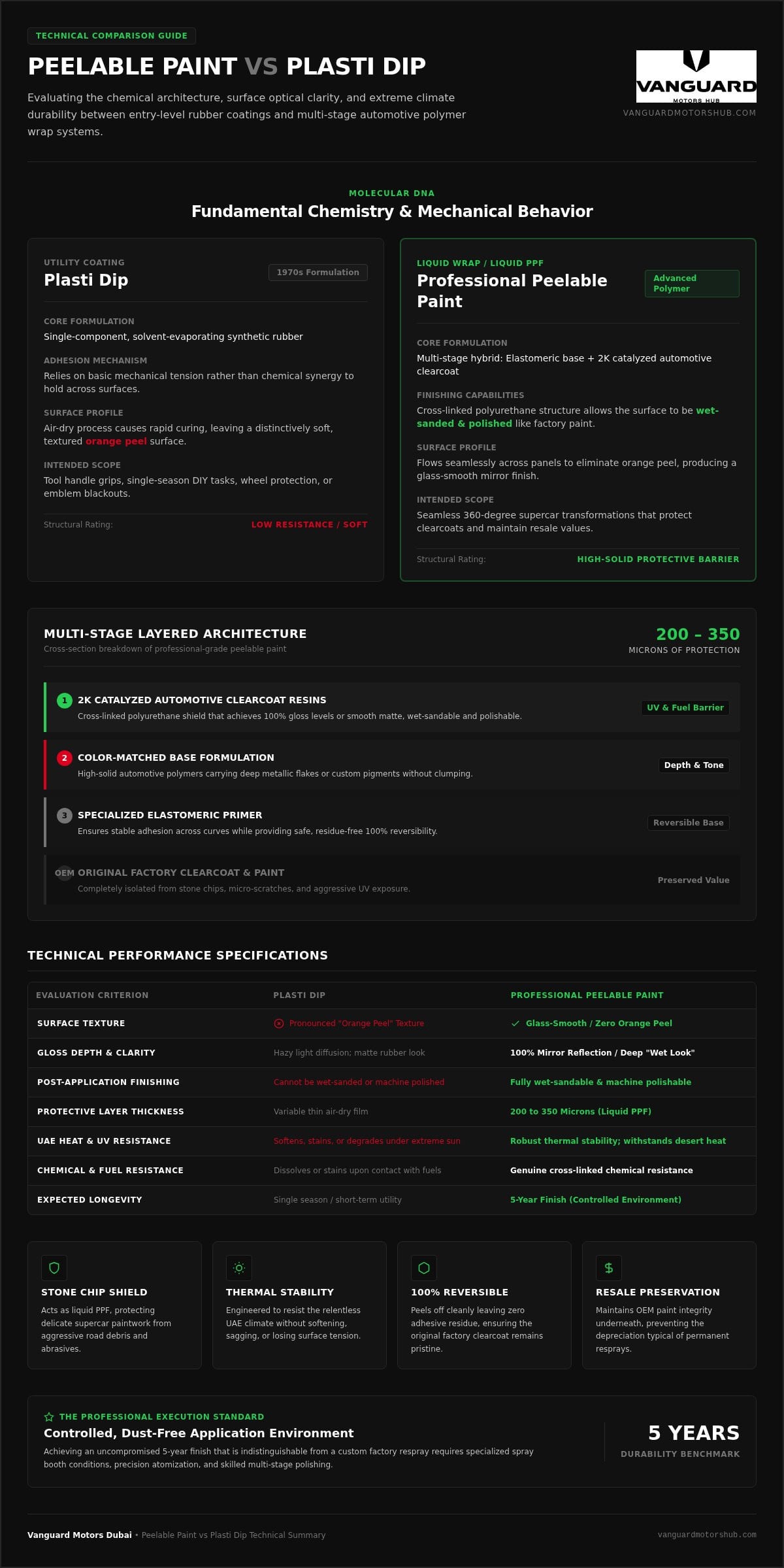
The primary distinction lies in the binder. Plasti Dip is a single-component, solvent-evaporating synthetic rubber. It relies on mechanical tension to stay in place. Professional peelable paint, often referred to in elite circles as “liquid wrap,” utilizes a multi-stage hybrid system. It combines an elastomeric base with genuine 2K catalyzed automotive clearcoat resins. This chemical synergy allows for a finish that isn’t just a covering, but a high-solid protective barrier that mirrors the depth and clarity of original equipment manufacturer (OEM) paint.
What is Plasti Dip?
Originally formulated in the 1970s as a multi-purpose rubber coating for tool handles, Plasti Dip found a second life in the automotive world. It’s a thermoplastic rubber that provides a functional, matte finish with a distinctively rubbery texture. Because it’s an air-dry coating, it remains relatively soft, which limits its resistance to harsh chemicals or abrasive contact. It’s an excellent choice for budget-friendly DIY projects, such as blacking out emblems or protecting wheels for a single season, but it lacks the structural integrity required for a full-body luxury transformation.
What is Professional Peelable Paint?
Engineered specifically for the high-stakes world of luxury automotive aesthetics, professional peelable paint represents the pinnacle of removable coatings. Unlike its rubberized counterparts, this system is designed to be wet-sanded and polished, allowing technicians to achieve a glass-smooth surface that’s completely free of texture. It offers robust fuel resistance and thermal stability, ensuring the coating doesn’t soften or stain when exposed to the intense heat of the UAE climate. Professional peelable paint serves as the sophisticated bridge between traditional permanent resprays and adhesive vinyl wraps. For those seeking this elite level of Peelable Paint Applications, the result is a seamless, 360-degree transformation that shields the factory clearcoat beneath 200 to 350 microns of high-tech polymer protection.
Aesthetic Excellence: Comparing Finish Quality and Texture
The visual standard for a supercar isn’t just about color; it’s about the surface’s optical clarity. When debating peelable paint vs Plasti Dip, the most immediate difference is found in the “orange peel” effect. Plasti Dip, while functional, inherently possesses a textured, rubbery finish. This occurs because the rubberized particles are larger and dry rapidly, preventing the coating from leveling out perfectly smooth. For a luxury vehicle, this texture often screams “temporary,” clashing with the precision-engineered lines of the bodywork.
Professional peelable paint eliminates this compromise. Because it utilizes automotive-grade polymers, the material flows across the panels, settling into a finish that is indistinguishable from a factory respray. It provides a level of depth and “wet look” that rubberized coatings simply cannot replicate. Whether you desire a deep metallic flake that catches the light or a sophisticated “frozen” matte aesthetic, the result remains smooth to the touch. This smoothness isn’t just for show. It makes maintenance significantly easier, as dirt and contaminants can’t hide in the microscopic peaks and valleys of a textured surface.
The Mirror Finish: Gloss Levels and Depth
Achieving a true mirror finish requires a multi-stage application process. While a standard rubber dip is often a single-product application, professional peelable paint is built in layers: a specialized primer, a color-matched base, and a high-solid clearcoat. This structure allows for 100% gloss levels. The light reflection is crisp and sharp, lacking the hazy diffusion common in lower-grade coatings. This technical precision ensures that your vehicle doesn’t just change color; it undergoes a total aesthetic elevation. If you’re ready to see how a bespoke finish can redefine your vehicle’s profile, consult with our technical experts about your color transformation today.
Sand, Buff, and Polish Capabilities
The most significant advantage of professional peelable paint is its post-processing capability. Unlike rubberized elastomers that burn or tear under mechanical friction, professional systems cure into a cross-linked automotive clearcoat. This means the surface can be wet-sanded with 1500 to 3000 grit paper, compounded, and rotary polished just like your original OEM paint. This capability allows technicians to remove surface scratches or swirl marks over time, maintaining a showroom shine for years. Plasti Dip is a “what you spray is what you get” product. You cannot buff out a scratch in rubber. With a polymer-based system, you have the freedom to refine the finish until it reaches absolute perfection.
Performance in Extreme Climates: Durability and UV Protection
In the United Arab Emirates, an automotive coating is only as good as its resistance to the sun. When comparing peelable paint vs Plasti Dip, the thermal properties of the material are the deciding factor for long-term success. Standard rubberized coatings are thermoplastic elastomers; they soften as temperatures climb toward the 50°C mark common in local summers. This softening makes the surface tacky, attracting dust and making it susceptible to staining from bird droppings or industrial fallout. In contrast, professional peelable paint utilizes cross-linked polyurethane resins that maintain structural integrity even under extreme thermal stress.
Chemical resilience is another area where the professional system excels. A single splash of fuel at the station can permanently liquefy and stain a Plasti Dip finish. Professional peelable paint incorporates a 2K catalyzed clearcoat that is completely impervious to automotive fuels, tire shines, and degreasers. This high-build layer doesn’t just look better; it functions as a “liquid PPF,” providing a sacrificial barrier that absorbs the energy of stone chips before they reach your factory finish. It’s a proactive approach to preservation that keeps your vehicle’s value intact while you enjoy a custom aesthetic.
Handling the National Heat Profile
The intense UV index in this region accelerates the degradation of inferior polymers. Premium peelable paint formulations are infused with high-performance UV inhibitors that prevent the fading, yellowing, and brittleness often seen in entry-level rubber dips after just one season. A professional application ensures that the coating is wrapped 360 degrees around panel edges, preventing the lifting and peeling caused by thermal expansion and contraction. For those seeking the absolute pinnacle of surface defense, understanding The Ultimate Shield: Why Paint Protection Film is the Standard for Excellence in 2026 provides essential context on how these liquid systems complement traditional film protection.
Impact Resistance and Self-Healing Properties
Physical protection is a game of microns. While a standard Plasti Dip application typically yields 100 to 150 microns of thickness, professional peelable paint is applied at 200 to 350 microns. This density is nearly double the thickness of a factory clearcoat, creating a robust shield against abrasive sand and road debris. Many of these advanced formulations even feature thermo-elastic self-healing properties. Light swirl marks or micro-scratches from washing can disappear under the heat of the sun, keeping the finish pristine. These polymer systems are also fully compatible with 9H ceramic coatings, allowing you to add an extra layer of hydrophobicity and gloss to your bespoke color transformation.
The Professional Edge: Application Complexity and Longevity
Excellence in automotive finishing is never accidental. It’s the result of clinical precision and a strictly controlled environment. When comparing peelable paint vs Plasti Dip, the environment of application is the first major divide. While rubberized dips are often applied in home garages or open-air shops, professional peelable paint requires a dedicated downdraft spray booth. This setup is non-negotiable. Without hospital-grade air filtration, microscopic dust particles settle into the wet polymer, ruining the optical clarity and creating permanent surface defects.
Longevity is where the professional investment truly pays dividends. Plasti Dip typically offers a service life of one to two years before it begins to dry out, lose its elasticity, or “bake” onto the clear coat. Professional polymer systems are engineered for a lifespan of five years or more. They retain their cohesive tensile strength, ensuring that when you’re ready for a change, the material peels off in large, continuous sheets. This residue-free removal is vital for preserving the factory clear coat, ensuring your vehicle’s original finish remains as pristine as the day it left the assembly line.
The Application Process: Precision Engineering
A bespoke finish begins long before the first layer is sprayed. The process starts with a multi-stage chemical decontamination to remove every trace of wax, grease, and fallout. Masking is equally rigorous, involving the careful sealing of every trim piece, light housing, and weather seal to ensure a seamless look. Unlike the low-pressure turbines used for DIY kits, professional installers utilize high-output industrial compressors and precision HVLP spray guns. This equipment allows for the exact atomization of the polymer, resulting in the glass-smooth surface characteristic of elite vehicles. For a broader look at how these techniques compare to other customization options, explore The 2026 Car Wrap Buying Guide: Transforming Luxury Performance Aesthetics.
Maintenance and Aftercare Requirements
Maintaining a professional polymer finish is remarkably similar to caring for high-end automotive paint. Because the surface is non-porous and cross-linked, it doesn’t possess the “grabby” or sticky texture associated with traditional rubber dips. This means it doesn’t attract dust or road grime at the same rate. Owners should utilize pH-neutral soaps and a two-bucket wash method to prevent surface marring. Specialized aftercare products, designed specifically for peelable polymers, help maintain the material’s flexibility and gloss. If you’re ready to upgrade your vehicle’s aesthetic with a finish that lasts, book your professional application today.
Making the Investment: Why Professional Peelable Paint Wins for Luxury Vehicles
Choosing between peelable paint vs Plasti Dip is ultimately a decision about the standard you set for your automotive assets. A luxury vehicle is a high-performance investment; its aesthetic should reflect its engineering. While budget-focused rubber coatings have their place in the DIY community, they often fall short of the expectations held by supercar owners. Professional peelable paint isn’t just a color change; it’s a sophisticated preservation strategy. It allows you to enjoy a radical, bespoke look while keeping the original factory paint in a pristine, untouched state beneath a high-solid polymer shield.
The “invisible” finish is what separates elite applications from temporary ones. Elite owners prefer a transformation that doesn’t scream “temporary.” Because professional polymer systems can be polished to a mirror shine, the result is indistinguishable from a custom factory respray. This level of quality is essential for maintaining the vehicle’s prestige. It also allows for limitless bespoke customization. Whether you’re matching a unique exterior hue to your interior’s leather stitching or highlighting the intricate weave of carbon fibre accents, the precision of liquid-applied paint offers a seamlessness that vinyl or rubber cannot match.
Final recommendations depend on the scale of the project. Plasti Dip remains a functional, cost-effective choice for small-scale accents, such as blacking out badges or protecting wheels for a short duration. However, for a full-body transformation on a high-performance vehicle, the polymer-based system is the only logical choice. It provides the durability, thermal stability, and optical depth required to complement a world-class machine.
The Vanguard Motors Dubai Standard of Customisation
We understand that for supercars, the quality of the finish is just as important as the protection itself. The expertise of Vanguard Motors Dubai in luxury car detailing and bespoke conversions ensures that every application meets a clinical standard of excellence. We often see a powerful synergy between our peelable paint applications and high-end body kit installations. Whether you are opting for a Brabus conversion or a Mansory kit, a professional polymer finish provides the perfect final touch to a complete vehicle overhaul. This holistic approach to customization ensures that every panel, vent, and winglet looks factory-perfect.
Your Next Step in Automotive Transformation
Investing in a professional polymer finish is a commitment to quality over short-term savings. It’s about ensuring your vehicle remains a standout masterpiece while its resale value stays protected from the elements and road debris. If you’re ready to elevate your vehicle’s presence with a finish that’s as resilient as it is beautiful, the next step is a tailored consultation. Consult with our specialists via WhatsApp to design your bespoke look and experience the pinnacle of automotive transformation.
Secure the Future of Your Automotive Aesthetic
The automotive landscape has evolved beyond simple rubberized coatings. When you weigh the benefits of peelable paint vs Plasti Dip, the choice for a luxury asset is clear. A professional polymer application provides the depth, durability, and 5-year longevity required to match the engineering of a supercar. It’s about more than just a temporary color change; it’s about a 100% reversible transformation that shields your factory paint from the harsh UAE elements while delivering a mirror-like aesthetic.
Vanguard Motors Dubai brings a legacy of expertise in luxury and supercar detailing for the world’s most elite brands. Our technicians operate in high-precision, controlled environments to ensure every finish is flawless. Whether you’re looking for a standalone aesthetic upgrade or a complete bespoke conversion featuring Brabus or Mansory kits, our team delivers results that redefine automotive excellence.
Design your vehicle’s new look with Vanguard Motors Dubai’s professional peelable paint specialists.
Your vision for a one-of-a-kind masterpiece is within reach. Let’s create something extraordinary together.
Frequently Asked Questions
Is peelable paint safe for my car’s original factory finish?
Professional peelable paint is completely safe for your vehicle’s original factory finish. It creates a physical barrier using an elastomeric base that doesn’t require sanding or abrasive preparation of the OEM clearcoat. This protection shields the paint from UV degradation and environmental acids. When you decide to remove it, the material peels away cleanly without leaving adhesive residue, ensuring the car’s resale value remains intact.
How long does professional peelable paint last compared to Plasti Dip?
The longevity of professional peelable paint vs Plasti Dip is significantly different. A professional polymer-based application typically lasts five years or more when maintained correctly. In contrast, rubberized coatings like Plasti Dip often begin to degrade or lose their elasticity within one to two years. The high-solid polyurethane resins used in professional systems are engineered to withstand the intense heat and UV levels found throughout the United Arab Emirates.
Can I wash my car normally after a peelable paint application?
You can wash your vehicle normally after a professional peelable paint application, provided you follow standard luxury detailing practices. We recommend using a pH-neutral automotive soap and the two-bucket wash method to prevent surface marring. While the coating is durable, you should avoid high-pressure sprayers at very close range and mechanical car washes with abrasive brushes. Regular maintenance ensures the polymer surface remains smooth and free of contaminants.
Can peelable paint be ceramic coated for extra protection?
Yes, professional peelable paint is fully compatible with 9H ceramic coatings for enhanced protection. Because the top layer consists of a cross-linked automotive clearcoat, it provides an ideal substrate for ceramic or graphene bonds. This combination adds a layer of extreme hydrophobicity, making the vehicle easier to clean. It also provides an additional shield against the industrial fallout and bird droppings common in our local environment.
What happens if the peelable paint gets scratched or chipped?
If the surface receives light scratches or swirl marks, professional peelable paint can be machine polished or rotary buffed to restore the finish. Many elite formulations also feature thermo-elastic self-healing properties that allow micro-scratches to disappear under direct sunlight. For deeper impacts, the 200 to 350 micron thickness acts as a sacrificial layer. This density is nearly double that of factory paint, effectively absorbing energy that would otherwise chip the metal.
Is peelable paint better than a traditional vinyl wrap?
Professional peelable paint offers several advantages over traditional vinyl wraps, including a completely seamless finish. Since it’s applied as a liquid, there are no visible edges, relief cuts, or risk of the material lifting in complex recesses. It also eliminates the need for knife-blade trimming near your factory paint. Additionally, the ability to wet-sand and polish the surface means you can achieve an optical clarity that vinyl simply cannot replicate.
How much does a professional peelable paint job cost in the UAE?
The cost of a professional peelable paint application in the UAE reflects the premium materials and clinical environment required for a flawless result. While it’s a more significant initial investment than a basic rubber dip, the five-year service life and superior protection provide better long-term value. Every project is unique, as variables like vehicle size and the complexity of the chosen bespoke color influence the final requirements for your customization.
Can I change the colour of my peelable paint later without a full respray?
You can change the color of your vehicle at any time without the need for a permanent, traditional respray. The existing layer is simply peeled away to reveal the pristine factory paint, allowing for a fresh application in a new bespoke hue. This flexibility is perfect for owners who want to stay ahead of aesthetic trends or match their vehicle to new carbon fibre accents or interior leather restorations.