
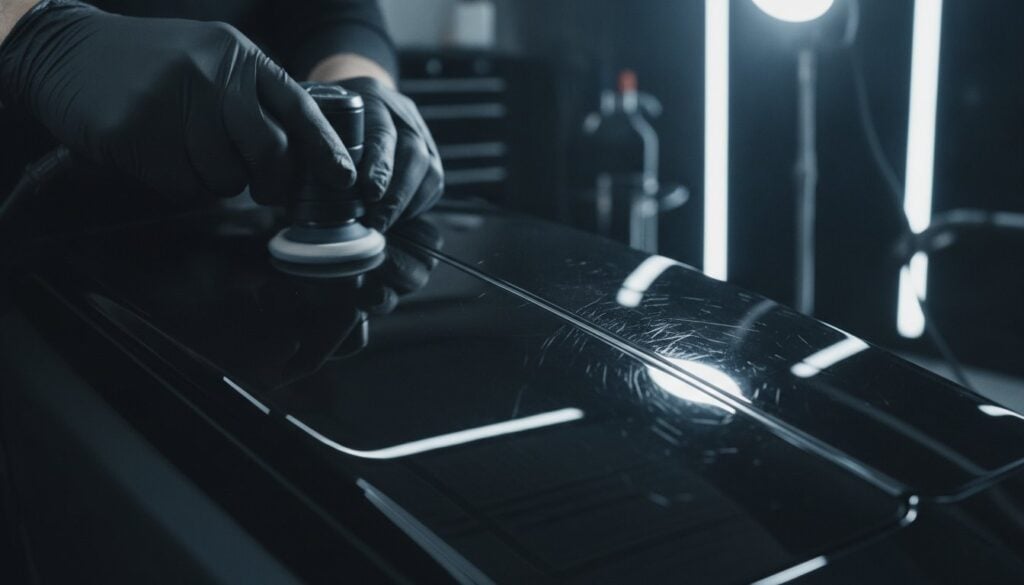
Piano black trim isn’t a decorative accent; it’s a high-maintenance automotive finish that demands the same level of surgical precision as your exterior paint. You’ve likely noticed those unsightly swirl marks dancing under direct sunlight or felt the frustration of fingerprints that seem to appear out of thin air. It’s a common pain point for luxury vehicle owners who value a flawless aesthetic but fear that a DIY attempt might burn through the delicate, thin clear coat. We understand that meticulous care is the only standard that suffices for a high-performance cabin.
This 2026 professional restoration guide reveals how to master piano black trim scratch repair to erase defects and restore a mirror-like depth to your interior. You’ll discover the technical nuances of professional-grade compounds and the critical difference between temporary polishing and permanent protection. We’re moving beyond basic cleaning to a comprehensive strategy that includes advanced Paint Protection Film (PPF) applications. By the end of this guide, you’ll have the expertise to transform your damaged trim and implement a “set and forget” solution that keeps your interior looking showroom-fresh indefinitely.
Key Takeaways
- Learn the technical nuances of clear coat leveling to permanently erase micro-marring while preserving the factory finish of your interior.
- Execute a surgical piano black trim scratch repair using a systematic decontamination and masking process that protects surrounding luxury materials.
- Understand the high stakes of clear coat thickness to prevent “strike-through” and other common pitfalls associated with inferior DIY restoration kits.
- Adopt Paint Protection Film (PPF) as the definitive, “set and forget” solution for maintaining a mirror-like shine against dust and fingerprints.
- Discover why piano black is uniquely susceptible to damage and how its non-metallic structure dictates specific restoration methods.
The Vulnerability of Piano Black Trim: Why It Scratches
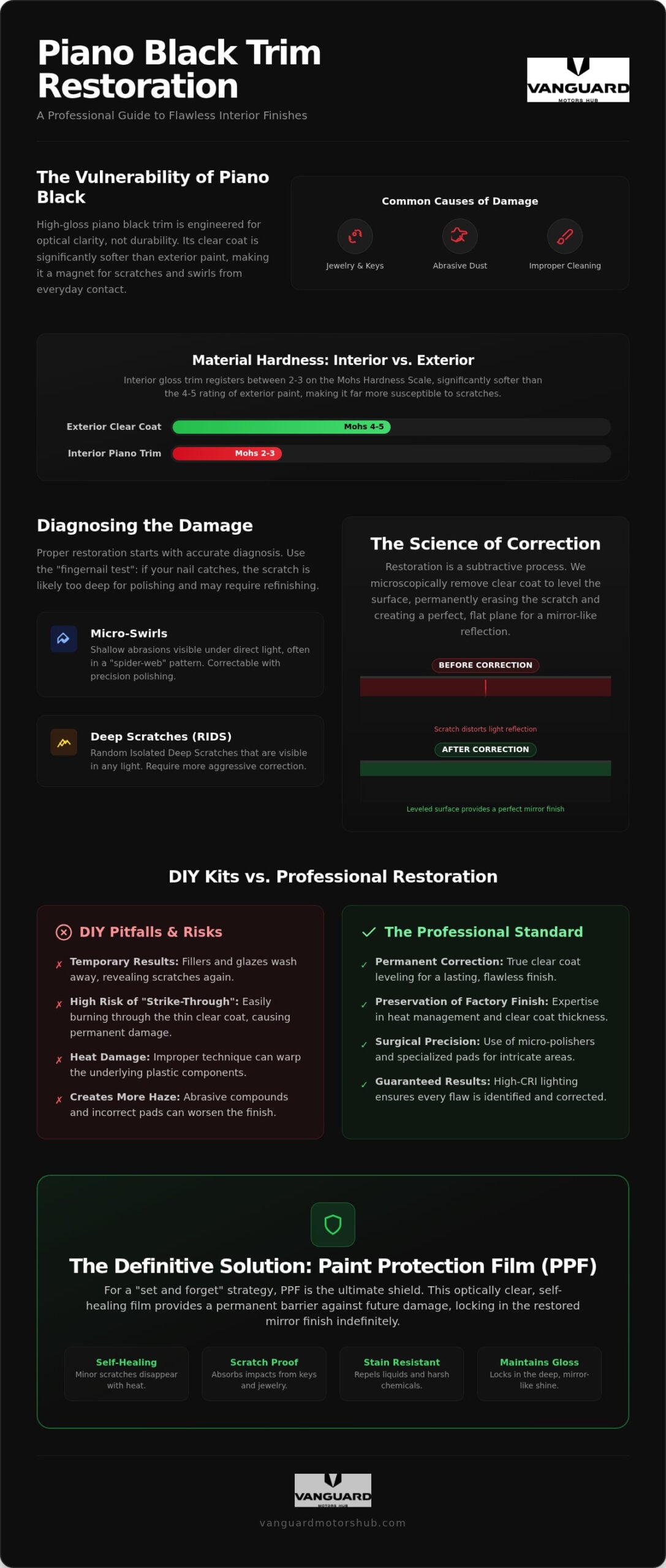
Piano black trim is a high-gloss, non-metallic finish typically applied to ABS plastic or aluminum substrates. While it delivers a stunning, mirror-like aesthetic, its beauty is inherently fragile. The deep luster comes from a specific clear coat layer that is significantly softer than the paint on your vehicle’s hood. This softness is a deliberate design choice to achieve maximum optical clarity, but it makes the surface a magnet for defects. Understanding this material science is the first step toward effective piano black trim scratch repair.
Even a clean microfiber cloth can be a hazard. If a single particle of silica-based dust is trapped between the fibers and the trim, the pressure of wiping creates micro-marring. Common culprits that degrade this finish include:
- Metal jewelry and wedding rings contacting the center console during gear shifts.
- Key fobs or coins tossed onto gloss surfaces.
- Abrasive dust particles that settle in the cabin and act like sandpaper when wiped.
- Aggressive scrubbing with improper chemicals during routine interior cleaning.
Interior vs. Exterior Gloss Trim
Exterior pillars face environmental stressors like UV radiation and industrial fallout, which degrade polymer bonds over time. In contrast, interior consoles suffer from constant physical contact and chemical exposure. Many standard interior cleaners contain harsh solvents that can haze the delicate finish, stripping the gloss and leaving a cloudy residue. On the Mohs scale of mineral hardness, typical automotive gloss trim usually registers between a 2 and 3, making it significantly softer than the 4 to 5 rating found in standard exterior clear coats.
Identifying the Depth of the Damage
Professional restoration requires a precise diagnosis. Micro-swirls, often called spider-webbing, are shallow abrasions visible only under direct light. These are the primary targets for piano black trim scratch repair. Random Isolated Deep Scratches (RIDS) are more severe and often result from sharp objects dragging across the surface. They require a more aggressive correction approach to level the surrounding material.
To determine if a scratch is repairable, use the fingernail test. If your nail catches in the groove, the damage likely exceeds the depth of the clear coat and may require part replacement or professional refinishing. Experts at Vanguard Motors utilize high-CRI (Color Rendering Index) detailing lights to reveal the true extent of the damage. This lighting mimics natural sunlight, exposing every flaw in the layers of modern automotive paint and ensuring no defect is missed during the correction process.
Restoration Science: Precision Polishing Techniques
True restoration is a subtractive process. Effective piano black trim scratch repair relies on the physics of clear coat leveling. To eliminate a scratch, you must microscopically remove the surrounding clear coat until the surface is uniform with the base of the defect. This creates a perfectly flat plane that reflects light without distortion. While retail “glazes” and fillers offer a temporary mask by hiding scratches with oils or resins, these products eventually wash away. Professional results require permanent correction through precision abrasion.
Heat management is the most critical variable when working with interior components. Unlike aluminum exterior panels that dissipate thermal energy, most piano black trim is backed by plastic, which acts as an insulator. Excessive friction causes rapid heat buildup that can lead to surface warping or clear coat failure. Professionals maintain a cool surface temperature by using short work cycles and allowing the material to rest between passes. If you’re concerned about the technical complexity of this process, you can consult with our detailing experts for a precision assessment.
The Role of Dual-Action (DA) Polishers
Dual-action polishers are the gold standard for delicate trim. Their orbital motion prevents the concentrated heat and “holograms” typically associated with rotary machines. For intricate center consoles and door switch plates, we utilize micro-detailing tools equipped with 1-inch and 2-inch pads. These smaller diameters allow for surgical precision in tight corners where a standard polisher cannot reach. Low speed settings combined with light downward pressure ensure the surface remains stable throughout the correction phase.
Abrasive Compounds and Pad Pairing
The restoration hierarchy begins with matching foam pad density to the severity of the marring. A medium-density polishing foam is often the starting point, paired with diminishing abrasives that break down into finer particles as they work. This prevents the introduction of new, deeper scratches during the process. A “one-step” polish is rarely sufficient for a true piano black mirror finish because the soft clear coat requires a dedicated ultra-fine finishing stage to achieve total optical clarity. By transitioning from a corrective compound to a non-diminishing finishing polish, we ensure the final surface is free of haze and ready for long-term preservation.
DIY Kits vs. Professional Cosmetic Repair
The allure of a retail “all-in-one” kit is undeniable. For approximately $40 to $60, these packages promise a showroom finish. However, these kits often rely on heavy fillers that temporarily mask damage rather than correcting it. For a permanent piano black trim scratch repair, the margin for error is razor-thin. The clear coat on these panels is frequently less than 30 microns thick. Attempting a DIY correction without precise measurement increases the risk of “strike-through,” a catastrophic failure where you polish completely through the gloss layer to the substrate below. Once this occurs, the part cannot be polished; it must be replaced or refinished.
Professional-grade results require a significant capital investment in tooling. A reliable dual-action polisher, a suite of micro-pads, and specialized lighting can cost between $200 and $500 for the initial setup. Beyond the hardware, the environment is a critical factor. Professional detailing bays are controlled, dust-free zones. In a standard garage, airborne contaminants can land on your pad mid-cycle, turning a polishing session into a destructive sanding event. Meticulous care demands a workspace that eliminates these variables.
When to Call a Professional Detailer
Complex geometries require a seasoned hand. Center consoles often feature tight tolerances and intricate curves near sensitive electronic buttons. One slip of a polishing pad can damage leather surrounds or Alcantara inserts. Exterior B-pillars are equally challenging, as they often require specialized masking or even trim removal to ensure a perfect, edge-to-edge finish. Integrating these precision repairs into a broader supercar detailing program ensures that your vehicle’s interior remains a sanctuary of perfection.
The Limits of Restoration
Restoration has its boundaries. If the gloss layer has begun delaminating or peeling from the plastic base, polishing will only accelerate the failure. Professionals use ultrasonic paint thickness gauges specifically calibrated for non-metal substrates to determine how much clear coat remains. If the “fingernail test” confirms a deep gouge, a bespoke wrap or part replacement may be the only viable path. We prioritize transparency, advising when a component has reached its finite limit of correction to prevent unnecessary material loss.
Step-by-Step Guide to Scratch Removal
Executing a successful piano black trim scratch repair requires a disciplined sequence of events. You can’t rush perfection. The process begins with the “test spot” methodology. This involves selecting the least aggressive pad and compound combination on an inconspicuous area. If a light finishing polish removes the defects, there’s no need to use a heavy cutting compound that removes more clear coat than necessary. This conservative approach preserves the finite thickness of the trim for future maintenance and avoids the risk of strike-through mentioned in previous sections.
Preparation and Decontamination
Cleanliness is paramount. Use a dedicated interior trim cleaner and an ultra-soft detailing brush to agitate dust in crevices. Avoid stiff bristles that could add new scratches before you even begin. Once clean, implement the “two-towel” method: use one damp microfiber to lift the cleaner and a second, dry, high-gsm towel to buff the surface. Masking is your insurance policy. Apply low-tack automotive masking tape to all adjacent surfaces, including leather, Alcantara, and rubber seals. This prevents compound staining and protects sensitive materials from accidental pad contact during the correction phase.
The Polishing Cycle
Begin the polishing cycle by applying three pea-sized drops of compound to a fresh pad. Work in a cross-hatch pattern, moving horizontally then vertically, to ensure even abrasive distribution across the panel. Stop frequently to clean your pads with a specialized brush or compressed air. Spent polish and removed clear coat particles can clump, creating “pigtail” scratches that ruin the finish. The polish has broken down and is ready for removal when the opaque film turns into a translucent, oily residue. This visual cue signals that the abrasives have finished their work and further buffing will only generate unnecessary heat.
After polishing, a final wipe-down with a 15% to 25% Isopropyl Alcohol (IPA) solution is mandatory. This strips away any remaining polishing oils that might be “filling” remaining scratches, revealing the true state of the surface. Inspect the results under a high-CRI light to verify total defect removal. If the finish is perfect, you’re ready for the protection phase. If you’d prefer a professional to handle this surgical procedure with guaranteed results, you can book your precision trim restoration here. Our team uses the same meticulous standards to ensure your cabin returns to a showroom state.
Long-Term Preservation: PPF and Beyond
Repairing defects is only half the battle. While a successful piano black trim scratch repair restores the immediate aesthetic, polishing is a finite solution. Every time you level the surface, you remove a microscopic layer of clear coat. Eventually, the material becomes too thin to sustain further correction, leading to permanent failure or strike-through. To break the cycle of constant restoration, you must pivot from a reactive maintenance mindset to a proactive preservation strategy. This is where modern material science offers a definitive advantage for high-end interiors.
Paint Protection Film (PPF) is the ultimate shield for sensitive gloss surfaces. Unlike waxes or sealants, PPF provides a physical barrier that absorbs impact and abrasion. Modern films feature advanced self-healing technology; the top polymer layer is designed to flow back into its original state when exposed to heat. If a light scratch occurs, simply parking the vehicle in the sun or applying warm water will erase the defect automatically. For those seeking an additional level of performance, a ceramic coating can be applied over the film to provide a secondary hydrophobic layer that repels dust and simplifies cleaning.
Interior PPF: The ‘Invisible’ Protection
Precision is the hallmark of professional application. We utilize digital templates that are laser-cut to the exact dimensions of your center console, door switchgear, and dashboard accents. This ensures an “invisible” fit with no exposed edges. Beyond protection, PPF effectively eliminates the persistent fingerprint problem. While high-gloss film maintains the factory look, many owners now opt for matte or satin film variants to create a sophisticated, smudge-resistant texture. Understanding how this protection fits into a broader cosmetic car repair plan is essential for maintaining a vehicle’s long-term value.
Establishing a Maintenance Routine
Once your trim is restored and protected, your maintenance routine must evolve. Ditch the traditional wipe-down in favor of a “no-touch” drying technique using filtered compressed air. This removes moisture from crevices without any physical contact that could mar the surface. Always select pH-neutral cleaners specifically formulated for high-gloss automotive polymers to avoid chemical hazing. The Vanguard approach combines precision PPF installation with meticulous detailing standards. This synergy ensures your piano black surfaces remain a highlight of your cabin rather than a source of frustration.
Elevate Your Cabin to Showroom Standards
Piano black trim is more than a design choice; it’s a commitment to automotive excellence. Achieving a flawless interior requires moving beyond temporary fillers toward the precision of clear coat leveling. We’ve explored how a systematic approach to piano black trim scratch repair can erase years of neglect and restore the deep, mirror-like depth your vehicle deserves. By transitioning to a proactive preservation strategy with Paint Protection Film (PPF), you ensure those results remain permanent through advanced self-healing technology.
As a specialized high-end cosmetic repair facility, Vanguard Motors combines meticulous detailing with the expertise of elite PPF technicians. Our extensive experience with prestigious luxury and supercar brands ensures your cabin receives surgical care and technical mastery. Restore your vehicle’s mirror finish with Vanguard Motors’ precision detailing and witness a transformation that defines elite quality. Your journey toward a defect-free interior begins with a single expert step.
Frequently Asked Questions
Can I use toothpaste to remove scratches from piano black trim?
Toothpaste is a common home remedy that we strongly advise against. While it contains mild abrasives, these aren’t engineered for automotive polymers. Using it on delicate surfaces often results in permanent hazing and micro-marring that requires professional correction to fix. For a successful piano black trim scratch repair, you must use diminishing abrasives designed specifically for high-gloss clear coats to ensure optical clarity without damaging the substrate.
Is it possible to polish piano black trim by hand, or do I need a machine?
Hand polishing is possible for very light surface oils but isn’t effective for removing actual defects. You generally need a dual-action machine for consistent results. Machines allow for precise heat management and uniform pressure across the panel. Hand polishing often creates uneven spots and “hot spots” that can lead to clear coat failure. A micro-detailing tool with a 1-inch pad provides the control necessary for intricate interior consoles.
How many times can piano black trim be polished before the finish is gone?
The number of polishing cycles is finite because each session removes a layer of the clear coat. Most piano black trim features a clear layer thinner than 30 microns. Depending on the severity of the correction, you may only be able to perform a full restoration two or three times. This is why we emphasize the “test spot” methodology to remove the absolute minimum amount of material required to achieve a mirror finish.
What is the best way to clean piano black trim without scratching it?
A “no-touch” approach is the safest way to maintain these sensitive surfaces. Start by using filtered compressed air to blow out dust from crevices and switchgear. If wiping is necessary, use a high-GSM microfiber towel and a pH-neutral cleaner. Never use a dry cloth or circular motions. Linear wipes with minimal pressure prevent the friction that causes the swirl marks common in high-traffic cabin areas.
Does ceramic coating prevent scratches on gloss black surfaces?
Ceramic coatings provide chemical resistance and hydrophobic properties, but they don’t prevent physical scratches. While they make the surface easier to clean, they lack the thickness and elasticity to absorb impacts. For true scratch prevention, Paint Protection Film (PPF) is the only definitive solution. PPF acts as a physical shield that can self-heal under heat, while ceramic coatings simply sit on top as a sacrificial layer.
Can deep scratches that I can feel with my nail be repaired?
Scratches that catch a fingernail typically indicate damage that has penetrated through the clear coat. These deep gouges generally can’t be repaired through polishing alone, as you’d have to remove too much surrounding material. In these cases, professional cosmetic repair involving refinishing or part replacement is the only way to restore the aesthetic. We use high-CRI lighting to assess these RIDS and provide an honest evaluation of repairability.
How much does professional piano black trim restoration typically cost?
Professional restoration costs vary based on the severity of the defects and the complexity of the trim’s geometry. Light clear-coat correction is more accessible than deep-panel refinishing that requires sanding and repainting. While retail kits are inexpensive, they often lead to “strike-through” that necessitates total part replacement. Investing in expert piano black trim scratch repair ensures a permanent fix using precision-calibrated tools that protect the long-term value of your luxury vehicle.
Is PPF visible once applied to interior piano black pieces?
Modern PPF is virtually invisible when applied using digital, laser-cut templates. These templates ensure that the film perfectly matches the geometry of your center console and door panels with no overlapping edges. High-gloss films maintain the factory appearance while adding a layer of depth. If you prefer a different aesthetic, you can opt for satin or matte films that eliminate the glare and fingerprint issues associated with standard factory trim.