
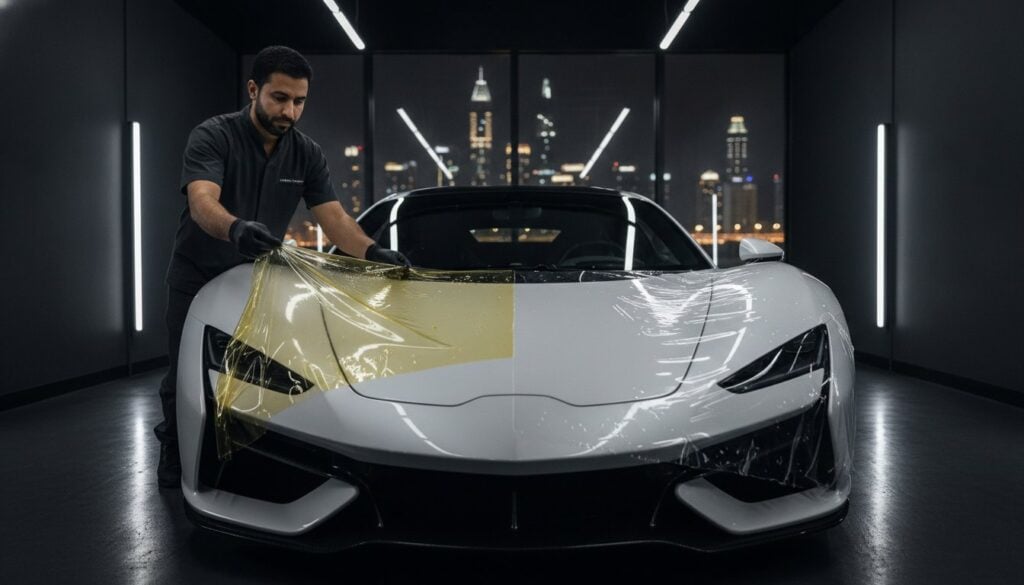
What if the shield meant to preserve your supercar’s showroom glow is actually the thing turning it into an eyesore? It’s a frustrating reality for many luxury owners who notice a dull, amber tint from PPF yellowing over time creeping across their pristine white or silver finish. You invested in protection to keep your asset flawless, not to watch it degrade into a visual reminder of subpar materials. We understand that seeing your vehicle’s aesthetic compromised is more than a minor annoyance; it’s a threat to the value of a high-performance machine.
This guide dissects exactly why this discoloration occurs, how the latest 2026 aliphatic polyurethane standards have virtually eliminated the defect, and the professional steps you can take to maintain crystal clarity. You’ll gain a clear understanding of modern film lifespans, which can now reach up to 12 years with proper care. We’ll preview technical innovations in UV resistance and discuss how the Vanguard Premium Package serves as the ultimate maintenance solution. By the end, you’ll know how to keep your finish pristine and choose a non-yellowing premium film that lives up to your standards of excellence.
Key Takeaways
- Master the distinction between modern aliphatic polyurethane and the outdated aromatic resins that historically caused rapid film failure.
- Pinpoint the specific environmental pollutants and UV interactions that drive PPF yellowing over time on high-visibility light paintwork.
- Adopt professional preservation strategies, including the strict avoidance of petroleum-based cleaners that can permanently stain your vehicle’s protective layer.
- Explore the technical limits of film restoration and why timely replacement is critical to prevent adhesive hardening against your factory finish.
- Leverage the Vanguard Premium Package to implement a rigorous decontamination schedule that maintains elite aesthetic standards year after year.
The Reality of PPF Yellowing: Is Discoloration Inevitable?
Yellowing isn’t a guaranteed fate for your vehicle; it’s a failure of either technology or maintenance. On a white supercar, even a slight shift in hue is catastrophic, turning a crisp factory finish into a dull, aged mess. Darker vehicles like deep blacks or metallic blues might mask the amber tint longer, but the film eventually loses its optical clarity. This makes the paint look “muddy” and robs the car of its intended depth. Historically, Paint Protection Film (PPF) was notorious for this shift, but the industry has undergone a radical transformation to meet the demands of elite collectors.
In 2026, premium protection means more than just a physical shield. It represents a commitment to long-term transparency. Modern expectations have shifted; a high-end film should remain invisible for a decade or more. Understanding PPF yellowing over time requires a look at the molecular level to see why some films thrive while others fail. We’ve moved beyond the era of “disposable” film into a period of permanent, high-performance aesthetics.
The ‘Old School’ PVC vs. Modern TPU Debate
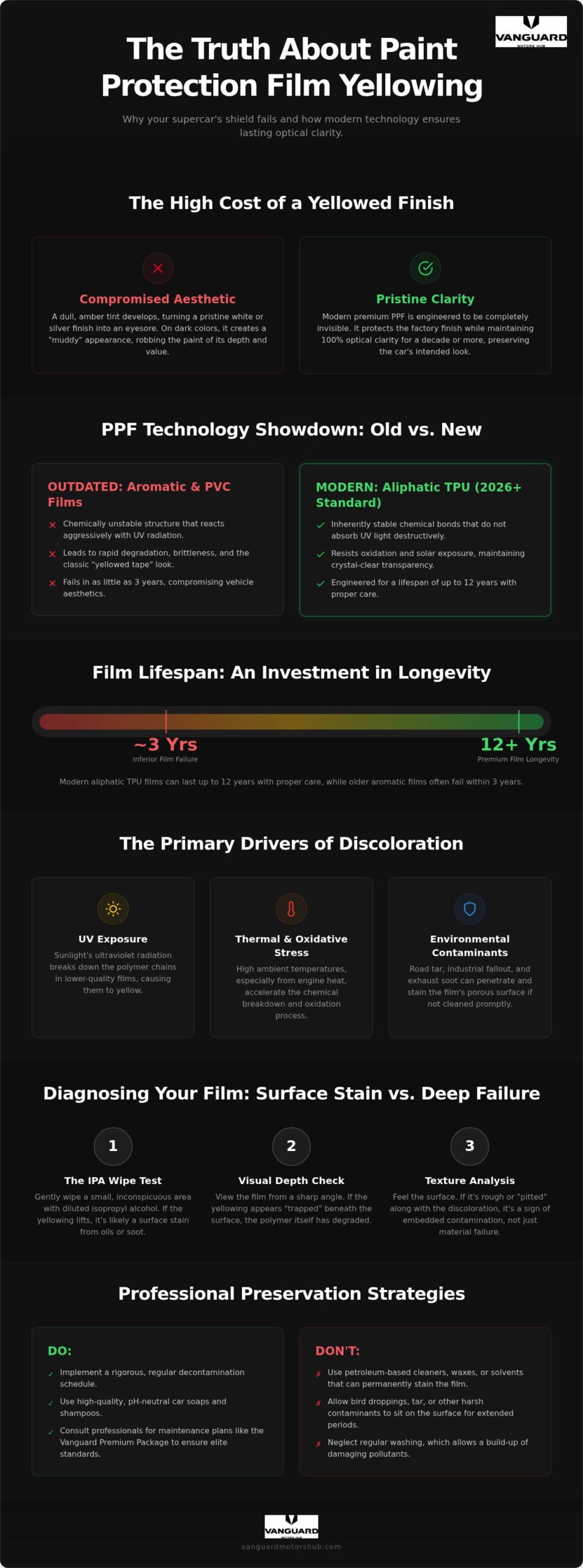
Early iterations of clear bras relied on PVC (polyvinyl chloride). These films were stiff, brittle, and chemically unstable. They reacted aggressively to UV radiation, leading to rapid degradation and that infamous “yellowed tape” look. Today, the industry has standardized Thermoplastic Polyurethane (TPU). Specifically, 2026 standards prioritize aliphatic TPU, which uses a chemical structure that doesn’t absorb UV light in the same destructive way as older aromatic urethanes. Aliphatic TPU is the superior choice for clarity because its chemical bonds are inherently stable against oxidation and solar exposure.
Surface Staining vs. Material Failure
It’s vital to distinguish between a film that has failed and one that is simply dirty. Surface staining occurs when road tar, industrial fallout, or bird droppings sit on the film too long. Modern premium films feature a high-density top coat. This layer acts as a sacrificial barrier, preventing pollutants from sinking into the porous lower layers of the film. If you’re unsure about the state of your protection, consider these simple diagnostics:
- The Isopropyl Alcohol (IPA) Wipe: A gentle wipe with a diluted IPA solution often removes surface yellowing caused by environmental oils or exhaust soot.
- The Visual Depth Check: Look at the film from an angle; if the yellowing looks “trapped” beneath the top coat, the polymer itself has likely degraded.
- Texture Analysis: If the film feels rough or “pitted” alongside the discoloration, it’s a sign of environmental contamination rather than molecular failure.
At Vanguard Motors, we’ve seen how inferior installations fail within three years. Choosing a high-end PPF installation serves as a preventative measure, ensuring your vehicle retains its elite aesthetic. Our Vanguard Premium Package is designed to combat these issues before they start, utilizing materials that meet the most rigorous 2026 aliphatic standards.
The Science of Degradation: Why Paint Protection Film Changes Color
Discoloration isn’t a surface-level flaw; it’s a molecular transformation that compromises your vehicle’s aesthetic. When we talk about PPF yellowing over time, we’re really discussing the gradual breakdown of the film’s chemical structure. This process is driven by three main factors: UV exposure, atmospheric oxidation, and extreme thermal stress. In climates with high solar intensity, these forces work in tandem to attack lower-quality resins. This causes them to lose their optical transparency and take on a sickly amber hue. High ambient temperatures further accelerate this resin breakdown, making heat management as critical as UV protection.
A Comprehensive Review of Polyurethane Degradation highlights how environmental factors like photo-degradation and thermal stress destabilize polyurethane elastomers. In 2026, the industry standard for elite protection relies on aliphatic polyurethane. Unlike its cheaper aromatic counterparts, aliphatic structures are inherently stable. They don’t possess the chemical “anchors” that UV light typically latches onto to begin the yellowing process. This molecular stability is why premium PPF installation remains clear even under the harshest sun, while budget alternatives fail within seasons.
UV Radiation and Molecular Integrity
UV light acts as a catalyst for photochemical breakdown. It literally severs the polymer chains that hold the film together. To combat this, premium films are infused with high concentrations of UV stabilizers and inhibitors. These additives absorb and dissipate harmful radiation before it can reach the film’s backbone. For vehicles operating in national climates with high UV indices, these inhibitors aren’t just a luxury; they’re a technical necessity for long-term preservation. Without these stabilizers, PPF yellowing over time becomes an inevitable consequence of daily driving.
Adhesive Oxidation: The Hidden Cause
Sometimes, the yellowing you see isn’t the film at all. It’s the adhesive layer beneath it. If a shop uses budget films or fails to seal the edges properly, oxygen and moisture can penetrate the glue. This leads to adhesive oxidation, where the bonding agent itself changes color. This is particularly common around the edges of the hood or fenders where the film is most vulnerable. Meticulous edge-sealing is a hallmark of elite installation, ensuring the glue remains hermetically sealed from the elements. If you’re noticing discoloration at the seams, it’s time to speak with a technical expert about a professional assessment.
Quality Tiers: Why Premium Film Outlasts Budget Options
Not all protection is created equal. While many films look identical on the roll, their performance diverges sharply after a few months of real-world exposure. Premium PPF is a sophisticated multi-layer composite. It typically consists of a release liner, a high-bond acrylic adhesive, a TPU core, and a high-density top coat. Budget-tier shops often bypass these engineering costs by using rebranded, white-label films. These generic products lack the advanced cross-linking required to prevent PPF yellowing over time. They might offer temporary shine, but they lack the molecular stamina of a professional-grade product.
There’s a vital distinction between self-healing properties and yellowing resistance. A film can “heal” swirl marks with heat but still turn yellow if its core lacks premium UV stabilizers. High-end films prioritize both. At Vanguard Motors, our selection process is ruthless. We exclusively utilize materials that maintain absolute optical clarity under extreme stress. We don’t settle for rebranded filler; we install the future of automotive preservation. Our focus is on long-term clarity that survives the harshest national conditions.
The Role of the Advanced Top Coat
The top coat is your first line of defense. It isn’t just for gloss; it’s a non-porous barrier that prevents bird droppings, road tar, and acid rain from etching into the TPU core. A truly hydrophobic surface ensures that pollutants slide off rather than bonding to the film. We believe that professional supercar detailing is a non-negotiable prerequisite for any application. This ensures the surface is chemically decontaminated, allowing the film to bond perfectly and function as intended for years without trapped impurities causing discoloration.
Warranty and Longevity Expectations
In 2026, a 10 to 12-year warranty is the benchmark for premium products. However, the fine print in budget warranties often hides “environmental factor” exclusions that let manufacturers off the hook for yellowing in high-UV regions. You need a partner that stands behind the installation as much as the material. A professional paint protection film installation ensures every edge is tucked and every surface is prepped. This prevents the lifting and oxidation that lead to premature failure. Don’t be fooled by “lifetime” claims that lack a physical service center to back them up.
Preservation Strategies: How to Prevent PPF Yellowing
Preservation is an active discipline. Even the most advanced 2026 aliphatic films require a rigorous maintenance schedule to combat the intense solar load and environmental pollutants found in high-UV national climates. While premium materials are engineered for stability, neglect can lead to surface-level degradation that mimics internal failure. Petroleum-based cleaners and harsh degreasers are the primary enemies of polyurethane. These volatile chemicals can swell the film’s pores, allowing microscopic contaminants to become trapped within the structure. Once these oils and pollutants are embedded, they create a permanent amber tint that characterizes PPF yellowing over time.
Routine decontamination is non-negotiable, particularly for white or light-colored vehicles where every imperfection is magnified. Iron particles from brake dust and industrial fallout can bond to the film’s surface and oxidize, creating a yellowed, “rusty” appearance. Strategic parking also plays a vital role in film longevity. Reducing the cumulative UV exposure by utilizing shaded parking or climate-controlled garages significantly extends the life of the film’s chemical stabilizers. This proactive approach ensures your vehicle remains a visual masterpiece for the duration of its service life.
Safe Cleaning Protocols for Film
Elite maintenance starts with the right chemistry. You should exclusively use pH-neutral shampoos and the proven “two-bucket” wash method to prevent surface marring. This technique ensures that dirt is never dragged across the film’s top coat. Bird droppings and bug splatter are highly acidic; they can etch into the film in a matter of hours when exposed to high ambient heat. You must remove these organic contaminants immediately using a dedicated film cleaner and a plush microfiber towel. Automated car washes with abrasive brushes are strictly prohibited, as they create micro-scratches that trap dirt and accelerate the appearance of PPF yellowing over time.
Boosting Resistance with Ceramic Overlays
A ceramic layer applied over your film isn’t a redundant expense; it’s a technical force multiplier. This secondary shield provides an additional layer of UV protection and extreme hydrophobicity, making it nearly impossible for pollutants to bond. The synergy between the physical protection of the film and the chemical resistance of a ceramic coating creates a nearly impenetrable barrier. We offer the Vanguard Premium Package as a holistic solution to maintain this peak performance. This package integrates specialized detailing and ceramic technology to ensure your investment remains flawless. To secure your vehicle’s future, book a professional preservation consultation today.
Restoration or Replacement? Professional Solutions for Aging Film
When PPF yellowing over time becomes visible, the first instinct is often restoration. Many owners ask if paint correction techniques can clear the haze. While light polishing can remove surface-level oxidation or minor staining, it cannot reverse molecular degradation. If the yellowing has permeated the TPU core or the adhesive layer, polishing is merely a cosmetic band-aid. Attempting to buff out deep yellowing often thins the top coat, destroying the film’s self-healing properties and leaving it even more vulnerable to the elements. Once the structural integrity of the polymer is compromised, replacement is the only viable path to clarity.
Leaving failed film on your vehicle is a calculated risk you shouldn’t take. As the polymer breaks down, the adhesive beneath it begins to harden and cross-link with your factory clear coat. This makes future removal significantly more difficult and increases the risk of paint delamination. If your film has lost its transparency or started to feel brittle, the window for safe, clean removal is closing. Acting now preserves the integrity of your original finish and prevents the need for more extensive paintwork later.
The Professional Removal Process
DIY removal of aged film is a recipe for disaster. Brittle film often snaps into tiny shards; pulling it cold can strip the paint right off the substrate. We utilize industrial-grade steam generators and specialized solvents in a controlled environment to safely release the bond. This meticulous approach ensures that the factory clear coat remains untouched. For vehicles that have suffered from previous poor installations or underlying paint issues, our expertise in cosmetic car repair provides a seamless path back to a showroom-quality finish.
Selecting Your Next Protection Layer
Replacing failed film is an opportunity to upgrade to the latest 2026-spec aliphatic TPU. Modern materials offer vastly superior clarity and chemical resistance compared to products from even five years ago. This is also the ideal time to consider bespoke car conversions, as a fresh re-wrap allows for perfect integration with new aerodynamic components or carbon fiber accents. Don’t let PPF yellowing over time diminish the impact of your luxury asset. Reach out to the experts at Vanguard Motors to evaluate your current protection and secure a non-yellowing future for your vehicle.
Preserve Your Showroom Finish for the Next Decade
A luxury vehicle is a masterpiece of engineering and design; it deserves a protective barrier that honors its aesthetic. We’ve dissected the transition from brittle PVC to advanced aliphatic polyurethane technology, proving that discoloration is no longer an inevitable fate. By prioritizing high-density top coats and rigorous decontamination, you effectively eliminate the primary drivers of PPF yellowing over time. Our team specializes in luxury and supercar detailing, providing national coverage for elite automotive care that exceeds 2026 standards. We don’t just apply film; we engineer long-term transparency.
It’s time to move beyond the fear of yellowing and embrace the peak performance of modern material science. Whether you’re protecting a factory-fresh finish or upgrading from a failed, brittle layer, our meticulous installation process ensures absolute optical clarity. Take the proactive step to safeguard your asset with a partner that understands the intersection of precision and passion. Secure Your Vehicle’s Future with Vanguard’s Premium PPF Solutions today. Your car’s brilliance should never be compromised by time or the elements.
Frequently Asked Questions
Is it normal for PPF to yellow after only one or two years?
It’s absolutely not normal for high-quality film to yellow within a two-year window. Modern aliphatic polyurethane standards ensure that premium installations remain optically clear for a decade or more. If you notice a shift in hue this early, it’s likely a symptom of PPF yellowing over time caused by inferior PVC-based materials or aromatic resins. Premium films are engineered to withstand intense UV exposure without the molecular breakdown that causes rapid discoloration.
Can I use a clay bar on my paint protection film to remove yellowing?
You should avoid using a clay bar on your film unless you’re a trained professional, as it can mar the delicate top coat. While claying might remove surface-level industrial fallout that looks like yellowing, it can’t fix deep molecular degradation within the film itself. For surface stains, we recommend a pH-neutral film cleaner or a specialized decontamination wash. If the yellowing remains after a thorough cleaning, the film’s chemical structure has likely failed.
Does the color of my car affect how fast the PPF yellows?
The car’s color doesn’t technically change the rate of degradation, but it significantly impacts how easily you see it. On white or silver vehicles, even a microscopic shift in the polymer’s clarity becomes immediately apparent as a dull amber tint. Darker finishes like metallic black or deep blue mask the early stages of yellowing much more effectively. Regardless of the paint color, the underlying chemical breakdown of the film occurs at the same pace under identical environmental conditions.
Will ceramic coating prevent my PPF from turning yellow?
A ceramic coating serves as a powerful secondary shield that significantly reduces the risk of discoloration. By adding an extra layer of UV inhibitors and extreme hydrophobicity, it prevents organic pollutants and acids from etching into the film’s pores. This chemical resistance stops surface staining, which owners often mistake for material failure. We recommend integrating a ceramic overlay as part of our Vanguard Premium Package to maximize the lifespan and clarity of your protection.
How do I know if the yellowing is on the film or the paint underneath?
You can distinguish the source of the discoloration by inspecting the film’s edges or comparing it to unprotected panels. If the amber tint stops exactly where the film ends, the issue is restricted to the polyurethane or the adhesive layer. In rare cases where the paint itself has faded, the discoloration will persist even after removal. A professional assessment can quickly determine if you’re dealing with PPF yellowing over time or a deeper clear coat issue.
What should I do if my PPF starts peeling at the edges and turning yellow?
If your film is peeling and yellowing at the seams, you must seek professional removal immediately. Peeling edges allow oxygen, moisture, and dirt to penetrate the adhesive layer, leading to rapid oxidation and hardening. This process can eventually bond the adhesive too aggressively to your factory finish, making removal risky. Once edges fail, the seal is compromised, and the only solution is to strip the old material and upgrade to a 2026-spec protection layer.
Does the national heat contribute to faster PPF degradation?
Extreme national heat acts as a catalyst that accelerates the photochemical breakdown of lower-quality resins. High ambient temperatures increase the rate of oxidation and can cause the adhesive layer to become brittle or discolored. This is why we exclusively utilize aliphatic polyurethane, which is specifically engineered to maintain its molecular integrity under intense thermal stress. Proper heat management, such as utilizing shaded parking, remains a vital preservation strategy for any high-performance vehicle in this climate.
Are all modern TPU films 100% guaranteed against yellowing?
Not all TPU films are created equal, and guarantees vary significantly between manufacturers. While high-end aliphatic TPU is exceptionally resistant to discoloration, budget-tier “rebranded” TPU films may still lack the necessary concentration of UV stabilizers. Most premium 10-year warranties cover yellowing, but they often exclude damage caused by improper maintenance or harsh chemicals. It’s essential to choose a film backed by a reputable brand and a professional installation center that understands national environmental demands.