
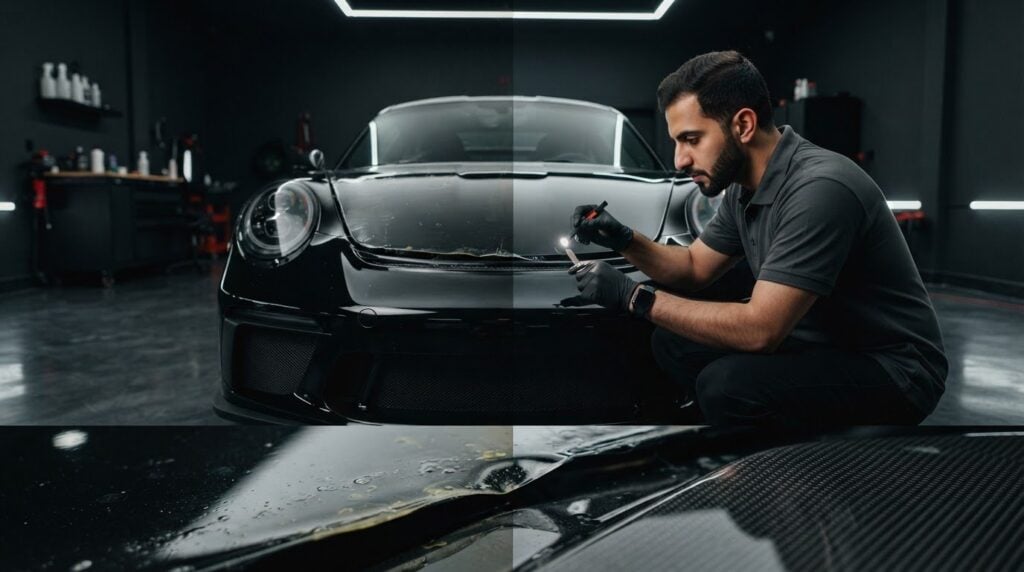
The cheapest PPF quote isn’t automatically the wrong choice, but it does deserve sharper questions. The problems with cheap PPF brands can include yellowing, staining, cracking, or edges that lift. However, a visible flaw doesn’t always mean the film itself is at fault. Installation technique, vehicle condition, and aftercare can also affect how the protection looks and performs.
It’s reasonable to compare options on price. The challenge is understanding what each price includes and whether claims about durability are supported by clear film details rather than broad marketing language. This guide explains how to spot warning signs, assess what may have caused them, and compare PPF options using evidence.
We’ll cover common film failures, how poor preparation or application can cause similar symptoms, and what removal concerns to discuss before committing. You’ll also find practical questions to ask about film specifications, installation methods, aftercare, and warranty terms, so you can make a more informed choice for your vehicle.
Key Takeaways
- “Cheap” describes a price, not a technical standard. Compare what each quote includes before judging value.
- Problems with cheap PPF brands can be difficult to distinguish from fitting faults or wear. Assess the symptom and where it appears before drawing conclusions.
- Look beyond material labels such as TPU. Ask for clear film information and compare coverage, installation scope, support, and written terms.
- Review relevant installation examples and ask how the installer approaches complex panels, edges, and aftercare.
- A careful installation process can help manage avoidable issues, but no film or installer can promise a flawless result in every circumstance.
Problems With Cheap PPF Brands: What Buyers Should Know First
Price differences are difficult to assess from a quote alone. One proposal may cover selected panels, while another includes broader coverage or more preparation. Without a clear scope and film information, the total doesn’t tell you exactly what’s being installed or how the work will be carried out.
“Cheap PPF” describes a price, not a technical category or a verdict on quality. A lower quote may reflect the coverage area, materials, labour, or a business’s overheads. Price alone can’t establish a film’s composition, durability, or expected appearance. Judge the evidence behind the quote, not the number in isolation.
The result also depends on more than the film. Paint condition, installation technique, how the car is used, and ongoing care all matter. For a neutral overview of Paint protection film (PPF), including its material background and uses, see the reference. The central principle is simple: investigate the product and service details before deciding whether a lower price is worth the risk.
Does a low PPF price automatically mean poor quality?
No. Two quotes may differ because they cover different parts of the vehicle, include different preparation work, or account for labour differently. Even when the scope appears similar, price doesn’t disclose the film’s construction or how it may perform over time. Ask for specific, verifiable information instead of relying on labels such as “premium” or “entry-level.”
What should a PPF quote actually tell you?
Start with the essentials: does the quote identify the film type, panels included, and preparation work? Ask whether paint inspection or correction is included if needed, and how edges and complex panels will be treated. Check whether removal, aftercare guidance, and any warranty terms are documented and explained. If a detail is missing, request clarification before comparing quotes.
A useful comparison is precise. Match coverage to coverage, preparation to preparation, and written terms to written terms. If you’re still weighing what the protection involves, the paint protection film fundamentals guide offers additional background. For an assessment specific to your vehicle, discuss your needs with a PPF installation team and ask them to explain the proposed scope before you commit.
Common PPF Problems: Film Defects, Installation Faults, or Wear?
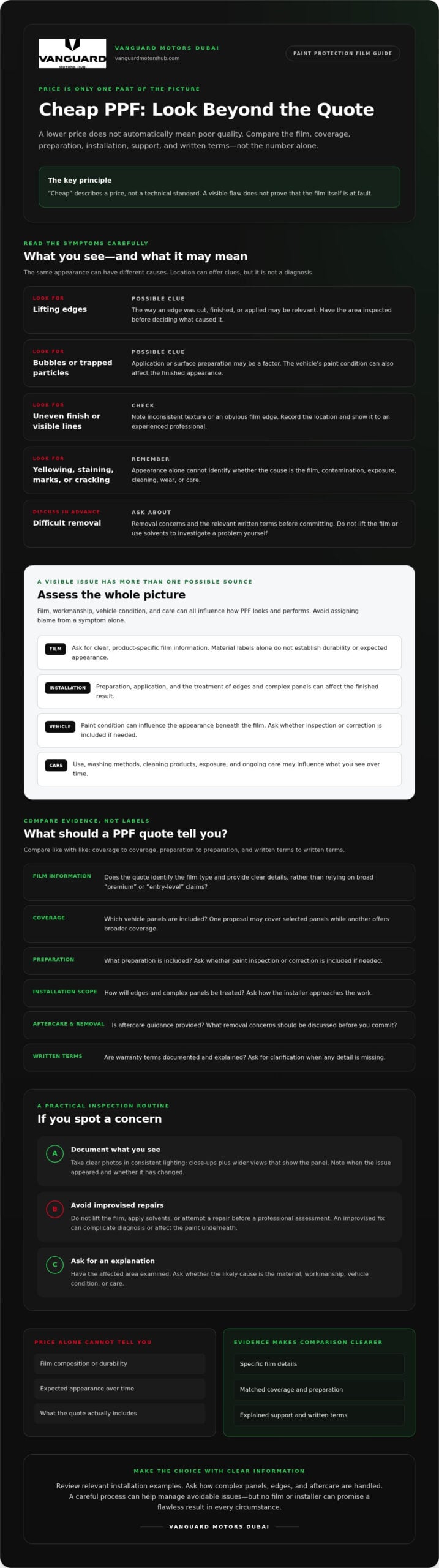
Lifting edges, bubbles, discolouration, staining, cracking, and difficult removal are possible concerns with paint protection film. They aren’t guaranteed outcomes of choosing a lower priced option, and a symptom alone doesn’t prove the film is cheap or defective. The same appearance can have different causes, so identify what you’re seeing before deciding what went wrong.
Which visible PPF issues should owners inspect?
Look for edges that have lifted away from the panel, bubbles that remain visible, or particles trapped beneath the film. An uneven finish may show up as inconsistent texture or an obvious line where the film ends. Discolouration and surface marks also deserve attention, but their appearance alone can’t reveal whether the cause is the film, contamination, exposure, or cleaning.
Record what you observe. Take clear photos in consistent lighting, including close-ups and wider views that show the panel. Note when the issue first appeared and whether it has changed. This gives an installer useful context for an inspection.
How can you tell film problems from installation or care issues?
Location can offer clues, but it isn’t a diagnosis. Lifting near an edge may relate to how that area was cut, finished, or applied. Bubbles or visible debris may point to application or surface preparation concerns, while the condition of the paint beneath the film can affect the finished appearance. Wear, washing methods, cleaning products, and exposure may also influence what you see over time.
Don’t lift the film, apply solvents, or attempt a repair before an experienced professional has assessed it. An improvised fix can complicate diagnosis or affect the paint underneath. Ask the installer to examine the affected area and explain whether the likely cause is the material, workmanship, vehicle condition, or care.
Be wary of universal claims about how long every film lasts or how quickly it should fail. Performance depends on the specific film, installation, vehicle, use, and maintenance. Any lifespan or failure rate figure should be supported by product specific documentation. For perspective on film installation terminology, the International Window Film Association’s resources focus on window film, so they shouldn’t be treated as PPF specific standards.
If you’re unsure what an issue indicates, document it and ask a PPF installation team for an assessment before taking action. You can also discuss your PPF concerns with Vanguard Motors Dubai.
Cheap vs. Premium PPF: Compare Evidence, Not Labels
“Premium,” “advanced,” and “long lasting” can sound reassuring, but they aren’t comparable specifications on their own. To assess two PPF options, ask for details you can verify and compare the full installation scope. The material is one part of the decision. Coverage, workmanship, support, and written terms matter too.
Thermoplastic polyurethane (TPU) describes a material, not the quality of every finished film made from it. A global paint protection film market report discusses TPU’s market position and associated performance characteristics, but that doesn’t establish the quality or expected results of a particular quoted product. Request the exact film identity and available technical documentation rather than relying on a material label alone.
| Compare | What to clarify |
|---|---|
| Film information | Exact film identity, disclosed material, and available technical documents |
| Coverage | Panels included, with any exclusions identified |
| Installation scope | Preparation, edge finishing, complex curves, and other stated finishing work |
| Support | Who to contact with questions or concerns after installation |
| Written terms | Aftercare guidance and any warranty coverage, exclusions, and claim process |
Which specifications and documents deserve closer scrutiny?
Ask the installer to identify the quoted film and share any relevant technical documents. If warranty terms are offered, request them in writing and check what’s covered, what’s excluded, and how a claim is handled. Missing or unclear details aren’t automatic proof of poor quality, but they are questions to resolve before you commit.
How should you compare two PPF quotes fairly?
Make the comparison like for like. Confirm that both quotes cover the same panels and account for similar paint preparation, installation work, and aftercare. Ask whether visible edges and complex curves are included, and what finishing work is specified. A lower quote may simply describe a narrower scope.
Use the Vanguard Motors website to explore its PPF installation service, and request clarification on the specific film and scope being quoted. Clear answers make it easier to judge whether the offer fits your needs, without relying on brand rankings or vague promises. This evidence led approach also helps you assess potential problems with cheap PPF brands without assuming that price alone predicts the outcome.
A Practical Checklist for Choosing PPF and an Installer
A confident decision starts with a clear sequence, not a brand slogan. Define what you want protected, compare the written scope, verify the film information, assess the installer’s work, then review the terms. This helps you compare options consistently and spot unanswered questions before your vehicle is booked in.
- Define your protection needs. Decide which panels matter most and explain how you use the vehicle. This gives each installer the same starting point.
- Compare written scope. Confirm exactly which panels are covered, what preparation is included, and how edges and complex curves will be finished.
- Verify film information. Ask which film is proposed and what product documentation is available. Keep the answer specific rather than relying on broad descriptions.
- Assess workmanship. Request examples of completed vehicles with similar panels or finishes. Ask how the installer handles difficult contours, and whether you can inspect relevant work where available.
- Review terms and aftercare. Get care instructions and any warranty coverage, exclusions, and claim steps in writing before agreeing to the work.
What questions should you ask before booking PPF?
Ask: “Which film will be installed, and what written information can I review?” Then clarify the coverage, paint condition assessment, preparation steps, edge treatment, expected aftercare, and any warranty exclusions. Ask to see relevant installation examples, particularly around intricate bumpers, body lines, and panel edges. A capable provider should be willing to explain the proposed process in terms you can understand.
What are warning signs in a quote or sales conversation?
Pause if the film description stays vague, coverage isn’t documented, or no one can explain who handles aftercare questions. Broad promises about appearance or durability deserve supporting documentation and clear terms. These gaps don’t prove dishonesty or poor quality. They mean you need clarification before moving forward. Ask every shortlisted installer the same questions, then compare the completeness and consistency of their answers.
Before work begins, make sure the vehicle’s current paint condition has been discussed and that you understand what preparation is planned. Confirm the aftercare guidance you’ll receive, too. This groundwork helps you evaluate potential problems with cheap PPF brands without treating price as the only signal, and gives the installation team a clearer brief for your vehicle.
For a vehicle specific discussion of your PPF requirements and installation scope, message Vanguard Motors about PPF installation.
How Professional PPF Installation Helps Reduce Avoidable Problems
Film selection matters, but even a suitable film can’t compensate for poor preparation, imprecise fitting, or unclear aftercare. Professional installation helps manage these parts of the process and the final finish. It isn’t a guarantee against every defect or wear issue, and it can’t remove the limitations of the film itself. The goal is to reduce avoidable installation problems through careful assessment and clear communication.
What should a careful installation process address?
Start with the paint. The installer should inspect its condition and explain what preparation is appropriate before the film is applied. Existing marks, repairs, or paint concerns may affect how the finished film looks, so ask how these will be assessed and discussed with you.
During application, accurate panel fit and controlled edge finishing matter, especially around tight curves, body lines, and panel gaps. Ask how the installer manages these areas and what the final inspection covers. Before collecting the vehicle, request clear care instructions, including any guidance for the period immediately after installation, and confirm whom to contact if you notice a concern. These are practical questions, not demands for a promise of perfection.
When should you ask a specialist to assess your options?
A specialist discussion can help if you’re unsure about existing paint condition, coverage priorities, or why two quotes differ. Bring the proposed film identity, coverage details, preparation scope, and written terms into the conversation. That makes it easier to identify what is known, what still needs checking, and whether the proposed work fits your vehicle and expectations.
Vanguard Motors provides Paint Protection Film installation. Its installation team can discuss your vehicle and PPF requirements without assuming a particular film brand or outcome. A clear conversation should help you understand the proposed service scope and which product details need confirmation before booking.
The problems with cheap PPF brands can’t be assessed by price alone. Film information, vehicle condition, installation decisions, and aftercare all contribute to the result. Take time to clarify the details that matter for your car. Share your vehicle, protection goals, and any outstanding questions when you discuss your PPF requirements with Vanguard Motors.
Choose PPF With Confidence
A lower quote isn’t proof of poor quality, just as a premium label isn’t proof of performance. To assess the problems with cheap PPF brands, look beyond price: compare the film information, coverage, preparation, installation details, and written terms. If you notice lifting, bubbles, or discolouration later, remember that the symptom alone may not identify the cause. Film condition, installation, paint, use, and care all deserve consideration.
Vanguard Motors provides Paint Protection Film installation as part of its automotive protection and customization services. Discuss your vehicle, protection goals, and any unanswered questions with the team before deciding what scope is right for you. Discuss your PPF requirements with Vanguard Motors.
With clear information and a considered installation plan, you can make a more confident choice for your car’s paint.
Frequently Asked Questions
Are cheap PPF brands always bad?
No, a low price alone doesn’t prove that a PPF option is poor quality. The quote may reflect coverage, preparation work, labour, or other differences in the service scope. Ask for the exact film identity, available product information, panels included, and written terms. Compare those details across quotes before deciding. Clear documentation lets you assess the offer on evidence rather than assuming that price or marketing labels tell the full story.
What problems can poor-quality PPF cause?
Possible issues include lifting edges, persistent bubbles, discolouration, staining, cracking, or removal that proves difficult. These are concerns to investigate, not inevitable results of choosing a lower priced film. Similar symptoms can also relate to installation, paint condition, exposure, or care. If you notice a change, photograph it and note when it appeared. Have the film assessed before attempting a repair or drawing conclusions about the cause.
How can I tell if PPF is poor quality?
You can’t reliably judge film quality from appearance alone. Bubbles, uneven edges, visible contamination, or surface marks may indicate an issue, but they don’t identify whether the cause is the film, application, vehicle paint, or maintenance. Request the film’s exact identity and available technical documentation, then compare those details with the written installation scope and terms. If a visible problem develops, seek a professional assessment before altering the film.
Can cheap PPF damage car paint when removed?
Removal can pose a risk to the underlying paint, but the outcome depends on factors such as paint condition, film and adhesive condition, installation, and removal technique. Existing repairs or weakened paint may need particular attention. Don’t pull the film off or use solvents in an attempt to remove it yourself. Ask a qualified professional to inspect the vehicle and explain an appropriate removal approach before work begins.
Does TPU mean a PPF brand is high quality?
No. TPU identifies a material, but it doesn’t establish the quality of a finished film or prove how it will look and perform on your vehicle. Ask for the specific film identity and any available technical information. Consider those details alongside coverage, installation methods, aftercare guidance, and written terms. A material label is one point of comparison, not a substitute for evidence about the particular product and service being offered.
What should I ask before choosing a PPF installer?
Ask which film will be used, what panels are included, and what preparation and edge finishing the work covers. Clarify how complex curves will be handled, what aftercare is recommended, and whether warranty coverage, exclusions, and claim steps are available in writing. Request relevant installation examples, too. Compare the answers consistently across quotes. If a detail is unclear, pause and ask for clarification rather than treating the gap as proof of poor workmanship.
Is professional PPF installation worth considering for a luxury car?
Yes, it’s worth considering if you want the film and installation plan assessed against your vehicle’s paint condition, panels, and protection priorities. Professional application can help manage preparation, fitting, and finish, but it can’t guarantee against every issue or compensate for unsuitable film. Vanguard Motors provides PPF installation as part of its automotive protection and customization services. Discuss the proposed film information, coverage, scope, and terms before deciding whether the service fits your needs.