
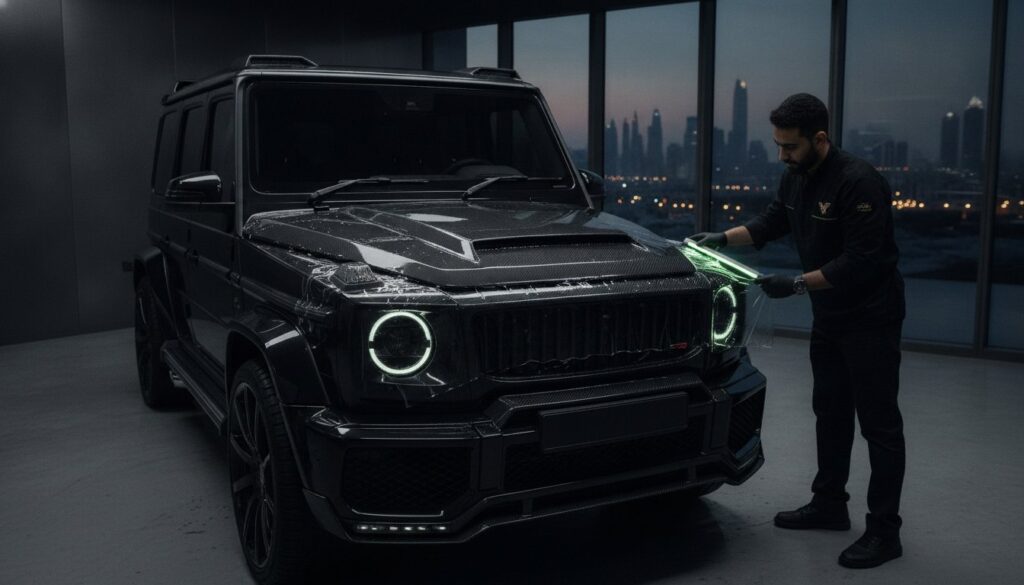
Imagine a finish so resilient that the midday sun across the UAE actually repairs your car instead of damaging it. For the elite driver, the constant threat of rock chips and abrasive sand isn’t just a nuisance; it’s an assault on a significant luxury asset. You’ve likely felt that sharp sting of anxiety when spotting a new scratch, but modern self-healing paint protection film ensures those imperfections don’t have to be permanent. We understand that maintaining a showroom-perfect aesthetic in the UAE’s extreme environment requires more than just regular detailing.
This article reveals how advanced thermal-activation technology transforms your vehicle into a self-correcting masterpiece. You’ll discover the science that enables high-grade TPU polymers to erase surface damage and fight off UV oxidation. We’re diving into the technical precision of the Vanguard Premium Package offered by Vanguard Motors Dubai and explaining how molecular memory keeps your finish immortal. From preserving the intricate lines of a Mansory kit to shielding raw carbon fiber, you’re about to learn why this technology is the ultimate standard for automotive preservation and long-term value.
Key Takeaways
- Understand how thermal-activation technology allows self-healing paint protection film to erase surface swirls and maintain a flawless showroom finish.
- Distinguish between high-impact physical films and thin ceramic barriers to select the superior defense for your high-performance vehicle.
- Master the specialized maintenance protocols designed to protect your automotive finish from the intense UV radiation and sand of the Emirates.
- Discover why precision hand-trimming is essential for seamless coverage on intricate Brabus, Mansory, or Jetour kit conversions.
- Realize how the Vanguard Premium Package acts as a permanent foundation for preserving both the form and function of your luxury asset.
Beyond Sacrificial Layers: The Evolution of Paint Protection Film
Modern Paint protection film (PPF) represents a radical departure from the basic vinyl wraps of the past. It’s a sophisticated, high-performance Thermoplastic Polyurethane (TPU) barrier specifically engineered to withstand the brutal conditions of the UAE. While traditional “static” protection merely sits on the surface, contemporary self-healing paint protection film acts as an active defense system. It’s designed to absorb and dissipate the kinetic energy from high-velocity road debris and abrasive sand. For owners of luxury assets, this transition from a passive layer to a dynamic polymer is the difference between a pristine finish and a sandblasted front end.
From Aerospace to Automotive: A Brief History
The technology began on the front lines, not the showroom floor. Originally developed to protect helicopter rotor blades from flying debris during the Vietnam War, these films were thick, heavy, and prone to yellowing. The automotive industry eventually adopted the concept, but early iterations used Polyvinyl Chloride (PVC) which lacked the clarity required for elite aesthetics. By 2026, the shift to advanced TPU has reached its peak. Modern films are now optically clear, offering near-perfect transparency that enhances rather than hides the vehicle’s depth. This evolution ensures that even the most complex curves on a Brabus or Mansory conversion remain visible while staying shielded.
Why Factory Clear Coats Aren’t Enough
You might assume your factory clear coat is sufficient, but it’s fundamentally different from a protective film. Standard paint finishes are designed for hardness and gloss; they’re brittle. When a rock hits a factory finish, the paint chips because it has nowhere to move. In contrast, TPU is characterized by its remarkable elasticity. It stretches and rebounds, absorbing impacts that would otherwise shatter the paint. This sacrificial layer preserves your original, VIN-matched paint, which is critical for maintaining the resale value of a luxury asset in Dubai’s competitive market. For those seeking comprehensive coverage, a full body PPF treatment delivers a true 360-degree shield that protects every panel from the relentless assault of road debris and desert sand.
Ultimately, self-healing paint protection film is the only physical barrier capable of preventing stone chips from reaching the metal or carbon fiber beneath.
The Physics of Self-Healing: How Heat Erases Surface Damage
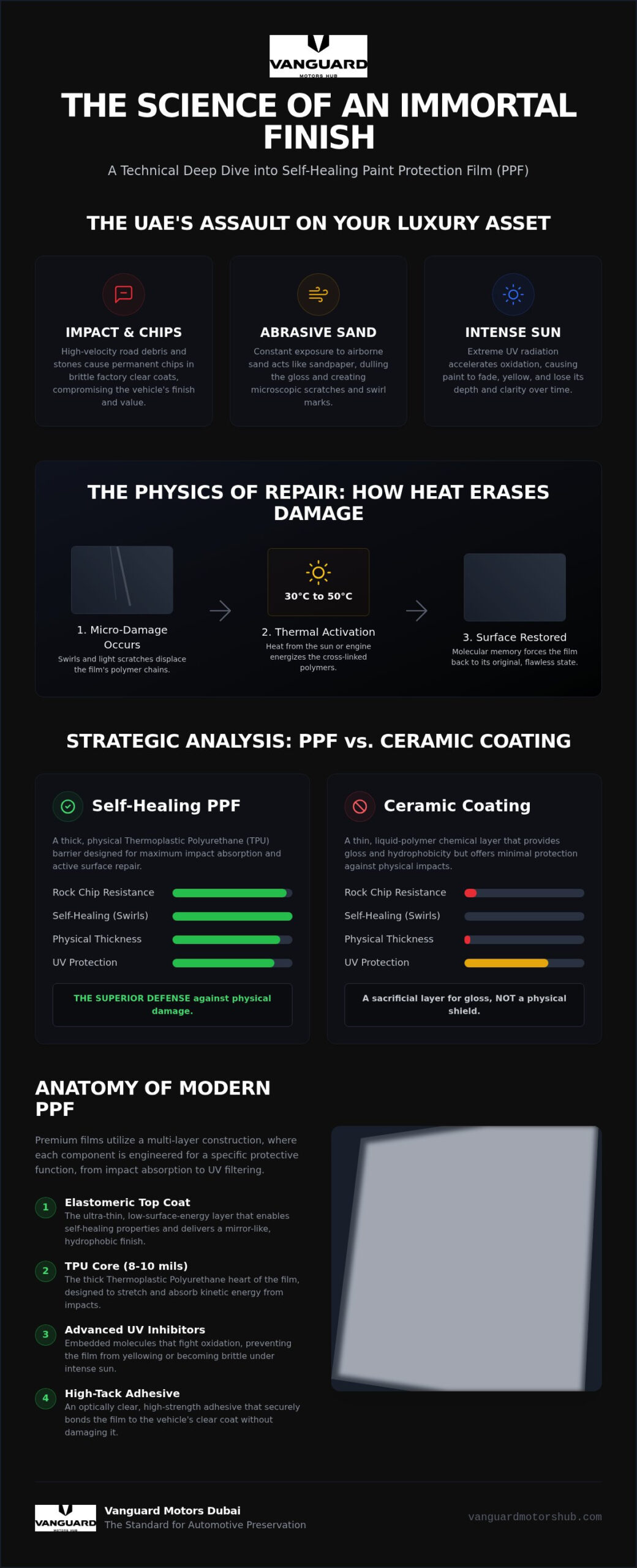
The science behind an immortal finish isn’t found in a bottle of wax; it’s engineered into the molecular structure of the film. High-grade Thermoplastic Polyurethane (TPU) possesses a unique property known as molecular memory. This allows the self-healing paint protection film to return to its original, manufactured state after being physically deformed. When a road pebble or a coarse wash mitt creates a swirl mark, it doesn’t actually remove material. Instead, it displaces the polymer chains on a microscopic level. Because these chains are cross-linked, they “remember” their flat orientation and wait for a catalyst to trigger their return.
Thermal Activation and Polymer Cross-Linking
Heat serves as the primary catalyst for automotive restoration. On a molecular level, thermal energy increases the mobility of the polymer chains, allowing them to flow back into their lowest energy state. Research into Self-healing polymers for aerospace has directly influenced how these materials perform under stress. In the United Arab Emirates, this activation often happens autonomously. The intense sunlight can quickly raise surface temperatures to the required 30°C to 50°C threshold, causing light scratches to vanish in minutes. If you’re looking to maintain that pristine look, exploring the Vanguard Premium Package ensures your vehicle benefits from this cutting-edge material science.
The Multi-Layer Architecture of Modern Film
To achieve this level of performance, premium films utilize a complex, multi-layered sandwich construction. It begins with a high-tack adhesive layer that bonds to the clear coat, followed by a thick TPU core, usually around 8 to 10 mils, which provides impact resistance. Embedded within this core are advanced UV inhibitors that prevent the film from yellowing or becoming brittle under the desert sun. The final layer is the elastomeric top coat. This ultra-thin, low-surface-energy layer is what enables the self-healing properties while also providing a mirror-like finish. By eliminating the “orange peel” texture common in lower-quality films, this architecture ensures the protection remains completely invisible to the naked eye.
While this technology is revolutionary, it does have physical limits. Self-healing paint protection film is designed to erase surface-level swirl marks, light abrasions, and wash-induced marring. If a sharp object penetrates the top coat and tears the TPU core, the film has reached its structural limit and will require professional replacement. However, for the 95% of daily wear and tear that typically ruins a luxury car’s finish, the physics of thermal activation provides a permanent solution to automotive aging.
Strategic Analysis: Self-Healing PPF vs. Ceramic Coatings
Choosing between a liquid coating and a physical film is the most critical decision you’ll make for your vehicle’s longevity. While both enhance a car’s appearance, they serve fundamentally different functions. A self-healing paint protection film is a robust, high-impact barrier measuring between 150 and 200 microns in thickness. In contrast, a professional ceramic coating is a liquid polymer that cures to a thickness of just 1 to 2 microns. This massive disparity in scale explains why a coating can’t stop a rock chip at highway speeds on the E11, while a premium film handles it with ease.
The distinction lies in “Self-Cleaning” versus “Self-Healing” capabilities. Ceramic coatings are prized for their extreme hydrophobicity, which repels water and contaminants to make washing effortless. However, they’re essentially glass-like layers that can still scratch or swirl if handled improperly. A self-healing paint protection film uses its molecular memory to actually repair those scratches. Many elite owners in the UAE opt for “stacking,” a method where we apply a ceramic coating directly over the PPF. This strategic combination provides the impact resistance of the film with the slick, dirt-repellent properties of a coating. To maximize this protection across every surface of your vehicle, investing in full body PPF coverage ensures no panel is left vulnerable to the UAE’s demanding driving conditions.
Impact Resistance vs. Hydrophobic Performance
Precision protection requires understanding the limits of each technology. PPF is specifically engineered to absorb the kinetic energy of sand and gravel, preventing the underlying paint from fracturing. Ceramic coatings offer zero physical impact protection; their strength lies in chemical resistance and UV defense. Over a five-year ownership period, the cost-benefit ratio of PPF is significantly higher because it prevents the permanent paint damage that necessitates expensive resprays. It’s the difference between a surface that stays clean and a surface that stays intact. For owners who also want the flexibility to change their vehicle’s appearance, understanding the full spectrum of options by exploring peelable paint vs PPF for luxury vehicle protection can help clarify which solution best suits your long-term ownership goals.
The Ultimate Hybrid: Ceramic-Infused PPF
The 2026 era of automotive care has introduced a revolutionary hybrid: ceramic-infused PPF. This technology bakes hydrophobic properties directly into the self-healing top coat during the manufacturing process. It eliminates the need for separate stacking while providing the same “easy-to-clean” benefits. For enthusiasts, this simplifies the detailing process without sacrificing the essential defense required for high-performance kits. You get a permanent, mirror-like finish that resists staining and erases swirl marks simultaneously, ensuring your vehicle remains a showroom-perfect asset with minimal effort.
Maximizing Longevity: Maintenance Protocols for Extreme Climates
The environment of the United Arab Emirates is a relentless laboratory for automotive finishes. Between scorching ambient heat and abrasive dust, standard maintenance isn’t enough to preserve your investment. While self-healing paint protection film offers unparalleled defense, its lifespan depends heavily on specific care protocols. A premium installation should realistically last between 7 and 10 years, provided you respect the material’s limits and the region’s unique stressors. Neglecting these standards can lead to premature lifting or a loss of the film’s clarity.
Adopting a “Safe Wash” method is the foundation of film longevity. You should never use automated car washes, as the stiff brushes can create deep gouges that exceed the film’s self-healing capacity. Instead, utilize a two-bucket hand wash with pH-neutral shampoos that don’t contain harsh degreasers. When drying, avoid high-pressure water jets near the edges of the film. Excessive pressure can compromise the adhesive bond and cause the edges to lift, especially on complex surfaces like those found on a Mansory or Brabus kit. For the highest standard of care, our Mobile Detailing Van provides professional maintenance that ensures your film remains perfectly bonded and optically clear.
Combatting UV Degradation and Yellowing
The sun is a silent predator for automotive plastics. High-quality self-healing paint protection film utilizes aliphatic TPU, a material specifically engineered to resist the oxidative yellowing that plagues cheaper, aromatic films. To maintain this resistance, we recommend applying UV-stable conditioners every few months. These specialized products keep the TPU core supple and prevent it from becoming brittle under the intense 50°C summer heat. Without this moisture, the adhesive layer can eventually dry out, leading to difficult removal processes later in the vehicle’s life.
The Sand Abrasion Factor
In arid regions, fine sand acts like high-grit sandpaper on every leading edge of your vehicle. At highway speeds, these particles create a constant barrage that would quickly dull a factory clear coat. The elastomeric top coat of your PPF is critical here; it absorbs these micro-impacts and uses the sun’s heat to smooth out the resulting marring. Regular professional inspections are essential to ensure that sand hasn’t begun to accumulate under any exposed edges. Keeping the surface clean prevents “sand-trapping,” which is the primary cause of edge failure in desert climates.
The Vanguard Standard: Precision Installation for Elite Vehicles
The highest quality self-healing paint protection film is only as effective as the technician applying it. A subpar installation leaves behind visible seams, trapped dust, and silvering that compromise the aesthetic of a high-performance machine. At Vanguard, we view protection as a fusion of technical skill and creative expression. We don’t just cover panels; we sculpt the film to the vehicle’s unique geometry to ensure the defense is as flawless as the factory finish. This meticulous attention to detail is what separates a standard wrap from elite automotive preservation.
Our methodology combines the surgical efficiency of software-cut templates with the artistry of bespoke hand-trimming. While digital templates provide a safe baseline, they often fail to account for the aggressive aerodynamics of bespoke body kits. For vehicles equipped with a Brabus, Mansory, or Jetour kit, standard cuts are insufficient. We extend the film beyond the template’s limits to ensure every vent, winglet, and carbon fiber edge is fully shielded. The Vanguard Premium Package represents this holistic approach, offering a level of coverage that makes the protection virtually invisible to the naked eye.
The Art of the Invisible Edge
Achieving a seamless finish starts long before the film touches the paint. Our decontamination process is exhaustive, removing every microscopic particle that could compromise the adhesive bond. We utilize the “wrapped edge” technique wherever possible, tucking the film behind body panels so no visible lines remain. This is especially vital for protecting intricate carbon fiber weave patterns. Because carbon fiber repair is both complex and expensive, a precision-laid film is the only way to safeguard its structural integrity without dulling its natural visual depth.
Securing Your Investment
Investing in professional protection is a calculated move to preserve a luxury asset. In the competitive secondary market of the UAE, a vehicle with verified, factory-perfect paint commands a significantly higher resale value. Beyond the financial ROI, it’s about the joy of ownership. You’re buying the freedom to drive without anxiety, knowing that road debris and sand won’t leave a lasting mark on your finish. It’s about maintaining that first-day showroom glow for the entire life of the vehicle. If you’re ready to experience the pinnacle of automotive care, you can secure your vehicle’s future with Vanguard Motors Hub and ensure your finish remains truly immortal.
The Future of Your Finish Starts Here
Preserving a high-performance vehicle in the UAE requires a defense that is as dynamic as the environment itself. We’ve explored how molecular memory and thermal activation turn a sacrificial layer into an active restoration system. By choosing self-healing paint protection film, you aren’t just preventing rock chips; you’re ensuring your car maintains its showroom-perfect aesthetic for years to come. This technology represents the ultimate intersection of material science and automotive passion.
At Vanguard, we specialize in the meticulous protection of elite assets, including bespoke Brabus, Mansory, and Jetour kit conversions. Our advanced TPU technology offers 10-year UV stability, ensuring your finish remains optically clear under the harshest desert sun. Through meticulous hand-finished edge wrapping, we guarantee a seamless application that is virtually invisible. Don’t let the elements dictate the lifespan of your luxury asset. Experience Precision Protection at Vanguard Motors Hub and give your vehicle the immortal finish it deserves. Your masterpiece is ready for the road ahead.
Frequently Asked Questions
Does self-healing paint protection film really erase scratches?
Yes, the film effectively erases surface-level swirl marks and light abrasions through thermal activation. The top layer of self-healing paint protection film is composed of an elastomeric polymer that maintains a “memory” of its original flat state. When the surface is marred, the polymer chains are displaced rather than removed. Applying heat causes these chains to flow back into their initial orientation, making the scratch disappear completely.
How long does it take for the film to ‘heal’ a scratch?
The healing process occurs in seconds or minutes depending on the intensity of the heat source. In the intense United Arab Emirates sun, light swirl marks often vanish almost instantaneously as the surface temperature reaches the activation threshold. For deeper abrasions, pouring warm water over the affected area or using a professional heat gun can accelerate the molecular return to a flawless finish.
Will the PPF turn yellow over time in high-heat environments?
Premium films utilize aliphatic TPU which is specifically engineered to resist UV oxidation and yellowing. While older, low-grade PVC films were prone to discoloration, modern high-performance films maintain 10-year UV stability even in extreme desert climates. This chemical resistance ensures your vehicle’s paint remains optically clear and vibrant without the brittle degradation common in entry-level protection products.
Can I wash my car normally after getting self-healing PPF installed?
You can wash your vehicle, but you must adopt a “Safe Wash” protocol to maintain the film’s integrity. We recommend waiting at least one week after installation before the first wash to allow the adhesive to cure fully. Always use a pH-neutral shampoo and the two-bucket hand wash method. You should avoid automated car washes with stiff brushes, as these can create gouges that exceed the film’s healing capacity.
Is it possible to apply ceramic coating on top of self-healing film?
Applying a ceramic coating over your self-healing paint protection film is a highly recommended practice known as “stacking.” This combination provides the best of both worlds: the impact resistance of the film and the extreme hydrophobicity of the coating. The ceramic layer makes the surface easier to clean and provides an additional barrier against chemical etching while the film handles physical stone chips.
What happens if the film gets a deep gouge that doesn’t heal?
If an object penetrates the TPU core and creates a structural tear, the film will not be able to heal that specific area. The self-healing properties are limited to the top elastomeric layer. In these cases, the damaged section of the film has fulfilled its sacrificial purpose by absorbing an impact that would have shattered your paint. You can simply have that individual panel’s film replaced to restore the perfection of your finish.
How much does a full-body self-healing PPF installation cost?
The investment for a full-body installation depends on the vehicle’s dimensions and the complexity of its body lines. Specialized kit conversions from Brabus or Mansory require significantly more labor due to the intricate trimming and edge-wrapping involved. Because every high-performance vehicle has unique requirements, we recommend a professional consultation to determine the precise scope of work needed for your specific model.
Does PPF affect the original color or gloss of my car’s paint?
High-quality films are designed to be virtually invisible and actually enhance the depth of your factory finish. The optically clear TPU core adds a rich, mirror-like gloss that can make the paint look even more vibrant than it did on the showroom floor. For those seeking a different aesthetic, we also offer matte-finish films that can transform a glossy paint job into a sophisticated satin look without changing the original color.