
Your vehicle’s clear coat is under a silent chemical siege that a standard bucket of soapy water is powerless to stop. You’ve likely felt that frustrating, sandpaper-like grit on the paint even after a meticulous cleaning. These bonded contaminants, from jagged iron particles to stubborn industrial fallout, act as microscopic anchors that dull your paint’s natural brilliance and depth. This is exactly why a full vehicle decontamination wash is the non-negotiable starting point for any high-performance aesthetic transformation.
We understand that for a discerning owner, a clean car isn’t enough; it must be surgically pure. In this guide, you’ll discover how professional decontamination serves as the essential foundation for elite vehicle protection and long-term preservation. We’ll explore the technical precision required to achieve a mirror-like, smooth-as-glass finish. From chemical breakdowns to mechanical claying, you’re about to see how we reset your vehicle’s surface to a factory-perfect state. This rigorous process ensures your investment in PPF or bespoke car kits remains flawless and structurally sound for years to come.
Key Takeaways
- Understand why a standard cleaning fails to remove bonded contaminants like iron filings and industrial fallout.
- Learn the multi-stage professional sequence of a full vehicle decontamination wash that utilizes pH-balanced chemistry and mechanical claying.
- Discover how removing microscopic surface grit enhances light refraction to create a deeper, mirror-like gloss.
- Identify the environmental warning signs in the UAE that signal your paint requires a deep chemical reset.
- See why this process is the mandatory foundation for elite protection like Paint Protection Film (PPF) and bespoke car kit installations.
Beyond the Surface: Defining the Full Vehicle Decontamination Wash
A standard wash is a cosmetic fix. A full vehicle decontamination wash is a technical necessity. While most owners believe a clean car is a protected car, the reality is far more complex. Beneath the shine, microscopic particles are physically bonded to your clear coat. These contaminants don’t just sit on the surface; they embed themselves into the paint’s pores. Professional decontamination is a multi-stage process engineered to break these bonds without compromising the integrity of your finish. It’s about achieving a state of chemical and mechanical purity that no standard car wash can replicate.
The Invisible Enemies of Automotive Paint
The threats to your vehicle’s aesthetic are often too small to see with the naked eye. Iron fallout is perhaps the most destructive. These are tiny metal shards originating from brake pads and railway transport. Even brand-new vehicles straight from the showroom often suffer from “rail dust” accumulated during transit. If left untreated, these shards oxidize and create tiny rust spots. Industrial fallout is another silent predator. In the UAE’s industrial zones, chemical pollutants form a stubborn film that obscures the paint’s depth. Finally, organic contaminants like tree sap and bird droppings pose a biological threat. These substances are highly acidic. They don’t just sit on top; they cause permanent etching that requires aggressive correction if not addressed through timely decontamination.
Why Standard Washing is Only the First Step
Standard Auto detailing often begins with a high-quality, pH-neutral soap. This is excellent for removing loose dirt and road grime. However, these soaps are designed to be gentle. They lack the chemical potency to dissolve bonded iron or break the adhesive grip of tar and sap. If you attempt to scrub these particles away during a normal wash, you’re essentially using them as sandpaper. This leads to the unsightly swirl marks and “spider webbing” that plague so many luxury vehicles. At Vanguard Motors, we believe there’s a profound difference between a car that looks clean and one that is truly pure. Our philosophy centers on removing every microscopic obstacle before we apply elite protection. By transitioning from a simple wash to a technical full vehicle decontamination wash, we ensure that your paint is a perfectly smooth canvas. This preparation is the only way to guarantee the longevity of the Vanguard Premium Package or a high-end PPF installation.
The Multi-Stage Chemistry of Professional Decontamination
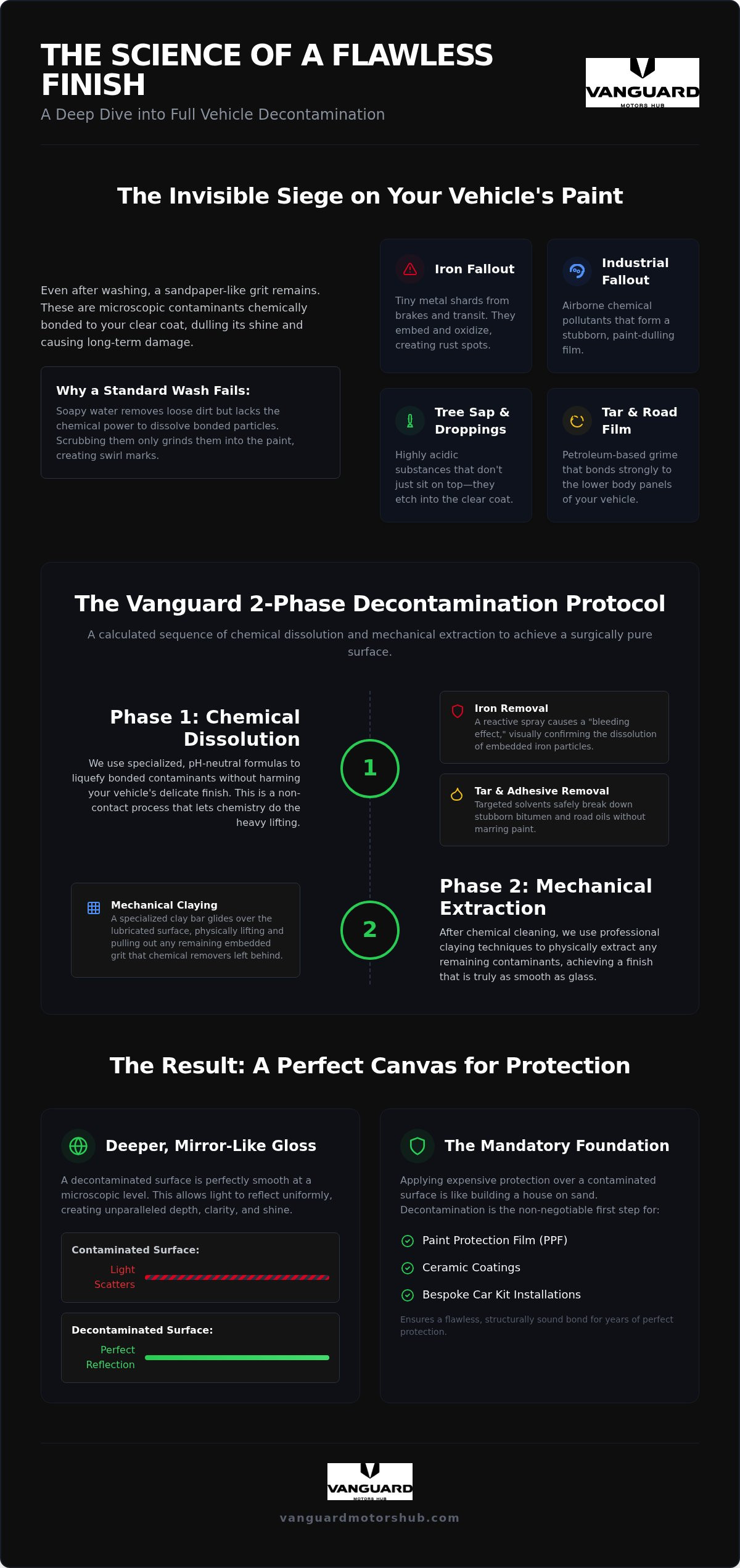
Professional preservation is a rigorous discipline that moves far beyond the capabilities of a standard wash bucket. A full vehicle decontamination wash is a calculated, two-phase operation: chemical dissolution followed by mechanical extraction. This sequence is vital because it addresses different types of molecular bonds. While chemicals liquefy metallic and organic matter, mechanical tools lift the physical grit that refuses to dissolve. At Vanguard Motors, we utilize professional-grade pH-neutral agents to ensure this aggressive cleaning never compromises the delicate finishes of a Brabus kit or the intricate carbon fiber components of a Mansory conversion.
Chemical Decontamination: Dissolving Iron and Tar
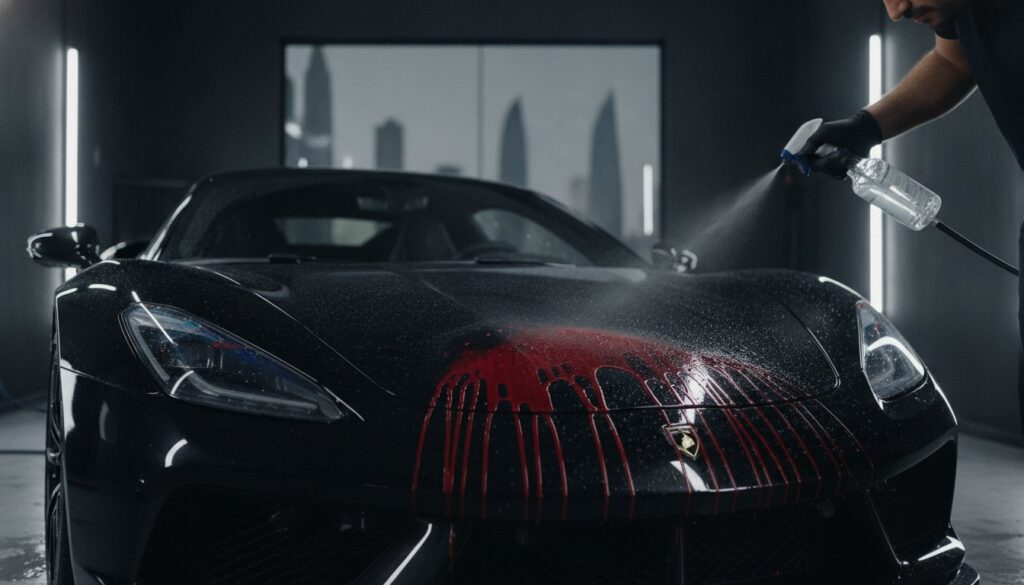
The first phase of a technical reset involves specialized reactive chemistry. Iron removers are the primary weapon here. These formulas contain surfactants that specifically target ferrous particles. When the solution contacts iron, a chemical reaction occurs, turning the particles into a water-soluble complex. You’ll recognize this as the “bleeding” effect, where the clear coat appears to weep purple or deep red liquid. This isn’t just for show; it’s the visual confirmation that embedded metal is being liquidated.
Following iron removal, we address bitumen and road oils. Tar and adhesive removers safely break down these petroleum-based contaminants without marring the underlying paint. Precision is paramount during this stage. Professional detailers must manage “dwell time” with extreme care. The chemicals must stay on the surface long enough to react, but they cannot be allowed to dry. Drying can lead to chemical staining or etching, particularly on the luxury trims found on high-performance vehicles. If you want to ensure your vehicle receives this level of technical precision and care, consulting an expert is the safest path forward.
Mechanical Decontamination: The Role of the Clay Bar
Even the most potent chemicals can’t dissolve every particle. This is where mechanical decontamination becomes essential. An automotive clay bar is a specialized resin compound designed to “shave” off remaining bonded grit. As the clay glides over the surface, it captures microscopic protrusions that survived the chemical phase, such as overspray or stubborn tree sap.
- Lubrication: We never use clay on a dry surface. High-lubricity sprays are mandatory to create a frictionless barrier, preventing the clay from causing micro-marring or “clay haze.”
- Synthetic Innovation: While traditional clay is effective, we often utilize synthetic clay mitts for modern, high-efficiency results. These tools provide more consistent surface contact and are easier to keep sterile.
- Tactile Verification: The process continues until the technician’s hand glides across the paint with zero resistance.
This exhaustive process at Vanguard Motors transforms the paint from a rough, contaminated surface into a pristine, glass-like canvas. It’s the only way to ensure that subsequent layers of protection, like our high-end PPF or peelable paint applications, bond perfectly to the substrate. Without this chemical and mechanical reset, elite protection is built on a foundation of sand.
Decontamination vs. Standard Detailing: Understanding the Value
A standard detail often focuses on what the eye can see, but a full vehicle decontamination wash prioritizes what the hand can feel. Most car enthusiasts are familiar with the “clean” look of a freshly waxed car. However, there is a fundamental difference between a visual shine and a tactile purification. If you run your hand across a car that has only been washed, it often feels like fine-grit sandpaper. This grit is the physical evidence of bonded contaminants that standard shampoos simply cannot touch. Achieving a mirror-like finish requires moving beyond the surface to eliminate every microscopic obstacle.
Surface Texture and Light Reflection
The brilliance of your paint depends entirely on how light interacts with the clear coat. When microscopic particles like iron dust or tar are embedded in the surface, they act as tiny prisms that scatter light in every direction. This diffusion is what makes even expensive paint jobs look “flat” or dull. Clear coat light refraction is the precise angle at which light reflects off a vehicle’s surface, a process that achieves peak brilliance only when the paint is free of microscopic defects and bonded contaminants. By removing these obstacles, we allow light to travel through the clear coat and bounce back with perfect uniformity. This is the secret behind the “wet look” that defines elite automotive presentation. Without this step, even the most expensive waxes are merely sitting on a jagged, uneven landscape, failing to reach their full aesthetic potential.
Longevity of Protective Coatings
Applying a ceramic coating, high-end wax, or Paint Protection Film (PPF) to a non-decontaminated surface is a recipe for premature failure. Protective layers are engineered to bond directly to the paint’s molecular structure. If a layer of industrial fallout or iron remains, the protection bonds to the dirt instead of the car. This creates a weak foundation that leads to peeling, bubbling, or the coating simply washing away after a few months.
For owners of high-performance vehicles, this purification process is a critical financial safeguard. A full vehicle decontamination wash at Vanguard Motors ensures that your investment in the Vanguard Premium Package is built to last. When the surface is chemically pure, the adhesive on a colored wrap or PPF can bite into the paint with maximum efficiency. This prevents edge lifting and ensures that the protection remains invisible and effective for years. In the world of supercar maintenance, professional decontamination isn’t an “extra” service; it’s the insurance policy that protects your aesthetic upgrades. It saves you money by extending the maintenance intervals of your protective layers and preventing the need for costly re-applications. Whether you’re preparing for a Mansory kit conversion or a simple seasonal refresh, the value lies in the purity of the preparation.
Identifying the Warning Signs: Does Your Vehicle Need Decontamination?
Paint health isn’t always something you can judge with a quick glance. Even a vehicle that appears pristine under the sun can be harboring a layer of destructive, bonded grit. A full vehicle decontamination wash is often required much sooner than most owners realize, particularly for those driving in high-intensity environments. If you notice that water no longer beads and rolls off your paint as it once did, you’re likely witnessing a loss of hydrophobicity. This happens because microscopic contaminants create a jagged surface that “traps” water rather than repelling it. This increased resistance is a primary indicator that your clear coat is saturated with environmental fallout.
Don’t assume that a brand-new car from the dealership is exempt from these issues. Most vehicles spend weeks or even months in transit, often sitting in shipyard holding lots or traveling via rail. During this time, they’re bombarded with iron rail dust and industrial pollutants. By the time you take delivery, the paint may already be embedded with metallic shards that a standard prep wash won’t remove. High-performance vehicles, especially those featuring bespoke carbon fiber or Mansory kits, require an immediate technical reset to ensure these particles don’t lead to premature oxidation or clear coat failure.
The Physical ‘Baggie Test’ Method
To accurately assess the state of your clear coat, you need to amplify your sense of touch. The most effective diagnostic framework is the “baggie test.” After you’ve performed a thorough wash and dry, place your hand inside a thin plastic sandwich bag. Lightly glide your fingertips across the horizontal surfaces of the vehicle, such as the hood, roof, and trunk lid. The plastic acts as a high-fidelity sensor. It amplifies the presence of iron filings, tree sap, and industrial fallout, making them feel like jagged boulders under your hand. If the surface feels anything less than smooth-as-glass, your vehicle is a candidate for a professional decontamination.
Environmental Factors and High-Risk Zones
The UAE national landscape presents a unique set of challenges for automotive preservation. The intense thermal energy from the sun doesn’t just heat the surface; it literally bakes atmospheric pollutants into the clear coat, making them significantly harder to remove. Proximity to industrial hubs or active construction zones further increases the density of heavy metal fallout. In coastal areas, salt air adds another layer of complexity. When saline mist dries on the paint, it leaves behind salt crystals that act as microscopic abrasives. These crystals can compromise the integrity of your finish and any existing protective layers. If your baggie test reveals a gritty reality, it’s time to book a professional diagnostic and decontamination session with our experts. At Vanguard Motors, we understand how to neutralize these regional threats before they cause permanent damage to your investment.
The Vanguard Standard: Decontamination as a Foundation for Excellence
Vanguard Motors treats every vehicle as a high-performance asset requiring surgical precision. In our facility, a full vehicle decontamination wash is never viewed as an optional upgrade. It is the mandatory foundation for every elite project we undertake. Whether we are preparing a factory-fresh supercar or a bespoke conversion, we begin by purging the clear coat of every microscopic threat. This uncompromising standard ensures that every subsequent layer of protection, from ceramic coatings to peelable paint, performs at its absolute peak. We don’t just clean cars; we restore surfaces to a state of molecular purity.
Preparing for PPF and Ceramic Coating
Surface purity is the technical difference between a flawless installation and a costly failure. When applying Paint Protection Film (PPF), even a single iron particle left on the paint can cause “silvering.” This phenomenon occurs when air or moisture is trapped around a contaminant, creating a visible silver bubble or haze under the film. By executing a rigorous full vehicle decontamination wash, we eliminate these risks before the film ever touches the car. This level of The Ultimate Shield: Why Paint Protection Film is the Standard for Excellence in 2026 relies on a substrate that is 100% pure. Our meticulous preparation guarantees that the adhesive bonds seamlessly to the paint. This results in a finish that is virtually invisible and structurally sound for the long term.
The Vanguard Premium Detailing Experience
Our expertise extends far beyond the clear coat. The Vanguard Premium Detailing Experience represents a holistic approach to automotive excellence. We integrate deep chemical decontamination with specialized care for high-end materials, including leather restoration and carbon fiber repair. For owners of Brabus or Mansory kit conversions, this level of detail is vital. These bespoke kits often feature complex geometries and exposed carbon weaves that trap environmental fallout more aggressively than standard body panels. We use professional-grade pH-neutral agents to neutralize these contaminants without risking the integrity of the specialized finishes.
This comprehensive strategy is further detailed in our Supercar Detailing: The 2026 Reference Guide to Meticulous Automotive Preservation. Vanguard Motors stands as the authoritative choice for national-level preservation because we never compromise on the preparation phase. We understand that the longevity of your investment depends entirely on the science of the initial wash. Elevate your vehicle’s protection by starting with the perfect foundation. Trust the experts who understand that elite results require an elite beginning.
Secure the Future of Your Finish
A flawless automotive aesthetic begins long before the first layer of film or coating is applied. By understanding the technical necessity of a full vehicle decontamination wash, you move beyond surface-level care to true structural preservation. We’ve explored how microscopic iron shards and industrial pollutants compromise your paint’s integrity and how a multi-stage reset ensures your protective investments actually last. Purity isn’t just a preference; it’s the professional standard for any high-performance vehicle navigating the unique environmental challenges of the UAE.
Vanguard Motors stands as the national authority for elite automotive protection. As specialists in supercar detailing and authorized installers for bespoke Brabus and Mansory kits, we possess the precision required to handle the world’s most delicate automotive finishes. Don’t let bonded grit undermine your vehicle’s brilliance or the lifespan of your PPF. It’s time to provide your car with the foundational purity it deserves. Book Your Vanguard Premium Decontamination Service Today and experience the transformation of a truly glass-like finish. Your vehicle is an investment; let’s protect it with absolute precision.
Frequently Asked Questions
Is a decontamination wash safe for my car’s ceramic coating?
A professional decontamination is not only safe but often necessary for maintaining a ceramic coating’s performance. Coatings can become clogged with iron fallout and environmental pollutants, which reduces their hydrophobic properties. Using professional-grade pH-neutral agents ensures that these contaminants are dissolved without degrading the coating’s structure. This process restores the slickness and water-beading capabilities that define high-end protection, effectively extending the life of your investment.
How often should I get a full vehicle decontamination wash?
For vehicles operating in the UAE’s high-intensity environment, we recommend a full vehicle decontamination wash at least twice per year. Factors like proximity to industrial zones, construction sites, or coastal air significantly accelerate the buildup of bonded grit. If your paint fails the baggie test or loses its mirror-like depth, it’s time for a technical reset. Regular intervals prevent contaminants from baking into the clear coat under intense thermal energy.
Can decontamination remove deep scratches or swirl marks?
Decontamination is a purification process, not a corrective one. It removes physical particles bonded to the surface, such as iron shards and tar, but it doesn’t level the clear coat to remove scratches or swirl marks. To eliminate those defects, you’d require professional paint correction following the decontamination phase. Purifying the surface is the essential first step that allows our technicians to see the true condition of the paint before beginning any restorative polishing.
What is the difference between a clay bar and an iron remover?
The primary difference lies in the method of extraction. Iron removers are chemical agents that react with and liquefy ferrous particles, making them water-soluble for easy rinsing. A clay bar is a mechanical tool that physically shaves off non-dissolvable grit like tree sap or paint overspray. Both are required for a comprehensive result. The chemical stage reduces the workload for the clay, which minimizes the risk of micro-marring during the mechanical phase of the process.
Will a decontamination wash affect my car’s matte wrap or PPF?
Modern decontamination techniques are perfectly safe for high-quality Paint Protection Film (PPF) and colored sticker wraps. However, matte finishes require specialized, wax-free chemicals to avoid adding unwanted gloss. Professional technicians use specific surfactants that break down industrial fallout without compromising the adhesive or the unique texture of the wrap. This maintenance is crucial for preventing staining on lighter-colored films and ensuring the film remains as transparent and effective as the day it was installed.
Can I perform a decontamination wash at home?
While consumer-grade products exist, performing this process at home carries significant risks for luxury vehicles. Managing chemical dwell time is difficult in a high-heat climate; if iron removers dry on the paint, they can cause permanent staining. Additionally, improper clay bar technique often leads to heavy micro-marring that requires expensive correction to fix. A professional environment provides the controlled conditions and technical expertise needed to achieve a surgically pure finish without damaging sensitive automotive trims.
Why does a new car need decontamination before PPF installation?
Showroom cars are rarely as pure as they appear. Most vehicles accumulate rail dust and industrial pollutants during transit via ship or train and while sitting in holding lots. If you apply PPF over these iron shards, they become trapped against the paint, leading to oxidation and visible silvering under the film. A full vehicle decontamination wash ensures the clear coat is a sterile canvas, which is the only way to guarantee a flawless, long-term bond.
How long does a professional decontamination process take?
A standalone professional decontamination typically requires two to four hours of meticulous labor. This duration accounts for the multi-stage chemical applications, thorough rinsing, and the precision required for mechanical claying across every panel. If the service is integrated into a larger Vanguard Premium Package involving leather restoration or carbon fiber care, the timeline expands accordingly. We prioritize technical excellence over speed to ensure every microscopic contaminant is successfully neutralized and removed from your vehicle’s surface.