
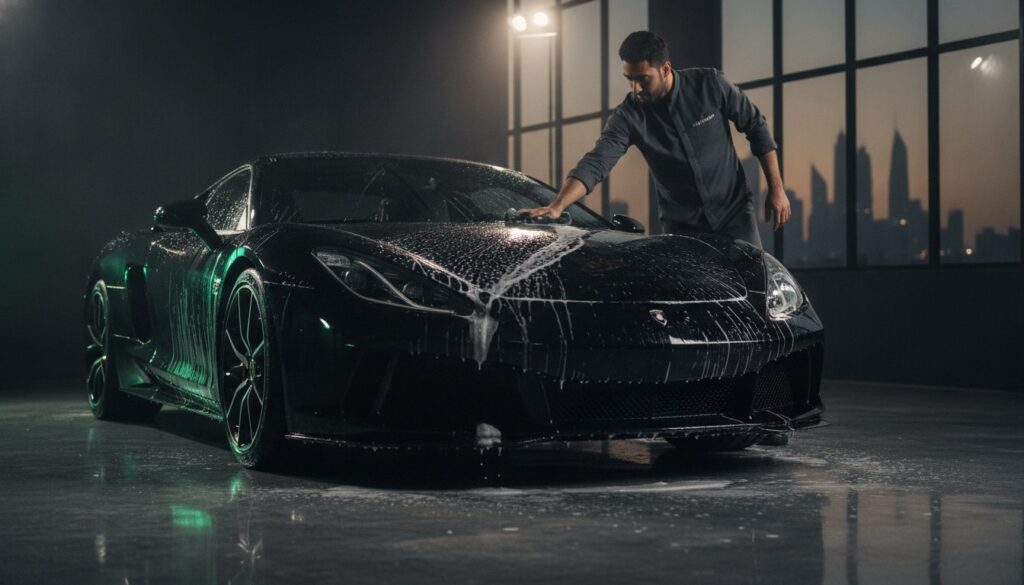
Your paint protection film isn’t just a passive barrier; it’s a high-performance skin that requires technical precision to maintain its elite status. You’ve invested in top-tier protection to keep your vehicle’s aesthetic flawless, yet the thought of a pressure washer peeling back a precision-aligned edge or a harsh chemical dulling the finish is enough to make any owner hesitate. Mastering the art of washing a car with PPF is the only way to ensure your investment continues to perform as designed, preserving that deep, liquid gloss for years to come.
We understand that you demand excellence from every aspect of your vehicle’s care. You want a maintenance routine that respects the sophisticated polyurethane chemistry and the innovative self-healing layers that make your film so valuable. This guide provides the professional blueprint you need to achieve a swirl-free mirror finish while maximizing the lifespan of your protection. We’ll explore the specific chemistry of film-safe soaps, the exact mechanical techniques to avoid edge lift, and the drying secrets used by the world’s leading detailing experts to keep your car looking showroom-ready.
Key Takeaways
- Understand why the unique structure of thermoplastic polyurethane requires specialized agitation to prevent contaminants from embedding in the film’s pores.
- Master the meticulous sequence for washing a car with PPF, utilizing a foam cannon pre-wash and a two-bucket system to eliminate the risk of swirl marks.
- Identify the specific pH-neutral chemicals that preserve self-healing properties while avoiding the dulling effects of low-grade waxes and harsh detergents.
- Learn the “Golden Rule” of pressure washer safety, including the precise angles and distances needed to protect delicate film edges from lifting.
- Recognize when to transition from home maintenance to elite professional services like the Vanguard Premium Package for comprehensive film and paint health.
Why Washing a Car with PPF Requires a Specialized Approach
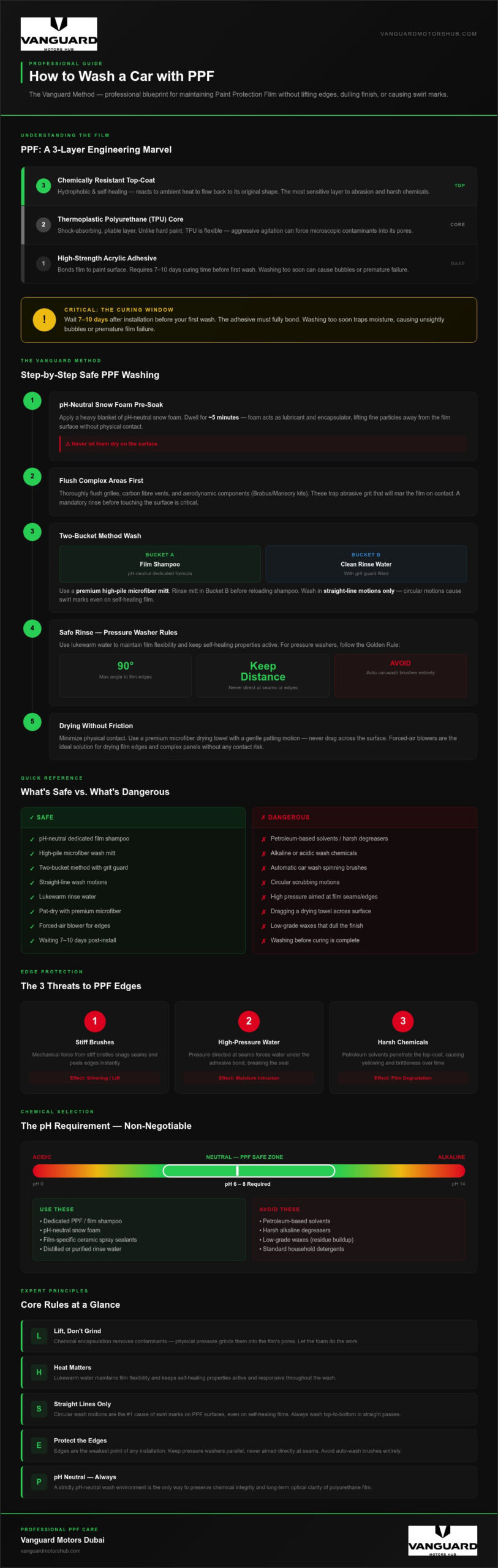
Paint Protection Film is an engineering marvel. It consists of three distinct layers: a high-strength acrylic adhesive, a shock-absorbing Thermoplastic Polyurethane (TPU) core, and a chemically resistant top-coat. This top-coat is where the magic happens. It’s designed to be hydrophobic and self-healing, reacting to ambient heat to flow back into its original shape. However, this sophisticated structure means washing a car with PPF isn’t as simple as a standard bucket-and-sponge job.
Traditional scrubbing techniques are often too aggressive for these surfaces. While automotive paint is hard and brittle, the top-coat of PPF is designed to be pliable. Aggressive agitation can actually force microscopic contaminants into the film’s pores. Once dirt is embedded, it can dull the finish and compromise the film’s clarity. Professional maintenance focuses on lifting debris away rather than grinding it in. Heat also plays a central role. Using lukewarm water during the cleaning process helps maintain the film’s flexibility, ensuring the self-healing properties remain active and responsive.
The “Curing Window” represents the most critical phase for any protected vehicle. After a professional installation at Vanguard Motors Dubai, the adhesive needs time to bond perfectly with the paint. We typically recommend waiting seven to ten days before your first wash. This patience ensures the edges are fully secure and the film is stabilized. Rushing this process can trap moisture under the film, leading to unsightly bubbles or premature failure.
The Vulnerability of Film Edges
Edges are the weakest point of any installation. Mechanical force from stiff brushes or high-pressure water can lead to silvering, where the film begins to lift and air or moisture gets trapped underneath. Touch-based automatic car washes are the primary enemy of PPF. Their heavy, spinning brushes are designed for speed, not precision; they can easily snag a seam and ruin a premium installation in seconds. Maintaining a safe distance and using the correct tools is essential for edge preservation.
Chemical Sensitivity of Polyurethane
Polyurethane has a different surface tension than a traditional clear coat. It reacts differently to chemicals. Petroleum-based solvents and harsh degreasers are particularly dangerous. These substances can penetrate the top-coat, causing the film to yellow or become brittle over time. Maintaining a strictly pH-neutral environment during every wash cycle is the only way to preserve the chemical integrity and optical clarity of your polyurethane investment.
The Step-by-Step Vanguard Method for Safe PPF Washing
Precision is the hallmark of elite automotive care. When washing a car with PPF, the objective is to eliminate friction at every possible stage. We utilize a systematic approach that prioritizes chemical decontamination over mechanical scrubbing. This ensures that the self-healing top-coat remains pristine and free from the micro-marring that often plagues standard wash routines. By following a structured workflow, you protect the integrity of the film while maintaining a showroom finish.
The Art of the Pre-Soak
The process begins with a heavy blanket of pH-neutral snow foam. This isn’t just for show; the foam acts as a lubricant and encapsulator, lifting fine particles of sand and dust away from the film surface. Choosing a foam that breaks down road film without stripping the hydrophobic top-coat is essential for long-term health. Dwell time should be approximately five minutes, but you must never let the product dry on the surface. Pay special attention to complex aerodynamic components. Bespoke conversions like Brabus or Mansory kits feature intricate grilles and carbon fibre vents that are notorious for trapping abrasive grit. A thorough flush of these areas is mandatory before any contact begins.
Once the pre-soak is rinsed, we move to the two-bucket method. One bucket contains your dedicated film shampoo; the other contains pure rinse water with a grit guard. Use a premium, high-pile microfiber mitt. Always wash in straight-line motions. Circular motions are the primary cause of swirl marks, even on self-healing surfaces. If you encounter stubborn contamination, let the chemical cleaners do the work rather than applying downward pressure. This meticulous approach is the only way to ensure the film’s “pores” remain clear and functional.
Drying Without Friction
Drying is the stage where most damage occurs. Physical contact should be minimized to prevent surface marring. Utilizing a dedicated car dryer or filtered compressed air is the professional standard. Air allows you to blow water out of film edges and seams, preventing the “weeping” that leads to unsightly streaks later. It also eliminates the need to drag a towel across the surface, which is the safest way to maintain a car with PPF.
If you must use a towel, select a high-GSM microfiber specifically designed for drying. For matte PPF, the ‘pat-dry’ method is non-negotiable. Wiping a matte surface can create localized “shining” or marring that is often permanent. If you notice water spots, treat them immediately with a dedicated spot remover before they have a chance to etch into the polyurethane. For owners who prefer a concierge approach to maintenance, our mobile detailing team brings this exact level of precision directly to your driveway.
Essential Tools and Chemical Selection for Film Integrity
Excellence in maintenance starts with the chemistry in your wash bucket. When washing a car with PPF, the wrong surfactant can be more damaging than the road grime you’re trying to remove. Standard off-the-shelf soaps often contain aggressive degreasers or artificial gloss enhancers that can compromise the film’s structural integrity. Your goal is to use a pure, pH-neutral shampoo that provides high lubricity without leaving behind a film of its own. This ensures the self-healing top-coat remains unobstructed and fully functional.
Avoid “Wash and Wax” products at all costs. These all-in-one solutions frequently utilize low-grade carnauba or petroleum-based waxes. On a traditional clear coat, they offer temporary shine; on polyurethane, they can lead to yellowing, swelling, or a cloudy finish. Professional-grade maintenance requires a dedicated approach. We recommend using a high-GSM (grams per square meter) microfiber mitt and towels. A rating of 500 GSM or higher is the professional standard. This density provides a deep pile that safely traps microscopic particles, preventing them from marring the film’s surface during contact.
Decontamination requires a surgical approach. Traditional clay bars, while effective on paint, are often too abrasive for the pliable surface of PPF. They can leave micro-marring that requires significant heat to repair. Instead, utilize a dedicated iron remover. This chemical solution dissolves metallic fallout and brake dust on contact, allowing you to rinse away contaminants without any mechanical friction.
Chemical Do’s and Don’ts
Stay away from any cleaners containing naphtha or kerosene. These solvents are common in heavy-duty bug removers but are catastrophic for polyurethane, often causing the film to lose its bond or become brittle. Instead, look for ceramic-infused maintenance sprays. These modern formulations add a sacrificial layer of SiO2 (silicon dioxide) that boosts hydrophobicity and UV resistance. For organic threats like bird droppings or bug splatter, keep a dedicated film cleaner in your trunk. These specialized enzymes break down organic acids before they can etch into the film’s top-coat.
Wheel and Trim Precision
High-performance aesthetics often involve specialized materials that require their own maintenance protocols. If your vehicle features a professional carbon fiber car installation, you must avoid acidic wheel cleaners. These chemicals can cloud the resin finish of carbon components. Use a water-based tire dressing to finish the job. Solvent-based dressings are prone to “slinging” while you drive. When these solvents hit the film behind your wheel arches, they can create permanent staining that even a deep clean won’t resolve.
Protecting the Edges: Pressure Washer and Heat Management
The mechanical force of water is a double-edged sword in the detailing world. While a pressure washer is the most efficient tool for removing heavy grit, it can become a destructive force if handled without professional discipline. When washing a car with PPF, the boundary between a flawless finish and a compromised edge is measured in inches and degrees. High-pressure streams can act like a precision blade, capable of lifting the film’s adhesive bond or even slicing through the polyurethane layer if the nozzle is held too close. This risk is amplified on supercars with aggressive aerodynamics, where the film is often stretched over complex curves and deep air intakes.
Adhering to the “Golden Rule” of pressure washing is the only way to guarantee long-term film integrity. Always maintain a 45-degree angle relative to the film’s surface, ensuring the water jet pushes *over* the seam rather than directly into it. A minimum distance of 12 inches must be kept between the nozzle and any film edge. This buffer zone allows the water pressure to dissipate slightly, reducing the risk of “silvering” at the seams. You must also be aware of stress points. Flared wheel arches, side skirt transitions, and carbon fibre vents are areas where the film is under the most tension. These zones require the most conservative approach to prevent the adhesive from failing under hydraulic pressure.
Pressure Washer Safety Protocol
Technical specifications matter when it comes to your equipment. For safe film maintenance, we recommend a pressure setting between 1500 and 1800 PSI. This provides enough power to encapsulate dirt without overwhelming the film’s top-coat. Never utilize a “turbo nozzle” or a “zero-degree” tip; these attachments create a concentrated, oscillating stream that can catch a film edge in a fraction of a second. Instead, use a 25 or 40-degree wide-fan nozzle. When rinsing the undercarriage or wheel wells, be mindful of the spray’s trajectory. A careless upward blast can easily catch the bottom edge of a door wrap or side skirt, leading to permanent lift that requires a professional patch or replacement.
Washing in High-Temperature Environments
Extreme heat introduces a new set of variables that can complicate your maintenance routine. Thermal shock is a genuine concern; applying cold water to a sun-baked panel can cause the film and the underlying paint to expand and contract at different rates, potentially stressing the adhesive. Always ensure the vehicle’s surface is cool to the touch before you begin. In regions with intense solar radiation, scheduling your wash for the early morning or late evening is the only way to avoid rapid evaporation. If you’re struggling to maintain a perfect finish in harsh conditions, book a professional maintenance session with our team to ensure your vehicle receives the care it deserves. We utilize deionized water systems to eliminate the risk of mineral spotting, which can etch into the film’s pores much faster when exposed to high ambient temperatures.
Elevating Protection with Professional Maintenance Packages
While consistent home maintenance is the foundation of vehicle care, professional intervention is what guarantees longevity. Even with the best tools, a standard routine for washing a car with PPF eventually meets its limit against stubborn environmental contaminants. Transitioning to a professional deep-clean every quarter allows for a level of decontamination that isn’t possible in a home garage. Our technicians at Vanguard Motors Dubai utilize high-register chemical treatments and specialized lighting to ensure every square inch of your polyurethane remains optically clear and physically sound.
The Vanguard Premium Package is our signature solution for holistic vehicle health. It’s designed to go beyond aesthetics, focusing on the mechanical and chemical stability of your film. During these sessions, we don’t just clean; we audit. We look for the subtle signs of edge lifting or silvering that often occur on high-tension curves. By identifying and repairing these minor stress points early, we prevent them from escalating into full film failure. For those with demanding schedules, our Mobile Detailing Van delivers elite results for washing a car with PPF directly to your door.
The Value of Professional Inspections
Professional oversight is essential to keep your paint protection film performing at its peak. Over time, the hydrophobic top-coat can become clogged with road film that a simple wash won’t budge. We specialize in deep chemical decontamination that restores these self-healing and water-repellent properties. These regular inspections also serve a critical administrative purpose. They ensure your installation remains compliant with warranty requirements, providing documented proof of elite-level care that preserves the resale value of your asset.
Bespoke Care for Supercars
High-performance conversions require a specialized touch that standard detailers often lack. Whether your vehicle features a Brabus, Mansory, or Jetour kit, the complexity of the bodywork demands extreme precision. Our team understands the nuances of carbon fiber polishing and interior leather restoration, integrating these services into a total care plan. We treat every vehicle as a unique project, ensuring that the intersection of technical skill and creative expression is always maintained. When you’re ready to elevate your maintenance routine, book your next professional wash with Vanguard Motors Dubai to experience the gold standard in automotive preservation.
Mastering the Art of Long-Term Automotive Preservation
Your vehicle is a high-performance asset that deserves more than a standard cleaning routine. Mastering the technical discipline of washing a car with PPF is the only way to safeguard your investment against the elements while maintaining that deep, liquid gloss. By prioritizing pH-neutral chemistry and respecting the mechanical limits of film edges, you ensure that your protection continues to perform as a flawless, self-healing shield. Precision care isn’t just about aesthetics; it’s about preserving the engineering excellence of your vehicle for the road ahead.
When your schedule demands concierge-level results, our specialized supercar detailing facility and mobile detailing van provide the ultimate solution. We offer expert care for Brabus and Mansory conversions, ensuring every bespoke detail is treated with surgical accuracy. Secure the longevity of your investment with Vanguard’s Premium Detailing Packages today. Drive with the confidence that your vehicle is protected by the industry’s highest standards of meticulous maintenance.
Frequently Asked Questions
Can I take my car with PPF through an automatic car wash?
Avoid touch-based automatic car washes entirely. The abrasive brushes are designed for speed and can easily snag the edges of your film, leading to permanent damage or silvering. While touchless systems are safer, they often use harsh chemicals that can degrade the polyurethane top-coat over time. Hand washing is the only way to ensure the long-term integrity of your investment and preserve the self-healing properties of the top-coat.
How long should I wait to wash my car after getting PPF installed?
You should wait between seven and ten days before the first wash after installation. This window allows the acrylic adhesive to bond completely with the paint surface and ensures all moisture has evaporated from the edges. Rushing this process can lead to lifting or bubbling. Once this curing period is over, you can resume a regular maintenance schedule using the professional techniques outlined in this guide.
Is it safe to use a pressure washer on a car with paint protection film?
It’s safe to use a pressure washer if you maintain a distance of at least 12 inches from the surface. Always keep the nozzle at a 45-degree angle to the film edges to prevent the water from getting underneath the film. Ensure your equipment is set between 1500 and 1800 PSI. Using a wide fan tip is much safer than a concentrated stream when washing a car with PPF.
What kind of soap is best for washing a car with PPF?
Use a dedicated pH-neutral automotive shampoo that contains no added waxes, silicones, or gloss enhancers. Many all-in-one soaps leave behind surfactants that can clog the pores of the film and interfere with its self-healing properties. A pure soap provides the necessary lubrication for a safe contact wash without compromising the chemical structure of the polyurethane. This is the professional standard for maintaining optical clarity and film health.
Can I wax or polish my car if it has PPF?
You should never use traditional abrasive polishes or petroleum-based waxes on paint protection film. These products can cause the film to yellow or lose its transparency over time. Instead, utilize ceramic-infused maintenance sprays or SiO2-based sealants designed specifically for polyurethane. These modern products enhance the hydrophobic properties of the film without the risk of chemical degradation or unsightly white residue along the seams and edges.
How do I remove bird droppings or tree sap from PPF without damaging it?
Remove organic contaminants like bird droppings or tree sap as soon as they are discovered. These substances are highly acidic and can etch into the top-coat if left to bake in the sun. Use a specialized film cleaner or a microfiber towel soaked in warm water to gently dissolve the debris. Avoid aggressive scrubbing; let the chemical cleaners or heat do the work to protect the film surface tension.
Does washing a car in direct sunlight affect the PPF?
Washing in direct sunlight is not recommended because it causes water and chemicals to evaporate too quickly. This leads to mineral spotting and soap etching that can be difficult to remove from the pliable film surface. Always perform your maintenance routine in the early morning or late evening when the panels are cool to the touch. This ensures a streak-free finish and maximizes the effectiveness of your cleaning products.
What should I do if the edges of my PPF start to lift during washing?
If you notice an edge beginning to lift, stop washing that specific area immediately to prevent further water intrusion. Avoid the temptation to trim the film or press it back down yourself. Instead, contact a professional facility like Vanguard Motors Hub for a technical inspection. We can often use specialized heat tools and adhesive promoters to secure the edge before the contamination makes a permanent repair impossible.